 Global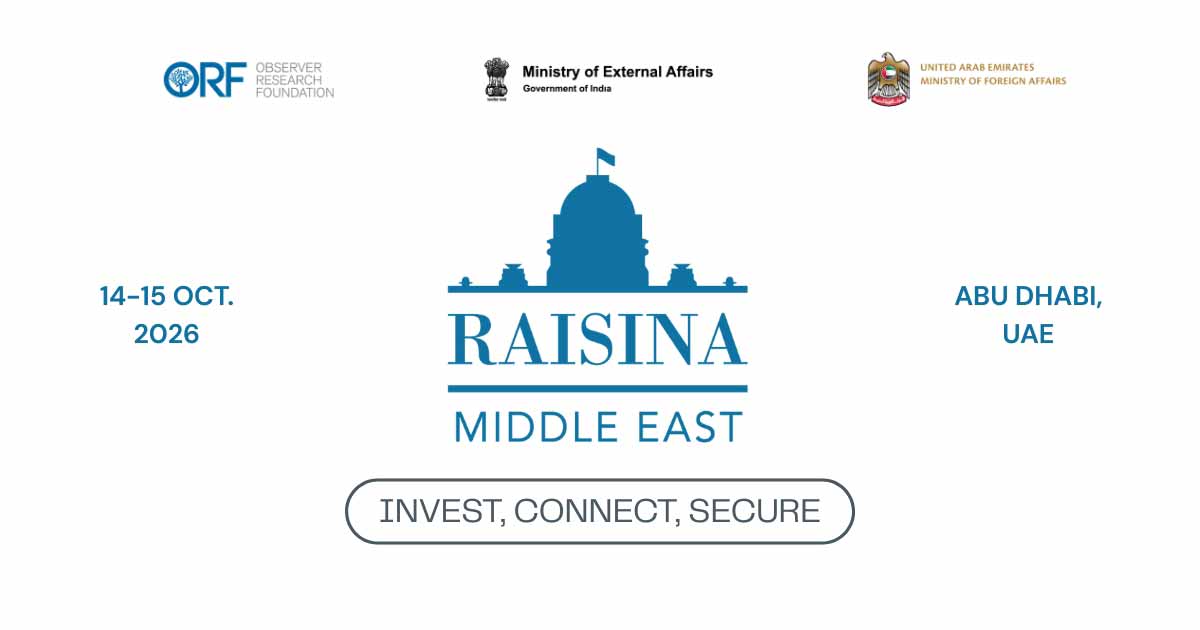
Raisina Middle East: Invest, Connect, Secure
14-15
Oct2026
Secure, Connect, Invest—these three ideas form the bulwark around which Raisina Middle East 2026 is devised. The past few years have seen the dismantling of the old and the birth of the new; the post–Cold War era of universal multilateralism, anchored in institutions like the UN and the WTO, is losing credibility, globalisation is withering in the face of growing protectionism, and the post-war consensus that underpinned global stability is under review. Peace is under severe duress. Threats from non-state actors, challenges posed by states contributing to regional instability, and disregard for international laws and systems have become rampant.
The erosion of the rules-based order is not an abstract concern. Recent conflicts have exposed the inability of institutions and frameworks designed to uphold international law to prevent war, bring conflicts to logical conclusions, or safeguard freedom of navigation through the world’s most critical waterways. The norms that once offered predictability to states, markets, and societies are not simply fading; they are being actively tested and violated.
Instead of a crisis, however, these challenges offer an opportunity: to return to first principles and rethink how the world connects, cooperates, and grows. A new global map that reflects today’s realities must be drawn—one rooted in respect for international law, open and secure commerce, and institutions capable of meeting contemporary challenges. This reimagined order necessitates connecting key actors and geographies with aligned visions of shared prosperity and rising aspirations. This is what Raisina Middle East 2026 seeks to achieve: a recalibration and renewal of priorities.
Thematic Pillars
1. Networked Deterrence: New Strategies for Evolving Security Challenges
The international security architecture is being challenged as traditional alliances give way to more issue-focused relationships. The nature of conflict itself is transforming, with hybrid theatres of warfare combining conventional military capabilities with AI-powered cyber operations, attacks on critical infrastructure, data manipulation and financial coercion. Future battlespaces will not be limited to land, sea and air but will extend to the cyber-physical domain, space and the electromagnetic spectrum.
Recent conflicts have also exposed a more fundamental challenge: the widening gap between the rules intended to govern conflict and the ability of international institutions to enforce them. The laws of armed conflict, established principles of sovereignty and the institutions responsible for maintaining international peace and security are under growing strain. For states that depend on an open, predictable and rules-based international environment, strengthening these frameworks is becoming an important component of security itself.
This pillar will explore how cooperative frameworks based on shared interests can respond to these pressures while strengthening collective security across the Arabian Sea and the wider region. Some may blend technology and trade to establish strategic incubators and deepen ties; others may strengthen
military interoperability, maritime domain awareness and the protection of critical infrastructure. Regional and cross-regional coalitions can also play a larger role in reinforcing international norms and addressing security gaps where traditional institutions have struggled to respond.
The discussion will extend to cyber and digital infrastructure, responsible AI development and the technologies that increasingly underpin global connectivity, commerce and security. The driving question is how new security partnerships can strengthen deterrence without weakening the international rules and institutions on which smaller and middle powers depend.
2. Tides of Change: Hubs and Groupings for an Evolving International Order
Across two maritime spaces, the Med-Atlantic and the Indo-Pacific, a new order of plurilateralism is emerging, built around issue-based cooperation among states and regional actors. Minilateral groupings and smaller cross-regional coalitions are shaping the contours of global governance and creating new avenues for cooperation on issues ranging from maritime security and connectivity to AI governance.
These maritime spaces have also become testing grounds for the international order. Recent conflict has demonstrated how quickly instability in one region can disrupt shipping, energy markets, supply chains and economic activity far beyond it. The Strait of Hormuz, alongside other strategic waterways, is not simply a regional asset but part of the infrastructure of the global economy. Safeguarding freedom of navigation, consistent with international law, is therefore a global public good.
The challenge is not to replace multilateral institutions, but to consider how regional and plurilateral coalitions can reinforce them when established mechanisms are unable to act effectively. The Middle East sits at the centre of this conversation, connecting the Mediterranean, Atlantic, Indian Ocean and Indo-Pacific and bringing together questions of security, trade, energy, investment and international law.
This pillar will examine whether a more networked international order can combine the legitimacy of multilateralism with the agility of smaller coalitions. It will ask how regional actors can help uphold common rules, protect shared spaces and provide practical responses to crises while preserving the principles of sovereignty and international law.
3. Waterway Volatility: Securing Global Trade Through Disruption
Geopolitical realignments, conflict, economic statecraft and protectionism are challenging the foundations of global commerce. The disruption of critical waterways has demonstrated how quickly regional insecurity can become a global economic shock, affecting shipping costs, insurance, energy supplies, food security and manufacturing networks thousands of kilometres from the source of conflict.
Freedom of navigation therefore sits at the intersection of international law and economic continuity. Existing and established frameworks provide rules governing the maritime domain, but recent crises have raised difficult questions about how these principles are protected when enforcement mechanisms prove inadequate. For trading economies across Asia, the Gulf, Africa and Europe, secure and open waterways are fundamental to economic stability.
This pillar will explore how countries can build resilience without retreating from globalisation. Diversified supply chains, strategic reserves, alternative transport routes and new infrastructure can provide greater protection against disruption. Emerging corridors and maritime networks give trade room to navigate geopolitical and maritime disruption, linking physical infrastructure with energy, financial and digital systems. The existing draft already places these corridors at the heart of the pillar; the shift would be to frame them more explicitly as instruments of resilience against geopolitical and maritime disruption.
The discussion will also consider how public and private capital can support these efforts, and how investment frameworks can contribute to post-conflict recovery. Conditional and long-term investment can help rebuild infrastructure, strengthen institutions and create economic incentives for stability, provided that such investment is anchored in transparent rules and locally determined priorities.
4. Frontiers of Growth: Technological Innovation and Energy Security for a Sustainable Future
The pathways to growth and prosperity in the 21st century will be shaped by two major forces: technological innovation and energy security. The Global South will be central to both. India and the UAE are already playing an important role, with growing investments in AI, digital public infrastructure, green hydrogen, renewable energy and other emerging technologies. Their partnership also shows how countries can work together to develop and deploy technologies that respond to their own priorities while contributing to wider global progress.
Energy and sustainability have become an important part of this partnership. The UAE’s presidency of COP28 brought global attention to the need to accelerate the energy transition, including through the expansion of renewable energy and greater investment in climate solutions. India, meanwhile, is undertaking one of the world’s largest expansions of renewable energy while responding to the needs of a large and growing economy. The experiences of both countries point to a wider question for the Global South: how can countries meet rising energy demand, support development and build more sustainable economies?
Technology presents a similar opportunity. AI, deep tech, advanced manufacturing, healthcare and space are opening up new possibilities for growth. Countries are looking to invest in their own capabilities, support
innovation at home and build partnerships that allow technologies and ideas to travel across borders. India and the UAE have increasingly sought to bring together capital, talent, markets and technology in these areas.
This pillar explores how technology and energy can become drivers of the next phase of growth. It will consider the role of the India-UAE partnership, as well as wider partnerships across the Global South, in advancing new technologies, strengthening energy security and building economies that are prepared for the future.
Host