 Global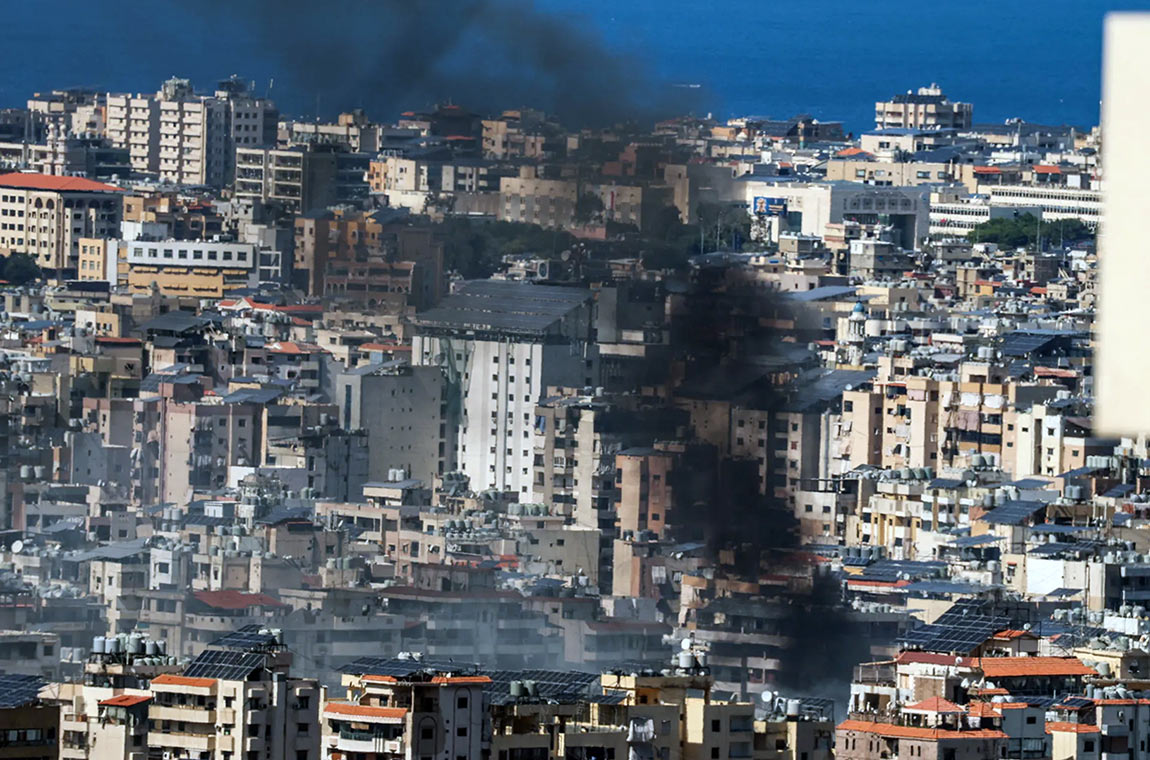
Expert Speak | 07 April, 2026
Lebanon’s Defining Moment: Authority, Security, and Regional Alignment
Spotlight
- While the Salam-Aoun administration has achieved an unprecedented rhetorical alignment to restore state authority, official policy remains sidelined by the ongoing Israeli invasion and the resumption of full-scale war.
- Hezbollah’s weakened command offers a historic opening for the LAF, but risks internal fragmentation as the state fails to fill the resulting social services vacuum for the Shia community.
- A fragmented international diplomatic approach increasingly treats Lebanon as a vacuum, risking a post-war order designed by regional powers rather than one negotiated by a unified sovereign state.
As the confrontation between the United States (US), Iran, and Israel intensifies, Lebanon finds itself drawn into a widening regional conflict it did not seek. Already characterised by a fragile governance structure, the country now faces compounded pressures that expose long-standing structural vulnerabilities. At the core of this dynamic lies Hezbollah — weakened in recent years, yet remaining a decisive military and political actor that operates alongside state institutions but beyond their full authority, and whose alignment with Iran has placed Lebanon on the front lines, both in 2024 and with the March 2nd offensive responding to the killing of Iranian Supreme Leader Ali Khamenei.
With more than one million people displaced and a death toll exceeding a thousand in less than a month, the crisis is further straining Lebanon’s already limited governance capacity. For a country already navigating a prolonged financial crisis, sectarian divisions, and repeated political vacuums, the resumption of full-scale war threatens to erode Lebanese state capacity itself.
The Governance of Paralysis
On the same day as Hezbollah’s offensive, Prime Minister Nawaf Salam announced a comprehensive ban on all military and security activities conducted by Hezbollah, formally restricting the group to a political role. This decree was strongly backed by President Joseph Aoun, the former Army Commander whose January 2025 election ended a two-year presidential vacuum and was seen as a mandate to restore state sovereignty. The decision followed cross-border rocket and drone attacks into Israel, which the government characterised as a violation of state policy and a direct threat to Lebanese security, accompanied by a demand for the transfer of non-state weapons to government control and instructions for the Lebanese Armed Forces (LAF) to enforce the state’s monopoly over the use of force north of the Litani River.
This builds on the disarmament framework advanced by US envoy Thomas Barrack in September 2025, outlining a phased process linking Israeli military withdrawal with the consolidation of Lebanese state control. While the first phase was completed — allowing the LAF to expand south of the Litani — the second phase, aimed at curbing Hezbollah’s capabilities north of the river, has stalled.
Hezbollah, meanwhile, maintains that its military posture remains defensive within the broader regional confrontation, rejecting both domestic directives and externally backed disarmament proposals.
The resumption of hostilities has disrupted this trajectory. Israeli military operations have expanded into a full-scale invasion, with the IDF ordering the total evacuation of Southern Lebanon to establish a permanent buffer zone up to the Litani River — a warfare model extended into southern Beirut, where mass evacuation orders indicate an intent to replicate a ‘Gaza model‘ of displacement and urban destruction.
Within this context, the LAF operates under significant constraints. Direct confrontation with Hezbollah risks internal fragmentation, while limited engagement raises questions about the enforceability of state decisions. Hezbollah, meanwhile, maintains that its military posture remains defensive within the broader regional confrontation, rejecting both domestic directives and externally backed disarmament proposals.
UNIFIL and the Erosion of the Security Framework
The escalation highlights the fragility of the international mechanisms established to stabilise southern Lebanon after 2006. United Nations Security Council Resolution 1701 relies on the United Nations Interim Force in Lebanon (UNIFIL) to monitor hostilities and support Lebanese force deployment south of the Litani. Although the mission’s mandate has been extended through 2026, its operational environment has become increasingly constrained, with its role shifting toward monitoring rather than enforcement due to the absence of enforceable mechanisms and sustained coordination among relevant actors. Longstanding territorial disputes along the Blue Line — including Shebaa Farms and Ghajar — continue to complicate implementation.
These dynamics signal a shift from institutionally managed border stability toward a security-driven environment where the Resolution 1701 framework is increasingly overwhelmed by realities on the ground. Peacekeepers are exposed to growing risk as illustrated by the recent killing of three Indonesian UNIFIL personnel, prompting calls from Indonesia for an investigation at the United Nations Security Council. The mission’s effectiveness is further constrained not only by operational limitations, but also by a host state that is physically and economically unable to provide adequate support.
Lebanese Diplomacy: Normalisation and Regional Realignments
The current escalation is unfolding alongside the possibility of normalisation with Israel, as external actors seek to stabilise the conflict and redefine the security architecture along Lebanon’s southern border. Three channels have emerged — involving the US, France, and Lebanon itself — converging around the objective of reducing hostilities while addressing Hezbollah’s role within Lebanon’s national security framework.
The coexistence of multiple tracks with distinct conditions reflects a fragmented international approach that increasingly treats Lebanon as a vacuum rather than a sovereign partner.
The approaches differ significantly in sequencing and implementation. French and Lebanese proposals prioritise an immediate cessation of hostilities alongside commitments to protect infrastructure and civilian populations, treating de-escalation as a necessary first step. France has played an active facilitative role, though progress remains limited, and direct Lebanon-Israel engagement continues to face political and strategic constraints.
The US framework adopts a more conditional approach, linking any ceasefire directly to concrete LAF steps to dismantle Hezbollah’s military capabilities. In this model, disarmament is not a longer-term objective but an explicit prerequisite for reconstruction assistance and security guarantees. Implementation responsibility is placed squarely on Lebanese state institutions, while aligning closely with Israeli security objectives.
These efforts are unfolding within the broader context of the Abraham Accords, which have redefined regional cooperation between Israel and several Arab states, and within which Lebanon has increasingly featured in discussions on future integration. However, such realignment remains problematic. While this would offer Israel long-term border security, its benefits for Lebanon remain contingent on the state’s ability to engage as a unified sovereign actor rather than a fragmented structure. Domestically, such prospects are also contested. Some Lebanese political actors advocate for direct negotiations — including President Aoun — while others reject normalisation without first addressing the Palestinian issue. Hezbollah, through Mahmoud Qmati, has firmly opposed any normalisation and framed it as a “mistake and a big concession.”
Despite these diplomatic tracks, the Israeli security establishment appears to prioritise a buffer zone over negotiated frameworks. The coexistence of multiple tracks with distinct conditions reflects a fragmented international approach that increasingly treats Lebanon as a vacuum rather than a sovereign partner. These frameworks continue to evolve in parallel, risking a post-war order imposed by regional powers rather than negotiated by a unified Lebanese state, which remains sidelined by kinetic realities on the ground.
Conclusion
Lebanon stands at a crossroads where the future of its national sovereignty is being decided by external actors, despite the unprecedented rhetorical alignment of the Salam-Aoun administration. The path toward durable stability and a ceasefire will largely depend on whether the Lebanese state can transition from a passive theatre of regional confrontation to an active sovereign player. This requires sustained international engagement through direct budgetary support and development frameworks capable of reconstructing critical infrastructure, particularly in the south.
The weakening of Hezbollah’s military command offers a historic opening for the Lebanese Armed Forces (LAF) to emerge as the sole guarantor of national security — yet it simultaneously risks internal fragmentation, as the absence of a dominant non-state actor leaves a vacuum in social services and security for the Shia community.
The ongoing escalation is likely to deepen existing sectarian divisions, limiting the state’s ability to assert unified authority over security and defence. The weakening of Hezbollah’s military command offers a historic opening for the Lebanese Armed Forces (LAF) to emerge as the sole guarantor of national security — yet it simultaneously risks internal fragmentation, as the absence of a dominant non-state actor leaves a vacuum in social services and security for the Shia community. A negotiated integration of Hezbollah’s structures into state institutions, underpinned by domestic consensus and external guarantees, may offer the most viable pathway toward consolidation.
The lack of confidence from the Israeli security establishment remains a significant obstacle, further constraining Lebanon’s ability to stabilise its borders or advance a sustainable resolution. Ultimately, Lebanon’s trajectory will be shaped by the alignment between domestic institutional capacity, the evolving role of non-state actors, and regional diplomacy. Without such alignment, Lebanon risks remaining a theatre where its political future is dictated from outside rather than determined from within.
Giada Kabrit is Program Assistant and Intern Coordinator at ORF Middle East.