 Global
Policy Briefs | 18 June, 2026 Download Report (PDF)
The Geography and Geopolitics of Hyperscale
Rising geopolitical competition over advanced technologies is reshaping how states approach the infrastructure that underpins digital power. This brief argues that hyperscale data centres, often treated as technical or commercial assets, are becoming increasingly central to geopolitical strategy, even as they face constraints in resource supply chains, physical infrastructure, and data governance regimes. To examine how these factors interact, the brief employs a three-part analytical framework focused on the geographies of resources, infrastructure, and data. It assesses how these dimensions influence where hyperscale capacity can be developed and the extent to which states can secure access to advanced compute amidst heightened global geopolitical competition.
Attribution: Elizabeth Heyes, “The Geography and Geopolitics of Hyperscale,” ORF Issue Brief No. 880, Observer Research Foundation, June 2026.
Introduction
Geopolitics examines how power is shaped by a country’s geography and physical features, including its possession of strategically significant resources or lack thereof.[1] While classical geopolitics typically focuses on territory, energy reserves, and trade routes, contemporary geopolitics is increasingly tied to digital infrastructure and to whether the raw materials, manufacturing capabilities, energy network, and data laws within a country’s borders are conducive to the large-scale deployment of advanced computational systems. Prime examples of the convergence between technological developments and geopolitics include semiconductor export controls in the United States (US) being used as instruments of strategic leverage against geopolitical rivals, and various states’ efforts to localise their subjects’ data to protect against unauthorised foreign access.[2]
Some scholars have introduced the term “technopolitics” into the geopolitical lexicon to highlight the centrality of new technology in organising power dynamics among political actors.[3] However, the term risks overlooking the extent to which many ostensibly “virtual” digital technologies, such as platforms and applications, remain deeply dependent on the physical geography of supporting hardware infrastructure and the data governance laws inside the national borders in which they operate.
Among the most consequential technological infrastructures today are hyperscale facilities: industrial-scale data centres that house and process the data underpinning the global digital economy.[4] The power consumption of hyperscale facilities exceeds 10 MW at a continuous load, with some reaching over 200 MW—the equivalent of a medium-sized city.[5] They are designed to host tens of thousands of servers and high-performance networking equipment, enabling cloud services, scientific computing, and, critically, the training and deployment of advanced AI models.[6] These facilities cost anywhere from hundreds of millions to more than a billion dollars to build and operate. Their scale requires extensive power infrastructure, backup generators, redundant systems, advanced cooling systems to counteract the heat generated by complex compute operations, and both cyber and physical security provision within and surrounding the hyperscale site.
As such, the location of hyperscale facilities depends on specific geographical conditions and data regulations within the host country. For the purposes of this brief, these can be understood through three dimensions:
- The spread of resources necessary for data centre construction, including raw materials, such as metals and elements, specialised manufacturing facilities, and innovative human resources.
- The existing geographical attributes of host countries, including water availability, energy resources, open space for construction, and proximity to cities; and
- The data sovereignty regimes governing the national borders in which hyperscale facilities are built.
The following section examines how the location of hyperscale sites influences where digital power can and cannot be built across the geopolitical landscape. It highlights how geography continues to impose material and operational limits on ostensibly borderless digital systems.
The Geography of Resources
At the most basic level, advanced computation depends on a supply chain of raw materials and manufacturing capabilities that are both highly concentrated and geographically fragmented. These include: (1) raw resources—critical minerals and their refining capacity; (2) manufacturing resources—semiconductor fabrication and lithography tooling; and (3) the human resources—specialised design and manufacturing talent driving successive advances in semiconductor development. These resource geographies shape who can access the most advanced chips for data centres, how quickly new capacity can be scaled, and where chokepoints create geopolitical leverage.
At the raw resource layer, the location and processing of AI-critical minerals provide source countries with leverage over downstream technology supply chains. China dominates the upstream supply of several critical AI-relevant semiconductor raw materials, accounting for around 60-70 percent of global rare-earth mining and nearly 90 percent of rare-earth processing capacity, alongside the majority of global gallium and germanium production. These elements are used in semiconductor manufacturing, and the latter is also used in data transmission between servers in data centres.[7] China also holds majority stakes in mines beyond its borders, enabling it to consolidate critical raw materials within Chinese-controlled global supply chains.[8] A Reuters analysis noted that China holds up to 94 percent of global production of rare-earth magnets, a key component in semiconductor manufacturing processes (precision wafer polishing, EUV lithography) as well as data centre operations (data storage, cooling systems).[9]
Figure 1: Concentration of Data Centre-Critical Metals and Minerals, by Country
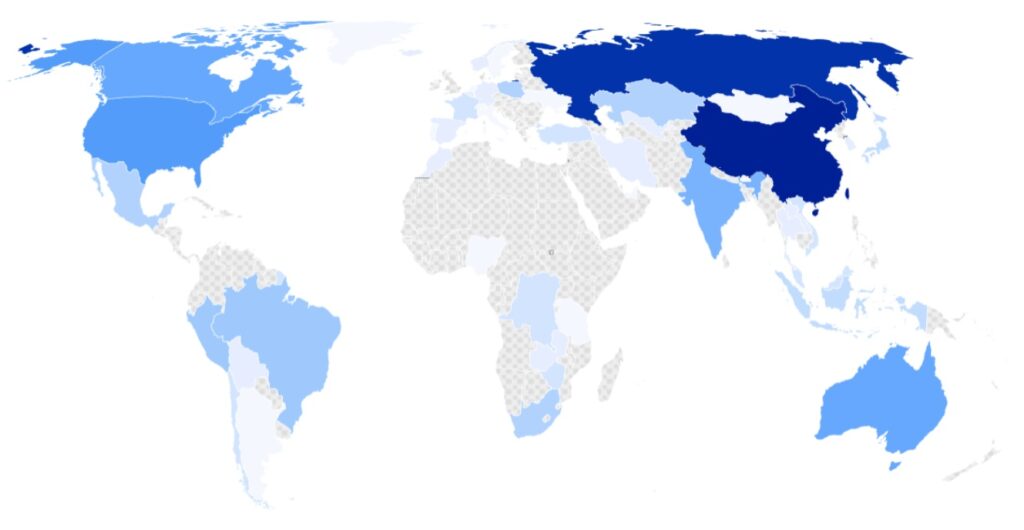
Source: Author’s own, using various sources[10]
For the data centre industry, access to advanced AI chips is a critical constraint. The manufacturing of these chips is dominated by a small number of foundries concentrated in East Asia, with Taiwan’s Taiwan Semiconductor Manufacturing Company Limited (TSMC) supplying the majority of the highest-performance chips used in AI accelerators.[11] TSMC is estimated to account for roughly two-thirds to over 70 percent of the global pure-play foundry market (manufacturers that fabricate chips designed by other countries), while South Korea’s Samsung Foundry represents the only other supplier operating at a comparable scale.[12] Even within fabrication, however, another chokepoint can be found specifically in lithography capabilities. Extreme ultraviolet (EUV) lithography tools are essential for producing the most advanced chips at scale, and the supply is effectively dominated by a single vendor. Reuters reports that the Dutch ASML holds a monopoly on EUV lithography and approximately 90 percent of the broader lithography market, making the Netherlands a critical node in the frontier chip pipeline.[13]
Figure 2: Presence of Major Lithography Providers
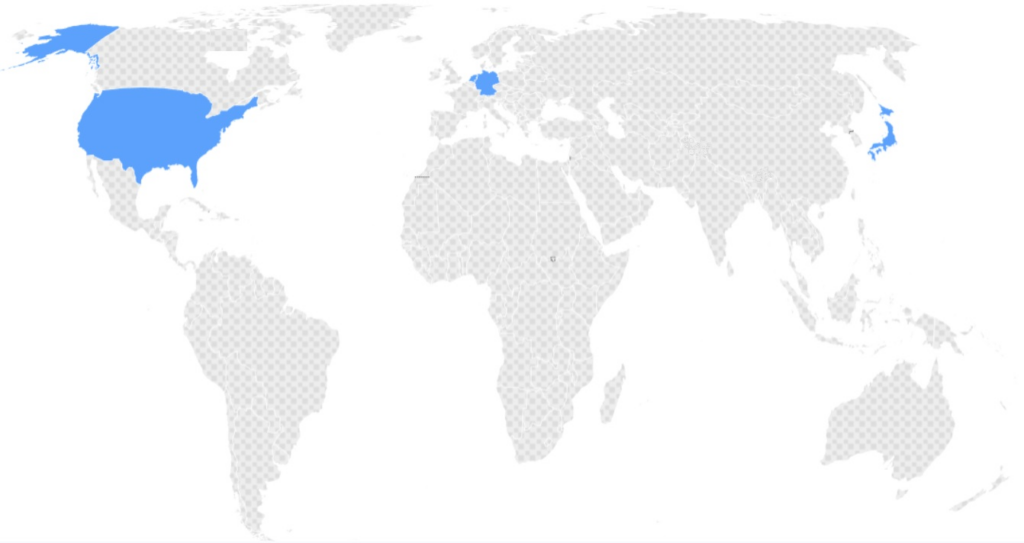
Source: Author’s own, using information from Mordor Intelligence[14]
Figure 3: Presence of Major Memory IC Manufacturing
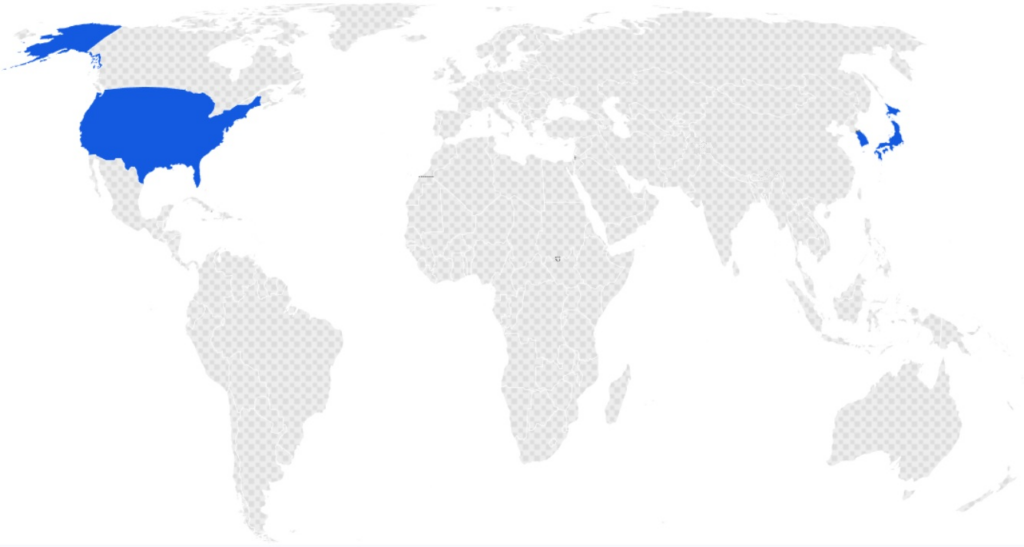
Source: Author’s own, using information from Mordor Intelligence[15]
Figure 4: Presence of Major Logic IC Manufacturing
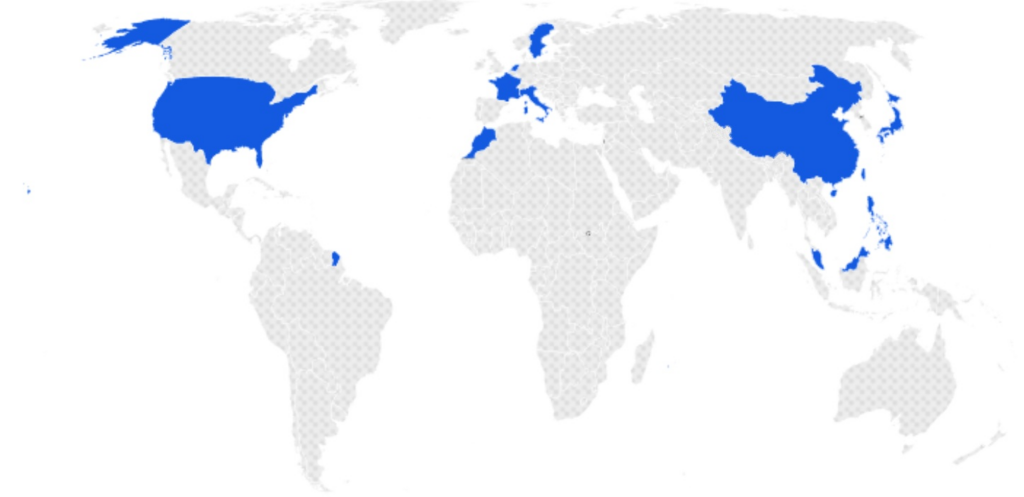
Source: Author’s own, using information from Mordor Intelligence[16]
Figure 5: Presence of Major Semiconductor Fabrication Facilities
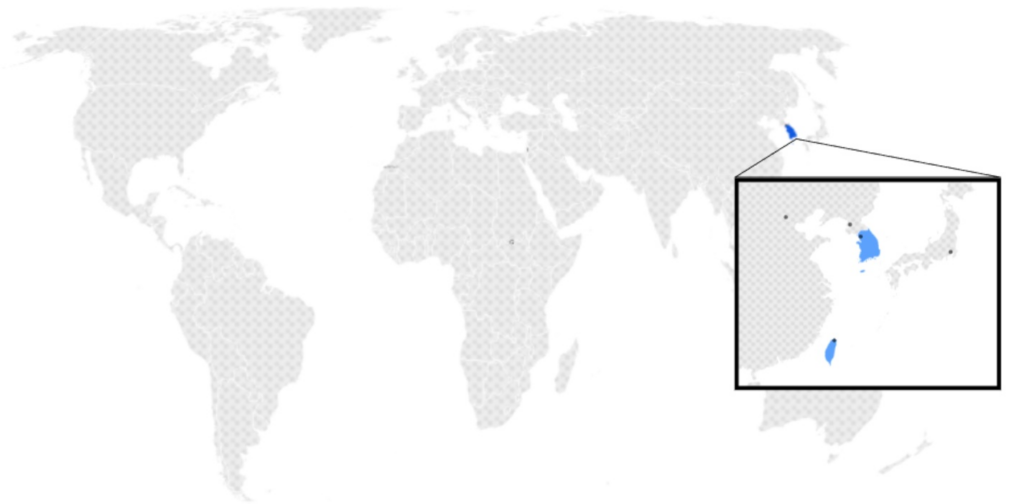
Source: Author’s own, using information from Mordor Intelligence, STMicroelectronics[17]
A parallel, and often underappreciated, consideration at the resource level is semiconductor design capability, with the geographical concentration of the “best minds” and research facilities reinforcing the material and manufacturing constraints already discussed. Engineers and researchers designing semiconductors and data centre infrastructure cluster within a small number of ecosystems where research institutions, universities (Stanford, Berkeley), chip designers, and capital are closely integrated, producing what economist Enrico Moretti terms “brain hubs”.[18] The United States, particularly Silicon Valley, remains the main hub for advanced technology design. Research institutions like Intel Labs and IBM Research, alongside chip designers including NVIDIA and AMD, benefit from a steady flow of graduates from nearby universities such as Stanford and Berkeley, funded by venture capital firms including Sequoia Capital and corporate investment arms such as Intel Capital and NVIDIA Ventures. Such talent concentration adds another layer to raw material supply-chain dependencies, consolidating hyperscale-relevant innovation in a small number of regions.
However, even when upstream resource availability and supply chains align, hyperscale capacity only materialises where countries can meet the downstream requirements of energy, water/cooling solutions, fibre connectivity, land availability, and disaster-risk profiles. This is because data centre infrastructure itself requires a specific geography.
The Geography of Infrastructure
The geographical location of hyperscale facilities is not incidental; it is dictated by a set of physical requirements with direct geopolitical consequences. A viable hyperscale site, or any other large-scale AI-related infrastructure project, requires at the minimum the following conditions, which already sharply limit the number of locations globally where hyperscale facilities can be built at scale:[19] abundant and reliable energy sources; sufficient water availability (or else alternative cooling technologies); high-bandwidth, low-latency connectivity; and large areas of land with low risk of natural disasters.
Energy availability is the primary driver. If a country hoping to construct a hyperscale centre lacks either the capacity to generate or the capital to import the additional energy to support hyperscale operations, such a project is effectively unviable. Recent grid events have highlighted the risks associated with locating hyperscale facilities close to urban centres, as sudden fluctuations in demand from hyperscalers can destabilise regional electricity networks. In the United States’ “data centre alley” in Virginia, the simultaneous disconnection of multiple data centres in March 2025 created a sharp power surplus and required operators to rapidly curtail generation to prevent system failures.[20]
Hyperscalers are thus increasingly being built in remote locations. While this reduces the risk to nearby cities, it also raises the cost of constructing additional power lines. As AI workloads continue to expand, energy demand will only intensify. While many countries possess the energy resources and land required to support data centres, only those with sufficiently developed and secure electricity grids that can be expanded to serve remote facilities are likely to attract hyperscale investment at scale.
Simultaneously, however, hyperscale facilities must remain connected to major fibre-optic backbones to ensure low-latency (latency referring to the speed at which information can be sent) and high-bandwidth operations (bandwidth referring to how much data can be sent per unit of time), particularly for cloud and AI workloads.[21] While locating data centres in remote areas reduces the risk of grid events and makes it often cheaper and easier to obtain planning permissions, a certain level of proximity is also key to effective operations, or else additional capital and time will be required to build new cable networks.
The cooling infrastructure essential to hyperscale operations also benefits from specific geographic conditions. In addition to energy, water availability or energy-intensive alternatives to bring down the temperatures of servers and other compute hardware components are critical operational constraints. Cooler climates and sites with nearby water resources therefore have a natural advantage, which explains a concentration of hyperscale facilities in the US’s Midwest region, and parts of Western Europe, coastal GCC cities, and East Asia.[22] While the hot desert climates of GCC countries may not appear to be most appropriate for cooling operations, their abundant hydrocarbon resources enable these countries to offset the disadvantages of their climates through energy-intensive cooling infrastructure.[23] However, the recent targeting of Gulf data centres by Iran also illustrates how geopolitical instability can override otherwise favourable physical conditions, making the proximity of aggressor nations a further consideration of hyperscale site selection.[24]
The energy, latency, spatial, and cooling demands of hyperscale facilities have contributed to high geographical concentration in geopolitically stable, energy-rich states with sufficient grid connectivity and cooling capacity and low likelihood of natural disasters or armed conflict. As such, even if a country had access to all the resources mentioned in the first section of this article, geography will also dictate which of them can feasibly host hyperscale facilities at scale from an operational and physical security perspective. However, this alone is not sufficient to determine where hyperscale facilities can operate; the functioning of these sites is also shaped by the legal and regulatory regimes governing the data they process, store, and transmit.
The Geography of Data
Beyond physical geography, the data regulations governing the countries in which hyperscale facilities are located play a decisive role in shaping their development. Since data centres exist to process data, data sovereignty laws—the rules governing where different types of data can be stored, processed, and transferred—directly affect how hyperscale infrastructure can be deployed and how effectively it can operate.
Data sovereignty is rooted in the principle that data generated within a jurisdiction should remain subject to that jurisdiction’s legal and regulatory framework. Countries such as China, Russia, and Türkiye mandate that certain categories of data—particularly those related to citizens, critical infrastructure, or national security—be stored domestically.[25] These requirements compel cloud providers and hyperscalers to build local facilities if they wish to serve these markets, particularly where public-sector or strategic-industry workloads cannot legally be processed abroad.[26]
However, data sovereignty laws also impose functional limits. Hyperscale facilities derive much of their efficiency from scale, workload aggregation, and global load balancing. Strict localisation requirements fragment this model by forcing leading international providers to duplicate infrastructure and reducing economies of scale. In the case of China and Russia, this challenge is mitigated by the presence of state-owned enterprises (SOEs) and large domestic technology firms capable of supporting local hyperscale ecosystems. Türkiye, meanwhile, benefits from its geographic position, which allows hyperscale facilities located there to serve surrounding countries across Europe, the Middle East, and parts of Asia at relatively low latency.[27]
However, for smaller and/or less lucrative markets, data localisation mandates may deter investment altogether. Due to the massive cost of hyperscale data centre construction, only a small number of global cloud and technology firms—primarily Amazon Web Services (AWS), Microsoft (Azure), Alibaba Cloud, Meta, and Oracle—possess the financial capacity to build such facilities at scale outside state-owned systems. As a result, the commercial potential of a market must justify the investment. In the case of Türkiye, the ability to serve neighbouring regions partially offsets the costs imposed by localisation requirements. For many smaller economies, policymakers therefore must balance limiting access to advanced compute rather than enhancing sovereignty and undermining national AI ambitions rather than supporting them.
Figure 6: Data Localisation and Sovereignty Regulation, by Country
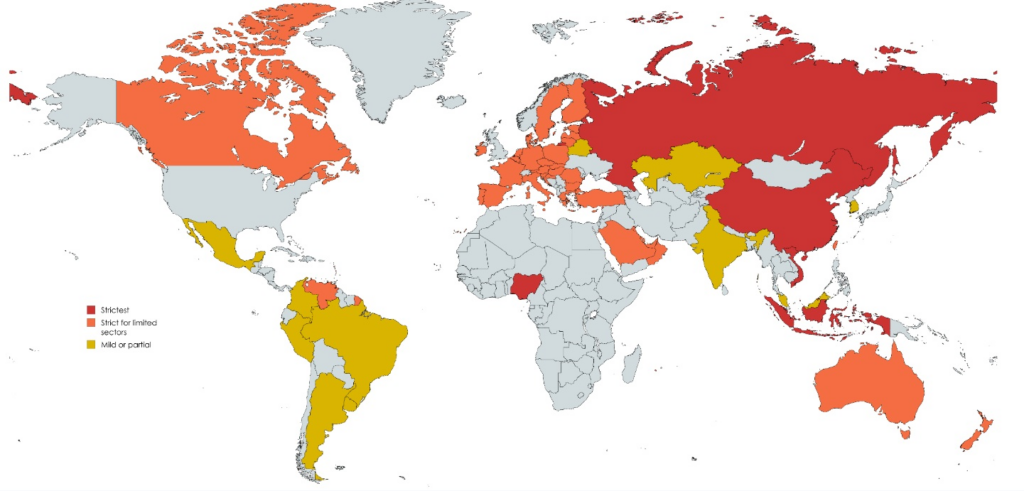
Source: Author’s own, using various sources[28]
Note: Countries shown in grey do not have known data localisation or sovereignty laws. Most notable is the US, which lacks a federal law governing data localisation in the private sector.
The Geopolitics of Hyperscale
From a geopolitical perspective, the geographies of resources, infrastructure, and data do not merely shape where hyperscale capacity emerges; they are actively leveraged as instruments of state power in competition over advanced computation.
At the resource level, the semiconductor supply chain has become an arena of geopolitical contestation. Leveraging its position as the geographical hub of semiconductor and data centre technology innovation, the US has deliberately used export controls on advanced AI chips and semiconductor manufacturing equipment to constrain China’s access to frontier compute capacity, explicitly framing these measures as necessary to preserve national security and technological leadership.[29] This strategy exploits the geographic concentration of advanced chip design in the US, fabrication in allied states such as Taiwan and South Korea, and critical tooling in the Netherlands to restrict China’s access to technologies central to its technological and geostrategic ambitions. In response, China has leveraged its control over critical minerals and domestic manufacturing capacity to restrict access to the raw materials required to produce advanced technologies.
These measures have generated growing tension with private US semiconductor firms, which bear the commercial cost of restricted market access despite being central to innovation. In contrast, China’s more state-directed technology sector allows greater control over businesses and therefore comparatively less pushback.[30] In this context, US President Donald Trump’s reversal in December 2025 of the ban on H200 chip sales—the second most advanced AI chip available—from US companies to China can be seen as reflecting concern over potential Chinese retaliation, recognising that China’s entrenched role in materials processing and downstream manufacturing gives it the capacity to impose costs on the broader semiconductor ecosystem.[31]
At the infrastructure level, physical geography is similarly relevant. Governments increasingly treat hyperscale facilities as strategic national assets, shaping policies on electricity grids, cable connectivity and land purchase regulation to stimulate the hyperscale market.[32] In the European Union, concerns over dependence on US-based hyperscalers have driven regulatory and industrial efforts to promote “sovereign cloud” infrastructure. These efforts reflect a geopolitical desire to anchor compute capacity within politically trusted jurisdictions rather than relying on foreign-controlled platforms.[33] Developing hyperscale infrastructure locally thus becomes a means of hedging geopolitical risk rather than merely optimising cost or performance.
At the data level, sovereignty regimes translate territorial authority into leverage over global digital firms. Countries including China, the UAE, and India have adopted or strengthened data localisation requirements to ensure that sensitive data remains within national borders, compelling hyperscalers to build local infrastructure or forgo access to these large and lucrative markets.[34] These policies are not solely concerned with protecting data privacy; they also seek to stimulate local economic activity and prevent external jurisdictions from exercising legal or intelligence access over domestic information flows.[35] As an example of the latter, recent discussions conducted by Observer Research Foundation and partners centring on data governance highlighted that Global South countries are becoming increasingly concerned that data collected in their countries but processed abroad is not being employed to benefit their public services or innovation ecosystems, but rather those of the Global North.[36] As such, data localisation and sovereignty frameworks can increasingly be seen as instruments of economic strategy and digital industrial policy aimed at retaining value within national economies.
Control over where compute can be supplied, constructed, and legally operated increasingly determines which states can shape the development of advanced AI systems and lead in the “AI race”, and which must adapt to the course set by the former. Recent examples, such as the announcement by Abu Dhabi’s AI and advanced computing group G42 that it will build a supercomputer in India, illustrate how interoperable governance frameworks and trusted regulatory alignment between states can directly influence where frontier compute capacity is deployed.[37] The same logic applies to hyperscale infrastructure, whose location is shaped not only by energy and resource endowments but also by legal and political compatibility between host jurisdictions and technology providers. As AI becomes more deeply embedded in economic, security, and governance functions, hyperscale infrastructure emerges as a critical terrain on which geopolitically aligned or opposed states seek to set the conditions.
Policy Recommendations
The preceding analysis has highlighted how hyperscale infrastructure is shaped by material, infrastructural, and regulatory constraints that are increasingly leveraged for geopolitical advantage. The following recommendations outline practical policy measures to strengthen resilience, preserve strategic autonomy, and sustain access to advanced compute amidst intensifying technological competition.
- Diversify and De-Risk Critical Resource Supply Chains
Given the high geographical concentration of upstream inputs, particularly China’s dominance in the extraction and processing of the minerals essential for data centre hardware, and Dutch ASML’s monopoly in EUV lithography, states seeking to expand hyperscale capacity should pursue coordinated supply-chain strategies to secure the resilience and continuity of the ecosystems underpinning hyperscale infrastructure. This includes targeted local or regional mining development where promising deposits exist and are economically viable, an example being the recent European Investment Bank (EIB) backing of Greece’s METLEN bauxite mine and gallium processing facility.[38]
Initiatives such as the G7 Critical Minerals Action Plan, the EU Chips Act, and the US CHIPS and Science Act already provide templates for combining industrial policy with security objectives through subsidies, export controls, and investment screening. The principal challenge now lies in operationalising these frameworks via coordination among aligned countries and sustained capital deployment at scale. In parallel, governments should not overlook investment in talent supply chains through supporting university–industry clustering, visa policies for high-skilled talent, and public R&D funding. Without strengthening both material inputs and innovation capacity, downstream hyperscale ambitions remain exposed to geopolitical disruption.
- Integrate Hyperscale Planning into National Energy and Grid Strategy
Hyperscale development should be treated as a structural component of national energy systems rather than as an external source of commercial demand. As demonstrated by grid instability events in Virginia, uncoordinated hyperscale expansion can introduce systemic risks into electricity networks. Governments should therefore require hyperscalers to co-invest in grid modernisation and expansion, energy storage, and demand-response systems capable of stabilising large and intermittent loads. Mapping and integrating hyperscale facilities demand into the upcoming nuclear, hydrogen, and renewable energy projects in the UK and Europe may reduce volatility while supporting decarbonisation targets, building closer alignment between new generation capacity and large-scale industrial demand.[39] Regulatory frameworks should also prioritise long-term energy security over short-term cost efficiency in site approval processes.
In practice, this implies integrated planning between energy regulators, infrastructure ministries, and private operators to ensure that hyperscale capacity growth does not detract from grid resilience.
- Adopt “Smart Sovereignty” Data Governance Models
While data localisation can attract hyperscale investment in large markets, rigid mandates risk fragmenting global infrastructure and deterring investment in smaller economies. Policymakers may consider adopting tiered or sector-specific frameworks that distinguish between sensitive and non-sensitive data categories.
For example, allowing cross-border processing for commercial data while mandating localisation for critical infrastructure or public-sector datasets can balance sovereignty with efficiency. Predictable and interoperable regulatory environments are more likely to attract hyperscale investment than rigid territorial controls, particularly where providers rely on scale to operate efficiently and cost-effectively.
- Treat Hyperscale as Strategic Infrastructure within National Security Policy
Hyperscale facilities should be formally classified alongside energy grids, telecommunications networks, and ports as critical national infrastructure. As the paper demonstrates, control over compute capacity is increasingly leveraged as an instrument of geopolitical power.
Governments should also incorporate hyperscale resilience into broader national security strategies, including military defence of hyperscale facilities and redundancy planning to maintain continuity of critical compute workloads (e.g., government, defence, and essential commercial services) across jurisdictions in coordination with allied states.
Given the international nature of semiconductor supply chains and data processing, unilateral policies risk increasing supply disruption and regulatory fragmentation. Coordinated approaches such as aligned export controls, shared security standards, and mutual contingency planning can reduce systemic risk while preserving private sector innovation.
Conclusion
Hyperscale facilities have emerged as a foundational layer of contemporary power and geopolitical leverage. Their location is constrained to a large extent by concrete realities: where resources can be accessed, where energy and water security is abundant, and where data can legally flow. In these facilities, geography and geopolitical strategy intersect in ways that entrench global technological hierarchies.
The concentration of hyperscale infrastructure in a limited number of locations—where resource access, infrastructural capacity, and predictable data governance regimes can be aligned—places certain states in a privileged position to shape AI development. Others are relegated to reliance on data centres beyond their borders or deployment of data centres by foreign companies within their borders, leaving them exposed to external commercial decisions and foreign legal jurisdictions over critical digital services. Data sovereignty laws, however, offer additional avenues for states to control the data being processed within and beyond their borders and encourage localisation, though simultaneously risking trade-offs that can limit access to frontier capabilities if companies choose not to localise.
The expansion of hyperscale infrastructure is becoming increasingly central to economic prosperity and productivity, military capabilities, and governance capacity. As a result, hyperscale infrastructure is likely only to grow in geopolitical significance and should therefore be analysed as strategic sites that both reflect and reshape global technological competition. The concentration of the resources necessary for hyperscale and its infrastructural requirements being limited to a small number of locations reinforces existing divides between states that can shape AI development and those that must adapt to it.
As AI becomes more central to economic and military capability, understanding its geography and geopolitics requires treating data centres not as economic or technological assets, but as strategic national infrastructure.
Elizabeth Heyes is Junior Fellow, Emerging Technologies, ORF Middle East.
Acknowledgement
The author acknowledges the use of ChatGPT 5.5 for language refinements prior to submission.
All views expressed in this publication are solely those of the author, and do not represent the Observer Research Foundation, either in its entirety or its officials and personnel.
Endnotes
[1] Cambridge Advanced Learner’s Dictionary and Thesaurus, s.v. “Geopolitics,” https://dictionary.cambridge.org/dictionary/english/geopolitics (accessed June 4, 2026).
[2] Library of Congress, U.S. Export Controls and China: Advanced Semiconductors, by Karen M. Sutter, 2025, https://www.congress.gov/crs-product/R48642; OECD, The Nature, Evolution and Potential Implications of Data Localisation, by Chiara Del Giovane, Janos Ferencz and Javier López-González, OECD Publishing, 2023, https://www.oecd.org/content/dam/oecd/en/publications/reports/2023/11/the-nature-evolution-and-potential-implications-of-data-localisation-measures_249df37e/179f718a-en.pdf.
[3] Can Kurban, Ismael Peña-López and Maria Haberer, “What is Technopolitics? A Conceptual Schema
for Understanding Politics in the Digital Age,” (paper presented at the 12th International Conference on Internet, Law & Politics, Barcelona, Spain, July 7–8, 2016), https://www.redalyc.org/pdf/788/78850913002.pdf.
[4] Phil Powell and Ian Smalley, “What Is A Hyperscale Data Centre?”, IBM, https://www.ibm.com/think/topics/hyperscale-data-center.
[5] Konstantin Pilz and Lennart Heim, “Compute at Scale—A Broad Investigation into the Data Center Industry,” Preprint, published November 3, 2023. https://arxiv.org/pdf/2311.02651.
[6] Michelle Kim, “Hyperscale AI Data Centres,” MIT Technology Review, January 12, 2026, https://www.technologyreview.com/2026/01/12/1129982/hyperscale-ai-data-centers-energy-usage-2026-breakthrough-technology/
[7] “China Currently Controls Over 69% of Global Rare Earth Production,” Mining Technology, January 18, 2025, https://www.mining-technology.com/analyst-comment/china-global-rare-earth-production/#:~:text=Analyst%20Comment-,China%20currently%20controls%20over%2069%25%20of%20global%20rare%20earth%20production,production%20quotas%20and%20export%20restrictions; “Distribution of Gallium Production Worldwide in 2023, by country,” Statista, https://www.statista.com/statistics/1445285/gallium-share-of-production-worldwide-by-country/?srsltid=AfmBOoqnv6N5jyBmm34TTFAhdvjMmsxFwGiyMrGaNaJ1MK2A2W3KAokH; “Distribution of Germanium Production Worldwide in 2023, by Country,” Statista, [n.d.], https://www.statista.com/statistics/1445497/germanium-share-of-production-worldwide-by-country/?srsltid=AfmBOoqAZ7-LRS5Jft9ScQLCZW4CEjbmnMXgJW11K9q5lt3McEbgG3Lg; U.S. Geological Survey Mineral Commodity Summaries, Gallium, 2024 https://pubs.usgs.gov/periodicals/mcs2024/mcs2024-gallium.pdf; U.S. Geological Survey Mineral Commodity Summaries, Germanium, 2024 https://pubs.usgs.gov/periodicals/mcs2024/mcs2024-germanium.pdf
[8] Cauvery Ganapathy, “Challenges to Breaking China’s Critical Minerals Grip,” Observer Research Foundation Middle East, December 5, 2025, https://orfme.org/expert-speak/challenges-to-breaking-chinas-critical-minerals-grip/
[9] Mark R. Ludwikowski, Kelsey Christensen and Ashley Gifford, “Critical Minerals: Licensing, Tariffs, and the New Supply-Chain Risk,” Reuters, January 29, 2026, https://www.reuters.com/legal/legalindustry/critical-minerals-licensing-tariffs-new-supply-chain-risk–pracin-2026-01-29/; “Rare Earths: The Hidden Drivers of Chips and Data Centers,” Rare Earth Exchanges, November 9, 2025, https://rareearthexchanges.com/news/rare-earths-the-hidden-drivers-of-chips-and-data-centers/
[10] U.S. Geological Survey, Key Minerals in Data Centers Infographic, 2025https://doi.org/10.71468/P1WC7Q; “Top Silver Producing Countries in the World,” Economy Insights, November 22, 2025, https://www.economyinsights.com/p/top-silver-producing-countries-in-the-world; “Gold Reserves,” Trading Economics, [n.d.], https://tradingeconomics.com/country-list/gold-reserves; “Copper Reserves by Country 2026,” World Population Review, [n.d.], https://worldpopulationreview.com/country-rankings/copper-reserves-by-country; “Tin Production by Country 2026,” World Population Review, [n.d.], https://worldpopulationreview.com/country-rankings/tin-production-by-country; “Tantalum Reserves by Country 2026,” World Population Review, [n.d.], https://worldpopulationreview.com/country-rankings/tantalum-reserves-by-country; “Palladium Production by Country 2026,” World Population Review, [n.d.], https://worldpopulationreview.com/country-rankings/palladium-production-by-country; “Platinum Production by Country 2026,” World Population Review, [n.d.], https://worldpopulationreview.com/country-rankings/platinum-production-by-country; “Alluminium Production by Country 2026,” World Population Review, [n.d.], https://worldpopulationreview.com/country-rankings/aluminum-production-by-country; “Production of Arsenic Worldwide in 2025, by Leading Country,” Statista, March 9, 2026, https://www.statista.com/statistics/264961/production-of-arsenic/; “Reserves of Fluorspar Worldwide in 2025, by Country,” Statista, March 6, 2026, https://www.statista.com/statistics/270406/distribution-of-fluorspar-reserves-worldwide-by-country/?srsltid=AfmBOortkfDCh1kAiLqnd1ouULt4WJdtyyo3GIEQazYA_Ey7OaHaa0aJ; “Gallium Reserves by Country 2026,” World Population Review, [n.d.], https://worldpopulationreview.com/country-rankings/gallium-reserves-by-country; “Germanium,” SFA Oxford, [n.d.], https://www.sfa-oxford.com/rare-earths-and-minor-metals/minor-metals-and-minerals/germanium-market-and-germanium-price-drivers/; “Leading Countries based on Production of Indium Worldwide in 2025,” Statista, March 9, 2026, https://www.statista.com/statistics/1060401/global-refinery-production-of-indium-by-country/?srsltid=AfmBOorXirL2rg6G9lwr-2vVOISLPzPtn6pLF1RE4zOcEZD2UjnteNs6; “Mine Production of Palladium Worldwide in 2025, by Country,” Statista, February 17, 2026, https://www.statista.com/statistics/273647/global-mine-production-of-palladium/?srsltid=AfmBOordEIL2Rtfu8_YQJocEkmx5pB20XfplIjLwCwbz1FPcuVp2EQqo; “Silicon Production by Country 2026,” World Population Review, [n.d.], https://worldpopulationreview.com/country-rankings/silicon-production-by-country; “Mine Production of Barite Worldwide in 2023, by Country,” Statista, November 27, 2025, https://www.statista.com/statistics/273330/baryte-production-output-worldwide/?srsltid=AfmBOorZsW8AUfFwLJZb1SckGy3AQ6Q9tP0XHdWF7g5DskF84lcGrVZO; “Reserves of Boron Worldwide in 2025, by Leading Countries,” Statista, February 16, 2026, https://www.statista.com/statistics/264982/world-boron-reserves-by-major-countries/?srsltid=AfmBOoo2J6B66F2lBsww3Jh72Rg-P9eQkDOFdN8BJVhg_0HQiZwgRXvL; “Rare Earth Reserves by Country 2026,” World Population Review, [n.d.], https://worldpopulationreview.com/country-rankings/rare-earth-reserves-by-country
[11] “Who Makes the World’s Chips? Top 5 Semiconductor Producing Countries Ranked,” Wafer Process Systems, July 17, 2025, https://waferprocess.com/artificial-intelligence/who-makes-the-worlds-chips-top-5-semiconductor-producing-countries-ranked/
[12] “4Q24 Global Top 10 Foundries Set New Revenue Record, TSMC Leads in Advanced Process Nodes, Says TrendForce,” TrendForce, March 10, 2025, https://www.trendforce.com/presscenter/news/20250310-12510.html
[13] Toby Sterling and Nathan Vifflin, “ASML Rides Nvidia’s Coattails with Lasers and Huge Chip ‘Printers’,” Reuters, January 27, 2026, https://www.reuters.com/world/europe/asml-rides-nvidias-coattails-with-lasers-huge-chip-printers-2026-01-27/
[14] “Semiconductor Lithography Equipment Market Size & Share Analysis – Growth Trends and Forecast (2026-2031),” Mordor Intelligence, [n.d.], https://www.mordorintelligence.com/industry-reports/semiconductor-lithography-equipment-market
[15] “Memory IC companies,” Mordor Intelligence, [n.d.], https://www.mordorintelligence.com/industry-reports/memory-integrated-circuit-market/companies
[16] “Standard Logic IC Companies,” Mordor Intelligence, [n.d.], https://www.mordorintelligence.com/industry-reports/standard-logic-ic-market/companies
[17] “Data Center and Server Semiconductor Market Size & Share Analysis – Growth Trends and Forecast (2025 – 2030),” Mordor Intelligence, [n.d.], https://www.mordorintelligence.com/industry-reports/data-center-and-server-semiconductor-market; STMicroelectronics, “Our Facilities,” STMicroelectronics Website, https://www.st.com/content/st_com/en/about/manufacturing-at-st/our-facilities.html#:~:text=Shenzhen%2C%20China,Continuous%20production
[18] Kathleen O’Toole, “Enrico Moretti: The Geography of Jobs,” Stanford Business, June 10, 2013, https://www.gsb.stanford.edu/insights/enrico-moretti-geography-jobs
[19] Observer Research Foundation, “Secure Frontiers, Shared Futures,” Event Promotion, January 29, 2026, https://www.orfonline.org/event/secure-frontiers-shared-futures [NO OPTION GIVEN FOR THIS, I USED CHICAGO SUGGESTED INSTEAD]; Rob Cooper, “Business Insights | Key Factors to Consider for Effective Data Centre Site Selection,” CBRE, February 19, 2026, https://www.cbre.co.uk/insights/articles/key-factors-to-consider-for-effective-data-centre-site-selection; Andrea Merkle, “Data Centre Site Selection: Criteria for Successful Development,” Ramboll, December 10, 2025, https://www.ramboll.com/insights/resilient-societies-and-liveability/data-centre-site-selection-criteria
[20] Matthew Gooding, “Virginia Narrowly Avoided Power Cuts when 60 Data Centers Dropped Off the Grid at Once,” Data Center Dynamics, March 20, 2025, https://www.datacenterdynamics.com/en/news/virginia-narrowly-avoided-power-cuts-when-60-data-centers-dropped-off-the-grid-at-once/
[21] Pilz and Heim, “Compute at Scale”
[22] DC Byte, “Hyperscale Maps,” DC Byte Website, https://www.dcbyte.com/us/hyperscale-maps/
[23] “Middle East and Africa Commercial HVAC Market Size & Share Analysis – Growth Trends and Forecast (2026 – 2031),” Mordor Intelligence, [n.d.] https://www.mordorintelligence.com/industry-reports/middle-east-and-africa-commercial-hvac-market
[24] Blake Montgomery, “Datacenters are Becoming a Target in Warfare for the First Time,” The Guardian, March 10, 2026, https://www.theguardian.com/technology/2026/mar/10/datacenters-target-warfare-iran
[25] “China Data Center Market Size & Share Analysis – Growth Trends and Forecast (2026-2031),” Mordor Intelligence, [n.d.] https://www.mordorintelligence.com/industry-reports/china-data-center-market; “Russia Data Center Market Size & Share Analysis – Growth Trends and Forecast (2026-2031),” Mordor Intelligence, [n.d.] https://www.mordorintelligence.com/industry-reports/russia-data-center-market; “Turkey Data Center Market Size & Share Analysis – Growth Trends and Forecast (2026-2031),” Mordor Intelligence, [n.d.], https://www.mordorintelligence.com/industry-reports/turkey-data-center-market; Alican Babalioglu and Naz Ugurlu, “Data Localisation Requirements in Turkiye,” Lexology, January 24, 2023, https://www.lexology.com/library/detail.aspx?g=e132f92b-6691-45f8-a24c-3beef84be555
[26] Güney Yıldız, “Turkey Can’t Match Gulf Hyperscale—So It’s Building A Digital Bridge,” Forbes, January 13, 2026, https://www.forbes.com/sites/guneyyildiz/2026/01/13/turkey-cant-match-gulf-hyperscale-so-its-building-a-digital-bridge/
[27] Mordor Intelligence, “China Data Center Market Size & Share Analysis”; Mordor Intelligence, “Russia Data Center Market Size & Share Analysis”; Mordor Intelligence, “Turkey Data Center Market Size & Share Analysis”
[28] Bridgette Hernandez, “Data Localization Laws Around the World,” Women in Localization, [n.d.] https://womeninlocalization.com/data-localization-laws-around-the-world/#:~:text=Laws%20in%20Brunei%2C%20China%2C%20Indonesia,servers%20within%20the%20country%20itself; “Data Residency Requirements & Law: By Country Guide,” Filecloud, November 4, 2025, https://www.filecloud.com/blog/data-residency-requirements/#:~:text=Data%20Residency%20in%20China%20and,laws%20on%20the%20private%20sector; “Data residency requirements in LATAM: Brazil, Mexico, and Argentina,” InCountry, July 22, 2025, https://incountry.com/blog/data-residency-requirements-in-latam-brazil-mexico-and-argentina/#:~:text=Unlike%20Brazil%2C%20Mexico%20does%20not,requirements%20may%20vary%20by%20sector; “Comparison Between GCC Data Protection Legislation,” Plexal, 2023, https://www.plexal.com/wp-content/uploads/2023/09/COMPARISON-BETWEEN-GCC-DATA-PROTECTION-LEGISLATION_.pdf
[29] Library of Congress, U.S. Export Controls and China
[30] Meia Nouwens, Maria Shagina and Erik Green, “China’s Use of Export Controls,” International Institute of Strategic Studies, February 27, 2025, https://www.iiss.org/online-analysis/charting-china/2025/02/chinas-use-of-export-controls/
[31] Elisabeth Buchwald, “Trump Greenlights Exports of Nvidia H200 Chips to China,” CNN Business, December 9, 2025, https://edition.cnn.com/2025/12/08/tech/nvidia-h200-chips-china-trump-export
[32] UK House of Commons Library, Data Centres: Planning Policy, Sustainability, and Resilience, by Adam Clark et al., London: UK, November 3, 2025, https://commonslibrary.parliament.uk/research-briefings/cbp-10315/; “AI Infrastructure and Grid Reform: What it Could Mean for Life Sciences Ecosystems,” Cambridge Network, March 17, 2026, https://www.cambridgenetwork.co.uk/news/ai-infrastructure-and-grid-reform-what-it-could-mean-life-sciences-ecosystems; Sarah Baillie and Emma Peveril, “The Future of Data Centres in Scotland,” Addleshaw Goddard, [n.d.] https://www.addleshawgoddard.com/en/insights/insights-briefings/2025/real-estate/future-data-centres-scotland/
[33] Lindsay Clark, “Europe’s Sovereign Cloud Spend set to Rriple as Geopolitics Bite,” The Register, February 9, 2026, https://www.theregister.com/2026/02/09/europe_sovereign_cloud_spend/
[34] Qian Zhou, “Navigating Trends in China’s Data Compliance Regime,” China Briefing, January 9, 2026, https://www.china-briefing.com/news/china-data-compliance-trends-rules-enforcement/; “The UAE’s Technology Ambitions,” International Institute of Strategic Studies, October 2024, https://www.iiss.org/publications/strategic-comments/2024/10/the-uaes-technology-ambitions/; Karthika Rajmohan, “Data Localization: India’s Tryst with Data Sovereignty,” Tech Policy Press, January 23, 2025, https://www.techpolicy.press/data-localization-indias-tryst-with-data-sovereignty/
[35] Liam Cordingley, “The Economics of Data Sovereignty and Data Localisation Mandates,” Oxford Economics, October 15, 2025, https://www.oxfordeconomics.com/resource/the-economics-of-data-sovereignty-and-data-localisation-mandates/; OECD, The Nature, Evolution and Potential Implications of Data Localisation
[36] Observer Research Foundation, “Secure Frontiers, Shared Futures.”
[37] “Abu Dhabi’s AI Giant G42 making 8-exaflop Supercomputer for India,” Firstpost, February 24, 2026, https://www.firstpost.com/tech/abu-dhabis-ai-giant-g42-making-8-exaflop-supercomputer-for-india-13982998.html
[38] “EIB backs Europe’s first Gallium Production Investment with €90 million Financing to METLEN in Greece,” European Investment Bank Group, January 15, 2026, https://www.eib.org/en/press/all/2026-011-eib-backs-europe-s-first-gallium-production-investment-with-eur90-million-financing-to-metlen-in-greece
[39] Department for Energy Security and Net Zero, Government of the United Kingdom, https://www.gov.uk/government/news/government-to-unlock-advanced-nuclear-to-grow-economy, 2026; “EU Backs 100 Hydrogen Infrastructure Projects in €1.5 Trillion Cross-Border Energy Overhaul,” Fuel Cells Works, December 1, 2025, https://fuelcellsworks.com/2025/12/01/electrolyzer/eu-backs-100-hydrogen-infrastructure-projects-in-1-5-trillion-cross-border-energy-overhaul; Abby Butler, “GOLDBECK SOLAR Polska signs Contract to build Europe’s Largest Solar Farm,” Energy Global, March 23, 2026, https://www.energyglobal.com/solar/23032026/goldbeck-solar-polska-signs-contract-to-build-europes-largest-solar-farm/