 Global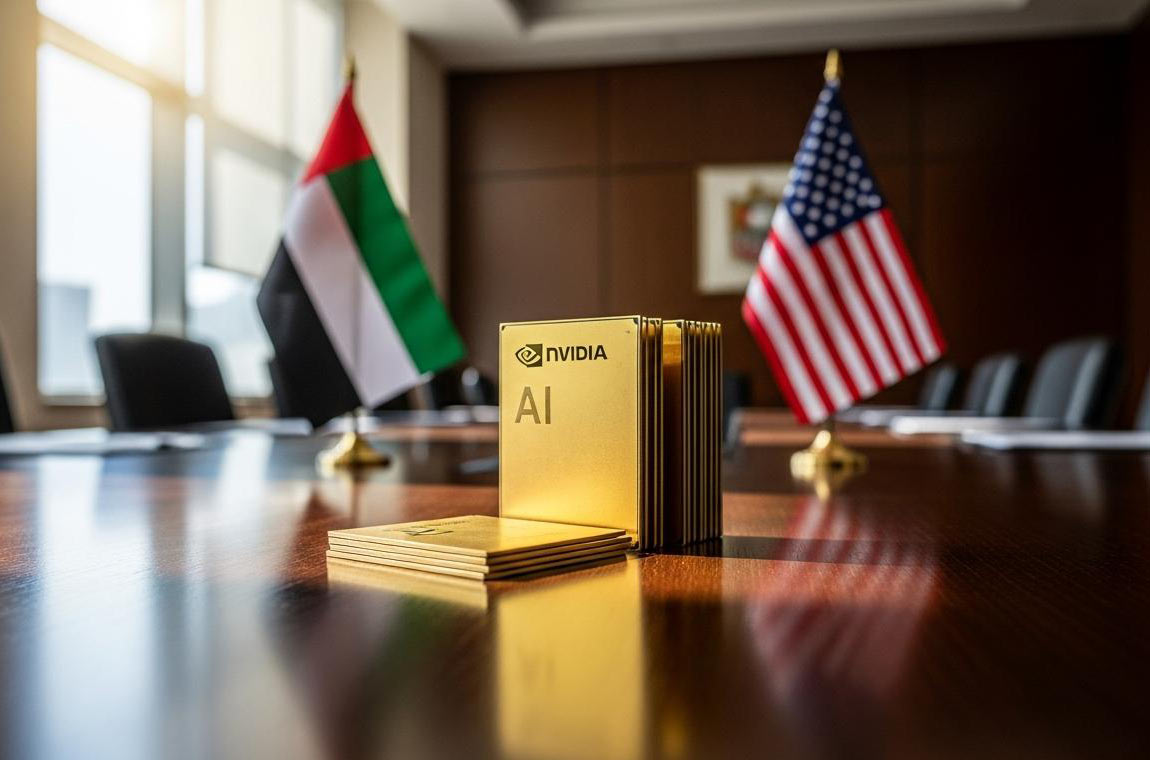
Expert Speak | 14 September, 2026
US Export Controls and the UAE’s Path Towards AI Capability
Spotlight
- The United Arab Emirates’ (UAE) access to advanced United States (US) technology is based on an approved list. As of now, government agencies, the companies G42 and Core 42, and subsidiaries of American firms do not require a licence to obtain it. But this arrangement will stop in April 2027.
- There is no official agreement regarding which customers can run their artificial intelligence (AI) workloads on procured US hardware. The Dubai Chambers’ agreement with NASSCOM can act as a testbed in the absence of a ‘green light’ category.
- The UAE’s national digital infrastructural projects, such as Stargate UAE, are operationalised over decades, but rest on a two-year licensing arrangement with the US. However, their hardware needs replacements and updates earlier than that.
Investment in frontier technologies such as artificial intelligence (AI) can contribute to the diversification of hydrocarbon-based economies like the United Arab Emirates (UAE) while providing solutions for emerging security risks, including cyber warfare. The actualisation of these promises, however, depends in part on access to advanced American technology. The UAE’s strong technology and security relationship with the United States (US) has facilitated sustained exchange of technology and capital between the two nations. How this bilateral relationship unfolds can offer a template to other nations with similar strategic priorities.
Two Indicators
Two developments may be useful indicators of how this relationship will develop. First is the announcement by the UAE federal government in April 2026 that agentic AI will be integrated across 50 percent of all government functions within two years. Second is the memorandum of understanding (MoU) signed between the Dubai Chambers and the National Association of Software and Services Companies (NASSCOM) to expand market access for Indian agentic AI firms in Dubai.
Taken together, the two developments suggest that the demand for compute capacity may significantly increase in the UAE over the coming years. The biggest planned compute infrastructure in the country will be at the UAE–US AI campus in Abu Dhabi, with a scale of 5 gigawatts (GW). Currently, infrastructure of this scale does not exist in the Dubai ecosystem. Given the UAE’s AI ambitions, the scale of the project and the resulting demand growth for compute capacity—through partnerships with foreign entities like NASSCOM—will probably require compute capacity at the campus to be leased across the nation and across borders.
How US Export Controls Affect Access
Access to US advanced computing hardware in the UAE is based on a list of approved recipients. A US commerce department rule, effective from 14 July 2026, enhanced the UAE’s standing under the US Export Administration Regulation. The approved list of UAE entities under this rule includes federal government agencies, but the approval does not apply to state-owned corporations or firms working under government contract. On the commercial side, the list names the conglomerate G42 Holdings, which includes G42 Cloud Technology; Core42; and US-based AI companies and their subsidiaries. Approval does not remove the end-use or end-user restrictions applicable under the regulation, though. Moreover, even though G42 and Core42 may receive advanced computing technology without a licence, American companies on the same list hold a broader trade authorisation.
Beyond being narrow, the export arrangement puts in place another restriction. The approvals for UAE private sector institutions will lapse in April 2027 if a continuation notice is not issued by the US Commerce Department. The timeline of the licensing arrangements, however, does not mirror that of infrastructure projects like data centres that have been planned over decades. Hardware updates also need to happen over shorter cycles, and each update will require licensing permissions to be in force. Continuation of hardware updates and operationalisation of data centres needs licensing decisions by the US Commerce Department. This creates an asymmetry where unilateral policy shifts in Washington or indecision by US authorities can halt infrastructure projects across the world that rely on American hardware.
Policy shifts are not unprecedented. The US Commerce Department authorisation available to three semiconductor fabrication facilities in China (owned by Samsung China Semiconductor and SK Hynix) was restricted in December 2025. This was to counter a “Biden-era loophole” that had allowed these companies to export American AI hardware licence-free. There was no allegation of wrongdoing by the entities operating in China; the arrangement changed simply because the classification of chip fabrication facilities changed.
Downstream of Export Controls
The risk of unilateral policy shifts and reclassification raises a key question: US hardware reaches a country through named recipients, but do any restrictions apply to the companies that borrow compute capacity from them? Although there is no official agreement on the answer, companies holding American accelerators as well as their customers currently do not fall under the July 2026 rule. General controls still apply, restricting supply where the buyer or the purpose fall into prohibited categories and barring anyone from proceeding while being aware of a possible violation. Foreign software firms renting compute capacity from Abu Dhabi to serve customers in Dubai are clear of this restriction, as long as they are not on a blacklist or doing prohibited work.
The case for the continuation of licensing arrangements between the UAE and the US also rests on the depth of their commercial and security relationship. In terms of capital, the UAE has pledged investments worth over US$1 trillion to the US. Partly due to this and partly because of Abu Dhabi’s cooperation with the US in the latter’s campaign against Iran over the previous months, the UAE’s standing in the US Export Administration Regulation has improved. Furthermore, the recent announcement of a joint military AI task force between the two countries signals deepening military and security cooperation, which would make licensing agreements politically costly to break.
The agreement between Dubai Chambers and NASSCOM should be carefully observed because it is creating a situation that will demonstrate how US export controls are applied.
The Global South Will Inherit the Architecture Created Here
The agreement between Dubai Chambers and NASSCOM should be carefully observed because it is creating a situation that will demonstrate how US export controls are applied. For instance, if Indian companies set up in Dubai buy their computing power from Abu Dhabi, the licensing arrangement will hold in its current shape. If, instead, they purchase their compute from non-US vendors without much of a price difference, it will indicate that restrictions may apply to the companies that borrow compute capacity from US-approved entities.
Two further indicators can be indicative of the future of US export controls. First, Washington will likely extend the licensing arrangement with UAE in April 2027. If it publishes reasons for the extension, the evolution of export controls will become less grey and more predictable. Second, following the announcement by the UAE government on integrating agentic AI in government functions, it needs to be seen whether this capacity is built using foreign operators with foreign software and hardware suppliers. The acceptance of foreign operators and suppliers will indicate broadening market access in the UAE. Whether US export controls get in the way of that market access is still an open question.
The US–UAE relationship is an indicator of how comparable partners will be treated by the former. It will reveal what a trusted entity means to the US, what security commitments will purchase, and whether approvals are renewed, and on what stated grounds.
The significance of the two-year licensing arrangement extends to countries beyond the UAE with whom the US has struck or will enter bilateral agreements. Washington is not interested in a single global framework for AI regulation and development and is proceeding instead through individual bilateral agreements. The objective is to export the American technology stack as a package that includes hardware, software, and increasingly military cooperation.
The US–UAE relationship is an indicator of how comparable partners will be treated by the former. It will reveal what a trusted entity means to the US, what security commitments will purchase, and whether approvals are renewed, and on what stated grounds. States that plan to enter agreements with the US later could use this bilateral agreement as a framework for their own arrangements.
Siddharth Yadav is Fellow, Technology, ORF Middle East.
The author acknowledges the use of Google Gemini 3.5 Flash for preliminary literature review and language refinements.