 Global
Expert Speak | 16 November, 2026
India’s Evolving Maritime Security Strategy in the North-West Indian Ocean
The following excerpt is from Chapter 5 — Hormuz: Breaking the Insecurity Continuum
Once considered ‘neglected,’[1] the Indian Ocean is currently at the centre stage of global geopolitical contestations. Beyond its growing strategic value within the Indo- Pacific, the region is drawing attention because of disruptions to shipping through the Strait of Hormuz since the conflict involving Iran, the United States (US), and Israel began on 28 February 2026. These disruptions have affected global oil markets and the world economy.[2] Although the conflict has so far stayed within the North-West Indian Ocean, the risk of it spreading to other theatres persists. The sinking of the Iranian frigate vessel IRIS Dena in a torpedo attack by the US near Indian waters was the first naval casualty in the region since the Cold War years.[3]
India’s expanding strategic interests and growing economic and military prowess have made the Indo-Pacific a focal point of the country’s foreign policy and security outlook. While early articulations of the Indo-Pacific in Indian policy can be traced to 2013 under former Prime Minister Manmohan Singh,[4] it was Prime Minister Narendra Modi’s 2018 speech in Singapore that set out India’s vision of a free, open, and inclusive Indo-Pacific.[5] Defined as a primary area of interest, the Indian Ocean is critical in mapping India’s maritime security priorities. The region’s salience has also grown alongside the Indo-Pacific construct. Given its central location and growing capabilities and ambitions, India has emerged as a principal maritime security actor in the region.
The conflict in the Middle East has demonstrated the fluidity of contemporary warfare, and the maritime domain has evolved as a vulnerable theatre of contest for control and influence. Given the importance of the North-Western Indian Ocean in India’s strategic thinking, New Delhi needs to rethink its strategy and priorities, recalibrating its multifaceted partnerships in the region to foster a secure and stable maritime order. Leveraging India’s capabilities and priorities, three areas are well placed to shape the new directions of India’s maritime security strategy in the North-West Indian Ocean region: cooperation in maritime domain awareness; enhancing interoperability among navies; and consolidating broader coalitions involving non-resident countries which despite not being geographically embedded in the region continue to hold strategic interest. These efforts would support New Delhi’s aim to broaden and deepen partnerships with regional countries such as the United Arab Emirates (UAE), as well as other partners farther in Europe. Multimodal connectivity networks such as the proposed India- Middle East-Europe Economic (IMEC) corridor are one route to this.[6]
The North-West Indian Ocean in India’s Maritime Strategy
The North-West Indian Ocean region encompasses various strategic pockets including the Arabian Sea, Persian Gulf, Gulf of Oman, Gulf of Aden, and the Red Sea. Given the region’s geopolitical volatility and strategic importance, increasingly evident amidst strains on global energy supply chains,[7] the North-West Indian Ocean is critical in shaping the maritime security balance in the wider Indian Ocean. The 2026 conflict in the Middle East and the security threats emerging in the region separate it from the wider Indian Ocean which, though vulnerable, is not experiencing any active conflict. These pockets are increasingly essential for India’s security calculations. A reorientation of India’s foreign policy appears to be underway in tandem with New Delhi’s growing strategic and economic heft.
Traditionally, New Delhi has found it difficult to foster and sustain cohesion and integration in its South Asian neighbourhood. India’s tensions with Pakistan on account of what it points to as crossborder terrorism from the latter[8] has impinged the scope for issue-based cooperation between the two countries, weakening regional cohesion. The dysfunctional state of the South Asian Association of Regional Cooperation (SAARC)[9] since 2016 demonstrates the constraints on regional cohesion in India’s neighbourhood.
Given the limited gains closer to home, New Delhi has sought to leverage its maritime geography by reimagining its neighbourhood to include distant continental geographies and count them as neighbours brought closer by shared maritime spaces. A maritime-turn, therefore, appears to be central in India’s calibrated strategic reorientation, and India’s engagement in the wider Indo-Pacific has reinforced this shift. As a result, several new regions such as Southeast Asia and East Africa now feature in India’s extended neighbourhood.[10] Similarly, the North-West Indian Ocean and the littoral countries in the region have become priorities for India’s maritime security strategy and operational preparedness.
Pillars of India’s Maritime Security Strategy in the North-West Indian Ocean
While this reorientation reflects a broader normative shift in India’s view of the North-West Indian Ocean, the operational pathways shaping its approach also merit attention. Given the evolving security maritime agenda, India’s strategic imperatives in the region are likely to be shaped by three operational pillars: maritime domain awareness (MDA) cooperation; naval exercises to enhance interoperability; and cooperation with non-resident countries in the region.
Maritime Domain Awareness Cooperation Given the complexities of the oceans as sites of geopolitical contest and economic interdependence, MDA has become primary to maritime security preparedness. Today, maritime security covers a wide range of issues, from protecting Sea Lines of Communication (SLOCs) and addressing maritime piracy and terrorism to managing depleting ecological resources and advancing a Blue Economy agenda.
As a principal maritime security actor in the Indian Ocean, India has sought to herald cooperation with various countries such as the United States, Australia, France, and Italy through the Information Fusion Centre – Indian Ocean Region (IFC-IOR), focusing on surveillance, information-sharing, and regional cooperation.[11] Mooted in 2017 at the Indian Ocean Rim Association Summit in Jakarta, the Indian Navy established the IFC-IOR in 2018 to strengthen cooperation on MDA in the region.[12] The IFCIOR has sought to foster cooperation through liaison officers from its partner institutions, supporting naval diplomacy and political trust alongside technical cooperation on information sharing.
The North-West Indian Ocean continues to face systemic challenges, which makes MDA particularly important there: piracy emanating off the coast of Somalia, the long risk of disruption of digital cables, and strains on energy supply chains. The 2026 conflict in the Strait of Hormuz and the use of naval mines further confirm that underwater domain awareness, in particular, is emerging as a critical node of cooperation in the region. While India has continued to pursue maritime cooperation with its neighbours in South Asia and Southeast Asia, the operational inclusion of partners such as Oman and France, Italy, and Spain indicates the growing vitality of MDA in New Delhi’s engagement with these regions. There is scope for new partnerships with countries such as the UAE, through white shipping information exchange and maritime intelligence sharing.
Naval Exercises to Enhance Interoperability
Like the wider Indian Ocean, the North-West Indian Ocean lacks regional institutions that can provide a broad framework for cooperation among stakeholders. In that sense, the maritime security architecture in the region remains fragmented.
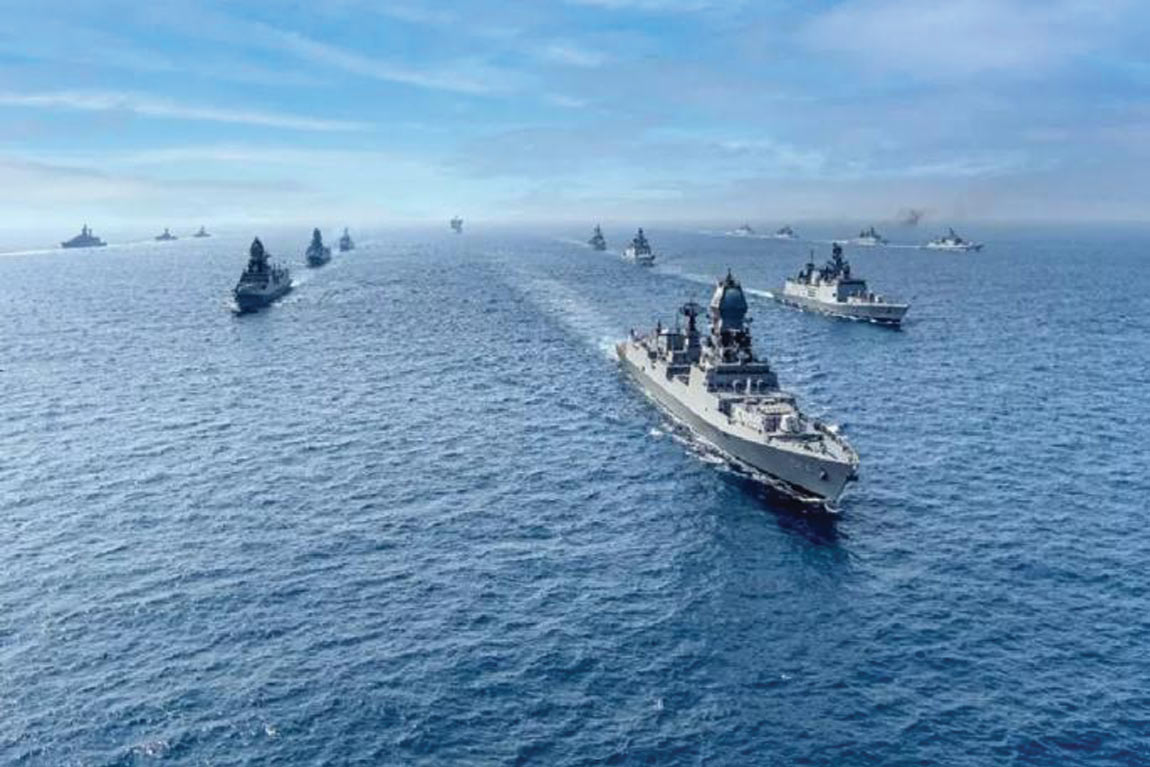
In this context, New Delhi has sought to expand naval cooperation in the region through a bilateral template. The Indian Navy participates in a number of naval exercises designed to enhance interoperability and exchange best practices with countries in the region. These include Exercise Naseem Al Bahr with Oman,[13] and Exercise Zayed Talwar with the UAE.[14] In October 2024, India and Oman concluded the 14th edition of Exercise Naseem Al Bahr off the coast of Goa. It aimed to enhance interoperability and foster mutual understanding and cohesion between the two navies.[15] Future iterations of the exercise are planned for the end of 2026. On the other hand, India and the UAE conducted Exercise Zayed Talwar in August 2023 at Port Rashid in Dubai. Two Indian Navy ships, INS Vishakhapatnam and INS Trikand, participated in the exercise, which focused on cooperation in tackling shared challenges such as piracy and smuggling, as well as undertaking joint humanitarian assistance and disaster relief (HADR) operations.[16]
The Indian Navy also took part in the Malabar Naval Exercise with the navies of the US, Japan, and Australia in the Northern Arabian Sea in 2020.[17] Such exercises aim to improve operational synergies, and strategic trust among participating navies. As the Indian Navy expands its role in advancing India’s naval diplomacy, engagement with regional navies is likely to remain a priority for New Delhi. Navies increasingly serve as instruments of diplomacy with like-minded countries. These exercises, therefore, broaden and deepen India’s presence as a strategic partner in the region.
Cooperation with Non-Resident Stakeholders in the Region
Turbulence in the North-West Indian Ocean risks affecting global stakeholders who are not geographically embedded in the region. This stands in contrast to resident stakeholders who remain at the heart of the evolving strategic equations. As a hub of global supply chains, energy routes, and sea lines of communication, the region has become a theatre shaping a rethink in maritime connectivity. With the onset of the Indo-Pacific discourse, several non-resident actors with strategic interest in the region have directed their attention to it.
The IMEC is one such framework that seeks to herald greater cooperation to forge connectivity partnerships in the region. Similarly, the tensions in the Strait of Hormuz and the ensuing strain on energy supply chains have galvanised interests among other non-resident actors to make efforts to foster a stable maritime security architecture in the region. The 2020 European Maritime Awareness in the Strait of Hormuz (EMASoH) is one such framework. Given, however, that several of the constituent countries lack the military, economic, and technological capabilities to emerge as key actor, there appear to be opportunities for India and its likeminded partners in the North- West Indian Ocean to foster cooperation. India, meanwhile, continues to enhance cooperation with its strategic partners to foster a stable maritime order in the region. India and France, for example, host the Varuna Exercise[18] in the Western Indian Ocean with its latest iteration hosted in 2025 off the coast of Goa.[19] Similarly, India and its Quad partners have brought their flagship Malabar Exercise[20] to the Western Indian Ocean.
Conclusion
Diplomatic efforts between the US and Iran, facilitated by mediators, to end regional hostilities have brought churn to the North-West Indian Ocean. Despite limitations in capabilities, the region remains key to India’s maritime security priorities. India’s growing naval diplomacy in the region shows New Delhi’s willingness to emerge as an actor shaping a favourable maritime security environment there. Its naval exercises with key partners such as Oman, the UAE, France, and its Quad partners underline the region’s importance in India’s naval outreach. It is imperative for New Delhi to deepen and broaden its partnerships in the region to herald a free, open, and rules based maritime order. Towards this end, three strands appear to be shaping India’s maritime security strategy in the region: MDA cooperation; naval cooperation to enhance interoperability; cooperation with non-resident stakeholders.
While India appears well positioned to take forward this agenda for maritime security cooperation in the region, it needs to delicately balance the changing strategic equations in the region, and navigate the uncertainties shaping this evolving theatre. New Delhi must continue to engage with its partners in the region, even as it looks for new opportunities to embed itself in existing mechanisms that promote a free and open maritime order in the North-West Indian Ocean.
Sayantan Haldar is Associate Fellow, Strategic Studies Programme, ORF.
[1] Christian Bouchard and William Crumplin, “Neglected no longer: the Indian Ocean at the forefront of world geopolitics and global geostrategy,” Journal of the Indian Ocean Region 5, no. 1 (2010), https://doi.org/10.1080/1948 0881.2010.489668.
[2] Samantha Gross and Ryan Beane, “From chokepoint to crisis: The Strait of Hormuz and global oil market,” The Brookings Institution, June 8, 2026, https://www. brookings.edu/articles/from-chokepoint-to-crisis-thestrait- of-hormuz-and-global-oil-markets/.
[3] Sayantan Haldar, “Iranian Ship Sinks: How A 2016 Deal With US Could Spell Trouble For India,” NDTV, March 5, 2026, https://www.ndtv.com/opinion/iran-israel-warwill- the-sinking-of-iranian-warship-near-sri-lanka-spellrisk- for-india-11170769
[4] Manmohan Singh, “Opening Statement by Prime Minister at Plenary Session of India-ASEAN Commemorative Summit,” (Speech: New Delhi, December 20, 2012), Ministry of External Affairs, Government of India, https://www.mea.gov.in/speeches -statements?dtl/20981/Opening+Statement+by+Pr ime+Minister+at+Plenary+Session+of+IndiaASE AN+Com memorative+Summit
[5] Narendra Modi, “Prime Minister’s Keynote Address at Shangri La Dialogue (June 01, 2018),” (Speech: Singapore, June 01, 2018), Ministry of External Affairs , Government of India, https://www.mea.gov.in/speechesstatements? dtl/29943/Prime+Ministers+Keynote+Add ress+at+Shangri+La+Dialogue+June+01+2018.
[6] Leonardo Del Piccolo, “IMEC and the Middle Corrdior: Competition or Complementarity?” Italian Institute of International Political Studies, July 27, 2026, https:// www.ispionline.it/en/publication/imec-and-the-middlecorridor- competition-or-complementarity-242256
[7] Farwa Aamer and Nadia Mondini, “Why Asia’s energy crisis makes the case for global collaboration,” The World Economic Forum, June 24, 2026, https://www.weforum. org/stories/energy-transition/asias-energy-crisis-globalissue/
[8] “India slams Pak, says Islamabad has a ‘long standing practice of corss-border terrorism’, warns of consequences,” LiveMint, September 26, 2026, https:// www.livemint.com/news/india/india-slams-pak-saysislamabad- has-a-long-standing-practice-of-cross-borderterrorism- warns-of-consequences-11790399187945.html
[9] Happymon Jacob, “The End of South Asia: A Region in Name Only,” Foreign Affairs, July 22, 2024, https://www. foreignaffairs.com/south-asia/end-south-asia.
[10] Sayantan Haldar, “Why maritime borders are critical in India’s national security thinking,” Hindustan Times, May 20, 2025, https://www.hindustantimes.com/india-news/ why-maritime-borders-are-critical-in-india-s-nationalsecurity- thinking-101747740839930.html.
[11] Mandeep Singh, “India’s fusion center expands global partnerships to bolster maritime security,” Indo-Pacific Defense Forum, May 13, 2026, https://ipdefenseforum. com/2026/05/indias-fusion-center-expands-globalpartnerships- to-bolster-maritime-security/
[12] “Indian Ocean Rim Association (IORA) Leaders’ Summit, Jakarta,” Ministry of External Affairs, Government of India, March 9, 2017, https://www.mea.gov.in/outogingvisit- detail?28124/Indian+Ocean+Rim+Associa tion+IORA+Leaders+Summit+Jakarta.
[13] “Naval Exercise to bolster India-Oman cooperation,” Times of India, October 20, 2024, https://timesofindia. indiatimes.com/city/goa/naval-exercise-to-bolster-indooman- cooperation/articleshow/114403513.cms.
[14] Shankhyaneel Sarkar, “India, UAE carry out naval exercise; deepen military cooperation,” Hindustan Times, August 8, 2021, https://www.hindustantimes.com/ india-news/india-uae-carry-out-naval-exercise-deepenmilitary- cooperation-101628443058494.html.
[15] Ministry of Defence, Government of India, “Indian Navy-Royal Navy of Oman Maritime Exercise (Naseem Al Bahr),” October 20, 2024, https://www.pib.gov.in/PressReleasePage. aspx?PRID=2066452®=48&lang=2.
[16] Manjeet Negi, “Indian Navy holds bilateral naval drill ‘Zayed Talwar’ with UAE,” India Today, August 13, 2023, https://www.indiatoday.in/india/story/indiannavy- holds-bilateral-naval-drill-zayed-talwar-withuae- 2420168-2023-08-12
[17] Pratnashree Basu, “Malabar 2020: Accelerating the Pace of Quad Cooperation?” 9dashline, November 6, 2020, https://www.9dashline.com/article/malabar-2020- accelerating-the-pace-of-quad-cooperation.
[18] “French Carrier Strike Group Conducts Air-Sea Manoeuvres with the Indian Navy,” France in India, November 25, 2025, https://in.diplomatie.gouv.fr/ en/french-carrier-strike-group-conducts-air-seamanoeuvres- indian-navy.
[19] Rajat Pandit, “India France to kick-off high voltage naval exercise in Arabian Sea,” Times of India, March 18, 2025, https://timesofindia.indiatimes.com/india/india-franceto- kick-off-high-voltage-naval-exercise-in-arabian-sea/ articleshow/119166402.cms.
[20] “Quad partners’ Malabar Exercise advances naval integration,” Indo-Pacific Defense Forum, November 30, 2025, https://ipdefenseforum.com/2025/11/quadpartners- malabar-exercise-advances-naval-integration/.