 Global
Expert Speak | 25 November, 2026
Global Energy Security in 2027: Convergence of Risks, Fragility of Redundancies
Spotlight
- The mitigation and adaptation strategies that cushioned energy supply disruptions in 2026 may not prove as effective in the face of multiple interrelated structural and geopolitical constraints in 2027.
- Wars of attrition in the Middle East and Europe may combine with new theatres of contestation in the South China Sea and the Horn of Africa to impact global energy flows.
- While it enables easier access, the globalised nature of energy trade also spreads contagion across interconnected geographies and supply chains.
“Diversification” and “integration of redundancies” have emerged as increasingly important and almost repetitive features of the 2026 lexicon of energy security. Supply disruptions triggered by the Middle East conflict have compelled hydrocarbon importers to diversify both their sources of procurement and the types of fuel in their domestic energy portfolios. Simultaneously, producers and exporters of hydrocarbons were forced to diversify their supply channels, whether through alternative maritime routes or pipelines. Proactive responses, such as drawdowns from strategic oil reserves and demand-side management, featured among the measures adopted by countries. These enabled energy trade—even if expensive and truncated—to continue flowing and helped prevent a global economic collapse after hostilities began in February 2026. The question is whether the diversification pursued and the redundancies integrated as part of these measures in 2026 will prove adequate in the face of multiple geopolitical contingencies and structural fractures that could worsen or emerge afresh in 2027, even if the US–Israel attacks on Iran and Tehran’s indiscriminate regional retaliations cease for now.
The question is whether the diversification pursued and the redundancies integrated as part of these measures in 2026 will prove adequate in the face of multiple geopolitical contingencies and structural fractures that could worsen or emerge afresh in 2027.
A combination of factors, not all of which were systemic or planned, helped cushion the energy shock when only the Strait of Hormuz and then the Bab el-Mandeb were blocked. The beginning of 2027, however, will see a contrived energy security landscape, as demonstrated by Figure 1.
Figure 1: Global Energy Markets Snapshot, November 2026
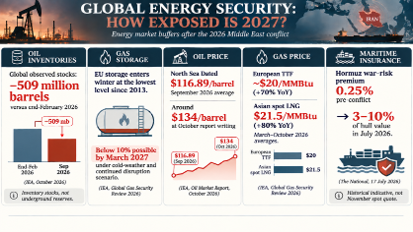
Source: Author’s own, based on data inputs to ChatGPT (GPT-6) from IEA Oil Market Report, October 2026, IEA Global Gas Review, and The National (17 July 2026)
The following geopolitical and structural factors could exacerbate energy security risks:
Persisting Wars of Attrition
Middle East: The maritime routes of the Middle East, a crucial artery of global energy trade, can be expected to remain embroiled in a war of attrition for the foreseeable future, as the conflict has exposed underlying tensions in the region. Notably, the resolution of most of these regional tensions is not contingent on the White House declaring an end to its own military campaign or on a negotiated settlement becoming acceptable to Iran, the US, Israel, and the Gulf Cooperation Council (GCC) simultaneously. Sporadic disturbances in the maritime waters flanking both the Strait of Hormuz and the Bab el-Mandeb, as well as potential attacks on energy production and supply infrastructure in the region, can become a regular feature of energy security in 2027. The successful weaponisation of critical maritime chokepoints in the region has set a dangerous precedent and their use as tools of war is likely to recur. This persistent volatility, which this epicentre of energy production is likely to grapple with in 2027, could adversely affect global energy security indices, even as trade flows are restored.
Any blockade here could make what happened in the Strait of Hormuz in 2026 appear, even if deceptively, like a momentary interruption.
Russia–Ukraine: The Ukraine War has severely impacted global energy security patterns. The decision by the European Union (EU) to phase out Russian energy imports by the end of 2027 means that the European countries will need to source energy from other suppliers. The timeline coincides with an increase in global stockpiling efforts, while constraints on oil supplies have raised further concerns. This, in turn, means increased competition for existing energy supplies and an upward pressure on prices. Simultaneously, attacks on energy infrastructure in both Ukraine and Russia have significantly impacted refining capacity. This is happening at a time when energy importers have limited flexibility in terms of the different grades of crude oil they are allowed to access easily. Consequently, reduced refining capacity could further constrain the options available to import-dependent countries that lack domestic facilities capable of adapting quickly. The Russia–Ukraine conflict could also see continuing grey-zone activities—common in wars of attrition—by both sides, with attacks focused particularly on energy infrastructure.
Potential Geopolitical Flashpoints
South China Sea: Any disruption arising from likely future Chinese action relating to Taiwan’s “reunification” with the mainland will be felt first in the South China Sea. The waterway carries about 21 percent of global maritime trade, with critical chokepoints like the Taiwan, Malacca, Sunda, and Lombok straits serving as feeder routes. In 2024, the Taiwan and Malacca straits each recorded goods trade worth over US$2.4 trillion. Malacca alone saw nearly 23.2 million barrels of oil flow transit in the first half of 2025. With nearly 29 percent of global oil flows passing through, it is the largest maritime chokepoint in energy trade. Any blockade here could make what happened in the Strait of Hormuz in 2026 appear, even if deceptively, like a momentary interruption.
In this interconnected geography, any of these chokepoints becoming impassable could have immediate and strong repercussions for the others, thereby throwing international maritime trade into disarray.
Figure 2: Key Maritime Chokepoints along the South China Sea
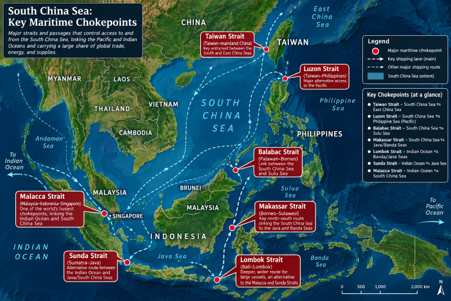
Source: Author’s own, generated through ChatGPT (GPT-6).
None of these straits needs to be fully blockaded for these shock waves to reach global energy markets; the risk perception alone can be expected to immediately increase war-risk insurance premiums and shipping costs in these straits and beyond. Disturbances along these straits would also affect critical supply chains beyond the energy sector, particularly those related to semiconductors and the energy transition, in which East Asian industrial economies play a central role.
The precedent set by Iran and the Houthis in weaponising their geostrategic influence over chokepoints and waterways may also be followed by actors in the Horn of Africa.
Horn of Africa: The western flank of the Red Sea borders the eastern coast of the Horn of Africa, where regional rivalries and the competing presence of other actors could snowball over time into a tense arena of geopolitical contestation. Sudan, Somaliland, Ethiopia, and Somalia have all experienced episodes of state fragmentation that have accorded greater agency and leverage to non-state actors. The precedent set by Iran and the Houthis in weaponising their geostrategic influence over chokepoints and waterways may also be followed by actors in the Horn of Africa, as demonstrated previously by the Somali pirates.
While the region itself is not a leading oil or gas producer, its ability to exert influence over and destabilise passage through the Red Sea could adversely impact Gulf energy flows and lead to higher risk premiums across commodity markets.
Figure 3: Potential Threats in the Horn of Africa
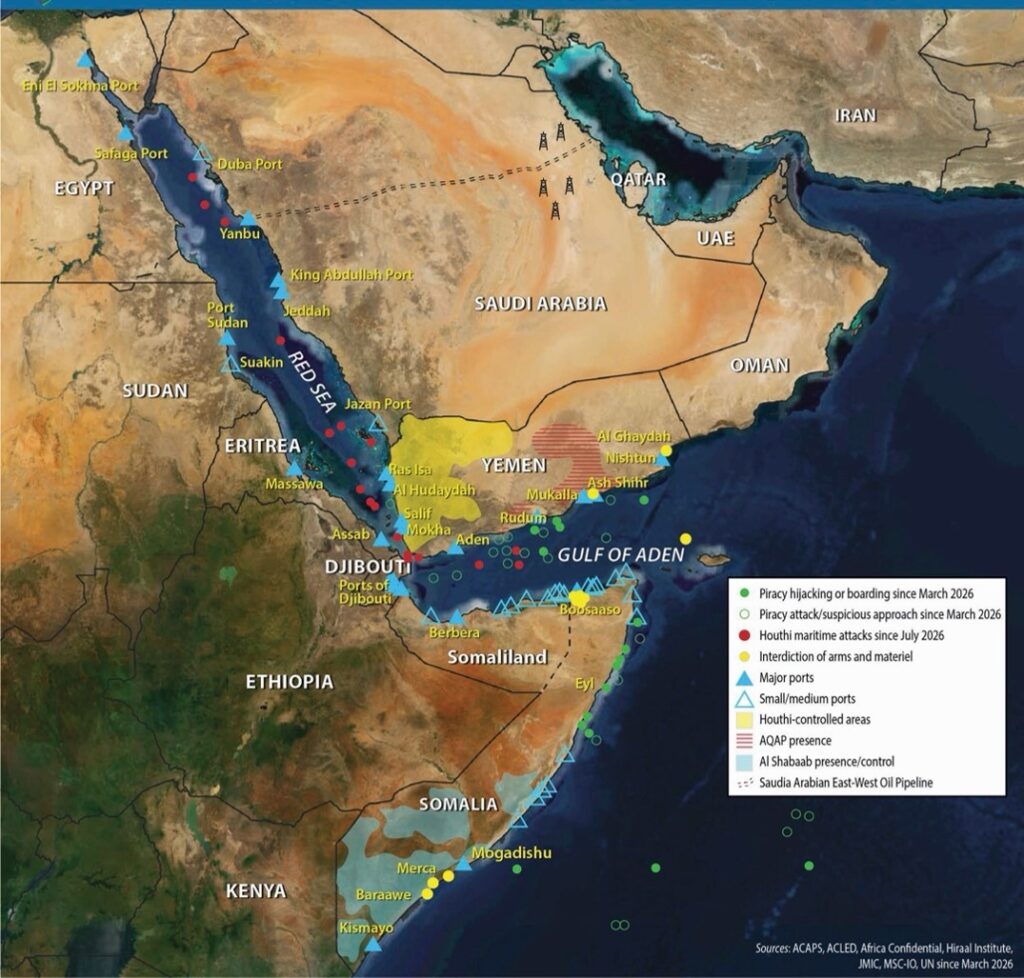
Source: Report by Africa Centre for Strategic Studies.
This could affect both the export earnings of Gulf producers seeking to use this route to bypass the Strait of Hormuz, as well as African, European, and Asian importers of energy.
Structural and Systemic Concerns
Geographically Distributed but Geopolitically Interconnected: Routes that are geographically and structurally distant from one another remain similarly exposed to interconnected geopolitical vulnerabilities. Systemic disturbances may affect even alternative routes and supply chains created to bypass a particularly vulnerable or compromised original route, severely constricting their effectiveness when multiple blockades are in place simultaneously. Disruptions to traffic along one route have repercussions in other regions, creating backlogs and logjams. For instance, restrictions on maritime passage in the South China Sea would impact the shipping volumes that the Malacca, Lombok, and Sunda straits would have to handle, just as blockades of the Strait of Hormuz changed shipping patterns through the Suez Canal and the Bab el-Mandeb. This also has important financial and logistical implications for energy trade.
The fungibility that allows energy resources to be readily substituted for one another has also facilitated the transmission of risk.
Double-Edged Flexibility: The second issue, paradoxically, arises from the flexibility demonstrated by global energy markets during the energy supply disruptions in 2026. The fungibility that allows energy resources to be readily substituted for one another has also facilitated the transmission of risk. Gas markets—although less fungible than oil—have developed a degree of adaptability and interconnectivity that creates a more integrated energy architecture than previously existed. The growth of spot-market gas trading has meant that Asian and European buyers are often forced to compete for the same supplies. Increased demand and purchasing power in one region, therefore, have an immediate bearing on the price and net supply of gas available to another region. This has effectively made the availability of gas in Asian spot markets and European hubs contingent on each other. As a result, an interruption in one region, whether due to structural, geopolitical, or logistical reasons, can transmit price volatility and supply constrictions to another area more easily and rapidly.
The scale of fractures that the Middle East conflict has caused to global energy security may pale in comparison to the losses and pressures that could arise if these geopolitical and systemic shocks materialise simultaneously in the coming year. In 2027, therefore, the limitations of the diversification and redundancy strategies that have shaped the international community’s response to the supply disruptions of 2026 may be exposed.
Cauvery Ganapathy is Fellow (Climate and Energy), ORF Middle East.
The author acknowledges the use of ChatGPT (GPT-6) for editorial support and to help generate the infographics and maps.