 Global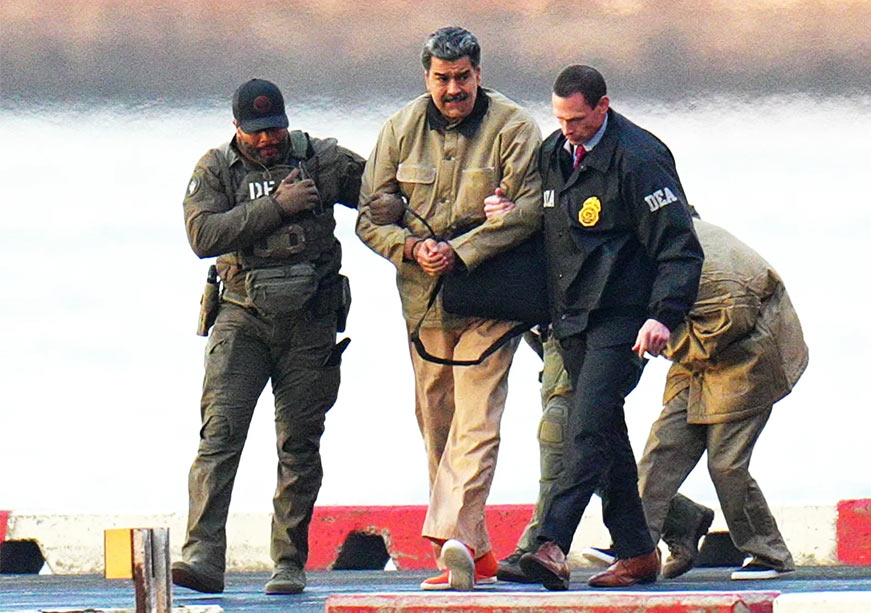
Expert Speak | 12 January, 2026
Venezuela Echoes Iraq: What is America’s Grand Strategy?
America’s capture of Venezuelan President Nicolás Maduro in “Operation Midnight Hammer” eerily mirrors the 2003 Iraq invasion: bold military action justified by security threats and promises of swift victory. As Trump officials such as Stephen Miller declare that the world should be “governed by force,” concerns mount about repeating Iraq’s nation-building failures.
America’s audacious capture of Venezuelan President Nicholás Maduro sent shockwaves not just across Washington’s backyard but beyond. United States President Donald Trump described the operation, codenamed Midnight Hammer, as “perfectly executed” and “one of the most stunning, effective, powerful displays of American military might.” In a subsequent interview, Trump said the US could remain Venezuela’s political overlord for “much longer” than a year. During that interview, Colombian president Gustavo Petro called to “explain the situation of drugs.” Like Colombia, Venezuela fell under Washington’s crosshairs due to its state-embedded criminal network, Cartel de los Soles – allegedly headed by Maduro – which the State Department designated a terror organisation last November.
The Latin American episode bears an uncanny resemblance to the 2003 Iraq War under the Bush administration. “Shock and awe,” Pentagon terminology for attacks so massive and sudden they overwhelm enemies, mirrors Trump’s account of the Venezuela raid. This term described the toppling of then-Iraqi President Saddam Hussein in an operation that left a controversial legacy. Washington did not anticipate an eight-year quagmire when US Marines pulled down Hussein’s statue in Baghdad on April 9, 2003. Despite Trump’s “peace through strength” rhetoric, the concern is repeating failed nation-building efforts from Iraq and Afghanistan.
Despite Trump’s “peace through strength” rhetoric, the concern is repeating failed nation-building efforts from Iraq and Afghanistan.
Faultlines have appeared among Trump’s MAGA allies and within the Republican camp, as the GOP frets over deploying American resources — including boots on the ground. Trump recently dismissed Iraq-Venezuela comparisons, claiming “We’re going to keep the oil”. In his victory speech after winning the 2024 presidential election, Mr Trump declared, “I’m not going to start a war. I’m going to stop wars.” A year into his second term, not only has this promise been called into question, but doubts have also emerged about America’s broader grand strategy.
Ghosts of the Past
The legacy of Iraq remains ugly for America. In 2002, when former President George W. Bush asserted in his State of the Union address the need to use military force to remove Saddam Hussein, he invoked ensuring “the nation’s security” — the same rationale President Trump is deploying in January 2026. But Bush went further in his speech, reaffirming “freedom’s price”. In rallying public support for this cause, then-US Secretary of State Colin Powell told the UN Security Council in February 2003 that “solid intelligence” justified disarming Iraq of weapons of mass destruction (WMD under UN Resolution 1441).
This solid evidence proved hollow. No WMD was found. Worse, inspectors later revealed that Iraqis cooperated in 2002-3, but their findings never reached US policymakers. The aftermath exposed the limits of Pax Americana (or America-led peace): a winless occupation and an Iran that later expanded its influence in the Middle East. American public support, according to Pew Research Center statistics, reached a high of 74 per cent in May 2003, deeming military force in Iraq the right decision. By November 2008, as Bush’s second term ended, however, support for the protracted war had plummeted to 39 per cent.
America had found itself entangled in Iraq — as in Vietnam and Afghanistan — until December 2011, when it withdrew all but a few thousand troops. During the Obama administration, Iraq spawned a new threat: the Islamic State of Iraq and Syria, prompting US airstrikes and the redeployment of a small American force.
The aftermath exposed the limits of Pax Americana (or America-led peace): a winless occupation and an Iran that later expanded its influence in the Middle East.
Venezuela’s developing situation is equally, if not, thornier. First, if oil motivates US control, it will require “lots of investment, lots of patience, and lots of time,” as Keith Johnson wrote. Second, removing Maduro does not automatically dismantle the trafficking regime. Instead, reports indicate the regime is exploiting this opportunity to crack down on public dissenters and political opponents.
This leaves the US in a Catch-22: if the Trump administration seeks short-term stabilisation, the current Venezuelan regime appears to be relying on the same toolkit of repression. Conversely, if the aim is sustained governance and security management, the Iraq case study has already demonstrated that hard power does not produce political legitimacy.
Donroe Doctrine?
Perhaps the foreshadowing of events in Latin America stems from the National Security Strategy (NSS) released by the White House in December 2025. According to the document, the Trump administration seeks to “enforce a ‘Trump Corollary’ to the Monroe Doctrine,” which emphasises American primacy in the Western Hemisphere. As the text explains, the means of achieving this is to “enlist” and “expand”, though the latter contradicts reality. Instead of “cultivating and strengthening new partners”, what we have witnessed thus far resembles expansionism more closely — with President Trump setting sights on Colombia, Cuba, and Mexico. Further afield, Greenland also faces the threat of annexation, whether through purchase or by force. Only Honduras remains an anomaly: its former President Juan Orlando Hernández received a pardon from Trump for charges of drug trafficking.
Other inconsistencies in the document invite interpretation, such as referring to Trump’s foreign policy as “pragmatic without being ‘pragmatist,’ […] principled without being ‘idealistic,’ muscular without being ‘hawkish’.” What is clear is that America’s interests are first and to achieve such a goal requires flexibility — even ambiguity. A year into Trump’s second term, the president has signed more executive orders than he did during his entire first term. He has also pursued a more muscular foreign policy, conducting airstrikes in Nigeria, Somalia, Syria, Iran, Yemen, and Iraq since taking office. Now, the Senate has advanced a bill to block further military action in Venezuela — an attempt to address the illegality of Midnight Hammer and the abuse of force.
What is also apparent is how commercial diplomacy forms part of the Trumpian playbook, which seeks to reverse the “unsustainable” current account deficit. The document references the Middle East as “no longer the constant irritant,” but a “place of partnership, friendship, and investment.” Trump’s visit to the Gulf Arab countries last May, which produced multibillion-dollar deals, is cited as a model example of “the appeal of American technology.” Yet the Middle East remains plagued by fragile and failed states, where central authority struggles with internal conflict. Syria, Yemen, Iraq, and Lebanon are just some examples.
So, What is America’s Grand Strategy?
As far as the concept of grand strategy goes, which refers to how states prioritise and mobilise military, diplomatic, political, economic, and other sources of power in accordance with national interests, the Trump administration is an outlier. US grand strategy has traditionally been characterised by one of four strands: (1) restraint, which relies on diplomacy to resolve conflicts; (2) deep engagement, which leverages military dominance and alliance commitments to uphold the international order while profiting from this security umbrella; (3) liberal internationalism, which holds that states should pursue multilateral agreements, uphold rules-based norms, and spread liberal ideals; and (4) conservative primacy, which promotes liberalism but allows for the use of force rather than diplomacy alone.
The Iraq War stained democracy promotion by conflating universal freedom with American military force. In Trump’s coercive tactics, however, one finds no comparable promise of Western democracy akin to the “Freedom Agenda“ launched by the Bush administration. To be clear, Trump has now withdrawn the US from 66 international organisations, signalling further disdain for the liberal internationalist values that the US was instrumental in maintaining within the global order for more than seven decades. Crucially, it is worth reiterating that the Iraq conflict did not diminish Arab support for democracy. Public surveys like the Arab Barometer consistently show high levels of support for democratisation across the region.
But make no mistake: Trump’s retreat from international institutions does not signal isolationism.
Rather, it represents robust internationalism that embraces power politics. Nor is he reluctant to wield American hard power, undermining the soft power cultivated over decades, from the “hearts and minds” campaign during the Vietnam War to USAID‘s humanitarian and development assistance, which Trump has now dismantled. For the United States, rebuilding trust will prove difficult when the very institutions built upon it are discarded.
Stephen Miller, the president’s Deputy Chief of Staff and Homeland Security Adviser, has already articulated how America views the world. When pressed on Trump’s desire to control Greenland, Miller asserted that the world must be “governed by force.” This philosophy portends trouble globally. Latin American countries should brace for turbulence. As for the Middle East, Trump’s promises of peace warrant scepticism: the region remains a tinderbox with fragile ceasefires in Gaza and Lebanon, widespread political instability, and states like Iran that may again become American targets.
Clemens Chay, Senior Fellow, Geopolitics, ORF Middle East.