 Global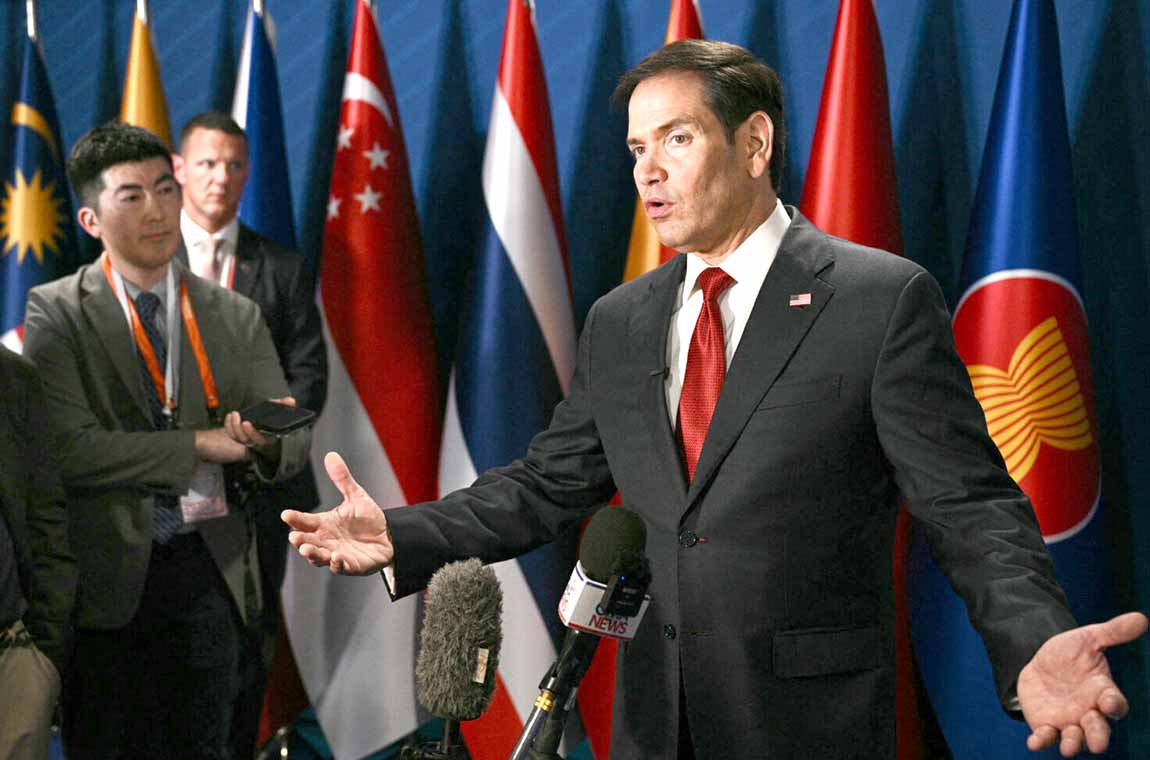
Commentaries | 28 July, 2026
Iran is Betting on American Fatigue
Speaking at the recent Asean Foreign Ministers’ Meeting in Manila, US Secretary of State Marco Rubio warned that Iran’s demand to control an “international waterway” in the Strait of Hormuz sets a “dangerous precedent” that could be replicated elsewhere. The remarks echoed those he made a month earlier, before Gulf Arab counterparts, reassuring them that their security would not be sacrificed for what they saw as a deal favouring Iran — the US-Iran MOU signed on June 17, which has since collapsed in spectacular fashion. Instead of working towards a final resolution, a new baseline has now been established: The United States continues to coerce Iran with air strikes, and the response has been missiles and drones from Tehran, as well as closure of Hormuz, and, now, the Red Sea.
As the region climbs the escalatory ladder, Washington’s military actions, which now include a reimposed naval blockade, show no sign of breaking Iranian resolve. If anything, shipping is bending increasingly to Tehran’s designs over the strait. The same Gulf ministerial meeting Mr Rubio attended saw Oman announce a temporary transit corridor for vessels; this, too, has failed to hold, with Iran targeting any vessel attempting to leave the waterway via Muscat’s coastal route.
Of the MOU’s 14 points — most of which have now been cast aside — only Clause 5, requiring Iran’s “best efforts for the safe passage of commercial vessels with no charge, for 60 days only,” alongside dialogue with Oman and “other Persian Gulf littoral states” to define the strait’s future administration under international law, remains in play. Iran has been adept at turning this to its advantage: Until the strait question is resolved, no other file, nuclear included, can even be discussed.
Survival and Stranglehold
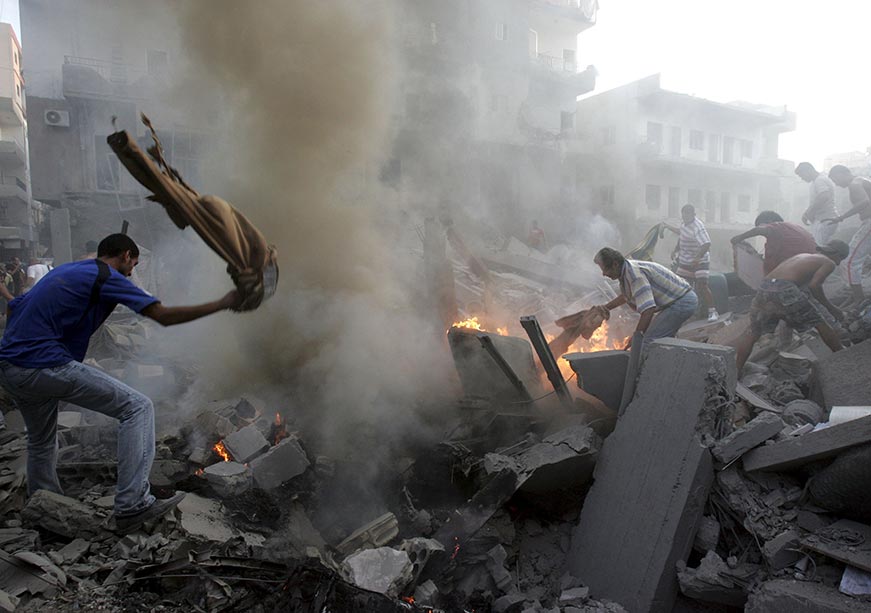
Meanwhile, events threaten to spiral out of control. Continued US strikes on Iran’s maritime capabilities, missile and drone storage, coastal surveillance, and air defence sites have overshadowed another American objective: Severing Tehran’s economic lifelines, particularly the port city of Bandar Abbas, through the destruction of surrounding roads and bridges. This makes Iran’s defiance over the strait an existential calculation. As the Iranian-American academic Vali Nasr put it, it is waging an “existential war” where “friend or foe doesn’t matter after a point” — in its struggle to survive, Tehran has ceased to discriminate between adversaries and states it has no quarrel with, and has instead lashed out wildly.
Iran’s own conduct bears this out: What began with retaliation against Kuwait and Bahrain while the MOU frayed soon widened, as US strikes intensified, to Oman, Qatar, and even Jordan — a state with no stake in the strait itself, but which offers proof that Iran’s retaliatory net now extends well beyond Hormuz’s littoral states. Kuwait’s power and desalination plants, which supply 90 per cent of the country’s drinking water, have come under fire too.
At sea, Saudi, Qatari, and Emirati vessels have all been struck, regardless of Riyadh’s sustained diplomatic engagement with Tehran or Doha’s role in mediating the US-Iran track. Neither was spared. Most tellingly, Oman, which has spent the war quietly absorbing attacks without naming Iran as the source, has now summoned Tehran’s ambassador in protest over recent drone strikes — a rupture for the one Gulf state that had both resisted American pressure to sever bilateral ties, and said outright that Washington had lost control of its own foreign policy.
This escalatory ladder, climbed and descended repeatedly, is normalising ever more intransigent rhetoric, further souring the prospects of any resumption of talks. President Donald Trump has vowed to destroy a bridge or power plant for every Iranian strike in the strait; Iran’s Parliament Speaker Mohammad Bagher Ghalibaf countered in kind, warning that “in a region where we do not sell oil, no one will sell oil,” and that the strait “can be secure only in the absence of American forces”. Talk of resuming negotiations, for now, is little more than lip service.
Iran Knuckles Down
To be clear, the US-Iran MOU signed in June advantaged Tehran, offering not just concessions but ambiguous language that deferred the issue that supposedly triggered the American-Israeli campaign on February 28: Iran’s nuclear ambitions. Clause 4 committed the US to lifting its naval blockade in tandem with Clause 5 — Iran’s “best efforts” to ensure safe passage across the strait — while Clause 13 made any negotiation on the remaining paragraphs, nuclear included, conditional on progress across those two alone. The release of frozen assets and an oil export waiver were bundled in alongside. These carrots have since been suspended, as Iran chose confrontation over compliance.
Even while profiting from the flimsy MOU, Iran’s “bazaar style“ negotiating strategy, aimed at wearing down its opponents, has left Mr Trump claiming at least 38 times that a deal was close, without any concrete evidence. The Iran-backed Houthis have now declared a naval blockade of Saudi Arabia through the Bab el-Mandeb, reportedly at Tehran’s request. With the Red Sea serving as an important bypass for Riyadh’s east-west pipeline, the price of oil spiked to US$100 a barrel on July 23 — the first time since May that has occurred.
Iran appears fully prepared to wage a war of attrition: It reportedly rejected an American ceasefire proposal delivered by Iraq. By dragging America’s, and the region’s, attention onto a second front, Tehran is buying time to regroup and reconsolidate, while retaining considerable capability to inflict pain — a point driven home sharply by strikes on Jordan and Iraq which killed several US soldiers.
The Long Game
For all the hard rhetoric, including Secretary Rubio’s “a head for an eye“ retort to Iranian Foreign Minister Araghchi’s own “eye for an eye” warning, Iran seems to be playing the long game. It knows it has a big stick: The capacity to hurt the region and the global economy at will. Gulf Arab neighbours are thus racing to build bypass routes, the latest being DP World’s 50-year concession to build two terminals on the UAE’s east coast as part of Abu Dhabi’s push towards “zero Hormuz dependency“. But these plans require time to materialise, and even then, will only mitigate, rather than resolve, the Hormuz issue.
Crucially, despite American refuelling aircraft arriving in Israel and Mr Trump telling the news outlet Axios that he is considering a “massive attack” bigger than Operation Epic Fury itself, Tehran appears determined to call the President’s bluff, hunkering down on both its position over the strait and its retaliatory tactics.
Washington’s own position is fraying. American casualties are mounting, with the Pentagon accused of quietly downplaying injury figures, while Mr Trump’s own base is losing patience. A Politico poll found the share of Maga voters who think the war is worth its economic cost has fallen to just over a third, down from half in May. That strain was on full display this week: Secretary of Defence Pete Hegseth and the Chairman of the Joint Chiefs of Staff, General Dan Caine, told the Senate on July 21 that the war has already cost US$37.5 billion, and sought supplemental funding for it; a day later, the House narrowly passed a US$1.15 trillion defence bill.
Iran’s calculation is straightforward: Rising US casualties and mounting costs will eventually force Washington to concede control of the strait. For now, Iran is holding all the cards, while the US scrambles just to keep its footing.
This commentary originally appeared in the Middle East Institute, National University of Singapore.