 Global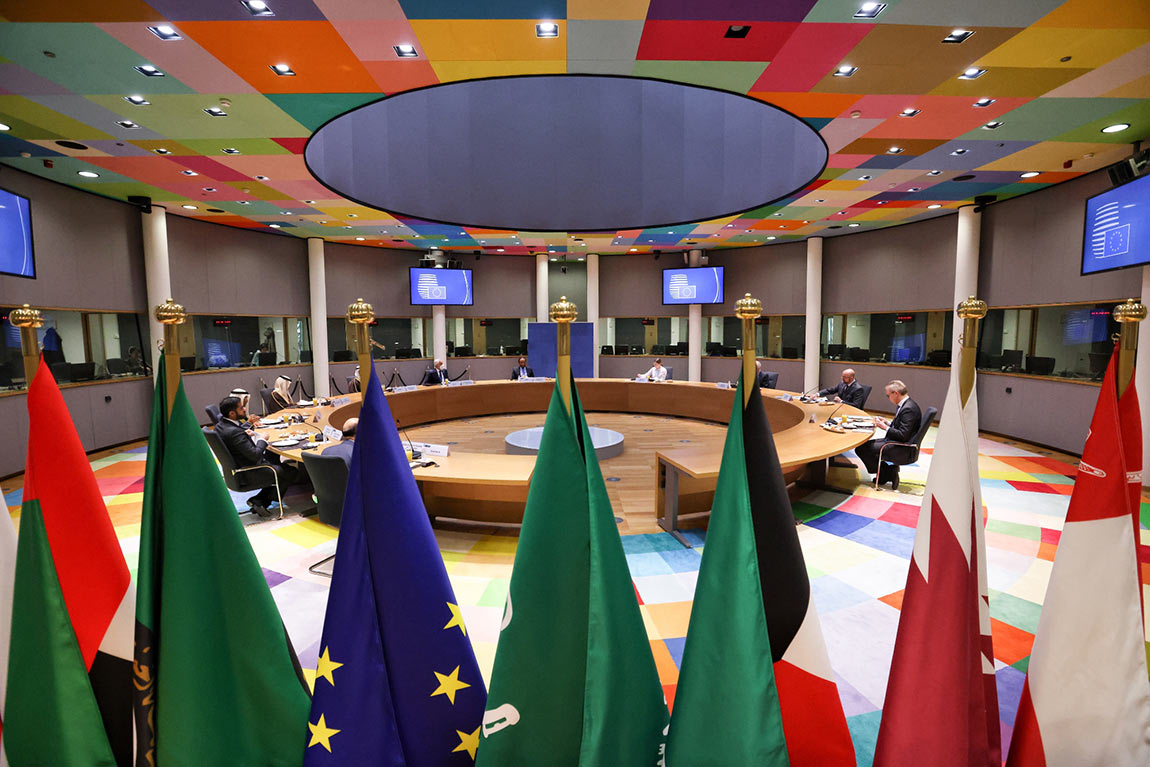
Occasional Paper | 25 March, 2026
The EU’s ‘Geopolitical Actorness’ in the Gulf: Purpose, State of Play, and Potential
In an era marked by conflict, tension, and rivalry, the unfolding global power dynamics are adversely impacting the interests of the European Union (EU). This paper argues that the EU recognises the need to reassess and reshape its external engagements, framed by the principle of ‘open strategic autonomy’, in order to ensure the protection of its vital interests. To analyse the interplay between the Union’s strategic rationale and its capacity to translate it into concrete actions and tangible results, this paper utilises the concept of ‘geopolitical actorness’ as an analytical guiding tool. It assesses the EU’s ‘geopolitical actorness’ in relation to the actors of the Gulf, a region that is particularly relevant to the Union’s security, prosperity, and stability.
Attribution:
Eszter Karacsony, “The EU’s ‘Geopolitical Actorness’ in the Gulf: Purpose, State of Play, and Potential,” ORF Occasional Paper No. 531, Observer Research Foundation, March 2026.
Introduction
In the current decade, the European Union (EU) has been confronted with the reality of a “harsh world”,[1] “characterized by raw power politics”[2] and “geostrategic competition”.[3] In this world, as then European Commission Vice-President Josep Borrell said in 2020, “we see increasingly the use of force in different ways” and the weaponisation of “economic and other instrument[s].”[4] Given the EU’sroximity to current and potential hotspots, its economic and security stakes, and thus its stability, are increasingly exposed to adverse impacts.
The EU sees its vital interests being threatened and its capacity to shape the international environment to its advantage severely tested.[5] The Union’s vital interests are, as outlined by the Egmont Institute, “those that determine the very survival of the EU’s social model, which is based on the core values of security, prosperity, democracy and equality.”[6] In essence, it can be understood as the preservation of the EU’s internal functioning and welfare structure, which is linked to the shaping of its external environment in ways necessary to sustain its peaceful, stable, and prosperous existence.
Consequently, the EU feels it “must relearn the language of power and conceive of Europe as a top-tier geostrategic actor.”[7] Against this backdrop, the Union’s “geopolitical consciousness”[8] has been growing in the current decade, compelling the EU to revisit its approach to its external actions. In the course of this process, Russia’s invasion of Ukraine in 2022 catalysed the Union’s “awakening as a geopolitical player.”[a],[9]
The EU’s approach to its external actions can perhaps be best understood through its open strategic autonomy (OSA) concept, which “refers to the capacity of the EU to act autonomously in strategically important policy areas […] [while] aim[ing] for multilateral cooperation wherever possible and appropriate.”[10] This requires the identification and mitigation of the Union’s vulnerabilities and dependencies.[11] Although the OSA has been shaping multiple EU policy areas,[12] it is particularly significant in the context of the Union’s vital interests: physical and economic security, prosperity, and overall stability. As such, the strategic rationale inherent to the EU’s geopolitical awakening[13] can be interpreted as the recognition of the need to reassess and reshape its external engagements in line with its OSA concept to protect its vital interests.
However, this geopolitical awakening does not automatically mean that the EU is capable of acting on its strategic rationale. This paper aims to explore the extent to which the EU can translate its intention to implement an external policy that safeguards its vital interests into concrete actions that yield tangible results. To support this assessment, the concept of ‘geopolitical actorness’ can be utilised as an analytical guiding tool.
‘Geopolitical Actorness’: An Analytical Guiding Tool
The EU’s ‘actorness’ was first outlined by political scientist Gunnar Sjöstedt in 1977[14] to refer to the then European Community’s “capacity to behave actively and deliberately in relation to other actors in the international system.”[15] Following this foundational definition, the Union’s ‘actorness’ has been further nuanced in the academic literature and adapted to different policy fields and regions. This analysis draws on Sjöstedt’s initial conceptualisation of ‘actorness’ and adapts it in line with the specific definition of ‘geopolitical actorness’ as put forward by scholars Dealan Riga and Liridon Lika.[16] According to Riga and Lika: “[g]eopolitical actorness can be understood as the integration of strategic thinking into the EU’s engagement with global affairs.”[17] They note that “the imperative for geopolitical actorness goes beyond the requirements of global actorness and emphasizes the need for novel approaches to political alliances and economic interdependencies.”[18]
Building on these interpretations, this paper defines the EU’s geopolitical actorness as the capacity to integrate its strategic rationale into its relations with third parties, and to actively and deliberately act on this rationale through strategically redefined relations to achieve tangible results. This interpretation of geopolitical actorness goes beyond viewing an actor’s capacity to deploy ‘hard power’ (and, by extension, a focus on the military and defence domains, which are often associated with geopolitical weight and influence). The concept is understood more comprehensively, referring to the actor’s general external action-capacity and ability to achieve security, prosperity, and stability related results, guided by a strategic logic. Therefore, it also encompasses domains such as economy, diplomacy, and politics.
This paper assesses the EU’s geopolitical actorness in relation to the Gulf—a region that is of particular significance to its vital interests. The Gulf region is significant for the Union given its proximity to the continent[19] and its strategic position as a “gateway between Europe, Asia and Africa.”[20] This spatial scope allows for a regional-level interpretation of the EU’s geopolitical actorness as the analysis extends beyond the EU’s interactions with individual states, and also focus on its ties with the Gulf Cooperation Council (GCC). The current study understands EU-Gulf relations[21] as the Union’s engagements and interactions with the GCC and its six member states: Bahrain, Kuwait, Oman, Qatar, Saudi Arabia, and the United Arab Emirates (UAE).[22] This understanding is consistent with how the EU describes its relations with the Gulf.[23]
The paper is structured around the following lines of enquiry: it evaluates whether the EU’s strategic rationale is discernible in its relations with the GCC and its members through a content analysis of leadership statements and strategic documents; and it explores the EU’s capacity to translate its strategic rationale into concrete actions to yield tangible results in its ties with the Gulf. This analysis will draw on factors that either help or hinder the Union’s interactions with regional actors: 1) the existence of EU political backing to the actions to be taken, together with the availability and effective deployment of the instruments and means required to carry them out; 2) the presence of supporting institutional procedures, frameworks, and mechanisms; and 3) the counterparts’ stance regarding their engagements with the Union, and ways the EU can make them interested in engaging.
A Strategic Turn
In two occasions, in October 2021 and October 2025, the EU’s successive High Representatives for Foreign Affairs and Security Policy/Vice-Presidents of the European Commission, Josep Borrell and Kaja Kallas, made remarks relevant to the present analysis.[b] While those remarks differed in their respective assessments of the intensity, level, and depth of engagement between the EU and the Gulf in the given period, they both recognised the strategic relevance of the EU’s ties with the Gulf. On 18 October 2021, Borrell stated that the “European Union is quite absent from the region. […] The Gulf wants an increased European Union presence and we have a strategic interest to engage with them. They play a key role [i]n foreign policy issues.”[24] Subsequently, “[e]nhanced and more focused cooperation between the European Union […] and member states of the Gulf Cooperation Council […] has become a priority for the EU, with a view to jointly addressing a series of global and regional challenges. Building on strong ties established over decades of a close trading and investment relationship, the EU is now seeking to put relations on a more secure footing, with new impetus and a much broader scope.”[25] Reflecting this rationale, in her remarks on 6 October 2025, Borrell’s successor, Kallas, outlined a reinvigorated dynamic with promising prospects, “EU–GCC relations are entering a dynamic new phase. Our strategic partnership is deepening: from trade and investment to climate action, energy, security, and humanitarian cooperation.”[26]
As such, amid its growing geopolitical consciousness and subsequent awakening, the EU’s ties with the Gulf have gained heightened significance. However, this temporal overlap does not automatically imply a causal link between the two. To establish such causality, it is essential to examine whether connections between global geopolitical transformations and the enhancement of EU-Gulf ties can be identified; and if the areas particularly concerned by the Union’s vital interests have been integrated into the strategic framework that shapes its relations with the Gulf. Two documents, in particular, can serve as references. The first, a unilateral EU document, the ‘Joint Communication to the European Parliament and the Council – A Strategic Partnership with the Gulf’ issued in 2022 by the European Commission and the High Representative of the Union for Foreign Affairs and Security Policy;[27] and the second, the ‘First European Union-Gulf Cooperation Council Summit Joint Statement’ from 2024.[28]
The joint communication from 2022, which serves as the EU’s “first ever Strategy for the Gulf region,”[29] clearly illustrates the causal connection between geopolitical shifts and the Union’s attempts to strengthen ties with the Gulf. The document states: “At a time of insecurity and significant challenges to the rules-based international order both in Europe and in the Gulf region, and as the world faces the consequences of the Russian aggression against Ukraine and the COVID-19 pandemic and the urgent imperative of the green and digital transition, the European Union stands much to gain from a stronger and more strategic partnership with the Gulf Co-operation Council (GCC) and its member states.”[30] Several areas of partnership detailed in the joint communication fall under the scope of the EU’s vital interests, such as economic cooperation for prosperity, collaboration in the field of security of supply with a specific focus on energy, and coordinated and joint efforts for a stable Middle East.
On economic cooperation and sustainable energy supply, the joint communication describes the EU’s relations with the GCC and its member countries as one that can allow the Union to strengthen its OSA. The document states: “A privileged trade and investment relationship between the EU and the GCC and its members is of strong mutual interest […]. This is even more relevant in a fast changing geopolitical context where the EU must build alliances and platforms of cooperation to pursue its objectives and enhance its open strategic autonomy.”[31] The document also emphasises that stability in the Middle East—in the shared neighbourhood of the EU and the GCC countries—is a fundamental goal for the EU and strongly contingent on the Gulf’s actions and engagements: “With Gulf states increasingly active in their own region and in the broader Middle East and beyond, it is clear that lasting stability in the EU’s broader neighbourhood will require close cooperation with them.”[32]
These policy areas are also included in the EU-GCC 2024 bilateral joint statement, which is structured around two main areas of cooperation: “partnership for sustainable prosperity and security” and “partnership for long-lasting stability and peace.”[33]
The development of an enhanced cooperation framework saturated with particular strategic significance—as covered in the two documents—is the initial and essential condition for the EU’s geopolitical actorness in the Gulf. The EU should now act based on the objectives and pathways established in this framework. Effective action is subject to the Union’s resources and resource-mobilisation capacity, as well as the partners’ continued willingness and interest in engaging with each other.
Internal Political Backing, Instruments, and Actions
A prerequisite for the EU to be capable of acting on its set objectives is internal political backing, both for its unilateral strategy and its bilateral engagements. The EU’s strategic partnership with the Gulf (2022) was granted this support by the Council of the EU (Council), which brings together government representatives from the 27 member states. The approval took the form of ‘Council conclusions,’[34] which serve to express a “political position on a specific topic.”[35] The conclusions stated, “The Council welcomes the Joint Communication […] and calls for its swift and efficient implementation.”[36] Furthermore, consistent with the substance of the joint communication, the Council conclusions also highlighted the strategic importance of these relations for the EU: “Building a strategic partnership with the Gulf Cooperation Council and its Member States, as part of enhancing EU engagement in the broader region, is a key priority for the European Union.”[37]
In addition, political support has been provided not only to determine the future direction and substance of the cooperation, but also for the use of specific instruments that might facilitate the achievement of the set objectives through enhanced economic and commercial relations and elevated political ties. In the case of the EU’s engagement with the Gulf, free trade agreements (FTAs) and strategic partnership agreements (SPAs) serve this purpose. The main aim of an FTA is market liberalisation, whereas an SPA seeks to provide a more comprehensive and strengthened cooperation framework for political and economic collaboration.[38] SPAs are the EU’s tools for “a tailor made partnership with each one of the Member States of the GCC,” and they have “three legs, the first is political […] the second leg is trade and investments except the [market] liberalization [which is under the remit of FTAs] […] and the third one is sustainability.”[39]
To engage in FTA negotiations on behalf of the Union, the European Commission needs an authorisation and negotiation directives from the Council.[40] Having received this political backing, the EU and the UAE launched free trade negotiations[c] in the first half of 2025.[41] Furthermore, an EU-GCC FTA is also under consideration.[42] The launch of SPA negotiations also requires a green light from the Council. This was provided in July 2025: the “[European] Commission welcome[d] the adoption of the EU mandate by the Council to launch negotiations with the six GCC countries.”[43]
In addition to these bilateral tools, the EU is also keen on involving the Gulf states as partners in other initiatives designed to strengthen the region’s security, prosperity, and stability. The EU-initiated ‘Palestine Donor Group’ (PDG) is an example. Seeking to bring together international and regional actors to support the effective implementation of the Palestinian Authority’s Reforms, it started to materialise in the second half of 2025.[d]
Another example of the potential association of the Gulf states to EU initiatives are triangular cooperation opportunities under the Global Gateway projects. The Global Gateway initiative—’predominantly addressed to middle- and low-income nations’[44]—is an EU external investment instrument to foster development,[45] in some cases through joint ventures with trusted third parties that are willing to be financially involved. This initiative, with a strong development cooperation and geoeconomic rationale,[e] aims to “narro[w] the global investment gap worldwide”[46] and “boost smart, clean and secure links in digital, energy and transport sectors, while also strengthening health, education and research systems across the world.”[47] As suggested in the 2022 joint communication, “[u]nder Global Gateway, the EU and Gulf partners could explore joint initiatives in third countries through triangular cooperation, financial support, capacity building and technical assistance.”[48] In the same document, the broader Middle East region and Africa were named as the potential target regions of “a joint venture with the Gulf to foster sustainable investments.”[49]
In addition to these instruments, exploring cooperation opportunities between the parties under minilateral and multilateral mechanisms could also be a viable approach to foster the achievement of the defined objectives. One such example is the India-Middle East-Europe Economic Corridor (IMEC).[f] This multi-regional project seeks to establish and enhance digital, energy, and transport connectivity between the Euro-Mediterranean, the Middle East, and the Indo-Pacific.[50] Given its geographical location, the Gulf (particularly Saudi Arabia and the UAE as signatory countries) has a pivotal role in the project’s effective implementation. Should the project be realised, it will contribute substantially to the EU’s supply security, prosperity, and economic stability. However, the project’s completion is dependent on a stable Middle East.
The list of instruments presented in this subchapter is illustrative, showcasing the tools in the EU’s arsenal to advance its strategically motivated cooperation objectives. However, considering the instruments’ significance with respect to the enhancement and elevation of EU-Gulf ties, the FTAs and SPAs might hold outstanding importance.
The EU’s international negotiations, for instance the ones of FTAs and SPAs, are based on a solid legal basis and well-established institutional procedures that enable goal identification, agenda setting, and implementation. In the realm of trade agreement negotiations, notable results have been achieved; the Union has established the “world’s largest network of trade agreements”.[51] Details of institutional involvement in international negotiations are outlined in the Treaty on the Functioning of the European Union.[g],[52] The scope of action of EU actors and institutions may vary depending on the form and content of the agreement, considering the areas covered and the competences involved at the EU or member states level.
In addition to the Brussels-based institutional ecosystem—where the establishment of the Directorate-General for the Middle East, North Africa and the Gulf[53] demonstrates the region’s increasing importance for the EU—other key institutional actors, either permanently stationed or frequently present in the region, play a role in upholding and advancing the EU’s interests. For instance, EU Delegations in the GCC states[54] are instrumental in implementing the Union’s external policies, acting as a bridge between Brussels and their host country, and enhancing the understanding of the Union and its actions within the local context.[55] Such Delegations are present in Saudi Arabia (‘accredited also to the GCC and covering Bahrain and Oman’[56]), the UAE, Kuwait, and Qatar. The latter opened after Borrell’s 2021 press remarks on the need to enhance the EU’s engagement and presence in the Gulf.[57] Furthermore, the first EU Special Representative for the Gulf region was appointed in mid-2023, to contribute to enhancing the Union’s strategic objectives and interests in the region, in coordination with and in support of the EU’s existing diplomatic networks.[58]
Alongside the EU’s own institutional framework and mechanisms supporting its strategic actions in the region, there are several dedicated bilateral platforms to facilitate the collaboration. The present paper focuses on some notable examples from the perspective of strengthening political and economic collaboration, essentially at the level of top leaders and ministers. The historical foundation and “legal basis for institutional cooperation” between the EU and the GCC is the 1989 Cooperation Agreement, complemented by bilateral ‘Cooperation Arrangements’ (signed between 2016 and 2021) between the European External Action Service (the EU’s diplomatic service) and the respective foreign ministries of the GCC countries.[59] Since the end of 2021, when the EU declared its aim to elevate and strengthen ties with the Gulf, new institutional platforms have been established and activated at multiple levels. The joint communication specifically mentions the organisation of an EU-GCC Summit to take place every two years (thereby ensuring the sustained continuity of exchanges at the highest levels), sectoral ministerial meetings to complement the EU-GCC Joint Council and the EU-GCC troika meeting, and an annual political dialogue.[60] The highest-level platform, the EU-GCC Summit, has already convened its first meeting in Brussels, with the next iteration scheduled for 2026 in Saudi Arabia.[61]
The EU’s institutional and procedural preparedness—coupled with its strategic approach, political will, cooperation means, and instruments—feeds into its geopolitical actorness. The partners’ receptiveness and sustained interest are also key factors of this ‘actorness’. However, if these were to waver, it could hinder the EU’s capacity to act in the region in accordance with its strategic rationale.
It Takes Two to Tango
An effective outcome of efforts to enhance and elevate EU-Gulf cooperation is contingent upon both sides’ interests and engagement within a symmetrical partnership dynamic. Any collaboration should be hinged upon achieving benefits that both parties identify and acknowledge. As such, the EU’s geopolitical actorness is also dependent on its ability to capitalise on the will of its partners to collaborate when it serves and supports its vital interests, and to present a form of cooperation that also resonates with the counterparts’ aims.
The EU’s ability to recognise and build upon the Gulf partners’ will to engage is illustrated by the change in the scope and ambition of cooperation between the two sides from end-2021 onwards. Additionally, the EU has presented a collaboration system and initiatives that seem to resonate with the interests of its Gulf counterparts and appeal to them. In its strategy for the Gulf, the EU stresses the shared aims and gains in areas strongly linked to its vital interests: “A privileged trade and investment relationship between the EU and the GCC and its members is of strong mutual interest”[62], and “Preserving peace, security and stability in the wider Gulf region is a key priority for the EU, and an important shared interest with the GCC and its Member States […].”[63] Furthermore, it specifically mentions, that the “EU has a lot to offer to the Gulf partners, as the world’s biggest single market, trading bloc and investor, a leader in research and innovation, and an important mediator and promoter of multilateralism, democracy and social transformation including human rights and gender equality.”[64] The relevance of what is on offer is particularly important when viewed in relation to the economic and social transformations underway (to varying degrees and speeds) in the Gulf countries, guided by their long-term ‘vision’ plans[65] and related strategic goals.
For instance, GCC states seek to diversify their economy which entails the reduction of their dependence on fossil fuel exports.[66] This goal can serve as an essential—but not necessarily exclusive—explanation for the Gulf countries “forging new alliances and expanding trade partnerships”[67] with actors from the East and the West.[68] At the time of writing this paper, “GCC states, through free trade agreements, are negotiating with a number of international partners” including the ‘United Kingdom, China, Türkiye, Japan, Indonesia, New Zealand, Pakistan, and South Korea’.[69] “These negotiations aim to enhance trade and investment flows, diversify income sources, and open new markets for Gulf products.”[70] Given these dynamics shaping the Gulf actors’ external cooperation in recent years, it is particularly important for the EU to put forward an ‘attractive’ collaboration offer. An essential source of the EU’s attractiveness is its internal market of around 450 million consumers[71] and its commercial relations with the Gulf. In 2024, the EU was “the GCC’s second-biggest trade partner,” “number two import partner,” and “fourth-biggest export partner”.[72]
Indeed, the EU’s offer appears to have met with interest. Nayef Falah M. Al Hajraf, the then GCC Secretary General was quick to welcome the EU’s 2022 joint communication as soon as it was issued, expressing “the keenness of the Cooperation Council to strengthen the Gulf-European strategic partnership and strengthen it in all fields to serve common interests.”[73] This statement and the subsequent progressive deepening of bilateral relations highlights that the collaboration aligns not only with the EU’s interests and goals but also with those of the GCC. Underpinning this logic, in October 2025, Jasem Mohamed AlBudaiwi, the current GCC Secretary General, “pointed out that the relations between the GCC and the EU are historic and constitute a strategic partnership based on many solid foundations that achieve mutual benefits for both sides.”[74]
In addition to these EU-GCC bloc-to-bloc developments, advancements—indicating mutual interest in enhanced bilateral engagements—can be observed not only on the front of the EU-UAE FTA, but also regarding the tailored SPAs the EU is keen to negotiate with each Gulf state. A pivotal moment in this process was the launch of SPA negotiations with Qatar[75] and the UAE,[76] announced in December 2025.
However, further progress could be constrained by factors that have impeded the advancement of EU-Gulf cooperation in the past. For instance, previous EU-GCC FTA negotiations were suspended in 2008[77] for various reasons, primary of which was the parties’ diverging stance on labour rights[78] and standards.[h] In the past decade or so, the EU has sought to integrate a trade and sustainable development chapter into its FTAs, “encompassing provisions on protection of the environment, labour rights and climate change.”[79] Consequently, the issue appears to be a matter of concern in discussions on the potential EU-GCC FTA and the EU-UAE FTA,[80] and will require flexibility and concessions from both sides for the negotiations to move forward.[i]
Although FTAs represent only one component of the evolving relations, any blockage on this front could hinder the overall cooperation dynamic. If this were to occur, the EU’s capacity to translate its strategic thinking into tangible results would be under doubt. To prevent such a scenario, the EU must manage this matter—and any other potential impediments, whether stemming from internal or external factors—with agility, such as by proposing or consenting to compromises that are acceptable to both sides while ensuring the EU’s credibility is unharmed and its vital interests are not affected. When accepting any compromise, the EU shall ensure that it does not jeopardise neither the existing internal political support that initially granted the mandate for its action, nor its international clout.
An additional potential challenge might be linked to the EU’s internal legislation concerning corporate “sustainability reporting and [sustainability] due diligence requirements.”[81] In December 2025, the GCC states expressed concerns over the legislation’s impact on their companies’ operations in the EU market: “[D]espite the simplifications proposed by the European Parliament, aimed at alleviating the burdens of certain provisions and removing others, these changes still fall short of the GCC States’ expectations and continue to constitute a source of harm and a potential source of wide-ranging risks to the interests of GCC companies operating in the European market.”[82]
As these examples show, in spite of the broad convergence of interests across many areas, there are also instances of divergences, which may strain cooperation. Considering its vital interests, credibility and proclaimed principles, the EU’s leaders should carefully weigh trade-offs and act accordingly. Provided the benefits of cooperation outweigh the drawbacks from its absence, the EU will need to first ensure that its partners remain interested in cooperating, and then negotiate and interact with them in ways that deliver results that are acceptable for all parties and do not harm the Union’s credibility and main interests in any way. The potential for this exists but remains to be substantiated.
The February 2026 outbreak of hostilities between Iran, on one side, and Israel and the United States, on the other—which has already harmed the Gulf states’ infrastructures and threatened the lives of their citizens[83]—could challenge the effectiveness and prospects of the EU-Gulf cooperation in the security domain. However, a coordinated de-escalation and post-conflict stabilisation planning could also inject new momentum and dynamism into EU-Gulf cooperation, and open avenues for a revised security architecture aligned with the parties’ interests.
Conclusion
The existing and potential impacts of the ongoing great-power competition on the EU’s vital interests and international clout has prompted it to undertake a geopolitical awakening. Consequently, the Union’s external approach is increasingly being defined by a strategic rationale to safeguard its security, prosperity, and stability. Taking a step further, transforming this logic into action and tangible results requires capacity. To uncover the interplay between the EU’s strategic rationale and its capacity to translate it into concrete outcomes that support its vital interests, the concept of geopolitical actorness can serve as an analytical guiding tool.
The EU’s strategic rationale is clearly discernible in its relations with the GCC and its members. As the Union’s 2022 joint communication indicates, strengthened cooperation with the Gulf holds significance in a geopolitical environment shaped by great-power competition and conflict. Indeed, the EU views revitalised, enhanced, deepened, and expanded relations with the GCC and its member states as beneficial for preserving its vital interests.
The EU has the political will, the means and instruments, and supporting institutional structures, procedures, and mechanisms to steer its relations in accordance with its strategic rationale. Importantly, the cooperation it has put forward also reflects and appears to meet the GCC’s and its member countries’ interests. The commitment of all parties to a sustained engagement is crucial to achieving the intended goals.
These observations suggest that in the case of its relations with the Gulf, the EU is capable of translating its strategic rationale into concrete actions. However, to affirm its geopolitical actorness, the Union needs to demonstrate that it can deliver tangible results. Yet, challenges, whether already discernible or latent, could hinder the momentum. The EU will need to act with strategic agility, including making concessions and adjustments to achieve outcomes that are acceptable to all parties, but only to the extent that neither its credibility nor its key interests—in third areas or with respect to its other relations—are compromised.
Eszter Karacsony is Non-Resident Fellow, ORF Middle East.
All views expressed in this publication are solely those of the author, and do not represent the Observer Research Foundation, either in its entirety or its officials and personnel.
Endnotes
[a] While the ‘awakening’ was triggered by Russia’s war launched against Ukraine in February 2022, a growing EU geopolitical ‘awareness’/ ‘consciousness’ has already been emerging for a few years.
[b] 18 October 2021: Remarks by the High Representative/Vice-President Josep Borrell at a press conference (Luxembourg);
6 October 2025: Remarks by High Representative/Vice-President Kaja Kallas at a joint press conference after the 29th EU-GCC Joint Council and Ministerial Meeting (Kuwait)
[c] The United Arab Emirates (UAE) uses the term ‘comprehensive economic partnership agreement’ instead of ‘free trade agreement’.
[d] All six Gulf states and the GCC joined the first meeting of the PDG held in Brussels in November 2025. See: https://north-africa-middle-east-gulf.ec.europa.eu/document/download/c5746285-9d42-491e-a0cf-5003e531365e_en?filename=Participants%20for%20press-PDG.pdf.
[e] Research Interview with an expert source from EU circles, October 2025.
[f] The signatories are the EU, France, Germany, India, Italy, Saudi Arabia, the UAE, and the United States.
[g] Details are provided in Article 207 and Article 218 of the Treaty on the Functioning of the European Union (TFEU).
[h] Research interview with an expert source with in-depth knowledge in the EU, in October 2025.
[i] This observation is based on an interview conducted with an expert with in-depth knowledge of the European Union, in October 2025.
[1] “Why European Strategic Autonomy Matters,” European External Action Service, https://www.eeas.europa.eu/eeas/why-european-strategic-autonomy-matters_en.
[2] Josep Borrell, “Europe Must Learn Quickly to Speak the Language of Power,” European External Action Service, October 29, 2020, https://www.eeas.europa.eu/eeas/several-outlets-europe-must-learn-quickly-speak-language-power_und_en.
[3] Borrell, “Europe Must Learn Quickly to Speak the Language of Power.”
[4] Borrell, “Europe Must Learn Quickly to Speak the Language of Power.”
[5] Josep Borrell, “Europe is Rediscovering the Harshness of the World,” March 15, 2024, https://www.eeas.europa.eu/eeas/us-speech-high-representative-josep-borrell-georgetown-university-%E2%80%9Ceurope-rediscovering-harshness_en.
[6] JSTOR, “Priority Regions and Issues,” Egmont Institute, 2011, https://www.jstor.org/stable/pdf/resrep06670.6.pdf?refreqid=fastly-default%3A65b5f99c271ed513261868beaf0afae7&ab_segments=&initiator=&acceptTC=1.
[7] Borrell, “Europe Must Learn Quickly to Speak the Language of Power.”
[8] “Elements For A Doctrine: In Conversation With Charles Michel,” Groupe d’Études Géopolitiques, September 8, 2021, https://geopolitique.eu/en/2021/09/08/elements-for-a-doctrine-in-conversation-with-charles-michel/.
[9] Borrell, “Europe is Rediscovering the Harshness of the World.”
[10] Henning Kroll, “Assessing Open Strategic Autonomy. A Two-Dimensional Index to Quantify EU-27 Autonomy in Industrial Ecosystems and Strategic Technologies,” Joint Research Centre (JRC), 2024, https://publications.jrc.ec.europa.eu/repository/handle/JRC136359.
[11] Kroll, “Assessing Open Strategic Autonomy. A Two-Dimensional Index to Quantify EU-27 Autonomy in Industrial Ecosystems and Strategic Technologies.”
[12] “Open Strategic Autonomy, Economic and Research Security in EU Foreign Policy,” European Commission, https://cordis.europa.eu/programme/id/HORIZON_HORIZON-CL2-2025-01-DEMOCRACY-04.
[13] Josep Borrell, “Europe in the Interregnum: Our Geopolitical Awakening after Ukraine,” Groupe d’Études Géopolitiques, March 24, 2022, https://geopolitique.eu/en/2022/03/24/europe-in-the-interregnum-our-geopolitical-awakening-after-ukraine/.
[14] William Wallace, “The External Role of the European Community,” International Affairs 54, no. 4 (October 1978): 666–667, https://doi.org/10.2307/2617335.
[15] Christian Rauh, “International Recognition of European Union ‘Actorness’: Language-Based Evidence from United Nations General Debate Speeches 1970–2020,” International Interactions (Routledge, 2025), 796.
[16] Dealan Riga and Liridon Lika, “The EU as a Geopolitical Actor: Opening Actorness Theoretical Framework”, in EU Geopolitical Actorness in a Changing World, Palgrave Macmillan, 2024.
[17] Riga and Lika, “The EU as a Geopolitical Actor: Opening Actorness Theoretical Framework.”
[18] Riga and Lika, “The EU as a Geopolitical Actor: Opening Actorness Theoretical Framework.”
[19] “EP Debate: EU’s Commitment to Promote Regional Stability and Security in the Middle East,” EEAS, November 23, 2022, https://www.eeas.europa.eu/eeas/ep-debate-eu%E2%80%99s-commitment-promote-regional-stability-and-security-middle-east_en.
[20] “What we do?,” The European Union, North Africa, the Middle East and the Gulf, https://north-africa-middle-east-gulf.ec.europa.eu/what-we-do_en.
[21] “EU – Gulf Bilateral Relations,” EEAS, May 2, 2024, https://www.eeas.europa.eu/eeas/eu-%E2%80%93-gulf-bilateral-relations_en.
[22] “Member States,” General Secretariat of the Gulf Cooperation Council (GCC), https://www.gcc-sg.org/en/AboutUs/MemberStates/Pages/default.aspx.
[23] “EU – Gulf Bilateral Relations,” EEAS.
[24] “Foreign Affairs Council: Remarks by the High Representative/Vice-President Josep Borrell at the Press Conference,” EEAS, October 18, 2021, https://www.eeas.europa.eu/eeas/foreign-affairs-council-remarks-high-representativevice-president-josep-borrell-press-conference_en.
[25] “A Strategic Partnership with the Gulf Old Ties, New Impetus,” European Parliamentary Research Service (EPRS), December, 2022, https://www.europarl.europa.eu/RegData/etudes/BRIE/2022/739228/EPRS_BRI%282022%29739228_EN.pdf.
[26] “EU-GCC: Remarks by High Representative/Vice-President Kaja Kallas at the Joint Press Conference Following the 29th EU-GCC Joint Council and Ministerial Meeting,” EEAS, October 6, 2025, https://www.eeas.europa.eu/eeas/eu-gcc-remarks-high-representativevice-president-kaja-kallas-joint-press-conference-following-29th_en.
[27] “Joint Communication to the European Parliament and the Council. A Strategic Partnership With the Gulf,” European Commission and High Representative of the Union for Foreign Affairs and Security Policy, May 18, 2022, https://www.eeas.europa.eu/sites/default/files/documents/Joint%20Communication%20to%20the%20European%20Parliament%20and%20the%20Council%20-%20A%20Strategic%20Partnership%20with%20the%20Gulf.pdf.
[28] “1st European Union-Gulf Cooperation Council Summit Joint Statement,” Consilium, October 16, 2024, https://www.consilium.europa.eu/media/k3wf2ewp/eu-gcc-joint-statement-final-2.pdf.
[29] European Commission DG MENA, “What we do?.”
[30] “Joint Communication to the European Parliament and the Council. A Strategic Partnership With the Gulf,” European Commission and High Representative of the Union for Foreign Affairs and Security Policy.
[31] “Joint Communication to the European Parliament and the Council. A Strategic Partnership With the Gulf,” European Commission and High Representative of the Union for Foreign Affairs and Security Policy.
[32] “Joint Communication to the European Parliament and the Council. A Strategic Partnership with the Gulf,” European Commission and High Representative of the Union for Foreign Affairs and Security Policy.
[33] “1st European Union-Gulf Cooperation Council Summit Joint Statement,” Consilium.
[34] “Council Conclusions on a Strategic Partnership with the Gulf,” Council of the European Union, June 20, 2022, https://data.consilium.europa.eu/doc/document/ST-10038-2022-INIT/en/pdf.
[35] “Council Conclusions and Resolutions,” Consilium, https://www.consilium.europa.eu/en/council-eu/conclusions-resolutions/.
[36] “Council Conclusions on a Strategic Partnership with the Gulf,” Council of the European Union.
[37] “Council Conclusions on a Strategic Partnership with the Gulf,” Council of the European Union.
[38] Observer Research Foundation Middle East, “Strategic Opportunities Ahead For The EU And The Gulf States,” YouTube video, October 17, 2025, https://www.youtube.com/watch?v=rpxxzo-ORv0.
[39] Observer Research Foundation Middle East, “Strategic Opportunities Ahead for The EU and The Gulf States.”
[40] “EU Trade Agreements,” Consilium, https://www.consilium.europa.eu/en/policies/trade-agreements/.
[41] “EU-United Arab Emirates Free Trade Agreement,” European Commission Directorate-General for Trade (DG TRADE), https://policy.trade.ec.europa.eu/eu-trade-relationships-country-and-region/countries-and-regions/gulf-region/eu-united-arab-emirates-agreement_en.
[42] “1st European Union-Gulf Cooperation Council Summit Joint Statement,” Consilium.
[43] “Commission Welcomes the Adoption of the EU Mandate by the Council to Launch Negotiations with the Six GCC Countries,” European Commission DG MENA, July 18, 2025, https://north-africa-middle-east-gulf.ec.europa.eu/news/commission-welcomes-adoption-eu-mandate-council-launch-negotiations-six-gcc-countries-2025-07-18_en.
[44] Dr. Olaf Wientzek et al., “Global Gateway” Slowly Gathers Momentum,” Konrad Adenauer Stiftung, October 2023, https://www.kas.de/documents/252038/22168750/%E2%80%9CGlobal+Gateway%E2%80%9D+is+slowly+gaining+momentum.pdf/10d61c17-e5e1-efa7-4939-568cbcdda1b2?version=1.0&t=1698749582144.
[45] “Joint Communication to the European Parliament, the Council, the European Economic and Social Committee, the Committee of the Regions and the European Investment Bank. The Global Gateway,” European Commission and High Representative of the Union for Foreign Affairs and Security Policy, December 1, 2021, https://international-partnerships.ec.europa.eu/document/download/461c4d47-86b1-46a2-a20a-9fcad0bce90f_en?filename=joint_communication_global_gateway.pdf.
[46] “Global Gateway Overview,” European Commission Directorate-General for International Partnerships (DG INTPA), https://international-partnerships.ec.europa.eu/policies/global-gateway/global-gateway-overview_en.
[47] “What is the Global Gateway?,” European Commission, https://commission.europa.eu/topics/international-partnerships/global-gateway_en.
[48] “Joint Communication to the European Parliament and the Council. A Strategic Partnership with the Gulf,” European Commission and High Representative of the Union for Foreign Affairs and Security Policy.
[49] “Joint Communication to the European Parliament and the Council. A Strategic Partnership with the Gulf,” European Commission and High Representative of the Union for Foreign Affairs and Security Policy.
[50] “Audition de M. Gérard Mestrallet, envoyé spécial du Président de la République pour le corridor économique Inde-Moyen-Orient-Europe (IMEC),” Sénat, April 2, 2025, https://www.senat.fr/compte-rendu-commissions/20250331/etrang.html#toc3.
[51] “EU-United Arab Emirates Free Trade Agreement,” European Commission DG TRADE.
[52] “Consolidated version of the Treaty on the Functioning of the European Union,” Official Journal of the European Union, 2012, https://eur-lex.europa.eu/LexUriServ/LexUriServ.do?uri=CELEX:12012E/TXT:en:PDF.
[53] “Middle East, North Africa and the Gulf,” European Commission, https://commission.europa.eu/about/departments-and-executive-agencies/middle-east-north-africa-and-gulf_en.
[54] “Gulf Cooperation Council (GCC) and the EU,” EEAS, https://www.eeas.europa.eu/eeas/gulf-cooperation-council-gcc-and-eu_en.
[55] Julien Abratis, “The Role of EU Delegations in Public Diplomacy. Challenges and Opportunities,” Sciences Po, 2020, https://www.sciencespo.fr/public/sites/sciencespo.fr.public/files/ABRATIS%20Julien%20-%20Thesis%20EAP.pdf.
[56] “Gulf Cooperation Council (GCC) and the EU,” EEAS.
[57] Josep Borrell at the press conference.
[58] “EU Special Representatives,” EEAS, https://www.eeas.europa.eu/eeas/eu-special-representatives_en; “Council Decision (CFSP) 2023/963 of 15 May 2023 Appointing the European Union Special Representative for the Gulf Region,” Official EN Journal of the European Union, 2023, https://eur-lex.europa.eu/legal-content/EN/TXT/PDF/?uri=CELEX:32023D0963.
[59] “EU – Gulf Bilateral Relations,” EEAS.
[60] “Joint Communication to the European Parliament and the Council. A Strategic Partnership with the Gulf,” European Commission and High Representative of the Union for Foreign Affairs and Security Policy.
[61] “First EU-Gulf Cooperation Council Summit,” Consilium, 16 October 2024, https://www.consilium.europa.eu/en/meetings/international-summit/2024/10/16/.
[62] “Joint Communication to the European Parliament and the Council. A Strategic Partnership with the Gulf,” European Commission and High Representative of the Union for Foreign Affairs and Security Policy.
[63] “Joint Communication to the European Parliament and the Council. A Strategic Partnership with the Gulf,” European Commission and High Representative of the Union for Foreign Affairs and Security Policy.
[64] “Joint Communication to the European Parliament and the Council. A Strategic Partnership with the Gulf,” European Commission and High Representative of the Union for Foreign Affairs and Security Policy.
[65] “EU – Gulf Bilateral Relations,” EEAS.
[66] GFA Consulting Group et al., “EU – GCC Dialogue on Economic Diversification Gulf Cooperation Council (GCC) Countries. Assessment of the Challenges and Opportunities for the Development of Blue Economy Projects in GCC Member Countries,” April 2021, https://www.eeas.europa.eu/sites/default/files/documents/Blue%20Economy%20projects%20in%20the%20GCC%20Report%202021%2004.pdf; “Renewable Energy Markets GCC 2023,” International Renewable Energy Agency, 2023, https://www.irena.org/-/media/Files/IRENA/Agency/Publication/2023/Dec/IRENA_Rnewable_energy_markets_GCC_2023.pdf.
[67] “5 Ways the GCC is Supporting Global Cooperation,” World Economic Forum, May 13, 2025. https://www.weforum.org/stories/2025/05/gcc-supporting-global-cooperation/.
[68] “5 Ways the GCC is Supporting Global Cooperation,” World Economic Forum, May; “Statement Issued by the Ministerial Council of the Gulf Cooperation Council During its 161st Session,” General Secretariat of the GCC, September 9, 2024, https://www.gcc-sg.org/en/MediaCenter/News/Pages/news2024-9-9-4.aspx.
[69] “HE GCCSG: The Strategic Geographical Location, Political Stability, & Strong Economic Foundations of the GCC States have Made them Global Investment Destination & Major Platform for International Partnerships,” General Secretariat of the GCC, December 4, 2025, https://www.gcc-sg.org/en/MediaCenter/News/Pages/news2025-12-4-3.aspx.
[70] “HE GCCSG: The Strategic Geographical Location, Political Stability, & Strong Economic Foundations of the GCC States have Made them Global Investment Destination & Major Platform for International Partnerships,” General Secretariat of the GCC.
[71] “Strengthening the Single Market in a New Geoeconomic Context,” Consilium, https://www.consilium.europa.eu/en/european-council/president/strengthening-the-single-market-in-a-new-geoeconomic-context/.
[72] “Gulf Region,” European Commission DG TRADE, https://policy.trade.ec.europa.eu/eu-trade-relationships-country-and-region/countries-and-regions/gulf-region_en.
[73] “Welcoming the Announcement of the Strategic Partnership Paper with EU: GCC Secretary General Stresses Strategic Gulf-European Relations, Keenness to Enhance it Across All Fields to Serve Common Interests,” General Secretariat of the GCC, May 18, 2022, https://www.gcc-sg.org/en/MediaCenter/News/Pages/news2022-5-18-8.aspx.
[74] “HE GCCSG: The GCC-European Strategic Partnership is a Model for Joint Stability & Security Amid Accelerated & Unprecedented Regional & Global Challenges,” General Secretariat of the GCC, October 6, 2025, https://www.gcc-sg.org/en/MediaCenter/News/Pages/news2025-10-6-1.aspx.
[75] “Qatar–EU Joint Statement: Launch of Negotiations for a Qatar–EU Strategic Partnership Agreement (SPA),” EEAS, December 6, 2025, https://www.eeas.europa.eu/eeas/qatar%E2%80%93eu-joint-statement-launch-negotiations-qatar%E2%80%93eu-strategic-partnership-agreement-spa_en.
[76] “Joint EU-UAE Statement on the Launch of the SPA Negotiations,” EEAS, December 12, 2025, https://www.eeas.europa.eu/delegations/united-arab-emirates/joint-eu-uae-statement-launch-spa-negotiations_en.
[77] “Gulf Region,” European Commission DG TRADE, https://policy.trade.ec.europa.eu/eu-trade-relationships-country-and-region/countries-and-regions/gulf-region_en.
[78] Leila-Maria Faddoul, “The Key Obstacles to the GCC-EU Free Trade Agreement in 2025,” Anwar Gargash Diplomatic Academy, 2025 https://www.agda.ac.ae/docs/default-source/2025/leila-maria-faddoul_agda-insight_final-draft.pdf?sfvrsn=e4a1633b_1.
[79] “Trade and Sustainable Development in EU Free Trade Agreements,” Marc Jütten, November 2023, https://www.europarl.europa.eu/RegData/etudes/BRIE/2023/754613/EPRS_BRI(2023)754613_EN.pdf.
[80] “EU Negotiations of TSD Chapters Update,” TSD Expert Group, October 7, 2025, https://ec.europa.eu/transparency/expert-groups-register/core/api/front/document/122884/download.
[81] “Council and Parliament Strike a Deal to Simplify Sustainability Reporting and Due Diligence Requirements and Boost EU Competitiveness,” Consilium, https://www.consilium.europa.eu/en/press/press-releases/2025/12/09/council-and-parliament-strike-a-deal-to-simplify-sustainability-reporting-and-due-diligence-requirements-and-boost-eu-competitiveness/.
[82] “GCC States Warn of the Implications of the EU’s Proposed Corporate Sustainability Due Diligence Legislation,” General Secretariat of the GCC, December 5, 2025, https://www.gcc-sg.org/en/MediaCenter/News/Pages/news2025-12-5-1.aspx.
[83] “Statement Issued by the 50th Extraordinary Meeting of the Ministerial Council of the Gulf Cooperation Council (GCC) Regarding the Iranian Aggression Against the GCC,” General Secretariat of the GCC, March 1, 2026, https://www.gcc-sg.org/en/MediaCenter/News/Pages/news2026-3-1-2.aspx.