 Global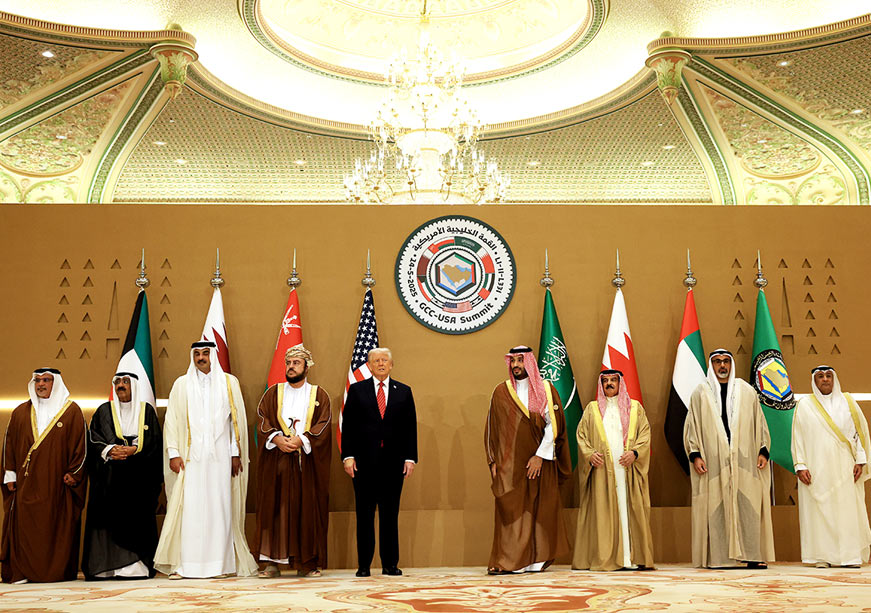
Expert Speak | 15 December, 2025
GCC Joint Defence Integration and the US Factor
As the GCC pursues a joint defence shield, this requires coordination with the US to solidify, but perhaps the Trump administration is not as keen as its Democrat counterparts to become the region’s ‘security integrator’
“The security of the GCC states is indivisible.” This notion of collective security has been repeated by GCC leaders and His Excellency Mr Jasem Mohamed Albudaiwi, Secretary General of the Gulf Cooperation Council (GCC), more than ever in recent months. For example, it was reiterated during the GCC Supreme Council’s 46th session in Bahrain on 3 December 2025, the 22nd session of the Joint Defence Council, held on 25 November 2025, in Kuwait, and notably, in the joint meeting for the strategic partnership between the GCC and the United States (US), held on 24 September 2025 on the sidelines of the 80th session of the United Nations General Assembly (UNGA) in New York.
The repetition of the statement in New York is particularly notable because the GCC is reportedly looking towards establishing a joint defensive shield for its member states in coordination with the US. Albudaiwi stated in December that the initiative, referred to as the ‘Joint Gulf Missile Defence Shield’, still requires resolving “many technical aspects,” and that regular meetings are underway with the US to finalise the defensive shield’s structure and operational mechanisms. It is therefore foreseeable that this could lead to the US participating in the large-scale joint military exercise in the Gulf scheduled for early 2027.
Ongoing coordination with the US exemplifies the constructive role that external agreements with overseas partners can play for the GCC as it seeks deeper defence integration. While this may start with the US (reasons outlined later), there is no reason to dismiss the prospect of other US-anchored partners joining in on defence cooperation with the GCC as a bloc. This indicates that the GCC is being propelled into further joint defence action and integration, replacing some of the momentum for unilateral efforts on this front.
GCC Defence Integration Progress
In 2013, the GCC leaders solidified the strongest move yet towards defence integration. The summit that year in Kuwait endorsed “the formation of a joint military command for the Gulf Cooperation Council states, as well as the establishment of a Gulf academy for strategic and security studies.” This was the most significant development since the 1982 formation of the Peninsula Shield Force and the Joint Defence Agreement at the turn of this century.
To direct the Unified Military Command to take the necessary executive measures to activate joint defence mechanisms and Gulf deterrence capabilities.
The Agreement has now formed the basis of the latest impetus for GCC defence integration, prompted by the Israeli and Iranian attacks on Qatar in 2025. An extraordinary session of the GCC Joint Defence Council, following the Israeli attack in September, convened in Doha “to direct the Unified Military Command to take the necessary executive measures to activate joint defence mechanisms and Gulf deterrence capabilities”. They decided to: increase intelligence exchanges; transmit air situation across all operation centres of the GCC states; accelerate the development of the Early Warning System against Ballistic Missiles; update joint defence plans; and conduct joint exercises. However, a lack of interoperability between the GCC militaries is a major challenge reflected by their consistent procurement of weapons systems with “subtle but significant” differences in hardware and software.
This is where US coordination with the bloc’s defence integration initiatives is necessary. Not only does it reflect the GCC’s own Vision to “strengthen internal capabilities, deepen regional and international partnerships, and support cooperation and coordination mechanisms at regional and international levels”, but it has become a consquence of relying on the US for technical maintenance and the boosting of interoperability of the differing weapons systems of the GCC – by and large imported from the US itself. Indeed, as has been noted, the GCC “needs the US to implement regional integration” because the US provides “the organization, the technology and the training”.
The GCC “needs the US to implement regional integration” because the US provides “the organization, the technology and the training”.
The US Discussions with the GCC
This paradigm shift by the US from the role of “security guarantor” to “security integrator” may have solidified since the 2015 Camp David, which convened between former US President Obama and the GCC leaders. The summit was particularly significant because the agreement to develop a region-wide ballistic missile defence capability received Washington’s support. Not only was this shift a result of discussions at a Gulf leadership level, but in 2015, the US Centre for Naval Analyses released a report following a Track 1.5 forum that brought together officials, scholars, and experts, including those from the Gulf. One outcome of this convening, as per the report, was that participants wanted the US relations with the GCC states to move towards helping them develop their own defence capabilities.
Given that GCC defence integration with the US will focus on knowledge transfer and capacity-building, it aims to achieve the common goal of the GCC states developing their own capabilities. This has been reiterated in the three US-GCC Defence Working Groups held to date, kick-started by the Biden administration in 2022 in the spirit of the 2015 Camp David discussions and continued through to 2024, with none yet since President Trump’s second term began. Indeed, even though Trump’s first term came with high hopes he would continue pushing for the GCC interoperable ballistic missile defence architecture, he has not been as adamant as his Democrat counterparts in pushing this agenda – at least not through public statements or convenings.
When compared to other Arab regional institutions, “the GCC remains the most successful experiment in integration”, that is, “even if its success is incomplete.”
Instead, President Trump’s office terms have seen the Gulf States continue the trend of bilateral security arrangements with the US rather than multilateral ones. In September 2025, he signed an executive order titled “Assuring the Security of the State of Qatar.” This order guarantees that the US will treat any attack on Qatar as a threat to its own national security. It also establishes a framework for joint contingency planning between the two countries. Additionally, in 2019, a Defence Cooperation Agreement was implemented between the US and the United Arab Emirates, following its signing in 2017. President Trump also led efforts to a Strategic Framework Agreement with Oman for the US Navy’s regular access to the Duqm and Salalah ports. While these efforts and the ongoing discussions with Saudi Arabia for another bilateral agreement are commendable, they fall short of multilateral efforts, which may reflect slow progress on this front for the years to come under a Trump administration – contrary to the GCC Secretary General’s stated hopes.
Conclusion
In conclusion, when compared to other Arab regional institutions, “the GCC remains the most successful experiment in integration”, that is, “even if its success is incomplete.” The attacks on Qatar highlighted the shortcomings of previous US administrations in addressing the defence interoperability issues within the Gulf Cooperation Council (GCC). However, US policymakers will face challenges in realising the renewed aspirations of the GCC for a joint defence shield without the support of President Trump, who needs to agree to the US becoming a security integrator.
If the GCC can renew a US push for coordination with the bloc to overcome interoperability challenges while simultaneously cultivating the political will for multilateral action, it may move beyond episodic cooperation toward a durable, collective defence posture. The success of this trajectory will allow the GCC to deepen its integration moving forward, not just with the US, but also with like-minded US partners.
Mahdi Ghuloom is a Junior Fellow at the Observer Research Foundation – Middle East