 Global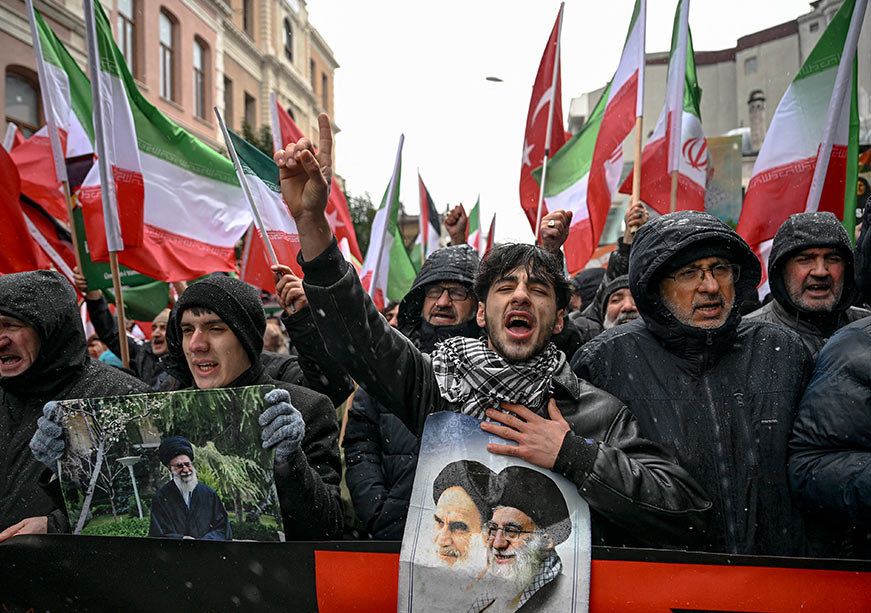
Expert Speak | 24 January, 2026
Iran’s Tryst With Its Future
As public unrest, economic stress, and succession politics collide, Iran’s revolutionary system is entering its most consequential test since 1979
The June 2025 strikes conducted by the United States and Israel against Iran were a pivotal moment in the geopolitics of the Middle East, the undercurrents of which are still reverberating through the region. Recent protests in various parts of the country have brought to the forefront not just the deepening of political crevasses within the state, but the fallout of economic ones as well.
Many analysts, such as Ashkan Hashemipour, accurately trace the ongoing discontent to factors rooted in the 1979 Islamic Revolution, which brought the then-exiled Ayatollah Khomeini back to power as the West-backed monarchy of Shah Reza Pahlavi was deposed. The current theological leader, Ayatollah Khamenei, who has been in power since 1989, now faces an inflection point on both the identity and sustainability of that Revolution-led definition of the state. While the current protests may have been successfully suppressed, for Tehran to proceed with a sense of business as usual may no longer be viable.
The delivery of essential infrastructure — electricity, water, employment, healthcare, and education — remains fundamental to the relationship between power and people. Hence, it was no surprise that while Iran has been on edge for months, the push off the precipice came from two fronts: a water crisis and a currency collapse.
Managing public grievances while maintaining political power within the construct of sanctions — and the associated isolationism that comes with them — is a delicate balance. In November, reports of the Iranian capital, Tehran, running out of water spread rapidly. Iran’s blueprint, economic as well as political, is built around self-sufficiency, largely as a consequence of years under sanctions. However, Iran is also a country of over 90 million people, making sustainability — and the very politics of self-sufficiency — challenging. Political systems, at the end of the day, are not that different from one another when it comes to basic structures, such as cultivating a relationship between the public and the state. The delivery of essential infrastructure — electricity, water, employment, healthcare, and education — remains fundamental to the relationship between power and people. Hence, it was no surprise that while Iran has been on edge for months, the push off the precipice came from two fronts: a water crisis and a currency collapse.
Iran’s internal politics has always been an amalgamation of structures that often circle back to influence zones operating under the tutelage of the Revolution — meaning the complete power of the Ayatollah and the systems he and his predecessor, Khomeini, institutionalised since 1979. This was on display as Iran’s President, Masoud Pezeshkian, found himself between a rock and a hard place. Pezeshkian was elected as the only moderate candidate in the 2024 polls, which were held following the untimely passing of incumbent president Ebrahim Raisi in a helicopter crash the same year. During the protests, Pezeshkian sided with the regime’s narrative that the unrest was fuelled by external interventions by the US and Israel, while simultaneously suggesting that the state must accept that mistakes were made. This exposed the limits of the Republic’s electoral structure, especially given that Iran often highlights itself as the region’s only Islamic state that regularly conducts elections.
For Pezeshkian — and the presidency itself — the balance has always been delicate. Any reform or change that an Iranian president seeks to bring depends on stability rather than chaos in the streets. Bringing together Iran’s multi-layered power centres to negotiate change is no easy task.
For Pezeshkian — and the presidency itself — the balance has always been delicate. Any reform or change that an Iranian president seeks to bring depends on stability rather than chaos in the streets. Bringing together Iran’s multi-layered power centres to negotiate change is no easy task. Pezeshkian, a doctor by profession, was the only moderate vetted by the Ayatollah to contest the elections. It was widely believed that the nominal representation of the moderates, a faction itself fraught with infighting, may amount to tokenism at best, as former nuclear negotiator Saeed Jalili — a conservative favourite — was widely seen as the natural successor to Raisi.
Today, the proverbial ‘moderatism’ itself appears as a severely bruised institution. This was not Pezeshkian’s first tryst with the uniquely translucent powers of his office. Last year, in the aftermath of US and Israeli bombing of Iranian nuclear installations — along with Israel eliminating many of Iran’s top military and intelligence leaders — Iran launched missiles towards the Al Udeid Air Base in Qatar, the largest US military facility in the Middle East. Qatar, which enjoys good relations with Tehran and hosts a communication channel between the US and Iran, became an example of Arab Gulf powers caught in the regional crosshairs of the conflict. The attack on the base crossed a rubicon that Arab capitals have feared for a long time. Pezeshkian then found himself in an awkward posture, delivering a message of “regret” to the Emir of Qatar over Tehran’s missile strike on the US base, an attack carried out by his own state’s military.
Pezeshkian then found himself in an awkward posture, delivering a message of “regret” to the Emir of Qatar over Tehran’s missile strike on the US base, an attack carried out by his own state’s military.
Moving forward, things may not become easier for the Iranian establishment. Well before the current cycle of upheaval, Iran was already going through intense internal debates on the succession of Ayatollah Khamenei, who is now over 86 years old. While many of these deliberations were kept close to the chest by those populating the various circles of power that make up the Iranian system, two names surfaced in public discourse. First, the now-late Ebrahim Raisi, and second, Ayatollah Khamenei’s second-eldest child, Mojtaba Khamenei. The latter possibility has raised concerns of rankling the rank-and-file support of the Revolution, as it would make the transition appear as a hereditary, monarchical handover — something the Revolutionary ideology would not want association with, particularly at a time when pro-monarchists took to the streets following a call by Reza Pahlavi, son of the former Shah of Iran, whom the Ayatollah had replaced.
Amid these calculations, the interests of the Islamic Revolutionary Guard Corps (IRGC) will also have to be factored in. The IRGC, operating exclusively under the Ayatollah’s authority, has proven to be both resilient and loyal to the system that created and nurtured it. Over the past few years, the IRGC has played a critical role in developing mechanisms to circumvent sanctions, enabling traders — a critically important constituency — to continue functioning. With deep interests in Iran’s political economy, the military unit has maintained its role and ensured that no collapse, particularly under its own weight, takes place.
The IRGC, operating exclusively under the Ayatollah’s authority, has proven to be both resilient and loyal to the system that created and nurtured it. Over the past few years, the IRGC has played a critical role in developing mechanisms to circumvent sanctions, enabling traders — a critically important constituency — to continue functioning.
Finally, an emotive push for the collapse of Iran would be deeply chaotic for both regional and international security, at a time when the global order itself has lost its bearings. The post-World War II order, anchored in several Western-led multilateral structures, is disintegrating at a rapid pace. While further strikes against Iran by the US cannot yet be taken off the table, how Iran manages its internal complexities will have a far greater impact on the future trajectory of this conflict than is currently being envisaged.
Kabir Taneja, Executive Director, ORF Middle East.