 Global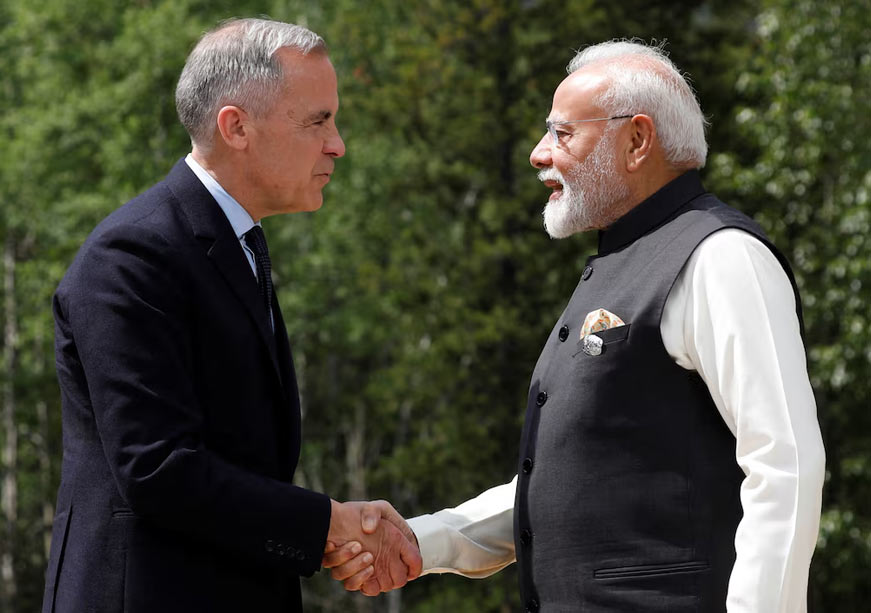
Expert Speak | 02 March, 2026
Energy as the Anchor: Recalibrating India–Canada Relations in a ‘Ruptured’ World Order
Spotlight
- Canadian Prime Minister Mark Carney’s upcoming visit to India is a strategic attempt in fostering cooperation among like-minded middle powers to recalibrate a ‘ruptured’ world order. Diversification of both resources and partners has become essential.
- Energy diplomacy is set to form the bedrock of India-Canada bilateral engagement and the anticipated Comprehensive Economic Partnership Agreement (CEPA).
- Key areas of cooperation could include conventional energy trade; critical minerals for the energy transition; a proposed 10-year C$2.8 billion uranium supply deal; a biofuels partnership; collaboration in food systems and food security; and enhanced Arctic and climate cooperation.
Canadian Prime Minister Mark Carney’s upcoming visit to India is significant. It represents a strategic attempt at fostering cooperation among like-minded middle powers to recalibrate a ‘ruptured’ world order,where the collective weight of coordinated states can balance established hegemonies. Bilateral relations between India and Canada, which were strained during the previous Trudeau administration, now appear to be experiencing renewed momentum under Carney’s leadership. The visit is expected to contribute to progress toward the anticipated Comprehensive Economic Partnership Agreement (CEPA).
Earlier this year, Canadian Minister for Energy and Natural Resources, Tim Hodgson’s visit to India concluded with a Joint Statement issued alongside his Indian counterpart, Hardeep Singh Puri, Minister of Petroleum and Natural Gas, promising deeper energy cooperation across both conventional and clean energy. They also agreed to relaunch the Canada–India Ministerial Energy Dialogue signaling that energy diplomacy will form the bedrock of bilateral engagement.
In an era characterized by rising maritime insecurity, strained energy chokepoints, and the growing politicization of energy security; diversification of both resources and partners has become essential. Consequently, it is reasonable to anticipate that energy will serve as the anchor of the India-Canada partnership.
Natural Allies: India’s Growing Energy Demands Meets Canada’s Diversification Imperative
Canada is widely recognized as resource-rich. It possesses the fourth largest reserves of oil and substantial reserves of uranium and critical minerals crucial for the energy transition,including Saskatchewan’s potash reserves, Ontario’s nickel Deposits, Quebec’s graphite resources, and rare earth deposits across multiple provinces. Yet nearly 98 per cent of Canada’s energy exports remain concentrated in the United States (US). Minister Tim Hodgson has described this over-reliance as a “strategic blunder”, emphasizing the importance of diversifying partnerships to mitigate risks associated with the potential weaponization of supply chains.
On the other hand, India pursued a series of trade agreements with many advanced economies including the European Union, United States, the United Kingdom, New Zealand, Australia and the United Arab Emirates (UAE) signal its rising stature as a trading partner driven by a growing market size and a favourable demographic profile. As the third-largest consumer of oil and Liquefied Petroleum Gas (LPG), fourth-largest importer of Liquefied Natural Gas (LNG) and home to the fourth-largest refining capacity in the world, India is projected to account for over one-third of the growth in global energy demand over the next two decades.
However, India’s import of discounted Russian crude oil exposes it to potential US tariff pressures, while its heavy dependence on Chinese supplies for critical minerals and energy inputs increases strategic vulnerabilities. Diversification, therefore, is not solely an economic imperative, but increasingly a matter of national energy security for both the countries. The completion of the Trans Mountain Expansion (TMX) pipeline is a significant development in this context, enhancing prospects for stronger connectivity between Canada and India.
Strategic Pillars of Energy Cooperation
India today stands as Canada’s seventh-largest goods and services trading partner. However, bilateral energy trade has been limited, mostly concentrated on India’s import of bituminous coal. Prime Minister Modi has announced a target of tripling bilateral trade by 2030, amounting to US$ 50 billion – a goal that energy cooperation could significantly advance.
Firstly, Conventional Energy: Trade in Canadian crude oil, LPG and LNG, along with India’s supply of refined petroleum products, is likely to be prioritized and strengthened.
Secondly, Critical Minerals: Currently, India accounts for only 1per cent of Canada’s critical minerals exports. Both the countries should explore potential pathways for investing in extraction of critical minerals like lithium, cobalt, and rare earth elements. These are essential for manufacturing electric vehicle batteries, wind turbines, solar panels and defense equipment–sectors central to India’s industrial ambitions and Canada’s export strategy. India could further position itself as the downstream processing and value addition hub for these critical minerals, integrating the Canadian raw material supply chain with India’s growing manufacturing ecosystem. This aligns well with India’s National Critical Mineral Mission which seeks to boost supplies from domestic and foreign sources, and build global competitiveness in mineral exploration, mining, beneficiation, processing, and recycling.
Thirdly, Nuclear: a 10-year C$2.8 billion uranium supply deal is reportedly under consideration and could emerge as one of the key outcomes of the Carney-Modi meeting. Canada is also a leader in Small Modular Reactor(SMR) development among G7 countries. India’s SHANTI Act, introduced in 2025, encourages private- sector participation in India’s nuclear development and may facilitate Canadian investment in the sector. Nuclear energy is expected to play an important role in securing India’s future energy demands, particularly in relation to expanding data center aspirations.
Fourthly, Biofuels: Canada relies heavily on the US for its biofuel imports. As the third-largest producer of biofuels, India can offer competitively priced sustainable fuel to Canada.
Fifthly, Food Systems: India imports nearly 25 per cent of its Muriate of Potash (MOP) from Canada. Deepening collaboration on organic fertilizers, food processing and storage, and agricultural waste into energy technologies will strengthen food security.And lastly, Arctic and Climate Cooperation: Almost 40 per cent of Canada’s landmass is considered Arctic. The region is emerging as a crucial hub for energy and climate governance. Cooperation on sustainable mining practices and technologies, and joint climate change research could further broaden engagement beyond traditional trade.
Securing the CEPA Dividend
A CEPA agreement between India and Canada is expected to increase trade by C$8.8 billion annually. While the India-EU Free Trade Agreement (FTA) took over two decades to materialize, the India-UAE CEPA came into force in under 90 days, setting a precedent for speed and decisive action. The tenacity and depth of India-Canada relations will depend on political willingness, regulatory clarity, and a shared commitment to advancing areas of strategic convergence —particularly in energy.
Mannat Jaspal, Director and Fellow, Climate and Energy, ORF Middle East.