 Global
Expert Speak | 18 March, 2026
The US-Israel-Iran Conflict Spillover Effects on Food and Water Security in the Arabian Gulf
Spotlight
- Immediate regional food supply chain shocks have been partially mitigated. Despite initial disruptions in food trade, the GCC states and Iraq maintain strategic food reserves. Iran have prohibited food exports to safeguard domestic supply.
- Attacks on water infrastructure exposes the fragility of large-scale projects. Destruction of facilities places communities without water storage reserves and desalination-dependent economies at high risk.
- Regional cooperation and trade diversification will be crucial. Adapting to both trade shocks and kinetic attacks will require transboundary cooperation, the creation of alternative trade corridors, and investment in resource storage and diversification.
As the United States(US)-Israel-Iran conflict escalates, new targets and stress points have emerged. Recent attacks on freshwater desalination plants in Qeshm Island in southern Iran and Bahrain highlight the vulnerability of critical infrastructure. For a region confronting severe water constraints, these plants symbolise a crucial lifeline, converting seawater to potable water for domestic and industrial consumption. Among the Gulf Cooperation Council (GCC) countries, desalination produces 42 to 90 percent of total drinking water supply.
These attacks follow air space closures, deliberate targeting of logistics infrastructure, and the paralysis of maritime chokepoints such as the Strait of Hormuz which facilitates 70 percent of the GCC’s food imports. The effects of food trade are materialising rapidly due to rising fuel prices and route closures. Australia has halted livestock shipments to the region, Indonesian shipping to the United Arab Emirates (UAE) has been suspended via Oman, rice shipments bound for the GCC remain stranded in India, and Iran has imposed a temporary ban on food exports.
The Arabian Gulf states, encompassing the GCC, Iraq, and Iran, face prospects of destabilised food and water security, with potentially cascading global repercussions. While strategies exist to mitigate immediate regional food supply chain shocks, a prolonged conflict is bound to disrupt supply chains, aggravating food inflation and insecurity. Moreover, the strategic impairment of critical water infrastructure largely threatens economies and livelihoods across the Arabian Gulf, unveiling the shortcomings of a technology-dependent response to water scarcity.
Impacts on Arabian Gulf Food Security
Despite immediate impacts, much of the region expresses confidence in its capacity to sustain domestic food supply, drawing on contingency strategies developed during prior shocks such as the COVID-19 pandemic. For example, the UAE’s Strategic Food Security Law adopted in March 2020 mandates that private sector companies maintain strategic stockpiles of essential food commodities. In Iraq, the Public Distribution System (PDS)—a universal ration program providing staple foods to nearly all households— function as a key shock absorber during periods of market volatility. Consequently, governments across the region have reported that food reserves are sufficient for several months and have repeatedly urged consumers to avoid stockpiling while reassuring fully stocked shelves at supermarkets. Seasonal harvest cycles could also provide limited near-term relief, as the conflict coincides with local farmers’ fruit and vegetable harvests, which may partially offset delays to imports of perishables.
However, strategic stockpiles may only provide temporary relief, since storage capacities are constrained by the region’s environmental realities. Cold storage infrastructure is critical for maintaining food availability during supply interruptions and determines the duration for which produce and meat can be preserved amid shipping delays. Nevertheless, the region’s harsh climate makes large-scale refrigerated storage costly and resource-intensive to sustain over extended periods. In Iraq, these pressures may be compounded by underlying constraints including drought conditions that have already reduced harvest yields, alongside longstanding inefficiencies in the Public Distribution System (PDS), particularly if the conflict results in displacement or fiscal strain.
Alternative trade routes help some countries circumvent the Strait of Hormuz, but the volume of diverted trade is placing significant strain these corridors. The UAE has rerouted vessels to ports such as Khorfakkan and Fujairah, while Saudi Arabia has redirected ships toward Red Sea ports. Some retailers have begun chartering cargo flights to secure fruits and vegetables supplies. By contrast, Qatar, Kuwait, Bahrain, and Iraq have limited direct maritime alternatives and rely heavily on overland routes through Saudi Arabia, or through Turkey in Iraq’s case, where reported truck delays heighten exposure to transport bottlenecks. Despite alternative routes, targeted infrastructure damage, such as the recent Fujairah port fire and Houthi attacks, demonstrates that vulnerabilities also extend to fallback corridors.
Gulf Alternative Routes for Food Imports
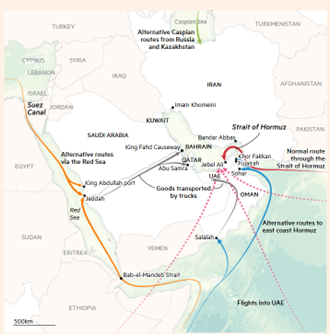
Source – Financial Times
Iran, on the other hand, faces a double-edged dynamic in which its blockade of the Strait of Hormuz provides leverage in the conflict, but a prolonged disruption risks intensifying domestic food insecurity. . Iran relies heavily on grain imports through the Strait and lacks viable alternative trade corridors.. The country already experiences mounting food security pressures from ongoing infrastructure vulnerabilities, civilian threats, sanctions, and elevated food prices. In effect, authorities are safeguarding short-term food demand by banning food exports, and leveraging its April cereal harvest and Russian wheat imports via the northern Caspian sea. However, Iran’s population and food demand substantially exceed domestic supply, creating risks of long-term food inflation and shortages.
While existing measures allow the region to manage short-term shocks, sustained trade disruptions pose significant risks of ripple effects across the global food system. To illustrate, the Gulf states are as dependent on global food producers as those producers are on Gulf-produced fertiliser. GCC economies import food staples from a concentrated group of suppliers, including Brazil, Australia, and India. Brazil, a major poultry exporter, is rerouting its shipments to the Middle East through the Cape of Good Hope, increasing fuel costs and transit time. On the other end, Brazil, India, and Australia import fertiliser from the Arabian Gulf. If trade disruptions seep into the harvest season, rising production costs in supplier nations are likely to elevate food prices for the Gulf. Although GCC states have the financial capacity to secure alternative imports, the scale and efficiency of the Strait of Hormuz remain difficult to replicate, meaning that prolonged interruptions would significantly constrain regional food supply chains.
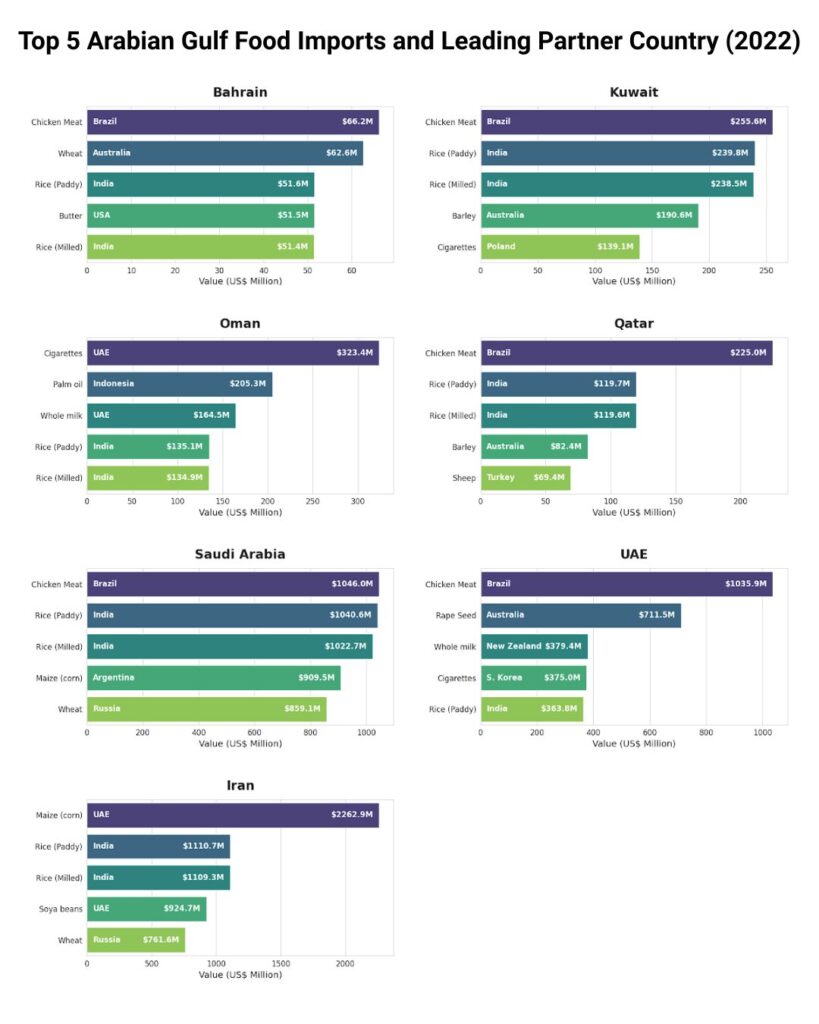
Source: FAO Stat 2022, Data Visualization through Google Gemini
What the Weaponisation of Water Infrastructure Reveals
Although food can be rerouted, inflicting damage on water infrastructure risks plunging the region further into deeper instability, with a prohibitively long recovery timeline, especially for countries lacking water reserves. Desalination facilities are large, fixed structures, operating on strict schedules where slight disruptions can rapidly interfere with water distribution and civilian life. The GCC states account for 60 percent of global desalination capacity, representing the largest regional cluster. Smaller and concentrated geographies such as Kuwait, Bahrain, and Oman are considerably more vulnerable to shocks since they currently acquire nearly 90 percent of drinking water from desalination, lack access to strategic reserves, and rank among the top five most water-stressed nations. Conversely, the UAE’s 45-day strategic water reserve developed from its Water Security Strategy 2036, reduces its immediate vulnerabilities. Attacks on critical water infrastructure have previously decimated Kuwait’s desalination capacity during the 1990-1991 Gulf War, leaving the country fully dependent on water imports and taking years to fully recover.
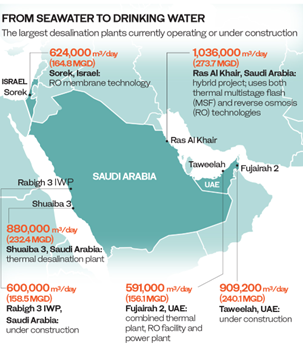
Source: Arab News
Similarly, potential attacks on Iran’s hydro dams, aqueducts, or pumping stations could trigger a larger humanitarian crisis. Closely preceding the war, a combination of water stress, energy deficits, global sanctions, mounting security risks, and systemic mismanagement had already impeded water service delivery in Iran, contributing to public discontent and nationwide protests. Any deliberate destruction of water infrastructure in Iran could severely compromise long-term prospects of stability, leading to regional spillovers and heightened cross-border tensions in the short-term.
Recent infrastructure attacks reveal the structural limitations of prioritising engineered supply-side solutions over preemptive, adaptive, and cooperative frameworks. For GCC states, pursuing fragmented nation-led and desalination-dependent water strategies has long operated on the contingency of a stable geopolitical landscape—a notion Iran is actively seeking to displace. While the ongoing clustering of desalination systems with industrial zones and national energy reforms helps drive efficiency and reduce costs, it also widens exposure to systemic collapse from kinetic attacks. Likewise, the increasing digitalisation of water management heightens vulnerabilities to cyberwarfare which can reroute water supply and impair distribution. Thus, preventative measures such as the diversification of water sources through enhanced national storage capacities, preventing water loss, embedding cybersecurity into water management, and building transboundary water agreements are increasingly more urgent. For Iran, infrastructure damage reflects the erosion of an entrenched political economy that once thrived on costly megaprojects like dams and water transfers.
Regional Cooperation and Diversification of Trade and Resources Defines the Way Forward
The US-Israel-Iran conflict exposes the fragility of the Arabian Gulf’s concentrated food trade routes and water management infrastructure to geopolitical shocks, underscoring a need for systemic reform. Managing future food shocks will require greater regional integration and diversification of trade networks. Iraq, in particular, remains heavily dependent on imports from Turkey and Iran. With Iran at the center of the conflict, expanding trade relationships across the broader Gulf to reduce risk is paramount. Investments in cross-border infrastructure will be critical. Projects such as the proposed GCC railway network and the recently announced Saudi Logistics Corridors Initiative, could function as strategic food corridors, enabling faster overland transport of essential commodities during maritime disruptions. Concurrently, governments should continue prioritising food security within national agendas, emphasising end-to-end resilience, from diversified imports and storage capacity to distribution networks and agricultural innovation.
The region is collectively approaching a point of “water bankruptcy”, in which water restoration may no longer be viable and management strategies must adapt to new geopolitical realities. With the UAE co-hosting the United Nations Water Conference in December 2026, assuring the resilience of water systems is vital to sustain reputational status, economic growth, and societal welfare. As water infrastructure emerges as a military target, prioritising water in the national security agenda may help expedite the development of water storage reserves. The shared impact of attacks across the Gulf may also reignite engagement in transboundary water management and cooperation, an approach that has historically faltered due to intra-regional tensions. Furthermore, infrastructure vulnerabilities emphasise the importance of balancing supply-side strategies with adaptive and less flashy approaches like groundwater monitoring and leakage control and diversifying sources by encouraging the development of smaller-scale circular wastewater reuse systems.
Leigh Mante is a Junior Fellow for Energy and Climate Change Programme at ORF Middle East
Reem Sagahyroon is a Research Assistant for the Energy and Climate Change Programme at ORF Middle East