 Global
Expert Speak | 23 April, 2026
Nuclear Science and Technology for Food and Water Security in MENA
This article is the part of “Policy Pathways for Food and Water Security in the MENA Region”
The Middle East and North Africa (MENA) region faces problems of water scarcity, limited arable land, and soil degradation which is exacerbated by climate change, threatening water and food security. As the region experiences rapid population growth,[1] states must contend with increasing demand for water, energy, and food (WEF),[2] which are all inextricably linked. To adapt, the region is striving to improve climate-smart agricultural practices,[3] reduce waste, and increase resilience.
This article argues that the use of nuclear science and technologies can offer viable and sustainable pathways for mitigating these challenges. It maps past and prospective applications of these technologies for food and water security in MENA, while evaluating both feasibility and barriers to implementation and scaling.
The following paragraphs outline the potential applications of nuclear science on various development domains in the MENA region.
Strengthening Climate-Smart Agriculture
The MENA region faces the challenge of land degradation from soil erosion as well as worsening soil quality due to sea level rise-driven salinisation,[4] increasing temperatures, and use of recycled wastewater,[5] negatively affecting crop yields. Nuclear techniques help assess and mitigate soil erosion.[6] Leveraging neutron probing sensors can help measure soil moisture levels to determine optimal irrigation application for soil remediation and crop growth.a,[7] This is useful for saline soil conditions in MENA, where conventional moisture sensing equipment is insufficient. To illustrate, isotopic techniques have supported the cultivation of high production volumes of millet in Lebanon, barley and safflower in Jordan, and quinoa in the United Arab Emirates, materialising through a technical Food and Agriculture Organization- International Atomic Energy Agency (FAO-IAEA) cooperation programme.[8]
Enabling Safe Food Storage
Improving food storage capacities across the value chain is crucial for mitigating food loss and waste in the MENA region. Food irradiation techniques[9] are gentle and non-invasive practices that eliminate microbes by exposing food to radiations like gamma or X-rays, while preserving nutritional value and quality.[10] Contrary to misconceptions, irradiation techniques do not turn food radioactive. Food irradiation yields health and food safety advantages, eliminating microbial contamination and lowering food-borne disease risk, and is considered more effective compared to heat and chemical methods.[11] Moreover, it supplements other shelf-life extension methods.
Food irradiation adoption in MENA is currently in early-stages,[12] with Egypt leading in applications for meat preservation and phytosanitary compliance. Demand for shelf-stable food and vegetable imports in the UAE and Saudi Arabia has contributed to investment in new irradiation infrastructure facilities since 2022. Irradiation solutions are more widespread in North America and Europe, which have developed legal frameworks to reiterate its safety. A 2025 study by Maataoui et al. comparing global acceptance of irradiated food found that MENA countries are more cautious about the viability of irradiated food, demonstrating the need for public information campaigns to increase public acceptance and implementation feasibility in MENA.[13] Increasing food shelf-life can also be valuable for food security considerations in remote MENA locations as well as in conflict zones that need humanitarian supplies.[14]
Enhancing Water Access and Efficiency
While the value proposition of nuclear technologies to food production is explained by its unique scientific ability to increase crop yields and food shelf-life, it is necessary to highlight the underlying logic of using nuclear energy per se for water desalination, for instance, in a region known for its oil and gas wealth.
Conventional desalination relies on non-renewables like oil and gas which produce significant emissions, despite being reliable. Although many countries in the region have substantial hydrocarbon resources, not all of MENA can count on such fossil fuel abundance. Many countries in the region have suffered fiscal strains due in no small part to rather large energy import bills. For instance, the freeing up of oil and gas resources in places like Egypt, where it is being used for water desalination, would make fiscal sense given high import bills for these hydrocarbons.
On the other hand, the energy-exporting MENA countries must contend with the opportunity cost of the consumption of every barrel of oil domestically—meaning one forex-earning barrel of oil less on the international market. This has cost-implications for many of these countries working towards economic diversification and investment of their hydrocarbon earnings into new sectors such as AI or manufacturing.
Further, there are gradual changes in the revenue buffers from MENA’s fossil fuels exports. This downward pressure on revenue streams could reasonably be mitigated to some degree by integrating nuclear energy into the energy portfolio wherever feasible, after duly considering both costs and risks associated with the type. Studies which focused on Tunisia and Algeria compared the use of oil and gas with nuclear for electric power generation and water production, and have effectively demonstrated substantial savings from the latter.[15]
Nuclear energy, with its higher energy density, offers the best baseload alternative to hydrocarbons.[16] Nuclear-powered desalination leverages reactor-generated heat and electricity to split salt from seawater, providing a three-fold advantage of reduced emissions, a stable water source, and low-costs. The integration of nuclear technology into the MENA’s water security portfolios has been led by the International Atomic Energy Agency’s (IAEA) sharing of toolkits like the Desalination Economic Evaluation Program (DEEP) and the Desalination Thermodynamic Optimisation Program (De-TOP).[17] Egypt, Jordan, the UAE, Saudi Arabia, Kuwait, and Tunisia have all invested under these guidelines in desalination and isotopetracing. b,[18]
SMR-Powered desalination is under consideration in Saudi Arabia, Egypt, and Kuwait,[19] while the IAEA has evaluated studies on using SMRs to convert Red Sea water into drinking water in Jordan. In countries like the UAE which has established a nuclear plant and where desalination is predominantly fuelled by natural gas, coupling desalination plants with future nuclear SMRs is projected to yield feasible[20] and cost-competitive outcomes.[21] Future nuclear and desalination plants can be combined to produce water as the only outcome or yield both electricity and pure water through a co-generation system.[22] This combination, including techniques such as Reverse-Osmosis, Multi-Stage Flash distillation and Multiple Effect Distillation, will have comparably favourable savings in both cost and emissions.c,[23],[24],[25]
Table 1. Feasibility, Added-Value, and Challenges of Nuclear Science and Technology Applications in MENA
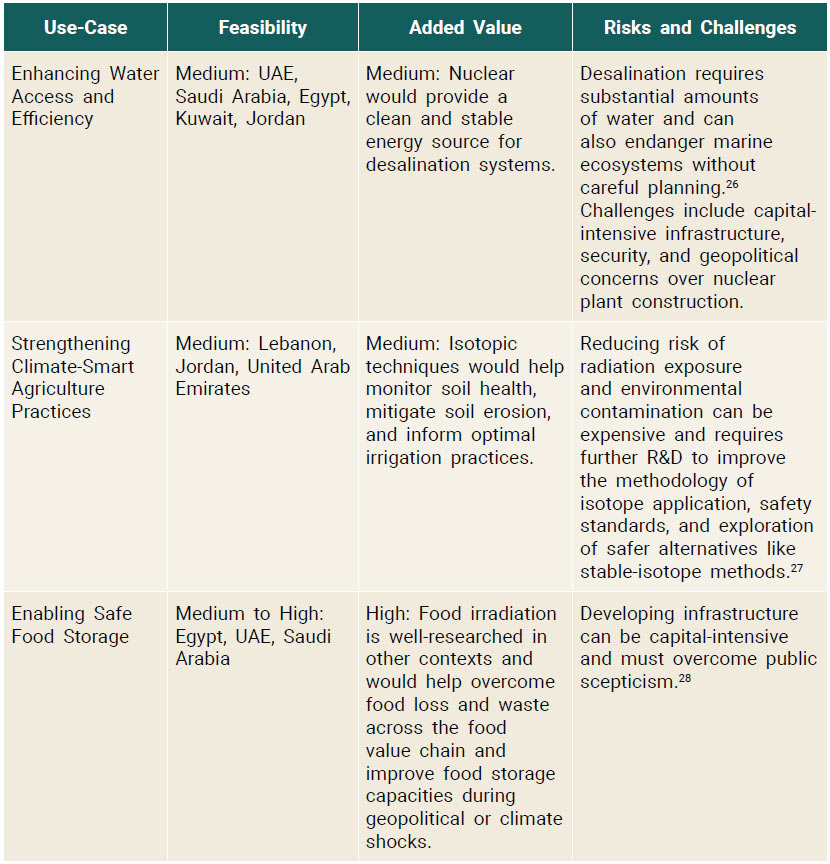
Source: Authors’ own, using Neupane et al.[29] and Ihsanullah et al.[30]
Challenges to Nuclear Uptake
Environmental
Without integrated planning,[31]1 the deployment of nuclear energy may inadvertently threaten domestic food and water supply by consuming vast amounts of freshwater resources to cool systems, and thereby competing with other water-intensive sectors. To illustrate,[32] oncethrough cooling systems withdraw very high volumes of water, recirculating cooling systems cause high water loss from evaporation, and dry cooling systems raise air temperatures. While coastal nuclear plants can leverage desalinated water for cooling, desalination brine discharge can imperil marine ecosystems. Transitioning to water-efficient designs is still in nascent stages.
Moreover, routine emissions can pose adverse ecological risks for soil,[33]3 groundwater, and marine ecosystems. Nuclear plants situated near shallow aquifers risk potable water contamination, damages the coastal saline agriculture and endangers marine ecosystems. In arid soil, radioactive isotopes can permeate quickly, leading to increased plant uptake.[34] In the long-term, released radionuclides can disrupt ecological food chains, erode genetic diversity, and transport to human food. Although the risk of radioactive waste is substantially mitigated, radionuclides can be released under rare and extreme conditions. Advancements in geospatial technologies and molecular biology techniques can help mitigate these impacts but increasing research on safer alternatives like stable isotopes are also crucial.d,[35]
Regional
The presence of nuclear installations, regardless of their form or scale, increases the securityrisk profile of any region, and these must be factored into any considerations regarding the adoption or deployment of the form. Although nuclear-based science inputs for agriculture have marginal exposure to risks of kinetic attacks and damage, the susceptibility of nuclear energy powered desalination plants to similar threats can be considerable. It would be worthwhile to consider the security umbrellas and supervision bandwidths of each country when assessing technology deployment. Furthermore, the level of skills and expertise needed for adoption and implementation of these technologies are substantial, and the region must strengthen its local talent pool.
Financing
Although governments have signalled interest in leveraging nuclear energy, there remains a lack of infrastructure, funding, and regional coordination to fully capitalise on its potential. Adopting nuclear energy comes with prohibitively high-capex requirements, and governments may be drawn to more cost-effective options.[36] Nuclear energy and its value as a strategic commodity further entrench the centrality of governmental role in adopting this energy form in MENA. The fuel supply chains intrinsic to the entire value chain of nuclear energy’s use further ensures that governments would have a more direct participation in the field rather than private players. As such, financing remains a governmental prerogative in the region that could benefit from enhanced cross-border coordination. Notably, the World Bank’s decision[37] to reverse its decades long moratorium on financing nuclear energy projects in early 2025, when coupled with the organisation’s commitments towards food security as part of its larger human security agenda, could prove to be a valuable harbinger of change for the MENA region.
Conclusion
Advancing beyond feasibility assessments for nuclear techniques requires coordination between academics, technical experts, and policymakers to assess long-term environmental implications, prepare site-specific precautionary and remediation strategies. Notably, initiatives like Atoms4Food[38] and the FAO/IAEA’s Centre for Nuclear Techniques for Food and Agriculture[39] coordinate applied research and capacity building and help secure private financing sources.[40]
Thus, establishing regulatory frameworks that cut across the heterogeneity of MENA’s constituent national abilities would help create a safe and conducive environment for nuclear deployment for desalination. This can be achieved by creating a regional regulatory and supervisory body to mandate and track adherence to non-proliferation standards.[41] The UAE has, for instance, set a benchmark through a provision to allow inspections of its nuclear facilities at short notice. The body can also mandate integration of mitigation techniques for all future desalination infrastructure and develop a robust data-sharing system to measure water levels and desalination discharge. Such efforts will enable a policy-environment of sharing technical know-how and best-practices, and facilitate trusted adoptions.
Leigh Mante is unior Fellow, Climate and Energy, ORF Middle East, UAE.
Cauvery Ganapathy is Fellow, Climate and Energy, ORF Middle East, UAE.
Endnotes
[1] United Nations Economic and Social Commission for Western Asia, “Economic and Social Commission for Western Asia Policy Briefs on Food Security Issues in the Arab Region Food SECURITY: Policy Briefs on Food Security Issues in the Arab Region,” UNESCWA, https://www.unescwa.org/sites/default/files/pubs/ pdf/food-security-issues-arab-region-english_0.pdf.
[2] Jagerskog et al., “The Water-Energy-Food Nexus in the Middle East and North Africa: Scenarios for a Sustainable Future,” Open Knowledge Repository, https://openknowledge.worldbank.org/entities/ publication/11ca3b25-d3ab-5c72-829c-9428fd898164.
[3] United Nations Economic and Social Commission for Western Asia, “Policy Briefs on Food Security Issues in the Arab Region.”
[4] Maha Deeb et al., “The Urgency of Building Soils for Middle Eastern and North African Countries: Economic, Environmental, and Health Solutions,” Science of the Total Environment 917, 2024: 170529, https://doi. org/10.1016/j.scitotenv.2024.170529.
[5] Deeb et al., “The Urgency of Building Soils for Middle Eastern and North African Countries.”
[6] “Nuclear Techniques to Enhance Nutritional Content in Plants and Protect Soil Health,” Foro Nuclear, November 14, 2024, https://www.foronuclear.org/en/updates/in-depth/nuclear-techniques-to-enhancenutritional- content-in-plants-and-protect-soil-health/.
[7] “Neutron Probe,” Soil Sensor, https://soilsensor.com/articles/neutron-probe/.
[8] Elodie Broussard, “Nuclear Techniques Support Crop Production on Salt-affected Soils in Middle East,” IAEA Office of Public Information and Communication, September 19, 2025, https://www.iaea.org/newscenter/ news/nuclear-techniques-support-crop-production-on-salt-affected-soils-in-middle-east.
[9] International Atomic Energy Agency, “What Is Food Irradiation and Why Is It Important?,” IAEA, July 15, 2025, https://www.iaea.org/newscenter/news/what-is-food-irradiation-and-why-is-it-important.
[10] “How Food Irradiation Works,” CDC Radiation and Your Health, February 27, 2024, https://www.cdc.gov/ radiation-health/food-irradiation/index.html.
[11] International Atomic Energy Agency, “What Is Food Irradiation and Why Is It Important?”
[12] “Food Irradiation Market Size ($408 Million) 2030,” Strategic Market Research, November, 2025, https:// www.strategicmarketresearch.com/market-report/food-irradiation-market#:~:text=Adoption%20is%20 still%20in%20its,stage%2C%20security%2Dfocused%20adoption.
[13] Jaber Maataoui et al., “Global Perceptions and Acceptance of Irradiated Food: A Comparative Systematic Review,” Italian Journal of Food Safety 14, no. 2 (May 2025), https://doi.org/10.4081/ijfs.2025.12885.
[14] International Atomic Energy Agency, “What Is Food Irradiation and Why Is It Important?”
[15] World Nuclear Association, “Desalination,” May 2, 2024, https://world-nuclear.org/information-library/nonpower- nuclear-applications/industry/nuclear-desalination.
[16] “The Urgency for Water Desalination,” ACWA Power Newsroom, https://acwapower.com/en/newsroom/ press-releases/market-insight/the-urgency-for-water-desalination/.
[17] “Nuclear Desalination,” IAEA, https://www.iaea.org/topics/non-electric-applications/nuclear-desalination.
[18] “Monitoring Soil-Water-Nutrient Interaction Using Isotope and Nuclear Techniques,” IAEA, October 2018, https://www.iaea.org/sites/default/files/18/10/monitoring-soil-nutrient-interaction-using-isotope-andnuclear- techniques.pdf.
[19] International Atomic Energy Agency, “Nuclear Desalination: A Sustainable Solution for Water Security in the Arab Region,” IAEA, September 17, 2025, https://www.iaea.org/newscenter/news/nuclear-desalinationa- sustainable-solution-for-water-security-in-the-arab-region#:~:text=Unlike%20conventional%20 desalination%2C%20nuclear%20desalination,stable%2C%20long%20term%20water%20source.
[20] Mussie Naizghi et al., “Nuclear Desalination and Its Viability for the UAE,” 2011, https://doi.org/10.13140/2.1.5146.3044.
[21] Muhammad Zubair and M. S. Sajna, “Techno-Economic Analysis of SMR Integration into UAE’s Existing Desalination Infrastructure,” Annals of Nuclear Energy 227, pt. B (2026): 111989, https://doi.org/10.1016/j. anucene.2025.111989.
[22] Mussie Naizghi et al., “Nuclear Desalination and Its Viability for the UAE.”
[23] World Nuclear Association, “Desalination.”
[24] “Multi-Stage Flash,” Science Direct, https://www.sciencedirect.com/topics/engineering/multi-stage-flash.
[25] “Multiple-Effect Desalination,” Science Direct, https://www.sciencedirect.com/topics/engineering/multipleeffect- distillation.
[26] Sustainability Directory, “How Does Nuclear Energy Affect Water Resources?,” December 6, 2025, https:// energy.sustainability-directory.com/question/how-does-nuclear-energy-affect-water-resources/.
[27] Basanta Neupane et al., “Advancement in Agriculture through Radioisotopes: Current Context, Challenges, and Future Directions,” Journal of Agriculture and Food Research 21 Part B, 2025, https://doi.org/10.1016/j. jafr.2025.101966.
[28] Ihsanullah and Rashid, “Current Activities in Food Irradiation as a Sanitary and Phytosanitary Treatment.”
[29] Neupane et al., “Advancement in Agriculture Through Radioisotopes: Current Context, Challenges, and Future Directions.”
[30] Ihsanullah and Rashid, “Current Activities in Food Irradiation as a Sanitary and Phytosanitary Treatment.”
[31] Sustainability Directory, “How Does Nuclear Energy Affect Water Resources?”
[32] Sustainability Directory, “How Does Nuclear Energy Affect Water Resources?”
[33] Jan Mihalik et al., “Challenges in Radioecology Following the New Trends in UAE’s Agriculture and Environmental Changes: A Review,” Environmental Science and Pollution Research 31, no.49 (September 30, 2024): 58779–94, https://doi.org/10.1007/s11356-024-35139-z.
[34] Hang Yang et al., “Unravelling the Nuclear Isotope Tapestry: Applications, Challenges, and Future Horizons in a Dynamic Landscape,” Eco-Environment & Health 3, no. 2 (2024): 208–226, https://doi.org/10.1016/j. eehl.2024.01.001.
[35] International Atomic Energy Agency, “Stable Isotopes,” https://www.iaea.org/topics/nuclear-science/ isotopes/stable-isotopes.
[36] International Atomic Energy Agency, “Funding and Finance,” https://www.iaea.org/topics/funding-andfinance#:~: text=The%20IAEA%20also%20publishes%20financial,construction%20to%20adding%20 additional%20units.
[37] World Nuclear Association, “World Bank Shifts Policy to Fund Nuclear Energy Projects,” https://world-nuclear.org/news-and-media/press-statements/world-bank-shifts-policy-to-fund-nuclearenergy- projects.
[38] International Atomic Energy Agency, “Atoms4Food,” https://www.iaea.org/services/key-programmes/ atoms4food.
[39] Food and Agriculture Organization of the United Nations and International Atomic Energy Agency, “Joint FAO/IAEA Centre of Nuclear Techniques in Food and Agriculture,” https://www.fao.org/agriculture/fao-iaeanuclear- techniques/en.
[40] International Atomic Energy Agency et al., “Atoms4Food: Transforming Agrifood Systems With Nuclear and Isotopic Techniques,” 2023, https://www.iaea.org/sites/default/files/atoms4food-growing-food-security.pdf.
[41] Yang et al., “Unravelling the Nuclear Isotope Tapestry: Applications, Challenges, and Future Horizons in a Dynamic Landscape,” 208–226.