 Global
Expert Speak | 05 May, 2026
A Switch, Not a Signal: Interpreting Iran’s 18-Hour Strait Opening
Spotlight
- Iran’s brief reopening of the Strait of Hormuz on a Friday evening was timed to exploit global shipping’s dependence on business hours, ensuring no real movement could occur.
- Structural obstacles—chaotic signals, complex approval chains, and risk-averse insurers—meant even a genuine reopening would not have enabled transit before Monday.
- Iran’s three-stage plan underscores the Strait as its key bargaining chip; broad negotiations will prolong costs, while targeted talks on the waterway could deliver faster relief.
More than two months into the Middle East crisis pitting the United States (US) and Israel against Iran, the situation has settled — uneasily — into a ceasefire now in its fourth week. A durable solution, however, remains elusive. Both sides are locked in rival naval blockades: on April 13, Washington announced it would intercept vessels travelling to or from Iran’s coast. Tehran calls it piracy. Iran’s top negotiator, Mohammad Bagher Ghalibaf, has stated unequivocally that reopening the Strait is “not possible” so long as the US blockade remains in place.
The costs are mounting. The Strait’s closure has delivered a supply shock across commodity markets, with Brent crude hitting a four-year high and tightening supplies of ammonia, sulphur, and helium rippling through global industry. UN Secretary-General António Guterres has called for the Strait to reopen to “let the global economy breathe.” The spectre of stagflation looms.
The timing was no accident. Iran acted on a Friday evening with full knowledge that global shipping — its insurance markets, its war risk premium negotiations, its multi-stakeholder decision chains — runs on business hours.
Against this backdrop, Iran appeared to offer a respite. On the evening of Friday, 17 April, Foreign Minister Abbas Araghchi declared the Strait completely open to commercial vessels for the duration of the Lebanon ceasefire. This led to a fall in oil prices and the rallying of stock markets. However, by Saturday morning, it was over — the Islamic Revolutionary Guard Corps (IRGC) reimposed control, citing Washington’s refusal to lift its blockade. The Strait had been “open” for roughly eighteen hours.
The timing was no accident. Iran acted on a Friday evening with full knowledge that global shipping — its insurance markets, its war risk premium negotiations, its multi-stakeholder decision chains — runs on business hours. Nothing of substance was ever going to move before Monday. The gesture cost Iran nothing. The leverage, however, was everything.
A Deliberate Geopolitical Decision
Iran’s brief reopening of the Strait was not a gesture of goodwill. It was a calibrated move, shaped by a precise understanding of how global shipping functions — and where its pressure points lie.
Consider the response of the industry’s own giants. Maersk, the world’s largest container operator, said only that it had “noted the announcement” — diplomatic language for institutional paralysis. Any change to its policy of avoiding the Strait, it added, would require fresh risk assessments of the security situation. Hapag-Lloyd, absorbing additional costs of an estimated US$40 to US$50 million per week, called the announcement “good news” before immediately itemising its unresolved conditions: insurance coverage, unambiguous Iranian military orders on the exact sea corridor, and a defined sequence for vessel departures. These were not administrative details. They were the structural prerequisites without which no responsible operator could commit a vessel and its crew.
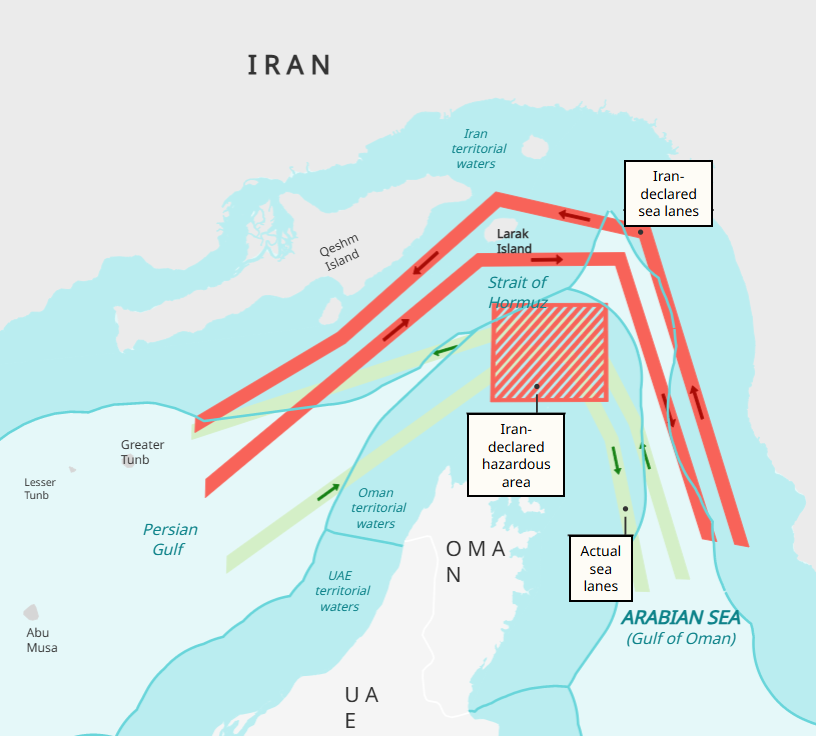
Those prerequisites were far from straightforward. Since mid-March, Iran had imposed a mandatory safe passage protocol — a rerouted corridor hugging Iranian territorial waters around Larak Island, away from the internationally recognised Traffic Separation Scheme. Each vessel was required to submit crew and ownership documentation for IRGC vetting, obtain a clearance code, and accept an escort through waters where Iran has laid mines. Four CMA CGM container ships attempting to cross the Strait during this narrow window eventually u-turned. Notably, on the very Saturday the Strait was reimposed, the Very Large Crude Carrier (VLCC) Sanmar Herald was fired upon by Iranian gunboats — despite having received prior IRGC clearance to pass.
The few vessels that did attempt transit hugged the Omani coastline rather than the IRGC-designated corridor near the Iranian coast — a telling signal that even those willing to move refused to submit to Iran’s safe passage terms. Commercial traffic ground to a halt once Iran reimposed control and gunfire resumed in the waterway.
Iran’s “safe passage” protocol
Source: John Feng/Newsweek
The Operational Wall: Why Monday Was Always the Earliest
Iran’s announcement landed on a Friday evening — and that timing was itself the strategy. As far as global shipping goes, the declaration of an open strait reads as an immediate invitation to resume commerce. In practice, it was an invitation issued in a language that the industry cannot respond to over a weekend. The obstacles were structural, sequential, and mutually reinforcing — and each hurdle runs on business hours.
The first disruption was informational. Ships attempting transit turned back not because the Strait was formally closed, but because the information environment was too chaotic to navigate — contradictory signals were being issued by all parties simultaneously. In shipping, uncertainty paralysis, is as effective as a physical blockade.
Behind insurance lies a multi-stakeholder chain: shipowner, charterer, designated person ashore, flag state, and insurer must all align before a Master can sail.
This was compounded by the insurance dimension. The Joint War Committee, a body of senior underwriters at Lloyd’s of London that designates which parts of the world are too dangerous for standard marine insurance cover, had already listed the Arabian/Persian Gulf as a high-risk area, forcing operators to purchase Additional War Risk Premium (AWRP) cover separately for each voyage. On 13 April, AWRP levels for tankers stood at around 1 percent of hull value, while insurers quoted around 3 percent for a single Hormuz passage — quotes swiftly withdrawn. Seven of the twelve major Protection and Indemnity clubs — mutual insurers covering ocean-going tonnage — had issued 72-hour cancellation notices for the Gulf. The insurance safety net had been pulled away, and rebuilding it was not a task achievable over a weekend.
Behind insurance lies a multi-stakeholder chain: shipowner, charterer, designated person ashore, flag state, and insurer must all align before a Master can sail. The crew dimension adds further complexity. Seafarers face a waterway patrolled by Iran’s so-called “mosquito fleet“ — a flotilla of small, fast, agile boats designed to harass and intimidate commercial shipping — in a channel where Iranian attacks on merchant vessels have been documented. Should operators choose to pay the IRGC toll to cross, they risk triggering US sanctions, potentially placing their vessel in the crosshairs of the American navy.
Finally, even a genuine reopening would not have cleared the backlog of around 2,000 commercial vessels. Among these, some 187 tankers remained trapped in the Gulf, loaded with 172 million barrels of crude and refined products. Processing that queue could take months. Iran closed the Strait on Saturday morning before any of it could begin.
The Strait As Weapon
Iran’s decision to reopen — and then swiftly close — the Strait of Hormuz within 18 hours was never about commerce. It was a demonstration of leverage: the ability to move global markets, reset diplomatic narratives, and expose the limits of American military power, all with a Friday evening announcement. Iran has long acknowledged the Strait as its most potent asymmetric weapon, and the events of April 17 confirmed it wields it with precision.
Washington, for its part, has banked on its naval blockade to squeeze Iran economically — a strategy that appears to be working. Tehran has since tabled a 14-point proposal setting a 30-day deadline for the US to lift its blockade on Iranian ports — signalling that the economic vice is tightening.
Yet the parties bearing the heaviest cost are neither governments nor negotiators. Baker Hughes, one of the world’s most influential oilfield services firms, assumes the Strait will not be fully operational until the second half of 2026. The International Energy Agency (IEA) has called this the largest oil supply disruption in the history of the global market. It is against this backdrop that Trump has now launched “Project Freedom“ — deploying 15,000 service members, guided-missile destroyers, and over 100 aircraft — framed as a humanitarian gesture, but inseparable from continued military coercion.
As Washington and Tehran continue to exchange proposals, the lesson is clear: the narrower the scope of negotiation, the faster the relief.
Regardless of when the Strait reopens, the precedent it has set — transit fees imposed by a border state, insurance markets collapsing overnight, seafarers trapped as pawns in geopolitical brinkmanship — will not be easily forgotten. That precedent hardened further on May 4, when the IRGC navy unveiled a new map formally delineating the Strait as an area under Iranian control and management; stretching from Iran’s coast to points off Fujairah and Umm Al Quwain in the UAE. The announcement warned that vessels violating its declared regulations would be stopped “with decisive force.” Iran’s recently submitted three-stage plan reinforces this posture: the first phase centres on the gradual reopening of the Strait and the lifting of the US blockade — underscoring that the waterway remains Tehran’s primary bargaining chip, deliberately bundled within a broader framework encompassing nuclear enrichment, sanctions relief, and a regional security architecture. This sequencing is less a gesture of conciliation than a mechanism of entrapment. As Washington and Tehran continue to exchange proposals, the lesson is clear: the narrower the scope of negotiation, the faster the relief. The longer both sides insist on comprehensive settlement, the longer 20,000 seafarers remain stranded, and the longer the world continues to pay the price of eighteen hours that were never intended to change anything.
Clemens Chay is Senior Fellow, Geopolitics, ORF Middle East.