
 Global
Expert Speak | 24 July, 2026
A Climate-Informed Approach to PHEIC Decision-Making
Spotlight
- The links between climate change and infectious diseases has been increasingly documented by scientific literature.
- Public Health Emergency of International Concern (PHEIC) alerts, the highest level issued by the World Health Organization (WHO), should incorporate climate-related risks and population vulnerabilities when assessing disease outbreaks.
- Climate and weather attribution can serve as complementary indicators to evaluate the influence of climate change on disease transmission and population health risks.
The scale and intensity of climate change has been a growing international concern over the past decade. Rising concentrations of greenhouse gases have made the earth’s climate more imbalanced today than at any point in observed history. This is not only increasing but accelerating. The World Meteorological Organisation found 2015–25 to be the hottest 11 years on record. United Nations (UN) Secretary-General António Guterres stated, “When history repeats itself 11 times, it is no longer a coincidence. It is a call to act.”
Climate change affects health through multiple pathways, including increased mortality and morbidity from more frequent extreme weather events; rising incidences of zoonotic, food-, water-, and vector-borne diseases; disruptions to food systems; and forced displacement, which often undermines social determinants of health, including livelihoods, equity, and access to healthcare. Furthermore, the escalating and compounding impacts of multiple sequential disasters limit the ability of vulnerable communities to prepare for, and adapt to, impacts. The World Health Organization (WHO), in 2015, formally recognised climate change as the “single biggest threat to health in the 21st century.”
Therefore, it is unsurprising that the WHO-convened independent body, the Pan-European Commission, concluded that climate change continues to pose a profound global threat to human health. It called on the WHO to declare climate change a public health emergency of international concern (PHEIC). The declaration aims to generate the political momentum needed to strengthen international and domestic coordination in health preparedness and responses to climate-related health hazards, areas in which current governance frameworks have proved insufficient.
Given the existing structure of the PHEIC framework under the International Health Regulations (IHR), this article argues for a targeted and practical modification through the inclusion of a ‘climate-informed’ component. Drawing on the growing body of evidence linking climate change to the emergence and spread of infectious diseases, it recognises the need to incorporate climate-related considerations into PHEIC decision-making, where robust scientific evidence demonstrates that climate change has contributed to the risk, severity, or transmission of an outbreak.
Understanding the PHEIC in the Context of Climate Change
Legal obstacles have stalled the formal recognition of climate change as a PHEIC. Under the International Health Regulations, a PHEIC constitutes an extraordinary event that (a) constitutes a public health risk to other states through the international spread of disease and (b) potentially requires a coordinated international response. The “event” is generally understood as a manifestation of disease or an occurrence that could potentially cause one, while “disease” is defined as any illness or medical condition, irrespective of its origin, that presents or could present significant harm to humans.
Historically, PHEIC declarations have been issued in response to infectious disease outbreaks that meet this definition, including the COVID-19 pandemic, Mpox, and the 2026 Ebola outbreak. Since climate change does not readily align with this definition, it is widely regarded as a risk factor triggering potential public health emergencies rather than an emergency in itself. Furthermore, assessing the risk level of climate change is challenging, given that its health impacts occur through multiple pathways. This complexity is further compounded by its temporal nature that encompasses both acute events—such as floods and heatwaves—and slow-onset processes, including sea-level rise and desertification.
Linkages between Climate Change and Infectious Diseases
While the PHEIC mechanism is designed to respond to acute and relatively short-term infectious disease threats, its decision-making process should nevertheless reflect the growing scientific evidence demonstrating that climate change can shape the emergence, transmission, and magnitude of infectious diseases.
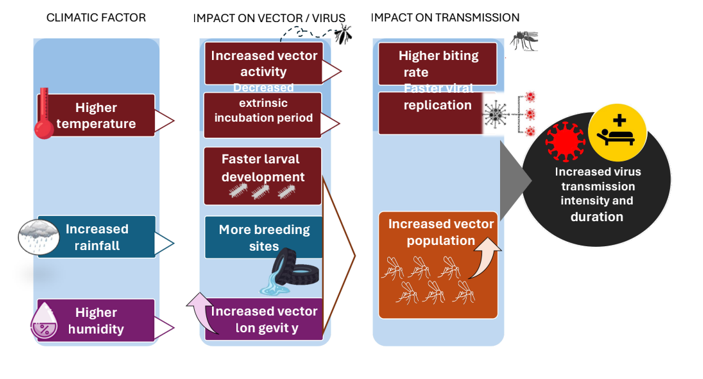
Shifts in climatic conditions are leading to more frequent and intense weather events, including storms, floods, wildfires, and extreme heat. While infectious diseases are influenced by multiple biological, environmental, and socioeconomic factors, many are recognised as climate-sensitive diseases. The consequences of climate change, such as warmer temperatures, increased humidity, and changes in precipitation patterns, are key drivers of infectious disease transmission, as they increase the survival and proliferation of pathogens and disease vectors, expanding vector geographies and breeding sites.
Figure 1: Mechanisms Through Which Climate Change Might Impact Virus Transmission
Source: CLIMADE Consortium
Early studies established associations between climatic variables and infectious disease transmission through the mechanisms mentioned above, but more recent ones also estimate the extent to which anthropogenic climate change has contributed to observed disease incidence or outbreak severity (see Table 1).
Climate change also increases the risk of infectious diseases through pathways beyond direct effects on pathogens by altering factors that influence disease transmission, including access to clean water and sanitation systems, poverty, housing conditions, and increased mobility and displacement.
Table 1. Infectious Disease and Climate Attribution: Case Studies
| Disease | Source Study | Findings |
| Dengue | Childs et al. 2025 | 18 percent of dengue cases across the countries examined can be attributed to historical climate change. Holding non-climatic factors constant, future warming is projected to increase dengue incidence by 49–76 percent. |
| Dengue | Harris et al. 2026 | 60 percent of dengue cases reported over three months in northwestern Peru after Cyclone Yaku attributable to extreme precipitation driven by climate change. |
| West Nile Virus | Fay et al. 2025* | The West Nile Virus in-transmission season in New York State has lengthened by an average of 24.8 days over the past 25 years, beginning four days earlier and ending 20 days later. |
| West Nile Virus | Erazo et al. 2024 | Based on historical data up to 2019, there was an estimated two- to sixfold increase in population at risk from West Nile virus in Europe. |
| Malaria | Carlson et al. | Net increase in the prevalence of childhood malaria in sub-Saharan Africa, characterised by regional increases and decreases. |
Source: Authors’ own, using American Society for Microbiology report.
Note: At the time of writing, these studies were not peer-reviewed publications but existed as publicly available preprints.
Integrating Climate-Change Vulnerabilities within the PHEIC
Existing PHEIC deliberations consider epidemiological and other relevant evidence, such as treatment failure, population demographics, and undernourishment prevalence, but do not formally incorporate climate-related assessments that may influence disease emergence, transmission, or severity, when evaluating the risk to human health and of international spread.
Two complementary bodies of evidence could provide a climate-informed assessment. Climate-attribution studies estimate the extent to which anthropogenic climate change has contributed to the occurrence or spread of a particular disease. Weather-attribution studies, led by initiatives such as World Weather Attribution, quantitatively assess how climate change has influenced the likelihood and intensity of specific extreme weather events by combining observational data with climate models in the immediate aftermath.
Integrating findings from these studies into the PHEIC process would strengthen evidence-based decision-making. Climate attribution provides a more comprehensive understanding of the environmental drivers of the disease emergence and transmission. Weather attribution adds an additional layer to the vulnerability indicators WHO assesses—such as refugee prevalence and age demographics—by clarifying how climate change affects environmental conditions within a country or region. An expert advisory panel should assess whether climate change may be contributing to, or is likely to exacerbate, an outbreak through its influence on environmental conditions. This would help identify climate-related vulnerabilities, including heightened risks associated with flooding, storms, droughts, and heatwaves, or shifts in vector habitats that could amplify disease transmission or impede public health response efforts.
To support such an approach, the WHO should foster an enabling ecosystem for climate attribution and climate-health research. This requires expanding climate health surveillance systems that combine predictive models grounded in the biological mechanisms of disease transmission with advances in machine learning and data science. Mobilisation of funding in climate attribution and climate health research, supported through partnerships with local communities, research institutions, national public health agencies, and international organisations, could strengthen scientific and technical capacity. Stronger international coordination can facilitate timely and sustained data sharing and risk assessments.
Together, these capabilities would provide WHO Emergency Committee members with robust evidence to inform WHO Temporary Recommendations, enabling member states to implement targeted measures to reduce emerging climate-related health risks. For example, if experts determine that recent flooding has created conditions likely to increase transmission of a disease with a potential PHEIC outbreak, WHO could recommend reinforcing water, sanitation, and hygiene (WASH) measures besides standard recommendations, such as enhanced disease surveillance and community risk communication.
Conclusion
Climate change remains a significant global threat to population health. Accordingly, global health governance frameworks such as PHEIC should continue to evolve and incorporate climate-related risks into public health decision-making. While not all changes in infectious disease incidence are attributable to climate change, systematically considering this factor when supported by scientific evidence would strengthen the basis for PHEIC deliberations, enabling better responses.
Reem Sagahyroon is Research Assistant, Climate and Energy, ORF Middle East.
The author acknowledges the use of ChatGPT 5.5 for language refinements prior to submission.