 Global
Expert Speak | 29 July, 2026
The Need for an Integrated Framework to Address the Climate–Health–Migration Nexus in Iraq
Spotlight
- Iraq’s central and southern populations face compounding pressures from climate change, driving an increase in internal rural-to-urban migration.
- Urban climate migration hotspots are experiencing heat island effects, the expansion of informal settlements, and increasing stress on already constrained public health infrastructure.
- A three-pronged Integrated Climate–Health–Migration Resilience Framework could address the root causes of migration, enable safe movement, and strengthen urban resilience to better manage population influx.
Middle East and North Africa (MENA) countries are located in some of the world’s driest and most water-stressed regions. Many of them face compounding challenges, including governance instability, rapid population growth, energy insecurity, fiscal pressures, and vulnerable infrastructure. Climate change exacerbates the scale and impact of these fragilities, serving as a ‘push factor’ for voluntary or forced migration. Slow-onset events, such as desertification, sea-level rise, and extreme heat, threaten spatial habitability leading to migration, while sudden-onset events, such as floods or desert storms, shut down public services, resulting in acute climate-induced displacement.
Iraq has been identified as being fifth-most vulnerable country to climate change. In 2024, southern Iraqi cities recorded the world’s highest global temperature levels (50˚C); projections suggest that water availability in these places could decrease by up to 20 percent by 2050. These trends pose significant risks to Iraq’s public health.
Climate impacts also affect agricultural systems, threatening livelihoods and prompting rural-to-urban migration. As of September 2025, 31,001 Iraqi families across 12 governorates remain displaced due to climatic factors, with 63 percent migrating to urban areas. This creates a strain on host governorates, forcing them to provide infrastructure and services to facilitate enhanced migrant integration.
This article evaluates the intersection between climate, migration, and health in Iraq and argues for a unified framework to strengthen integrated governance over climate and health to enable safe migration pathways.
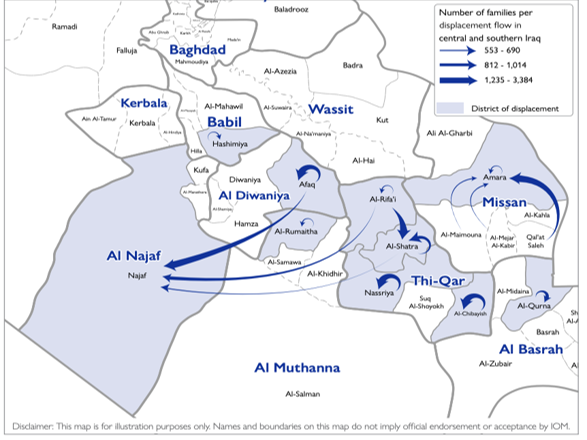
Figure 1: Mapping Climate-Induced Displacement in Iraq
From Environmental Stress to Health Concerns and Human Mobility
Iraq has historically benefited from fertile lands that support a strong agricultural sector, but increased water scarcity is driving food insecurity and displacement. Agriculture contributes almost 3 percent of Iraq’s gross domestic product (GDP) and employs more than 19 percent of the workforce, nearly 25 percent of whom are women. However, the central and southern regions, home to the majority of the population, have experienced disproportionate climate-change effects. Decline in precipitation has led to an increase in water and soil salinity, contributing to a 30 percent loss of productivity in agricultural land over the past three decades. Water shortages and decreased crop yields have worsened malnutrition trends, especially among women and children. Drought and disputes over water access further increase the risk of instability and displacement.
Figure 2: Impact of Climate Change on Iraq
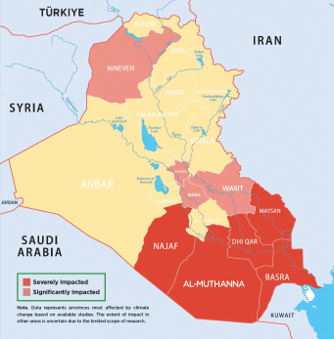
Source: IN-2
In late 2025, Iraq’s northern regions experienced extreme flooding events, overwhelming drainage systems and forcing residents in low-lying neighborhoods to evacuate. Southern and coastal governorates also face frequent flooding risks from sea-level rise. Recurrent flooding contaminates drinking water, leading to the spread of waterborne diseases such as gastrointestinal infections and cholera.
These interconnected challenges catalyse rural-to-urban migration, as individuals either voluntarily leave for better economic opportunities or are forced to relocate due to extreme weather patterns.
However, climate change does not work in isolation. The central and southern regions of Iraq face compounded pressures from unregulated upstream water use, the discharge of agricultural and industrial pollutants, inefficient agricultural methods such as limited crop diversification, and reduced water flow caused by water management in neighbouring countries. These interconnected challenges catalyse rural-to-urban migration, as individuals either voluntarily leave for better economic opportunities or are forced to relocate due to extreme weather patterns. Key districts for this displacement in Iraq include Al-Shatra, Amara, and Nassriya (see Figure 1).
Urban Resilience and Strain on Public Health Systems
As of 2025, over 70 percent of Iraq’s population lives in urban areas. However, the country’s urban infrastructure and institutional capacity remain fragile, limiting its capacity to meet the health needs of host and migrant communities. Over three million live in urban slums and informal settlements, increasing congestion and disease transmission. Moreover, urban areas lack wastewater treatment plants, leading to improper discharging practices where untreated industrial and sewage waste are disposed into rivers, degrading water quality. Higher water demand, coupled with the inability of urban infrastructure to meet it, will increase the risk of exposure to waterborne diseases.
Extreme heat conditions are expected to worsen, with more frequent heatwaves. Combined with power outages, this will impact human health and potentially lead to increased mortality. Baghdad and Basra are already experiencing temperatures over 50°C. The number of heat-related deaths is projected to double between 2000 and 2030, from 1.6 to 3.2 deaths per 100,000 people.
Increasing heatwaves will lead to a higher demand for healthcare services, placing more strain on urban health systems that already struggle to provide quality care. Large public health centres (PHCs) have limited resources and are overwhelmed with patients. Doctors often choose to work at private facilities that offer better healthcare over PHCs due to higher salaries, but only patients with available funds can avail private hospitals.
As of 2025, over 70 percent of Iraq’s population lives in urban areas. However, the country’s urban infrastructure and institutional capacity remain fragile, limiting its capacity to meet the health needs of host and migrant communities.
Iraq has historically benefited from international development aid, which has now reduced. Due to this, financing urban and health resilience has become a challenge as civil society organisations and government agencies have lower financial capacity to provide adequate services. For example, the dismantling of USAID operations in February 2025 resulted in the discontinuation of a US$20 million four-year water and sanitation improvement initiative, negatively impacting 2.5 million people across five Iraqi provinces.
Moreover, Iraq’s public health funds rely heavily on oil exports, which account for approximately 90 percent of government revenues. This dependence creates fiscal vulnerabilities, as fluctuations in oil revenue can constrain government spending on healthcare, water infrastructure, and social services.
An Integrated Climate–Health–Migration Resilience Framework
In 2020, Iraq established a National Migration Management Strategy in accordance with its first National Plan to Promote Safe, Orderly and Regular Migration in August 2025. However, the strategy focuses on conflict-induced cross-border displacement; there is no parallel unified framework for internal climate migration. Strict guidelines restrict its benefits to victims of security- and conflict-related displacement alone. Climate-induced migrants face difficulties in registering with the Ministry of Migration and Displacement (MoMD) for legal recognition as ‘drought and desertification internally displaced persons (IDPs)’ to avail social and health protection benefits.
Moreover, the Iraqi government views climate impacts as economic challenges rather than drivers of displacement, resulting in institutional silos regarding governance of environment, health, and migratory movements. While local communities express confidence in their strategies to anticipate and handle climate-related events, they emphasise a lack of preparedness by state systems. Weak technical monitoring and slow coordination limits access to funds, delaying responses to climate shocks and contributing to displacement.
A clear governing framework for climate migration would help ensure formal recognition and allocation of rights for migrants, facilitate coordination to address systemic drivers of migration, and minimise negative health impacts
A clear governing framework for climate migration would help ensure formal recognition and allocation of rights for migrants, facilitate coordination to address systemic drivers of migration, and minimise negative health impacts on the population. The following three-pronged framework aims to strengthen intersectoral cooperation to enable anticipatory action, facilitate safe migratory movements, and ensure that urban areas have the capacity to absorb the influx of climate migrants.
1. Coordination for Anticipatory Climate-Health Adaptation
This would entail establishing a coordination mechanism between the Iraqi Meteorological Organization, Ministry of Agriculture, National Center for Water Resources Management, and Ministry of Health to develop shared data systems mapping climate effects, mobility drivers, and socioeconomic determinants of health within governorates. Mapping the intersection of migratory movements and extreme weather events to inform early warning systems could assist in creating disaster risk reduction frameworks, leading to better public health planning and emergency management. Migration monitoring systems are largely nascent, since limited data is available on environment-driven displacement, such as the informal settlements in northern Iraq. Synergising disaster risk reduction, climate adaptation, health preparedness, and emergency planning can help create infrastructure, ensure health service continuity, and formalise operating procedures for migration during sudden-onset events such as floods. Iraq can parallel Sudan and Morocco’s integration of health considerations in their National Adaptation Plans, such as geo-mapping climate-health risks that increase migration (Sudan) and anticipating climate-driven evacuation scenarios (Morocco).
Since climate and the threat of livelihood loss are often interconnected migration drivers, partnerships between Iraq’s Ministry of Agriculture and international organisations can facilitate knowledge exchange and technology transfer to implement climate-resilient agricultural methods, demand-side water management, water infrastructure rehabilitation, and capacity building to encourage diversified or alternative livelihoods and mitigate impacts of slow-onset events like droughts.
2. Facilitate Safe Migratory Processes
Increasing recognition of climate–health interactions within migratory governance frameworks can ensure dignified migration processes and sustained health access. Increasing preventative health measures would enable safe migration pathways—for instance, maintaining health access during relocation through mobile units, access to water and safe sanitation, and expanding cross-border health surveillance. Previously, the Iraqi Red Crescent Society deployed mobile health teams to support those displaced by water shortages. Easing administrative processes to gain legal recognition with the MoMD would fast-track migrant access to urban health and social protection systems.
3. Advance Climate-Resilient Urban and Health Systems
To accommodate rising patient numbers and address their unique health needs, capacity building for health facilities in high-risk zones should be increased, with tools to manage heat stress and waterborne diseases. This would require closing the current funding gap for services at primary health centres on priority. The urban heat island phenomenon can be mitigated through nature-based solutions, green infrastructure, and improved ventilation with local materials. Public and private funders could invest in local innovators, such as the Green Insulation and Ventilation (GVI) team that creates vertical gardens using low-maintenance plants reusing filtered sink water.
In addition, managing the proliferation of informal settlements is essential to reduce potential public health risks. This can be done through settlement rehabilitation, improvements in water and sanitation services, and upgrading infrastructure. The Roadmap for Addressing Informal Settlements in Iraq would serve as a useful guide to scale up such efforts.
The assessment of Iraq’s experience demonstrates the need for a more integrated governance approach that links climate adaptation, public health, urban planning, and migration management.
Conclusion
Intensifying climate risk is leading to an increase climate-related migration as an adaptation strategy. Iraq’s cities will continue to serve as primary destinations for climate migrants, adding pressure to already strained infrastructure and health systems. Developing a unified framework is the first step to strengthen institutional coordination.
While financing is critical for implementation, climate adaptation has historically struggled to attract funding due to uncertain financial returns, small project sizes, and long-time benefit horizons. However, the added health dimension opens new financing pathways. For example, green health insurance was recently piloted in Egypt with support from the World Bank. According to this, victims of climate change are eligible for free health insurance tailored to climate-sensitive health risks, while service providers are incentivised to reduce emissions or waste. The Iraqi government can structure revenue raising to finance infrastructure projects, leveraging green bonds for those with environmental benefits. Islamic finance can also be leveraged for resilience initiatives. Pairing takaful coverage with parametric insurance can provide payouts to farmers based on drought triggers. Likewise, waqf or endowment funds can be directed towards water infrastructure restoration projects.
The assessment of Iraq’s experience demonstrates the need for a more integrated governance approach that links climate adaptation, public health, urban planning, and migration management. This will address the primary drivers of climate-induced migration while supporting the successful integration of migrants into host communities.
Leigh Mante is Junior Fellow, Climate and Energy, ORF Middle East.
Reem Sagahyroon is Research Assistant, Climate and Energy, ORF Middle East.