 Global
Expert Speak | 19 August, 2026
Who Will Pay for Climate Action Now?
The following excerpt is from Chapter 4 — ORF Global Quarterly | Energy and Tech: Powering the Future.
Despite strong and sustained multilateral efforts, global climate finance continues to fall short of the needs of Emerging Markets and Developing Economies (EMDEs), and the gap between financing needs and actual flows continue to widen. According to the Independent High-Level Expert Group on Climate Finance (IHLEG), annual global climate finance requirements will reach US$6.7 trillion by 2030 and US$8.1 trillion by 2035. Of this, EMDEs will require some US$2.5 trillion annually by 2030 and US$3.1 trillion by 2035.[1] However, the actual finance received by these economies has historically fallen short. In 2023, for example, EMDEs other than China mobilised only US$385 billion, which is 15 percent of the total annual requirement.[2]
This retrenchment of finance is not merely a result of a temporary slowdown in climate finance commitments by the developed countries. It may also signal a deeper restructuring of the climate finance architecture driven by changing institutional priorities within the multilateral system that was expected to anchor the transition. Reversing this trend will require global policymakers to address three key challenges: where finance is flowing; on what terms it is being provided; and whether the institutions expected to support the transition to a renewable energy future remain available and fit for purpose.
To be sure, climate finance is just one part of a rapidly evolving global financial architecture. Traditional sources of public and private capital are becoming less predictable, while global multilateral finance institutions like the World Bank face growing political pressure to roll back climate policies and financing. At the same time, alternative sources of capital are emerging on terms that may not align with the needs of EMDEs. For these countries, the challenge is not only to mobilise more financing but also to secure financing that is affordable, accessible, better distributed across climate priorities, and aligned with development needs.
Policymakers across the globe should adopt three priorities for the 2026 climate finance agenda: 1) reorienting private finance towards underserved sectors and geographies; 2) restoring concessional finance (finance at better than market rates) and working through MDBs to de-risk project pipelines and lower the cost of capital; and 3) reinforcing South-South cooperation as a growing channel for finance, technology transfer, and knowledge sharing.
Weakening Commitments and Architecture
The United States’ (US) withdrawal from the Paris Agreement in 2026 and its reduced engagement with multilateral climate initiatives—including the Green Climate Fund—have created uncertainty around future climate finance flows. It has also pressured the World Bank to scale back its climate finance commitments and increase financing for natural gas projects. This marks a notable shift for an institution that had committed to allocating 45 percent of its financing to projects with climate co-benefits by 2025 and exceeded that target by directing US$39.2 billion (48 percent of its financing) to such projects in 2025.[3] As multilateral development banks (MDBs) remain the largest source of international public climate finance,[4] any dilution of the World Bank’s climate commitments could have wider implications for climate finance flows to developing countries.
Policymakers must address three key challenges: where finance is flowing; on what terms it is being provided; and whether the institutions expected to support the transition to a renewable energy future remain fit for purpose.
A similar trend is evident across the broader climate finance landscape. Bilateral and multilateral Official Development Assistance (ODA) is also shrinking, with Germany, the United States, the United Kingdom, Japan, and France accounting for more than 95 percent of the projected decline in ODA in 2025.[5] This is significant because ODA remains a critical source of financing for climate-sensitive sectors such as healthcare, nutrition, food security, and resilience.[6] Declining ODA may intensify competition between climate and broader development priorities in countries already facing fiscal stress.
As traditional sources of finance become less predictable, alternative pools of capital are gaining prominence. Gulf sovereign wealth funds (SWFs) have emerged as an important source of green finance, investing in projects ranging from established renewable energy assets to emerging green hydrogen ventures. However, this capital cannot substitute for concessional and multilateral finance, as investment decisions are driven by commercial returns and geopolitical considerations. The West Asia crisis of 2026 has also raised questions over the investment priorities of Gulf SWFs, as major regional economies reassess investments worth an estimated US$5 trillion. A greater share of these resources may be redirected towards domestic priorities and fiscal stabilisation.[7]
The Persistent Misalignment Challenge
While the overall climate finance gap remains substantial, financing is also distributed unevenly across climate priorities. Mitigation continues to receive the large share, while adaptation initiatives struggle to mobilise long-term finance despite being an immediate priority for climate-vulnerable countries in the Global South. In 2023, approximately 94 percent of the global climate finance (US$1.8 trillion) went towards mitigation, driven mainly by private-sector investments in energy systems, transport electrification, and energy-efficient infrastructure.[8] Mitigation finance also remains highly concentrated in certain geographies. Of the US$980 billion of mitigation finance received by EMDEs in 2023, US$670 billion went to China alone.[9] This finance is also largely driven by domestic private-sector investments in sectors considered commercially viable, such as energy and transport.
The adaptation finance gap, meanwhile, continues to widen. According to the United Nations Environment Programme’s (UNEP) Adaptation Gap Report of 2025, developing regions will require adaptation finance equivalent to 12 times current flows by 2035. The cost of adaptation by 2035 is estimated to be around US$310 billion to US$365 billion per year.[10] However, in 2023, of the total climate finance mobilised (US$1.9 trillion), adaptation finance accounted for only US$65 billion, of which US$48 billion went to EMDEs.[11] The majority (~93 percent) of the adaptation finance flowing into these markets came from public sources.[12] Private sector investment remains limited because adaptation projects often lack clear revenue models and have long investment horizons before benefits are realised.
Developing economies do not have welldeveloped capital markets that can provide long-term finance for climate projects.[13] This makes the mobilisation of private finance essential, not as a substitute for public capital but as a necessary means to bridge the climate finance gap. The dearth of private sector finance, specifically for adaptation projects, can be attributed to various factors.
There is a clear mismatch between investor expectations of immediate returns and short gestation periods and the nature of adaptation investments. Unlike sectors such as clean energy, which often have clear and welldefined revenue streams, some adaptation interventions, like the nature-based solutions, may not generate traditional income but can provide long-term benefits and protection against floods and landslides. Quantifying these outcomes may require complex methodologies and resources, which further adds to the cost and perceived high risks of adaptation investments.[14] Additionally, many development banks also struggle to create a comprehensive project pipeline of good-quality and scalable projects for adaptation. The lack of skills in the project development community adds to the challenge.[15]
The Concessionality Gap
Although international concessional finance— defined as “finance offered at more favourable terms than the market”[16]16—has increased by 50 percent over the last decade, reaching US$81 billion in 2022, it remains insufficient to meet global climate finance needs. Global concessional finance will need to increase at least five-fold by 2030 to achieve the global climate goals.[17] Additionally, most concessional finance is provided as low-cost project debt instead of grants (See Figure 1). Bilateral and multilateral development finance institutions (DFIs) usually rely on concessional loans, while the grant component of concessional finance remains limited. Multilateral climate funds, which are better placed to provide grantbased concessional support—especially for adaptation—remain small. The withdrawal of US$4 billion in US funding from the Green Climate Fund further weakens this important source of grant-based concessional finance for developing economies.[18]
Figure 1: Global Concessional Finance, by Actors and Instruments
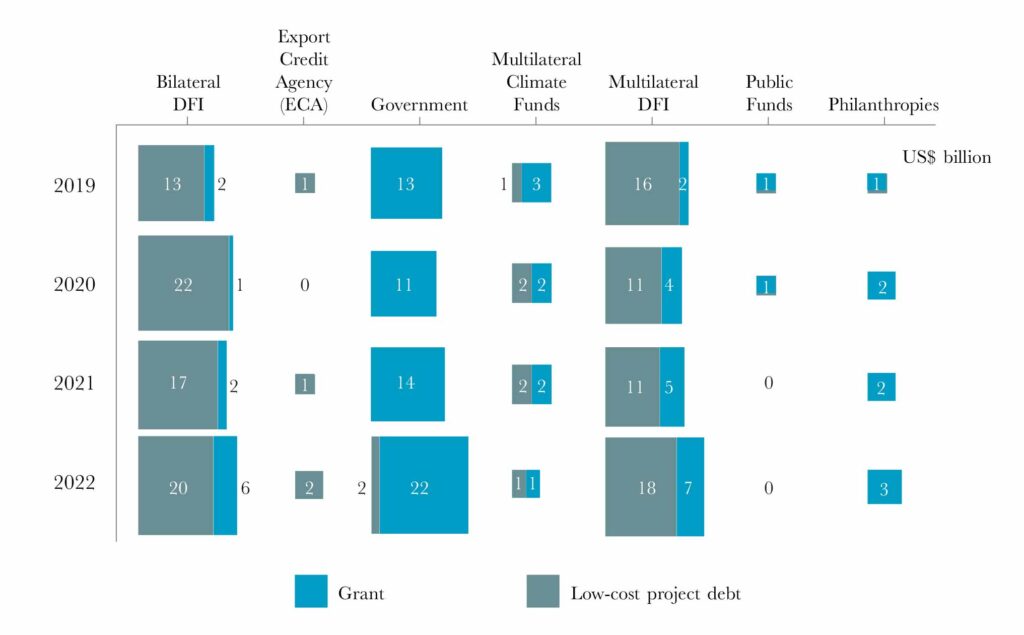
Source: Climate Policy Initiative[19]
This gap cannot be ignored as the terms and quality of finance directly impact the viability of climate investments. Emerging market economies already face a higher cost of capital than most developed countries. For instance, even mature segments like renewables have a cost of capital that is at least twice as high as that in developed economies. The average cost of capital for a 100 MW solar project in India is estimated at 10.5 – 11 percent, compared with 2.8 percent in Germany and 5.3 percent in the United States.[20] According to the International Monetary Fund’s (IMF) estimates, even a onepercentage- point decline in the cost of capital could lower annual transition finance costs by approximately US$150 billion.[21]
In addition to the high cost of capital, climate projects also face currency risks. Developing countries rely on hard currency for their climate finance, but climate projects, especially those related to clean energy, usually generate revenue in local currency.[22] These projects also have a long tenor, which further exposes them to these currency risks. For example, the average life span of solar panels is usually 20-30 years.[23] Institutional and regulatory risks further exacerbate the problem. In many emerging economies like India, renewable energy projects face delays in signing PPAs due to uncertainty and disputes over tariffs.[24]
These risks combined trigger a vicious cycle of macroeconomic pressures, debt sustainability challenges, and shrinking fiscal space for climate investments which eventually weakens the creditworthiness of the developing economies.[25] The concessionality gap therefore goes to the core of climate finance effectiveness. For EMDEs, the issue is not only whether capital is available but also whether it is available on terms that make climate projects viable without worsening debt pressures or crowding out other development priorities.
The 2026 Climate Finance Agenda
These trends expose structural gaps in the way global climate finance is organised and disbursed. The year 2026 is likely to be another year of competing signals in climate finance, especially for emerging economies, where the need for capital is higher. Climate leaders should focus on the following three priorities.
First, private-sector finance will remain central to scaling climate investment, but it must be reoriented towards geographies, sectors, and technologies where investment needs are high, emissions abatement potential is high, and commercial risks remain difficult to price. This includes institutional investors, commercial banks, private equity, infrastructure funds, and corporate capital.[26] Reorienting private finance will require building the information architecture around climate investments. This means stronger climate-related disclosures, better project-level data on climate risks, and more credible transition planning frameworks that allow investors to assess risks and opportunities more objectively.
For adaptation finance, the information gap is even more pronounced, as investors often struggle to assess how adaptation projects generate value or fit within their return expectations. This is partly because adaptation still lacks clear and widely accepted taxonomies, making it difficult to define what qualifies as an adaptation activity. Stronger disclosure, governance, and climate-risk data frameworks are therefore essential to ensure that finance flows to credible projects.
There are structural gaps in the way global climate finance is organised and disbursed. The year 2026 is likely to be another year of competing signals in climate finance, especially for emerging economies, where the need for capital is higher.
Second, restore concessional finance. MDBs and DFIs must improve both the scale and quality of finance by de-risking project pipelines, structuring and advancing blended finance mechanisms, and further reducing the cost of capital. Since traditional concessional finance structures are under pressure, 2026 will also test whether new mechanisms can generate affordable capital for climate action. The Brazil-led blended-finance mechanism launched at COP30, called the Tropical Forests Forever Facility (TFFF), aims to mobilise US$125 billion (US$25 billion from donor countries and US$100 billion from private investors) for tropical countries.[27] However, its success will depend on the ability to source the initial US$25 billion from donor countries and build on the existing US$6.6 billion mobilised last year at COP30.
Third, reinforce South-South cooperation. Climate finance flows among developingcountry institutions have grown steadily, rising from US$16 billion in 2018 to US$26 billion in 2023.[28] This points to the growing role of South-South climate finance, including through regional development banks and finance from larger EMDEs to other developing economies. Existing initiatives, from the India-backed renewable energy projects in Cameroon to small hydropower and renewable energy research partnerships in Asia, demonstrate the range of cooperation. South-South cooperation also extends beyond finance to knowledge sharing and local implementation. Platforms and citylevel initiatives led by ICLEI, have enabled municipalities in India, Indonesia, and South Africa to exchange experiences on renewable energy deployment and energy-efficiency practices.[29]
India has also helped shape South-South climate cooperation through platforms such as the International Solar Alliance and the Coalition for Disaster Resilient Infrastructure (CDRI). While the ISA supports wider access to affordable solar energy across solar-rich countries, particularly in the Global South, the CDRI focuses on strengthening infrastructure resilience by bringing together governments, institutions, and experts working on climate and disaster risks.[30]
Institutions like the BRICS New Development Bank are also emerging as channels for mobilising more finance for EMDEs. The NDB’s 2024 annual report shows that, by the end of 2024, the Bank had approved around US$6.5 billion for mitigation-related projects and US$1.6 billion for adaptation finance.[31] South-South cooperation needs to be more systematically tracked and strengthened as an emerging avenue for climate action. Beyond expanding finance for EMDEs, it can support technology transfer, knowledge sharing, and wider economic cooperation across the Global South.
The retrenchment of climate finance is not only about declining volumes but also about changing priorities and a weaker system for financing climate action in EMDEs. In 2026, the credibility of climate finance will depend less on headline commitments than on whether finance becomes more accessible, affordable, and better aligned with development priorities.
Gopalika Arora is Deputy Director, Centre for Economy and Growth, ORF.
ChatGPT 5.5 was used to generate citations for this article.
[1] Amar Bhattacharya et al., Raising Ambition and Accelerating Delivery of Climate Finance, London: Grantham Research Institute on Climate Change and the Environment, London School of Economics and Political Science, November 2024, https:// www.lse.ac.uk/granthaminstitute/wp-content/uploads/2024/11/Raising-ambition-and-accelerating-delivery-ofclimate- finance_Third-IHLEG-report.pdf.
[2] Rajeev Gopal, “Miles to Go,” Down To Earth, April 16, 2026, https://www.downtoearth.org.in/climate-change/miles-togo.
[3] Matteo Civillini, “US Pressure Puts World Bank’s Climate Plan at Risk,” Green Central Banking, April 23, 2026, https:// greencentralbanking.com/2026/04/23/us-pressure-puts-world-banks-climate-plan-at-risk/.
[4] Global Landscape of Climate Finance 2025: Summary Handout, Climate Policy Initiative, November 2025, https://www. climatepolicyinitiative.org/wp-content/uploads/2025/06/Global-Landscape-of-Climate-Finance-2025-Summary- Handout.pdf.
[5] “A Historic Decline in Foreign Aid: Preliminary 2025 ODA Data,” OECD, April 9, 2026, https://www.oecd.org/en/ data/insights/data-explainers/2026/04/a-historic-decline-in-foreign-aid-preliminary-2025-oda-data.html.
[6] Nilanjan Ghosh and Swati Prabhu, eds., No Country for Aid Alone: Strategic Partnerships for Development Finance, Observer Research Foundation, May 11, 2026, https://www.orfonline.org/research/no-country-for-aid-alone-strategic-partnerships-fordevelopment- finance.
[7] Andrew Mills, Rachna Uppal and Federico Maccioni, “Gulf Trio Review Sovereign Investments to Offset Iran War Impact, Official Says,” Reuters, March 11, 2026, https://www.reuters.com/world/middle-east/some-gulf-states-reviewingsovereign- investments-offset-economic-shock-iran-war-2026-03-11/.
[8] “Global Landscape of Climate Finance 2025: Summary Handout”.
[9] Baysa Naran et al., Global Landscape of Climate Finance 2025, Climate Policy Initiative, October 2025, https://www. climatepolicyinitiative.org/wp-content/uploads/2000/10/Global-Landscape-of-Climate-Finance-2025-EMDESpotlight. pdf.
[10] United Nations Environment Programme, Adaptation Gap Report 2025: Running on Empty – The World is Gearing up for Climate Resilience – Without the Money to Get There, UNEP, October 2025, https://wedocs.unep.org/items/b547996e-14ee-4f1ca6d4- b811dd373ae9.
[11] “Global Landscape of Climate Finance 2025: Summary Handout”.
[12] “Global Landscape of Climate Finance 2025”.
[13] Zeineb Ben Yahmed et al., “Managing Currency Risk to Catalyze Climate Finance,” Climate Policy Initiative, August 2024, https://www.climatepolicyinitiative.org/wp-content/uploads/2024/08/Currency-Risk-Report.pdf.
[14]
Gopalika Arora, Mobilising Private Finance for Ecosystem-Based Adaptation Through Nature-Based Solutions, Observer Research Foundation, November 2024, https://www.orfonline.org/public/uploads/posts/pdf/20241121122709.pdf.
[15] Guillermo Martinez, Ken Schell-Smith and Abha Nirula, Partnering for Finance Adaptation, Climate Policy Initiative, September 2024, https://www.climatepolicyinitiative.org/wp-content/uploads/2024/09/CPI_Partnering-for-Finance-Adaptation. pdf.
[16] Baysa Naran, Tinglu Zhang, and Ishrita Gupta, Understanding Global Concessional Climate Finance 2024: Enhancing Its Scale and Efficiency for Climate Action, Climate Policy Initiative, October 2024, https://www.climatepolicyinitiative.org/wp-content/ uploads/2024/10/Understanding-Global-Concessional-Climate-Finance-2024.pdf
[17] “Global Landscape of Climate Finance 2025”.
[18] Matteo Civillini, “After US Retreat, Countries Clash Over Who Should Make Up Green Climate Fund Shortfall,” Climate Home News, February 21, 2025, https://www.climatechangenews.com/2025/02/21/after-us-retreat-countries-clash-overwho- should-make-up-green-climate-fund-shortfall/.
[19] “Global Landscape of Climate Finance 2025”.
[20] Franco Bruni et al., Beyond Global Polarization: New Cooperation Wanted, ISPI, ORF, and PCNS, December 2025, https:// www.orfonline.org/public/uploads/posts/pdf/20251217144432.pdf.
[21] “Beyond Global Polarization: New Cooperation Wanted”.
[22] Yahmed et al., “Managing Currency Risk to Catalyze Climate Finance”.
[23] Yahmed et al., “Managing Currency Risk to Catalyze Climate Finance”.
[24] Yahmed et al., “Beyond Global Polarization: New Cooperation Wanted”.
[25] Yahmed et al., “Beyond Global Polarization: New Cooperation Wanted”.
[26] Morgan Richmond, Pallavi Sherikar and Jake Connolly, “Tracking Private Investment for Adaptation: The Need, Our Progress, and Next Steps,” Climate Policy Initiative, July 23, 2025, https://www.climatepolicyinitiative.org/trackingprivate- investment-for-adaptation-the-need-our-progress-and-next-steps/.
[27] Edward Davey et al., “The Tropical Forests Forever Facility Could Finally Finance Nature Conservation. Will Funders Back It?,” World Resources Institute, November 26, 2025, https://www.wri.org/insights/financing-nature-conservationtropical- forest-forever-facility.
[28] “Global Landscape of Climate Finance 2025”.
[29] REEEP, “Local Renewables: South–South Cooperation Between Cities in India, Indonesia and South Africa,” https://reeep.org/projects_programmes/local-renewables-south-south-cooperation-between-cities-in-india-indonesiasouth- africa-done/.
[30] Ananya Shukla, “Climate Shifts, Power Plays: India’s Climate Diplomacy in a Changing Global Order,” The Geostrata, October 26, 2025, https://www.thegeostrata.com/post/climate-shifts-power-plays-india-s-climate-diplomacy-in-achanging- global-order.
[31] “Global Landscape of Climate Finance 2025”.