 Global
Expert Speak | 28 October, 2026
Squeezing Riyadh: The Houthis Take a Leaf Out of Iran’s Playbook
Spotlight
- The Yemeni Houthis are pressuring Saudi Arabia for direct retaliation in the interval before the Israeli and US ballots, borrowing from Iran’s own conduct of war, using geography as leverage, escalation by invitation, and strikes aimed at the economic project behind Vision 2030.
- Riyadh has options but no settlement, with a limited US role, an ambiguous Mecca pact, and a defensive Egyptian mandate all curbing its partners’ actions.
- Diplomacy is late but not dead. However, with strikes likelier after 3 November, Saudi Arabia’s test runs on two clocks: its dialogue with Tehran and Washington’s next move.
The United States (US)-Israel–Iran war has not so much de-escalated as relocated. After months of plateaued intensity, the pressure has shifted to Saudi Arabia, delivered by the Iran-backed Yemeni Houthis (also known as Ansarullah) through attacks that killed at least 12 people and wounded over 300 at Riyadh’s King Khalid International Airport on 10 October 2026, followed by two more deaths in strikes at Dammam’s King Fahd International on 21 October. Riyadh had kept diplomatic channels to Tehran open throughout the war; this only reinforces the point, since the new front it represents sits on top of the unresolved Strait of Hormuz situation—with the Red Sea coast a target and Bab al-Mandab a second disrupted chokepoint. The question therefore is no longer whether this crisis will escalate, but whether Riyadh, its neighbours, and the wider world can absorb the price of that escalation before Washington resumes a war of its own making.
Two Consequential Ballots
The Houthis operate within a window with two dimensions, in Tel Aviv and Washington, each tied to a vote. The first is Israel’s legislative election on 27 October 2026, ahead of which Prime Minister Benjamin Netanyahu was reported to be pushing for action against Iran. This call led to an “unprecedented confrontation” between him and Chief of the Israeli Defence Forces Eyal Zamir, who reportedly sought signed legal authorisation before any execution.
Surrounding facts, however, indicate that strikes have only been held off for now. On 19 October, US Defence Secretary Pete Hegseth flew unannounced to Ovda Air Base in Southern Israel, where US refuelling aircraft and fighter jets are deployed. This occurred a day after Trump gave Netanyahu his “complete and total endorsement,” to which Netanyahu expressed his gratitude on X, saying, “Together we will complete the mission!” These developments point to a joint strategy in the making, in which the shape of the next Israeli government remains a variable in Washington’s planning.
The second dimension is the US midterms on 3 November 2026, and here the constraint is Trump’s own. On 8 October, he wrote on Truth Social, “We will not be attacking Iran at any time prior to the midterm elections”—probably aimed at placating the American public. According to a recent Pew Center survey, around two-thirds of Americans (65 percent) disapprove of his handling of Iran, with higher gas prices and domestic casualties being “top public concerns.” Regardless of Trump’s public rhetoric, however, the Pentagon has shown no signs of slowing down, assembling three aircraft carriers—the USS George Washington, USS George H.W. Bush and USS Theodore Roosevelt—in a temporary overlap. The New York Times also reported how the Pentagon previously drafted a three-day strike plan against Iranian missile and drone stockpiles, which has now evolved into specific plans by both American and Israeli forces. With Trump reportedly telling aides to expect bombing in November, escalation is anticipated only after the ballot, and the Houthis are capitalising on this interval of American restraint.
Tactics from the Iranian Playbook
The Houthis are borrowing from Tehran’s war on a smaller map, which is evident in both personnel and sequence. On 13 July 2026, a Mahan Air flight from Tehran carried between 10 and 21 Islamic Revolutionary Guard Corps (IRGC) personnel, including senior commanders, days after the Houthis announced direct Sanaa–Tehran flights—a trip Tehran describes as a delegation returning from Ayatollah Khamenei’s funeral. Subsequent reporting in September placed the IRGC’s Quds Force Commander Abdul Reza Shahlai on the ground in Yemen. The result is an escalatory ladder that closely mirrors Iran’s war tactics, out of which three steps stand out.
The Houthis are borrowing from Tehran’s war on a smaller map, which is evident in both personnel and sequence.
The first is using geography as leverage. In September, the Houthis captured Perim Island, Mocha, and the approaches to Dhubab in Yemen, which put them on the Bab al-Mandab strait. As Iran closed Hormuz with fast boats and cheap drones, they acquired the means to create a second chokepoint, a position Saudi-backed forces claim to have partly reversed but not entirely resolved. The Houthis’ claimed strikes on Aramco’s Yanbu facilities on 25 October extend their reach to a Red Sea outlet Riyadh increasingly relies on.
The second is escalation by invitation, and the sequence matters. After the Riyadh-backed Yemeni government struck Sanaa International Airport in July to cut the air link with Iran, flights were diverted to Hodeidah. The Houthis moved towards a blockade of Saudi shipping so that when the Saudi-backed counter-offensive began on 5 October, they could expand their target list to oil fields and airports, just as Iran answered the US offensive on its southern coast by striking critical infrastructure across the Gulf.
The third is to aim at the heart of the project. Attacking Riyadh would destroy the showcase of Saudi Vision 2030’s bet on finance and events, while Saudi Arabia’s postponement of its flagship Future Investment Initiative (FII) conference to 2027 shows the cost incurred. Similarly, Iran’s early strikes on the United Arab Emirates (UAE) aimed at shattering Dubai’s opulent image as a financial and travel hub.
The Saudi Search for a Solution
While Riyadh has options, it lacks a settlement. Thus far, it has chosen coalition over retaliation, having put 100 aircraft behind a Yemeni government offensive that reclaimed the Dhubab, Bab, and Hadeid territories. Yet, ground is still lost around Taiz, the last major urban centre held by forces opposing the Houthis. Beyond that, Saudi Arabia has defended its own skies despite running low on interceptor stocks, prompting a turn to regional and Western partners.
Riyadh remains in search of support to respond more directly, with Washington agreeing to only a limited role—for now. The US is supplying intelligence, targeting support, and refuelling, but has declined to join strikes. The position is familiar—after the Houthi-claimed attack on Abqaiq oil facilities in 2019, Trump’s response was: “That was an attack on Saudi Arabia, and that wasn’t an attack on us.”
The Mecca pact is another pillar. Signed on 7 August 2026, it was activated for the first time on 5 October, committing the three members (Saudi Arabia, Pakistan, Türkiye) to “collective deterrence measures” and rapid force deployment. The text published on 21 October shows the limits: Article 2 treats an external attack on one as an attack on all, but defines the aggressor in terms of states. This effectively limits the response against a non-state actor like the Houthis. Nonetheless, Pakistan’s defence minister says that Pakistani and Turkish forces will play a supporting role; in other words, reconnaissance as opposed to rescue. Pakistan’s role as mediator between Washington and Tehran adds another layer of complexity. The irony is hard to miss: a defence agreement signed in Mecca has yielded little result even as debris from Houthi attacks has fallen on Mecca and Medina.
The irony is hard to miss: a defence agreement signed in Mecca has yielded little result even as debris from Houthi attacks has fallen on Mecca and Medina.
Egypt sits outside the pact but has moved in parallel. After Egyptian President Abdel Fattah El-Sisi asked his Parliament on 17 October for authorisation to defend Saudi Arabia if requested and the National Defence Council backed “all necessary and possible” support, the mandate was approved on 26 October by the two-thirds majority Egypt’s Constitution requires. The authorisation, however, probably entails a defensive mission shielding the kingdom, not an offensive one in Yemen. Its passage reflects the diplomacy that followed Crown Prince Mohammed bin Salman’s 15 September visit to Cairo.
Diplomacy Is Late, Not Dead
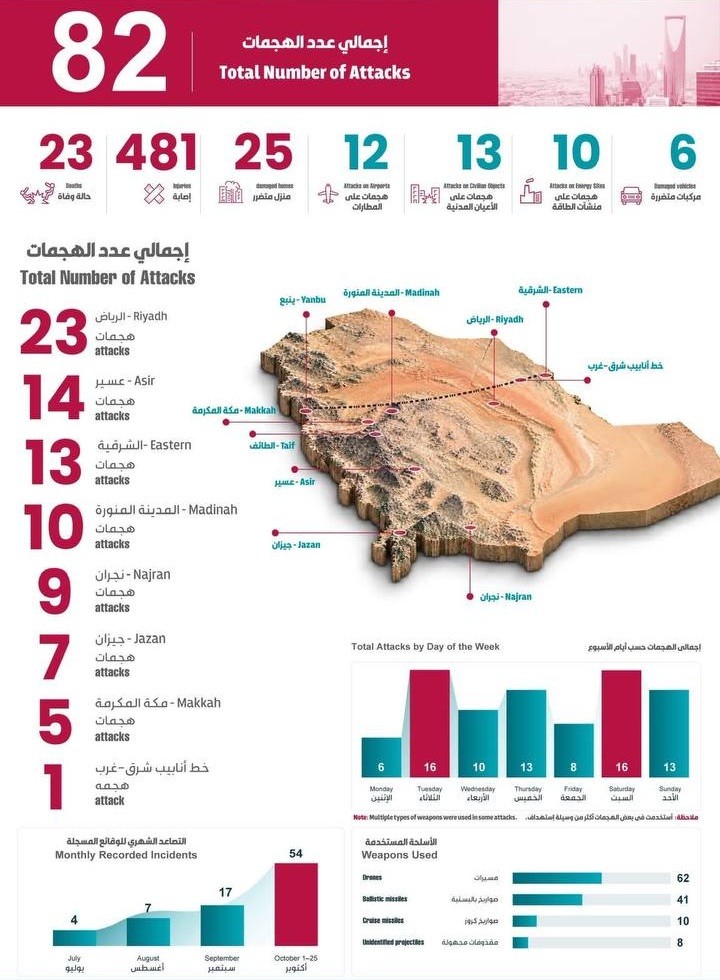
US strikes on Iran after 3 November are the likelier course, with Iran’s continued assault on shipping in Hormuz supplying the justification. Yet, the knots to untangle are the Red Sea front and the Houthis’ escalatory ladder towards maximum damage on prominent Saudi cities (see Figure 1). Despite Riyadh keeping the phone line to Tehran open throughout the war, with exchanges in April, June, July, and September, down to a foreign ministers’ call in October, it was attacked.
Figure 1: Statistical Overview of Houthi Attacks on Civilian Targets in Saudi Arabia (13 July to 25 October 2026)
Source: Gulf Research Center
The difference is that Saudi Arabia now brings support. On 26 October, Defence Minister Prince Khalid bin Salman, Pakistani Field Marshal Asim Munir, and Türkiye’s intelligence chief İbrahim Kalın went to Tehran for the Mecca pact’s first joint approach to the crisis, meeting Iranian President Masoud Pezeshkian and security chief Mohsen Rezaei, who argued that the regional states should have cooperated earlier and that security must rest with them, free of outside interference. The meeting produced no concrete action, only an undertaking for continued dialogue, with Tehran Spokesperson Esmail Baghaei calling it a possible first step towards a regional security framework.
In a “no war, no peace” status quo tilting towards escalation, that leaves Riyadh’s test running on two clocks: its dialogue with Tehran and a Washington expected to act after 3 November.
A recent, harder message came from Quatar where Tom Barrack, US ambassador to Türkiye and special envoy for Syria, said on 20 October that America’s role as a regional security guarantor has shifted—Washington would tend, not own. Urging regional states to take responsibility for their own security, he echoed former US President Barack Obama’s call to “share the neighborhood.” In a “no war, no peace” status quo tilting towards escalation, that leaves Riyadh’s test running on two clocks: its dialogue with Tehran and a Washington expected to act after 3 November. Whether Riyadh has enough influence over either is an open question.
Clemens Chay is Senior Fellow, Geopolitics, ORF Middle East.