 Global
Expert Speak | 20 April, 2026
Catalysing the GCC’s Waste-to-Energy Prospects for Agriculture
This article is the part of “Policy Pathways for Food and Water Security in the MENA Region”
The Gulf Cooperation Council (GCC) is projected to experience exponential population growth in the coming years, which will undoubtedly compound waste generation. In parallel, the region is accelerating domestic food production efforts to meet growing demand and enhance food security, resulting in increases in agricultural residues and food waste.1 These trends are driven by factors such as rising affluence, cultural preferences towards consuming new goods, and the short shelf-lives of imported food.2,3,4 To illustrate, in 2023, the amount of agricultural waste collected in GCC countries increased by 44 percent, while the amount of food waste in 2022 averaged 150kg per capita annually, surpassing the global average by 14 percent.5,6
Waste-to-Energy (WtE) refers to the process of generating electricity or heat from waste treatment.7 While incineration tends to be more prevalent, anaerobic digestion (AD) and pyrolysis are commonly deployed to convert organic matter into biogas and bio-fertiliser.8 Converting waste into energy presents several co-benefits, namely strategic waste management enforcement, landfill diversion, material recovery, resource looping, and contributions to renewable energy. Given converging national commitments towards promoting circular economy principles and reducing food loss and waste, WtE through AD and pyrolysis offers a nascent yet economically viable solution to address agriculture and food waste, meet facilitylevel energy needs, and promote regenerative agriculture. This article assesses the evolving WtE landscape across the Gulf, evaluating opportunities and key challenges to leverage WtE within the region’s rapidly expanding agriculture sector.
Converging National Policies Enable Catalysation of WtE Growth
All six GCC countries have established targets for renewable energy production, but WtE currently comprises a tiny fraction of this output.9 Harnessing WtE conversion potential first requires developing a strong foundation for waste collection, separation, and management. Despite progress, the GCC countries’ waste management strategies are greatly limited to landfilling, which currently processes more than 85 percent of the region’s waste.10,11 Currently, less than 20 percent of solid waste is adequately treated, and less than 5 percent is recycled.12 Food waste comprises the largest portion sent to landfills and is the primary source of methane.13 This strategy will also likely falter in the long term for countries like Qatar, Kuwait, and Bahrain, which have limited land capacity.14
A handful of GCC countries have instituted converging waste, energy, and circular economy policy commitments, enabling WtE to gain traction over the last five years. Well-established and commercial-scale plants exist in the UAE and Qatar and are rapidly materialising in Saudi Arabia, Bahrain, Oman, and Kuwait. These plants largely convert municipal solid waste (MSW), which includes organic food waste, to electricity through incineration, a process that releases carbon emissions from burning, albeit to a lesser extent than landfilling.15
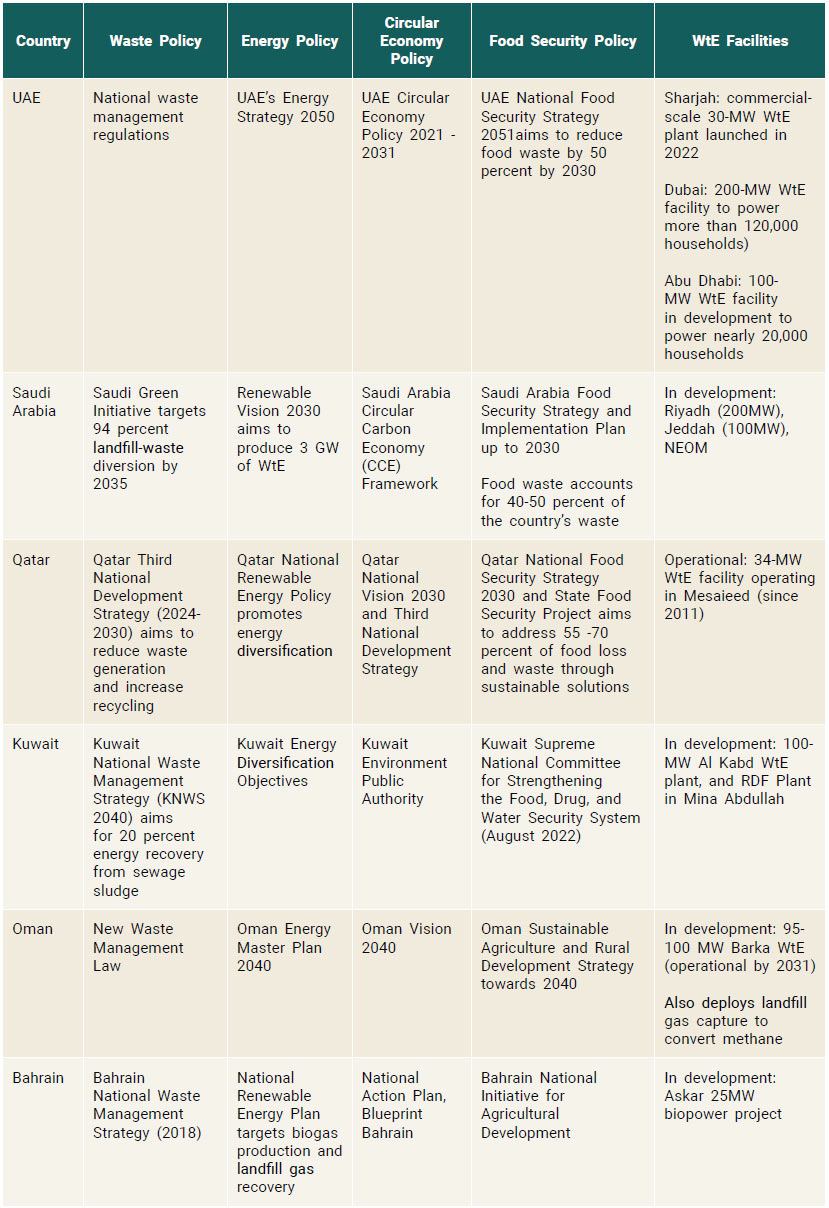
Source: Compiled by the author
Expanding WtE in the GCC’s Agriculture Sector
The GCC countries have set forth national vision and food security strategies outlining commitments towards accelerating domestic food production and food waste reduction initiatives.16 Agriculture, food, and beverage facilities should consider implementing on-site, localised and integrated AD and pyrolysis systems through industrial symbiosis to extend the life of scarce resources and encourage closed-loop processes.17,18,19 GCC countries are increasingly leveraging AgriTechnologies to boost resource efficiency amidst water and climate constraints, but this can be energy-intensive.20 Therefore, converting food residue into biogas through anaerobic digestion (AD), a process where micro-organisms decompose organic matter to produce biogas, can help meet facility-level energy needs.21 Pyrolysis converts organic waste and digestate byproducts from AD into biofuel or biochar, which strengthens soil fertility and water retention, reducing irrigation needs.22,23,24 The GCC’s existing crop commodities (date palms, cereal, fruits and vegetables) and animal waste are all suitable and energy-rich feedstock inputs for AD and pyrolysis.25,26 One study notes that GCC crop residues offer 1.68 Mtpa of untapped energy, while animal waste offers 25.52 Mtpa, offsetting up to 13.35 percent of current electricity consumption.27 AD also has a lower environmental impact compared to incineration.28
Compared to stand-alone operations, on-site integrated AD and pyrolysis systems offer more cost-effective, water- and energy-efficient solutions.29 Electricity generated from biogas is minimal compared to conventional sources if pursued on a larger scale.30 Additionally, unlike MSW feedstock, agricultural waste quantities may fluctuate depending on the harvest season. However, when paired with renewables like solar, biogas can help meet facility-level electricity demand. On-site infrastructure would save resources allocated towards transferring waste for sorting and complement reuse methods like composting. Challenges include managing the heterogeneity of food waste, which risks influencing the quality of feedstock that can be converted into biogas.31
Diverting organic waste from landfills would also help reduce water contamination, while biochar products would help reduce dependence on water-intensive synthetic fertilisers.32 Combining these processes with growing efforts to leverage local water treatment and reuse systems for the agriculture sector would reduce pressure on constrained water systems.33 Ensuring compliance with water quality standards and monitoring and deploying alongside comprehensive awareness campaigns would prevent unwanted contamination and ease concerns that inhibit technology uptake in the region.34
Despite the proven technical feasibility of generating biogas from AD across Oman, Qatar, and Kuwait, the strategy remains heavily underutilised.35,36,37 The potential electricity generated from Oman’s organic waste could offset up to 22.5 percent of the country’s total energy consumption, yet it is currently managed through landfills.38 In Qatar, the traditionally landfilled organic fraction of municipal solid waste, livestock manure, and sewage sludge waste can all be valorised through AD to generate 3.5 million MWh of surplus clean energy.39 In Kuwait, food waste is the most energy-rich feedstock, yet biogas contributes to zero percent of the country’s renewable footprint.40
Scholars note the economic feasibility of AD in the UAE, Saudi Arabia, and Bahrain. In the UAE, AD matches the economic feasibility of incineration. In Saudi Arabia, an abundance of food waste and low annual operational costs make biomethanation (a form of AD) a suitable option.41 The levelised cost of energy produced from biomass is also comparable to that of solar in Saudi Arabia.42 In Bahrain, establishing an AD plant to treat biodegradable waste is expected to generate 213.3 GWh/y with approximate annual revenues of US$4.2 million a year from electricity sales.43
Organisations like ReFarm in Dubai have taken the initiative to integrate high-tech food waste recycling in their closed-loop food production system.44 ReFarm is a waste-to-value gigafarm producing more than 3 million kg of food powered with energy produced from incinerating its solid waste. Khalifa University has also researched the use of pyrolysis to transform green farm waste into biochar, which helps sequester atmospheric carbon dioxide when reused in soil, contributing to regenerative agriculture.45 The Gulf can also learn from Egypt, where companies like Wastilizer convert animal waste into water, biogas and plant fertiliser, enhancing crop and water quality.46 As domestic agricultural production grows, there is unharnessed potential to leverage on-site WtE in agricultural centres.
Capitalising on the Gulf’s WtE Potential: Next Steps
Implementing and scaling pilots remains a challenging feat since developing WtE remains a highly capital-intensive process, competing against lower-cost traditional landfilling methods in the immediate term.47 Many regulatory frameworks and financial incentive structures are still emerging and lack consistency.48 Small-scale initiatives would benefit from stateled tax incentives for the private sector, carbon credit allowances, and increasing landfill gate fees to increase appeal for AD development in the GCC.49 Financial feasibility would increase if combined with strict waste disposal regulations, strengthened integration between research, policy, and development, and the development of markets for biochar and digestate fertiliser.50 Establishing joint ventures and de-risking innovation through blended finance, like green sukuk, would also help scale efforts.51
Effective waste-to-energy operations also hinge on receiving consistent and high-quality feedstock sources to maximise energy generation. However, the efficiency of collection and sorting processes, as well as the quality and scale of logistics and agricultural infrastructure, currently vary among GCC countries, limiting the consistency of feedstock quality.52 Whilecountries like the UAE lead in food value chain innovations, others like Oman could benefit from integrated capacity building to facilitate technology adoption by small-scale farmers.53
Ensuring consistent feedstock for WtE should not overshadow the underlying need to regulate unsustainable consumption practices. Thus, prevention, reuse, and recycling should remain at the forefront of sustainable waste practices.54 WtE should incentivise strengthening implementation of stronger public awareness, recycling, and waste segregation programmes to help cultivate better habits, facilitate and improve waste operations.55
Conclusion
WtE is rapidly gaining momentum in the Gulf, with the potential to become a highly lucrative industry. Organic waste from food comprises a significant component of MSW but remains highly underutilised in Gulf countries.56 As the GCC strategises improvements in waste management practices and feasibility studies continue to highlight the versatility of WtE in the region, this solution emerges as a strong contender to promote closed-loop economies, especially for expanding sectors like agriculture. Catalysing WtE in the agricultural sector to reap the strategic benefits for the water-energy-food nexus will require harmonising waste management and water reuse standards across the GCC and reducing upfront financing barriers through public-private initiatives.
Leigh Mante is Junior Fellow, Climate and Energy, ORF Middle East, UAE.
Endnotes
1 Wael Al Mubarak, “The GCC Imports 85% of Its Food – Here’s How It Is Increasing Food Security Through Innovation,” World Economic Forum, 2025, https://www.weforum.org/stories/2025/02/gulf-food-securityinnovation/.
2 “GCC Waste Management Market Size & Share Analysis – Growth Trends and Forecast (2025-2030),” Modor Intelligence, https://www.mordorintelligence.com/industry-reports/gcc-waste-management-market.
3 Abdullah Alghafis et al., “Harnessing Renewable Waste as a Pathway and Opportunities Toward Sustainability in Saudi Arabia and the Gulf Region,” Sustainability 17, no. 20 (2025), https://www.mdpi.com/2071- 1050/17/20/8980.
4 Hamid El Bilali and Tarek Ben Hassen, “Food Waste in the Countries of the Gulf Cooperation Council: A Systematic Review,” Foods 9, no. 4 (2020), https://doi.org/10.3390/foods9040463.
5 “GCC-Stat: 267.7 Million Tons of Waste Collected, 192.0 Million Tons Treated Across GCC Countries,” 2025, https://www.wam.ae/en/article/15oej8a-gcc-stat-2627-million-tons-waste-collected-1920.
6 Alexander Pohl and Sabri Hamade, “Tackling Food Waste in the GCC Grocery Market,” Oliver Wyman, https:// www.oliverwyman.com/our-expertise/insights/2025/mar/how-to-successfully-reduce-retail-food-waste-inthe- gcc.html.
7 United Nations Framework Convention on Climate Change, “Waste to Energy Technologies,” https://unfccc. int/technology/waste-to-energy-technologies.
8 Jun Dong et al., “Comparison of Waste-to-energy Technologies of Gasification and Incineration Using Life Cycle Assessment: Case Studies in Finland, France and China,” Journal of Cleaner Production, no. 203 (2018), https://doi.org/10.1016/j.jclepro.2018.08.139.
9 IRENA, Renewable Energy Markets: GCC 2023, Abu Dhabi, International Renewable Energy Agency, Abu Dhabi, 2023, https://www.irena.org/-/media/Files/IRENA/Agency/Publication/2023/Dec/IRENA_Rnewable_ energy_markets_GCC_2023.pdf.
10 Gulf Daily News, “GCC Countries Need Stronger Waste Management Reforms,” ZAWYA by LSEG, 2024, https://www.zawya.com/en/economy/gcc/gcc-countries-need-stronger-waste-management-reformsry4f79ze.
11 “Driving Value from Waste: The Circularity Opportunity,” Tadweer Group, https://www.worldfutureenergy summit.com/content/dam/sitebuilder/rxae/worldfutureenergysummit/docs/WFES-2025-Driving-Valuefrom- Waste.pdf.coredownload.328851850.pdf.
12 Arafat Aden, “Waste Prevention in Middle East – Prospects and Challenges,” EcoMENA, 2025, https:// www.ecomena.org/waste-prevention/#:~:text=Making%20products%20that%20are%20more,being%20 urbanized%20at%20over%2090%25.
13 Hamid El Bilali and Tarek Ben Hassen, “Food Waste in the Countries of the Gulf Cooperation Council: A Systematic Review,” Foods 9, no. 4 (2020), https://doi.org/10.3390/foods9040463.
14 Baqir Al-Alawi et al., “State of Play for Cirular Built Environment in Gulf Cooperation Council,” Arup, 2021, https://www.oneplanetnetwork.org/sites/default/files/gcc_final_210214.pdf.
15 Fionnuala Murphy, “Environmental Impacts of Waste Management Strategies: Case Studies Compilation,” IEA Bioenergy, 2025, https://www.ieabioenergy.com/wp-content/uploads/2025/04/IEA-Bioenergy-Task-36_ Case-Study-Report-Env-Impacts-of-Waste-Management-Strategies.pdf.
16 Wael Al Mubarak, “The GCC Imports 85% of Its Food – Here’s How It Is Increasing Food Security Through Innovation,” World Economic Forum, 2025, https://www.weforum.org/stories/2025/02/gulf-food-security-innovation/.
17 Gunther Pesta et al., “Implementation of Anaerobic Digestion Facilities In The Food and Beverage Industry,” IEA Bioenergy, https://www.ieabioenergy.com/wp-content/uploads/2025/03/IEA-Bioenergy-Task-37-Foodand- Beverage_20250302.pdf.
18 Qifan Zhang et al., “Anaerobic Digestion + Pyrolysis Integrated System for Food Waste Treatment Achieving Both Environmental and Economic Benefits,” Energy 288, 2024, https://doi.org/10.1016/j.energy.2023.129856.
19 Saida Tayibi et al., “Synergy of Anaerobic Digestion and Pyrolysis Processes for Sustainable Waste Management: A Critical Review and Future Perspectives. e, 2021, 152, https://hal.inrae.fr/hal-03463924v1/ document#:~:text=Coupling%20anaerobic%20digestion%20%2D%20pyrolysis%20processes,4.
20 Gabriel Dauchot et al., “Energy Consumption as the Main Challenge Faced by Indoor Farming to Shorten Supply Chains,” Cleaner and Circular Bioeconomy 9, 2024, https://doi.org/10.1016/j.clcb.2024.100127.
21 V. Burg et al., “Agricultural Biogas Plants As a Hub to Foster Circular Economy and Bioenergy: An Assessment Using Substance and Energy Flow Analysis,” Resources, Conservation and Recycling 190 (2023), https://doi. org/10.1016/j.resconrec.2022.106770.
22 Jessica Graca et al., “Pyrolysis, A Recovery Solution to Reduce Landfilling of Residual Organic Waste Generated From Mixed Municipal Waste,” Environmental Science and Pollution Research 31 (2024): 30676- 30687, https://doi.org/10.1007/s11356-024-33282-1.
23 Tayibi et al., “Synergy of Anaerobic Digestion and Pyrolysis Processes for Sustainable Waste Management: A Critical Review and Future Perspectives.”
24 Shubh Pravat Singh Yadav et al., “Biochar Application: A Sustainable Approach to Improve Soil Health,” Journal of Agriculture and Food Research 11, 2023, https://doi.org/10.1016/j.jafr.2023.100498.
25 Andrew Welfle and Ali Alawadhi, “Bioenergy Opportunities, Barriers, and Challenges in the Arabian Peninsula – Resource Modelling, Surveys and Interviews,” Biomass and Bioenergy 150, 2021, https://doi.org/10.1016/j. biombioe.2021.106083.
26 Gebresilasie Gebremedhin Gebresilasie et al., “Comparative Potential of Biogas Production From the Distillery, Fruit and Vegetable Waste and Their Mixtures (Digestion),” Heliyon 11, no. 2 (2025), https://doi. org/10.1016/j.heliyon.2025.e42068.
27 Welfle and Alawadhi, “Bioenergy Opportunities, Barriers, and Challenges in the Arabian Peninsula – Resource Modelling, Surveys & Interviews.”
28 Fionnuala Murphy, “Environmental Impacts of Waste Management Strategies: Case Studies Compilation.”
29 Solomon Inalegwu Okopi et al., “Environmental Sustainability Assessment Of a New Food Waste Anaerobic Digestion and Pyrolysis Hybridization System,” Waste Management 179, 2024: 130-143, https://doi. org/10.1016/j.wasman.2024.01.038.
30 Omnia Bakhiet and Riham Mustafa, “Biogas Production in Abu Dhabi – An Evaluation based on Energy and Economy,” https://www.diva-portal.org/smash/get/diva2:844949/FULLTEXT01.pdf.
31 Mariana Ferdes et al., “Food Waste Management for Biogas Production in the Context of Sustainable Development,” Energies 15, no. 17 (2022), https://doi.org/10.3390/en15176268?urlappend=%3Futm_ source%3Dresearchgate.net%26utm_medium%3Darticle.
32 Anton Fagerstrom et al., “The Role of Anaerobic Digestion and Biogas in the Circular Economy,” IEA Bioenergy, Task 37 (2018), https://www.ieabioenergy.com/wp-content/uploads/2018/08/anaerobic-digestion_web_ END.pdf.
33 AS Qureshi, “Challenges and Prospects of Using Treated Wastewater to Manage Water Scarcity Crises in the Gulf Cooperation Council (GCC) Countries,” International Center for Biosaline Agriculture (ICBA), https://www. mdpi.com/2073-4441/12/7/1971.
34 Anastasis Christou et al., “Sustainable Wastewater Reuse for Agriculture,” Nature Reviews Earth & Environment 5, 2024: 504-521, https://doi.org/10.1038/s43017-024-00560-y.
35 Abdul Rahim Al Umairi et al., “Biogas Production from Cow Manure Using an Anaerobic Digestion Technique,” Proceedings of the International Conference on Civil Infrastructure and Construction (CIC) 1 (2023), https://doi. org/10.29117/cic.2023.0184.
36 Sophia Ghanimeh et al., “Harnessing Waste for Emission Cuts: the Anaerobic Digestion Potential in Qatar,” Earth Systems and Environment 9 (2025): 1923-1936, https://doi.org/10.1007/s41748-025-00698-9.
37 Jean H. El Achkar, “A Bioenergy Blueprint for Kuwait: Regional Research Insights, Waste Valorisation, Feasibility and Policy Pathways,” LSE Middle East Center (2025), https://eprints.lse.ac.uk/129838/1/A_ Bioenergy_BluePrint_for_Kuwait.pdf.
38 Andrew Welfle and Ali Alawadhi, “Bioenergy Opportunities, Barriers, and Challenges in the Arabian Peninsula – Resource Modelling, Surveys & Interviews,” Biomass and Bioenergy (2021), https://doi.org/10.1016/j. biombioe.2021.106083.
39 Ghanimeh et al., “Harnessing Waste for Emission Cuts: the Anaerobic Digestion Potential in Qatar.”
40 Achkar, “A Bioenergy Blueprint for Kuwait: Regional Research Insights, Waste Valorisation, Feasibility and Policy Pathways.”
41 Omar Ouda et al., “An Argument for Developing Waste-to-Energy in Saudi Arabia,” Environmental Science 45 (2015): 337-342, https://doi.org/10.3303/CET1545057.
42 Muhammad Sadiq and Zakariya Kaneesamkandi, “Biodegradable Waste to Biogas: Renwable Energy Option for the Kingdom of Saudi Arabia,” International Journal of Innovation and Applied Studies 4, no. 1 (2013): 101- 113, https://www.researchgate.net/publication/303254958_Biodegradable_waste_to_biogas_Renewable_ energy_option_for_the_Kingdom_of_Saudi_Arabia.
43 Sumaya Yusuf Abbas, “Feasibility of Anaerobic Digestion as an Option for Biodegradable Waste Management in the Kingdom of Bahrain,” Journal of Research in Environmental Science and Toxicology 9, no.1 (2020): 16-21, https://www.researchgate.net/publication/344337892_Feasibility_of_Anaerobic_Digestion_as_an_Option_ for_Biodegradable_Waste_Management_in_the_Kingdom_of_Bahrain.
44 Babu Das Augustine, “Dubai’s Food Tech Valley and ReFarm to Build A Hi-tech Gigafarm,” The National News, 2023, https://www.thenationalnews.com/business/technology/2023/12/06/dubais-food-tech-valley-andrefarm- to-build-a-hi-tech-gigafarm/.
45 Erica Solomon, “How Agricultural Waste Can Contribute to the UAE’s Food, Water, and Energy Security,” Khalifa University, 2018, https://www.ku.ac.ae/how-agricultural-waste-can-contribute-to-the-uae-s-food-water-andenergy- security.
46 “GCC Cooperation and Innovation Improve Food Security,” Oxford Business Group, https://oxfordbusinessgroup. com/reports/kuwait/2024-report/trade-investment/at-the-source-ensuring-food-supply-is-proving-apromising- area-for-investment-analysis/.
47 Gulf Magazine, “UAE Waste-to-Energy Plants Operational: Turning Waste into Renewable Energy,” https:// gulfmagazine.co/uae-waste-to-energy-plants-operational-turning/.
48 Abdullah Alghafis et al., “Harnessing Renewable Waste as a Pathway and Opportunities Toward Sustainability in Saudi Arabia and the Gulf Region,” Sustainability 17, no. 20 (2025), https://www.mdpi.com/2071- 1050/17/20/8980.
49 Ali Marefat et al., “Financial Feasibility and Optimization of Anaerobic Digestion Systems for Sustainable Waste Management: A Comprehensive Global Analysis,” Cleaner Environmental Systems 19 (2025), https:// doi.org/10.1016/j.cesys.2025.100339.
50 Achkar, “A Bioenergy Blueprint for Kuwait: Regional Research Insights, Waste Valorisation, Feasibility and Policy Pathways.”
51 “UAE’s First Waste-to-energy Project Receives Landmark Award for First-of-its-kind Financing Loan,” Masdar (2018), https://masdar.ae/en/news/newsroom/uaes-first-waste-to-energy-project-receives-landmark-award-for-first-of-its-kind-financing-loan.
52 Gulf Magazine, “UAE Waste-to-Energy Plants Operational: Turning Waste into Renewable Energy”
53 Government of the Sultanate of Oman, “Sustainable Agriculture and Rural Development Strategy Towards 2040,” FAO (2016), https://faolex.fao.org/docs/pdf/oma214204E.pdf.
54 “Waste Hierarchy,” European Union, https://eur-lex.europa.eu/legal-content/EN/TXT/?uri=LEGISSUM:waste_ hierarchy.
55 Waste-to-Energy Projects in Saudi Arabia (2025), https://setupinsa.com/waste-to-energy-projects-in-saudiarabia/.
56 Achkar, “A Bioenergy Blueprint for Kuwait: Regional Research Insights, Waste Valorisation, Feasibility and Policy Pathways.”