 Global
Expert Speak | 20 March, 2026
Why Regime Change in Iran is Difficult
Spotlight
- The assumption that removing Iran’s Supreme Leader will precipitate state collapse fundamentally misreads the regime’s structure; it is an institutionalised theocracy built for survival, not a fragile personalist dictatorship.
- The Islamic Republic is sustained by three foundational pillars—the IRGC, the clerical establishment, and a massive state bureaucracy—that are bound together by a multi-billion-dollar web of economic patronage.
- The swift 2026 elevation of Mojtaba Khamenei mirrors the 1989 succession, proving that when the regime faces existential threats, the elites will rapidly bypass traditional theological hierarchies to preserve the regime.
The assassination of Supreme Leader Ayatollah Ali Khamenei in February, 2026, amid an unprecedented escalation of US-Israeli military strikes, prompted wide ranging speculations regarding regime change. The assumption was that the fall of the Islamic Republic’s paramount authority would inevitably precipitate the collapse of the regime itself. Yet, as of mid-March 2026, the Iranian state has not fractured. Instead, the Assembly of Experts moved with ruthless efficiency to appoint his 56-year-old son, Mojtaba Khamenei, as the third Supreme Leader. It is important to understand why the regime continues to function despite this catastrophic shock. The fundamental miscalculation is the belief that removing the leader guarantees the regime’s collapse. Iran is not a fragile, personalist dictatorship but a highly entrenched, institutionalised theocracy fortified by vast economic patronage networks.
The Miscalculation of Decapitation
The strategic logic of decapitation relies on the historical precedents of personalist dictatorships, a logic that proved effective against Saddam Hussein in Iraq. In such systems, the institutions of the state are often hollowed out, serving merely as personal instruments of the autocrat. When the autocrat is removed, the center cannot hold and the state apparatus rapidly disintegrates.
Iran is not a fragile, personalist dictatorship but a highly entrenched, institutionalised theocracy fortified by vast economic patronage networks.
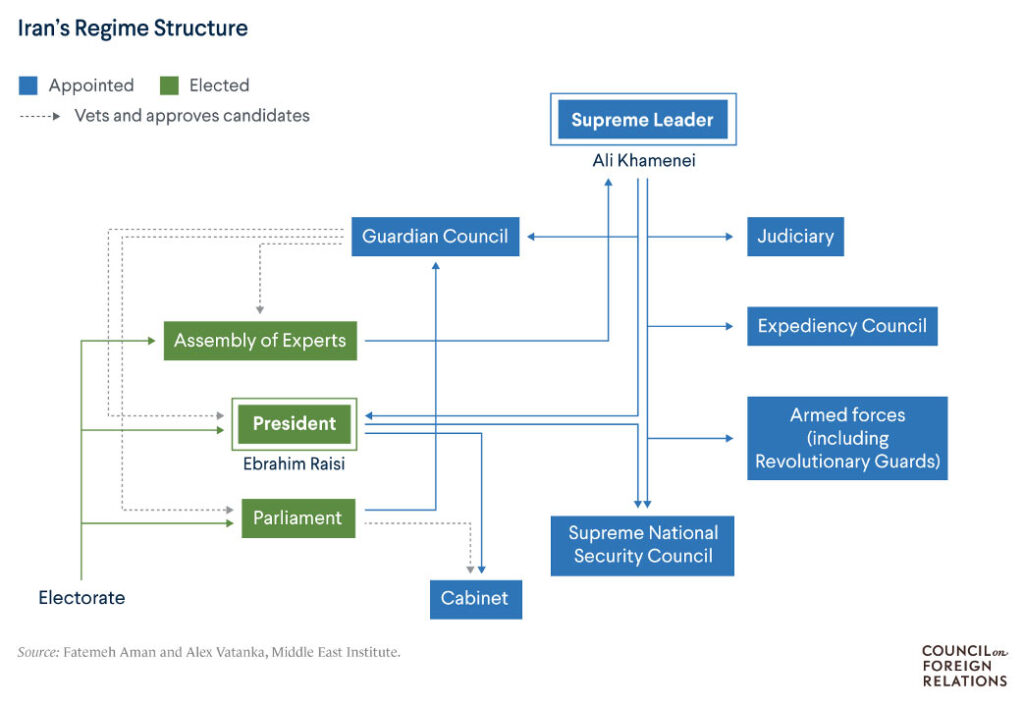
However, applying this paradigm to the Islamic Republic is a profound analytical error. The Iranian system is designed explicitly for institutional survival. While the Supreme Leader undeniably held immense overarching power, he sat atop a deep and highly structured power architecture supported by three foundational pillars: the military, the clerics and the state bureaucracy. The intricate structure of this regime can be understood in Figure 1. The rapid ascension of Mojtaba Khamenei perfectly illustrates the resilience of this structure. It was not a chaotic scramble for power, but a highly organised succession driven by the functioning system within Iran. The institutions consolidated immediately because all three pillars possess overwhelmingly strong incentives to protect the system that guarantees their wealth and survival.
Figure 1: Iran’s Power Structure
Pillar I: The Military and the Economics of Monopoly
The Islamic Revolutionary Guard Corps (IRGC) is the most powerful military organisation within Iran but viewing it purely through a military lens fundamentally misunderstands its nature. The IRGC is a multi-billion-dollar economic empire. Over the past decades, it has systematically controlled the Iranian economy, transforming into the country’s most powerful corporate conglomerate.
IRGC exercises monopolistic control over Iran’s most lucrative sectors. It dictates the extraction and export of oil and gas, monopolises major construction projects and controls the nation’s telecommunications networks, mining operations, banking institutions and heavy industry. This economic hegemony generates the significant revenue required to fund both its domestic security apparatus and its extraterritorial proxy networks.
If the theocratic regime falls, the IRGC commanders do not merely lose their political influence but they lose their immense wealth and face the absolute certainty of criminal prosecution.
Consequently, the IRGC’s calculus regarding regime survival is increasingly economic and existential. If the theocratic regime falls, the IRGC commanders do not merely lose their political influence but they lose their immense wealth and face the absolute certainty of criminal prosecution. For the military elite, regime change equates to total imprisonment or worse. Therefore, they will fight with uncompromising brutality to survive. The IRGC’s decisive role in swiftly installing Mojtaba Khamenei, a figure deeply embedded within their security and intelligence networks, was a calculated move to secure a chief executive that is known to be a hardliner.
Pillar II: The Clerical Establishment and the Patronage Economy
The second pillar sustaining the institutional fortress is the clerical establishment. While analysis frequently focuses on the ideological positions of the Shiite clergy, their enduring grip on power is equally rooted in a sophisticated system of economic patronage. The dominance of the clerical establishment traces itself back to the Iran-Iraq war which compelled the Islamic Republic to mobilise every institutional resource for survival and had the unintended consequence of strengthening the clerical regime. Therefore, currently the clerics do not merely dictate morality, they manage vast segments of the national wealth through the Bonyads or charitable foundations. Originally established to manage the confiscated assets of the erstwhile Shah and his elite, these bonyads have evolved into tax-exempt, highly opaque mega-corporations. They control a significant percentage of Iran’s non-oil gross domestic product. Crucially, the bonyads function as the regime’s primary mechanism for dispensing economic patronage.
The clerical elite oversees these foundations, extracting immense wealth and dispensing rents to maintain their socio-political dominance. If the Islamic Republic collapses, the clergy will be violently stripped of these assets and their monopoly on social power. The survival of the system is therefore an absolute economic imperative for the clerical class. This could explain the Assembly of Experts’ willingness to bypass traditional theological hierarchies and overlook the fact that Mojtaba Khamenei is a mid-ranking cleric to appoint him as the Supreme leader, as he is sure to further his father’s legacy organisations.
With no consensus over Iran’s next leader, Khamenei was elevated to the top position and the constitution was subsequently amended to accommodate him despite his qualifications.
The precedent for this was established in 1989, when Ali Khamenei himself was unexpectedly elevated to Supreme Leader despite also being a mid-ranking cleric who did not meet the constitutionally required religious qualifications. Ayatollah Hussein-Ali Montazeri, Khomeini’s designated heir since 1985, had been dismissed after publicly condemning the regime’s brutal excesses. With no consensus over Iran’s next leader, Khamenei was elevated to the top position and the constitution was subsequently amended to accommodate him despite his qualifications. The parallel with 2026 is striking: just as Ali Khamenei was a wartime selection in the immediate aftermath of the devastating Iran-Iraq War, chosen not for theological eminence but for his political reliability, so is Mojtaba Khamenei a wartime selection. In both instances, the Assembly of Experts demonstrated that when the regime’s survival is at stake, institutional pragmatism decisively overrides theological orthodoxy. Therefore, the preservation of the economic and political structure vastly outweighs any internal debates over theological doctrine or the anti-dynastic origins of the 1979 revolution that is anti-thetical to appointing the former Supreme Leader’s son to the highest office in Iran.
Pillar III: The Bureaucracy and the Fear of the Void
The final pillar supporting the regime is the sprawling state bureaucracy. Iran possesses a massive administrative apparatus. Iran has structured institutions including the Guardian Council that vets laws and election candidates, Islamic Consultative Assembly which is the national parliament and the Judiciary of Iran that enforces Islamic codes. As a result, approximately 80 percent of Iran’s economic activity is driven by the state sector and many Iranians depend entirely on the state for their salaries. In a macroeconomic environment devastated by years of Western sanctions and chronic mismanagement, state employment is often the only reliable lifeline. Estimates show that eight million Iranians are on the Islamic Republic’s payroll.
The collapse of the state structure threatens to plunge the nation into an economic abyss or worse, a catastrophic civil war akin to those witnessed in neighboring states.
For this vast bureaucratic class, the prospect of regime change presents a terrifying unknown. While ideological devotion to the Supreme Leader may be waning, as evidenced by the massive, bloody protests of recent years, the bureaucratic apparatus relies on the regime for its day-to-day survival. The collapse of the state structure threatens to plunge the nation into an economic abyss or worse, a catastrophic civil war akin to those witnessed in neighboring states. This ensures that the bureaucracy continues to function out of self-preservation, if not absolute loyalty.
The Enduring Institutional Fortress
As of March, 2026, the Islamic Republic of Iran remains embroiled in an existential conflict, absorbing unprecedented kinetic strikes from abroad and simmering discontent at home. Yet, the swift and seamless transition of power to Mojtaba Khamenei demonstrates a decisive reality: the regime is operating exactly as its architects intended. It has proven that it is an institutional fortress, not a cult of personality.
The Islamic Republic is sustained by an iron triangle of the military, the clerics and the bureaucracy with the Supreme Leader sitting in the middle.
The assumption that external pressure or the assassination of a single leader will trigger an organic, democratic collapse fundamentally misreads the political economy of the Iranian state. The Islamic Republic is sustained by an iron triangle of the military, the clerics and the bureaucracy with the Supreme Leader sitting in the middle. These factions are bound together not merely by shared religious ideology, but by an intricate multi-billion-dollar web of economic patronage and monopolistic wealth. For the elites commanding these pillars, the fall of the regime guarantees their complete destruction. Therefore, it is important to accept that the Iranian Regime is a highly incentivised and heavily armed corporate-theocratic conglomerate that will fight to the bitter end for its survival.
Samriddhi Vij, Associate Fellow, Geopolitics, ORF Middle East.