 Global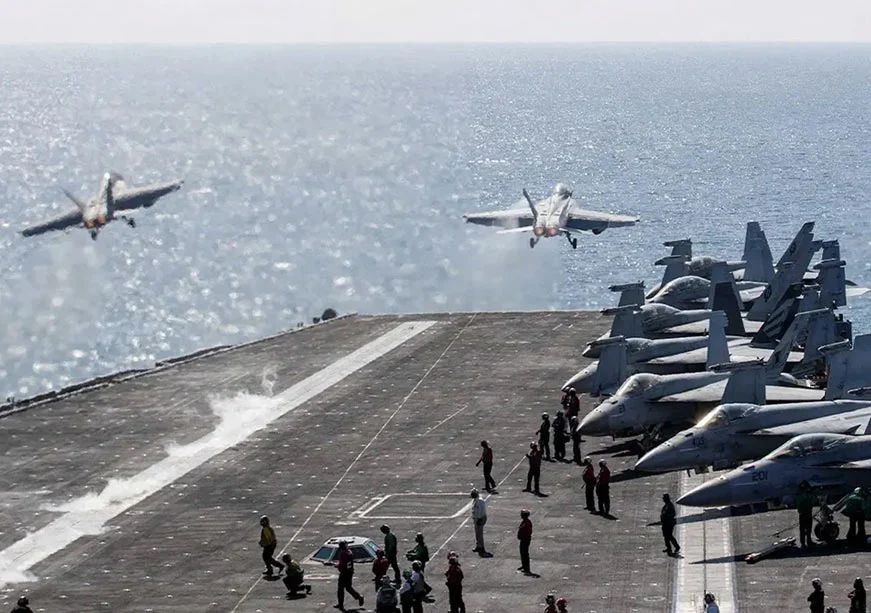
Commentaries | 03 April, 2026
Dominance without Control: Naval Dynamics in Operation Epic Fury
Despite overwhelming conventional superiority, Operation Epic Fury reveals the limits of US naval dominance as Iran’s asymmetric sea-denial strategy turns control of the Strait of Hormuz into a protracted contest of endurance
After years of acrimony with Iran, the US began a joint operation called ‘Epic Fury’ in partnership with Israel, aiming for regime change in Tehran. To establish naval dominance in the operation, the US Navy deployed two carrier task groups in the region. However, following the initial assault, the operation has evolved into a naval encounter requiring swift adaptation by the US after Iran decided to impose a selective blockade on a key chokepoint of global energy trade – the Strait of Hormuz. Iran has targeted at least 16 commercial vessels transiting through the narrow waterway, halting all traffic into the Persian Gulf, and as a consequence, disrupting global supply chains. As the conflict enters its second month, it is important to understand why, despite initial military success and naval dominance, the US now faces its biggest challenge yet: reopening the Strait of Hormuz to commercial shipping.
Iran has targeted at least 16 commercial vessels transiting through the narrow waterway, halting all traffic into the Persian Gulf, and as a consequence, disrupting global supply chains.
Strategically, controlling access to the Persian Gulf gives Iran the leverage to deny the US the operational success it seeks. As the conflict moves toward attrition, this article argues that, despite establishing conventional naval dominance, the US will find it difficult to counter Iran’s well-formulated sea-denial strategy and establish control over the Strait of Hormuz. With reports indicating an impending US ground operation to establish control over the waterway, this article examines the current naval warfare dynamics of Operation Epic Fury.
Decapitation and Shock: Conventional Force Dominance
The precision and pace of US and Israeli strikes on senior Iranian leaders and key military assets in the early phase established US networked warfare superiority, giving it a decisive advantage. The US’s multi-domain intelligence, surveillance, and reconnaissance (ISR) dominance enabled swift decision-making and dynamic targeting of Iran’s naval assets. This mass targeting destroyed and incapacitated more than 150 Iranian vessels and auxiliary craft, including multiple flagship assets like a drone carrier, a submarine, and an entire fleet of frigates. Major Iranian naval bases and support infrastructure were also targeted, degrading Iran’s capacity to mount a coordinated naval campaign east of Hormuz. Additionally, the torpedoing of the IRIS Dena in the Indian Ocean, about 20 nautical miles off the coast of Sri Lanka, resoundingly demonstrated the bandwidth of American naval dominance. Then, the Israeli decapitation strike, eliminating the IRGC naval commander coordinating Iran’s blockade, further reflected operational astuteness. How the US translates this naval dominance into sustained battlespace control will determine the outcome of the operation.
Iran’s Leverage: Denying the Strait
Blocking the Strait of Hormuz to international shipping using an anti-access/area-denial (A2/AD) strategy has become an inevitable reality for this generation of Tehran’s decision-makers, to ensure regime survivability. Their perspective was shaped by the events of the Tanker War in 1988, during which a US frigate suffered heavy damage after it hit an Iranian naval mine while on patrol in the Central Persian Gulf. In response, Washington retaliated with Operation Praying Mantis, destroying two oil terminals, sinking a corvette, a missile boat, and severely damaging a second corvette. It was a devastating loss for Iran. Consequently, this forced Iran’s strategists to recalibrate and acknowledge the limits of conventional deterrence against a more capable adversary. Over time, they refined their approach, learning from subsequent US campaigns in the region. They concluded that the only way to establish deterrence was to adopt an asymmetric naval strategy centred on effective, distributed unconventional capabilities (referred to as ‘mosaic defence’) that could disrupt access to the Persian Gulf. The result was a force structure built around decentralised command and control, and layered asymmetric capabilities geared towards shallow-water warfare.
Whatever remains of Iran’s capabilities is designed for maritime guerrilla warfare. The principal component of this strategy is Iran’s minelaying capacity. Iran reportedly possesses 3,000 to 4,000 naval mines of various types, thus retaining the capacity to ensure that transit in the region cannot resume until a comprehensive counter-mine mission is completed.
Despite losing frontline naval assets, including minelayers, in the initial phase of the operation, which rendered Iran’s conventional forces largely ineffective, Tehran retains the resilience to sustain an extended sea-denial campaign (Refer to Table 1). Whatever remains of Iran’s capabilities is designed for maritime guerrilla warfare. The principal component of this strategy is Iran’s minelaying capacity. Iran reportedly possesses 3,000 to 4,000 naval mines of various types, thus retaining the capacity to ensure that transit in the region cannot resume until a comprehensive counter-mine mission is completed. Traditionally, mine-clearing missions, even under perfect conditions, take weeks, and this is Iran’s strategy right now – to buy more time.
Concomitantly, to deter such a mission, Iran has developed a fleet of fast-attack craft armed with missiles and torpedoes that could swarm any incoming naval force. Completing this strategic ploy are mobile batteries armed with anti-ship cruise missiles, located in a network of tunnels and caves marking the rugged terrain overlooking the chokepoint. Moreover, the inductions of midget submarines and uncrewed systems, including one-way attack drones, have further solidified this tactic, as they can relay targeting information for mass fires and, if necessary, complete the kill chain themselves. The region’s geography restricts the manoeuvrability of large vessels, making them easy targets for highly mobile Iranian assets and, conversely, making such shoot-and-scoot assets difficult to engage for the US. However, the success of this strategy rests on Iran’s ability to preserve its localised ISR networks. Tehran anticipated US hesitation to undertake such high-risk mine-clearing operations, which is the key rationale behind Iran’s strategic posture. Every day of Iran’s blockade tests the resilience and endurance of US logistical networks and combat systems, thereby intensifying strategic pressure on Washington, without requiring outright naval success.
| Table 1: Estimated Functional Combat Capability of Iran for A2/AD Operations (Approximate)* | ||||
| Asset Type | Pre-Op Estimate | Likely Lost/Incapacitated | Possibly Still Functional | Strategic Effect |
| Midget Submarines | 16 – 20 | 2 – 4 | 12 – 16 | Sub-Surface Mine-Laying and ISR Capacity Remains |
| Major Surface Combatants | 9 – 10 | 8 – 9 | 1 – 2 | Conventional Surface Combat Capability Degraded |
| Patrol/Coast Craft | 400 + | 120 – 160 | 240 – 280 | Residual Swarm Threat in Coastal Waters |
| Support Vessels | 60 + | 5 – 10 | 50 + | Sustained Area-Denial Operations |
| Naval Mines | 3000 – 4000 | N.A. | N.A. | Persistent Mine Threat |
*Data is compiled by the author using various sources. Primary sources are The IISS Military Balance 2026 (Vol. 126); Janes Fighting Ships 2024–2025; Benjamin Jensen, How to Lose a Navy in 10 Days, CSIS (12th March 2026)
Countering an Asymmetric Force: The Real Test for the US Navy
Therefore, the main operational constraint the US currently faces is the prospect of clearing the narrow waterway of Iranian naval mines. The US Navy’s capability for such a complex operation has been severely depleted, as Washington recently decommissioned its Avenger-class mine-countermeasure vessels. Its replacement, the Independence-class Littoral Combat Ships (LCS), are either undergoing maintenance or deployed outside the operational area. Notably, concerns exist regarding the Independence-class ships’ mine-clearing capability, their AN/AQS-20 system, and the associated uncrewed modules.
Furthermore, any mine-clearing mission would require an escort from frontline US surface combatants, which would entail a significant risk. Prolonged clearance sorties will put them within range of Iranian sea-skimming anti-ship cruise missiles and torpedoes. Additionally, Iranian multi-domain uncrewed systems — whether aerial (UAVs, unmanned aerial vehicles), surface (USVs, unmanned surface vessels), or underwater (UUVs, unmanned underwater vehicles) — will likely saturate the battlespace, further extending denial and persistence. Similarly, one-way attacks by USVs and UUVs, along with Iranian midget submarines, will likely threaten surface ships with surprise attacks, compressing US reaction time. These threats also negate any possibility of US forces conducting escort missions for commercial shipping.
Washington’s lack of political groundwork and strategic cooperation with its partners before the conflict leaves the US deprived of allied mine-clearing expertise and support.
With the US confirming that it has deployed uncrewed drone speedboats for patrols for the first time in an active conflict as part of its operations against Iran, this indicates US tactical flexibility. The US could plausibly expedite the deployment and use of improved uncrewed mine-countermeasure systems to reduce risk to conventional manned assets. Washington’s lack of political groundwork and strategic cooperation with its partners before the conflict leaves the US deprived of allied mine-clearing expertise and support. While US Secretary of War Pete Hegseth stated that Washington had air superiority over the Strait of Hormuz, it remains unclear whether this aerial superiority can translate into US control of the waterway. However, continuous US airstrikes do stretch Iran’s ability to sustain the blockade indefinitely.
What Next: Breaking The Deadlock
As this effective deadlock continues and Operation Epic Fury enters its second month, three possible scenarios could emerge:
Scenario 1: The US is unable to counter Iran’s selective blockade of the Strait of Hormuz, given the risk surrounding sustained counter-mine operations. This stalemate provides Iran with a psychological advantage, and it will most likely keep charging a toll on ships seeking to transit through, establishing this as the new normal. This will most likely lead to higher energy prices, putting pressure on the US to secure a diplomatic end to the conflict. Even a limited mine presence or missile threat can sustain the blockade through insurance risk alone, without any need for kinetic engagement.
Scenario 2: The US is mobilising amphibious and airborne forces for a possible assault on Iranian positions adjacent to the Strait, including strategically important islands. A ground assault would trigger a vertical escalation of the conflict, with Iranian ground forces resolutely defending their positions and perhaps even initiating a counterattack. Such an operation could also invite retaliation from Iran-backed Houthi forces based in Yemen, to implement an additional naval blockade of the Bab-el-Mandeb Strait, opening another front of operations, and further paralysing global energy trade.
Scenario 3: Washington is attempting to assemble a combined maritime task force with the help of regional Gulf partners and NATO allies, including France and the UK. If this initiative succeeds, such a force would lend greater legitimacy and naval capability for mine-clearing operations and/or escort missions for commercial shipping. If the Iranians engage this task force to sustain the blockade, they will invite a more comprehensive international response, weakening their diplomatic position. Alternatively, upon encountering such a massive naval coalition, Iran may de-escalate, lift its selective blockade, and seek a diplomatic solution to the conflict.
The conflict demonstrates that naval dominance without mine-clearing capacity cannot guarantee maritime control in a contested littoral. The outcome of this conflict ultimately rests on the US ability to remain tactically flexible and cogitate a new strategy to counter Iran’s asymmetric sea-denial capacity.
Conclusion: Dominance is not Control
There is a sharp disparity between the strategies of the two forces as the conflict enters its second month. Iran’s asymmetric flexibility contrasts with the US’s strategic multi-domain dominance, making this conflict a clear clash between sea control and sea denial, and underscoring important lessons for future naval warfare. It resembles another ongoing conflict, albeit in a different maritime theatre – the Black Sea, where innovative but far less capable Ukrainian forces have implemented a concerted sea-denial strategy against a highly capable Russian Navy. Similarly, Iran is precipitating a sea-denial strategy against a far more capable naval force, perhaps the most dominant navy in the world, where both sides’ resilience, endurance, and persistence are being tested. Iran’s long-range strike attempts against the US naval base in Diego Garcia in the Indian Ocean illustrate that Tehran retains the ability to engage US forces in the wider battlespace beyond Hormuz. As reports indicate the US has only been able to destroy a third of Iran’s missile arsenal, if such attacks continue, it will force US planners to switch to a defensive posture, reducing operational concentration near Hormuz. The conflict demonstrates that naval dominance without mine-clearing capacity cannot guarantee maritime control in a contested littoral. The outcome of this conflict ultimately rests on the US ability to remain tactically flexible and cogitate a new strategy to counter Iran’s asymmetric sea-denial capacity. Counter command, control, communications, intelligence, surveillance, and targeting (C-C5ISR-T) efforts could prove crucial in such a formulation to disrupt Iranian decision-making and operational reach. In a sea-denial operation, the side that exercises effective control over time and information, not territory alone, ultimately shapes the outcome.
This commentary originally appeared in Observer Research Foundation.