 Global
Commentaries | 24 March, 2026
Fortifying Bahrain: Allied Reinforcements Amid Iranian Aggression
Iran’s escalating missile and drone strikes on Bahrain are testing the island’s military capabilities and exposing Western security commitments in the Gulf.
In the volatile theatre of Middle Eastern geopolitics, Bahrain has emerged as a precarious outpost, acutely exposed to Iran’s mounting belligerence. According to Wall Street Journal estimates, the small Gulf island maintains the region’s most limited stockpile of ballistic missile interceptors, a consequence of prolonged fiscal constraints, societal reluctance toward extravagant defense budgets, and inherent logistical and territorial limitations.
This vulnerability has now reached a critical juncture: since February 28, Bahrain has been the third most attacked Gulf state in Iran’s offensive campaign. This reality underscores the urgent need to augment defensive resources and secure allied support, as Iran’s low-cost projectiles attempt to overwhelm Bahrain’s finite defense arsenal. Even if Manama’s current reserves withstand the immediate barrage, the prospect of a prolonged or recurring confrontation persists.
As the war continues, Bahrain’s defenses will face mounting pressure, likely prompting both immediate appeals for allied support and longer-term contingency planning.
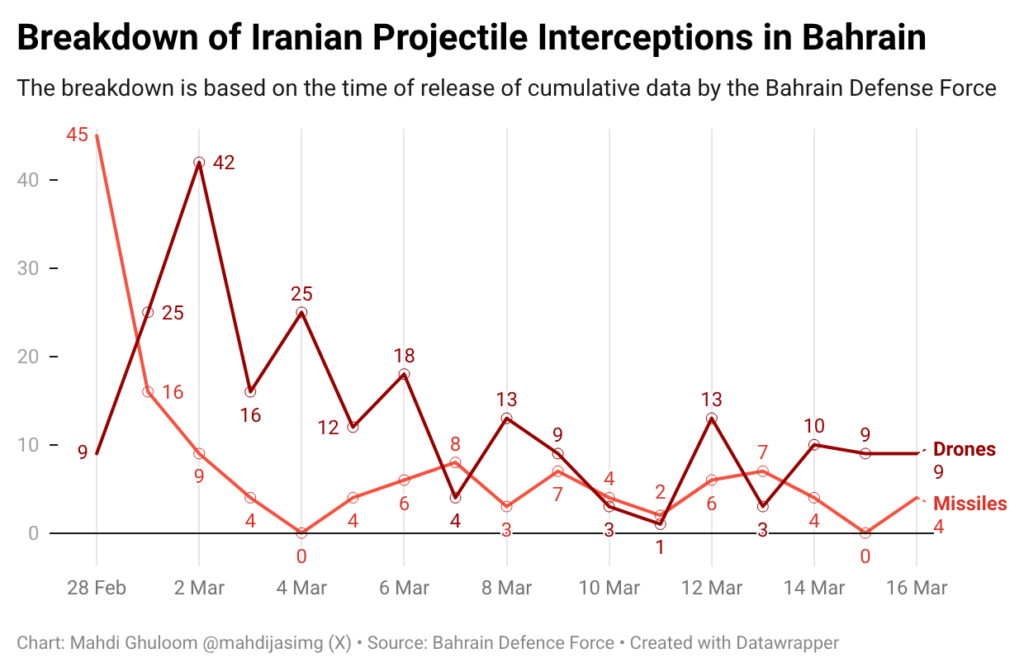
A review of the Bahrain Defense Force’s sequential data disclosures reveals a declining pattern in intercepted missiles and drones (Figure 1), even as these threats endure with unpredictable intensity. Iran’s latest incursions have exacted a human toll: a drone assault on Sitra near the BAPCO refinery injured 32 people and prompted the refinery’s parent company to declare force majeure, legally pausing export commitments from its gas, oil, and petrochemical subsidiaries. One Bahraini woman was also killed after being struck by debris from an Iranian drone that hit a building. Additionally, an Iranian drone damaged a water desalination plant in the country. While the water supply was not affected, the strike highlights the indiscriminate nature of Iran’s aggression. As the war continues, Bahrain’s defenses will face mounting pressure, likely prompting both immediate appeals for allied support and longer-term contingency planning.
Figure 1: Trends in Missile and Drone Interceptions by Bahrain Defense Force (Dissected from Cumulative Data, February 28–March 16, 2026).
Alliances Under Examination
Historically, Bahrain has navigated its security landscape through a focused reliance on select partners outside the Gulf region, reinforced by its hosting of the U.S. Fifth Fleet and the United Kingdom’s unique Naval Support Facility. The presence of American and British bases on the island has fostered an implicit ethos of reciprocity, though without explicit obligations. While U.S. support for Bahrain during the war has remained out of the public eye, British Prime Minister Keir Starmer conveyed to Bahrain’s King that four RAF jets stationed in Qatar could defend the Kingdom. RAF Typhoons reportedly intercepted two drones bound for Jordan and Bahrain, reinforcing these assurances. The United Kingdom’s contributions, grounded in a recently disclosed 2012 Defense Cooperation Agreement, have remained limited in public view, largely confined to the jets and a courtesy visit by the United Kingdom’s Senior Defense Advisor for the Middle East to Bahrain’s military command.
Diplomatic backing, on the other hand, has been robust and multifaceted. The Bahrain News Agency has documented a steady stream of leader-to-leader engagements globally since the conflict’s onset. On March 11, Bahrain marshalled 135 co-sponsors for a UN Security Council resolution insisting on “the immediate cessation of all attacks by the Islamic Republic of Iran against Bahrain, Kuwait, Oman, Qatar, Saudi Arabia, the United Arab Emirates, and Jordan.” Occupying the Arab seat on the Council this year and next, Bahrain’s diplomatic leverage has intensified amid the ongoing turmoil. As the Crown Prince and Prime Minister noted at the EU-Gulf Cooperation Council (GCC) summit, declarations from the GCC, the GCC-EU Ministerial Meeting, and the Arab League’s emergency session articulated a unified rebuke of Iran’s violations.
While U.S. support for Bahrain during the war has remained out of the public eye, British Prime Minister Keir Starmer conveyed to Bahrain’s King that four RAF jets stationed in Qatar could defend the Kingdom.
Perhaps the clearest test of Bahrain’s strategic alliances has been the activation of Article II in the Comprehensive Security Integration and Prosperity Agreement (C-SIPA), which links Bahrain, the United Kingdom, and the United States in a framework for security cooperation. The March 5 convening of its Defense Working Group deliberated on “mutual commitments to enhance security cooperation and collective deterrence against external threats,” marking an early test for the pact. While the agreement stops short of constituting a formal mutual defense treaty, the extent to which these provisions are implemented will profoundly influence regional perceptions of Western security pledges in the Gulf.
Looking ahead, Bahraini officials are pursuing further diversification of their defense partnerships. This includes a new defense pact with France, which President Emmanuel Macron’s office touted in February as fostering “new opportunities for industrial cooperation in defense.” Bahrain’s security relationship with Israel stemming from the Abraham Accords, as well as a potential relationship with Ukraine, also offer avenues to broaden the Kingdom’s network of security cooperation in times of crisis.
Domestic Security and Economic Threats
The Bahraini government may face pressure on two fronts: abroad and from within. Allied solidarity, therefore, must extend beyond aerial defense to counter Iran’s multifaceted threats. Tehran’s arsenal includes clandestine networks, propaganda warfare, and espionage aimed at internal erosion. During the current war, Bahrain has detained at least four suspects allegedly colluding with the Islamic Revolutionary Guard Corps (IRGC), as well as others accused of circulating footage endorsing Iran’s actions. Iran’s preoccupation with Bahrain derives from its significant Shia demographic, which Tehran seeks to co-opt ideologically. Opposition elements within Bahrain have often amplified discord through protest calls and disregard for wartime solidarity, flouting a recent edict banning public gatherings on roads and public squares. Foreign allies could bolster Bahrain’s fortitude through intelligence collaboration, identifying emerging threats and tracking foreign actors seeking to sow internal division.
Much of Bahrain’s industrial capacity and energy infrastructure is concentrated in relatively small areas, meaning even limited attacks can generate disproportionate economic disruption.
Economically, another threat is emerging as Iran continues to target critical infrastructure and disrupt economic activity. Much of Bahrain’s industrial capacity and energy infrastructure is concentrated in relatively small areas, meaning even limited attacks can generate disproportionate economic disruption. In addition to the force majeure declared by BAPCO Energies, Aluminium Bahrain, one of the world’s largest aluminum smelters, has also declared force majeure due to disruptions in the Strait of Hormuz.
In response, policymakers have focused on reassuring the public about the availability of essential goods and services. The Crown Prince and Prime Minister has visited commercial markets, while the Minister of Industry and Commerce has conducted inspection visits to monitor the availability of goods and price stability. Yet Bahrain has limited capacity to improve its fiscal outlook in the short term. Preemptive international assistance is essential to safeguard import channels, while post-conflict recovery and growth will require sustained global support.
Reinforcing Gulf Deterrence
Reflecting on Bahrain’s resilience since the upheaval of 2011, the Kingdom has eradicated its previous security complacencies. However, the ongoing war elevates interference to direct kinetic assaults, with renewed implications for internal security. This shift amplifies the need for international partnerships. Looking ahead, Bahrain, like other Gulf states, is likely to increase military spending and seek allied support, particularly as defense expenditures already exceed 10 percent of government spending.
With military spending rising and alliances in focus, Bahrain can no longer afford to prepare for distant contingencies.
With military spending rising and alliances in focus, Bahrain can no longer afford to prepare for distant contingencies. The conflict has already begun, and if past precedents are any indication, similar challenges may arise in the future. Addressing them will require reliable access to military equipment and supplies, an expansion of the defense forces, and strengthened vigilance over internal security and national cohesion.
The West’s response to Bahrain’s security needs will also carry broader signaling effects across the Gulf. If Iran perceives Bahrain as the most vulnerable link within the region, it may intensify pressure on the small island state. Overt allied support could therefore strengthen deterrence for Bahrain and the wider Gulf. In this context, a renewed push for a collective Gulf defense framework, supported by external partners, may become increasingly important to guard against persistent regional threats.
This commentary originally appeared in Gulf International Forum.