 Global
Commentaries | 05 November, 2026
The chase is on for a new Middle East security architecture
The ‘Mecca Agreement’ alliance’s outreach to Tehran highlights competing visions for West Asian security
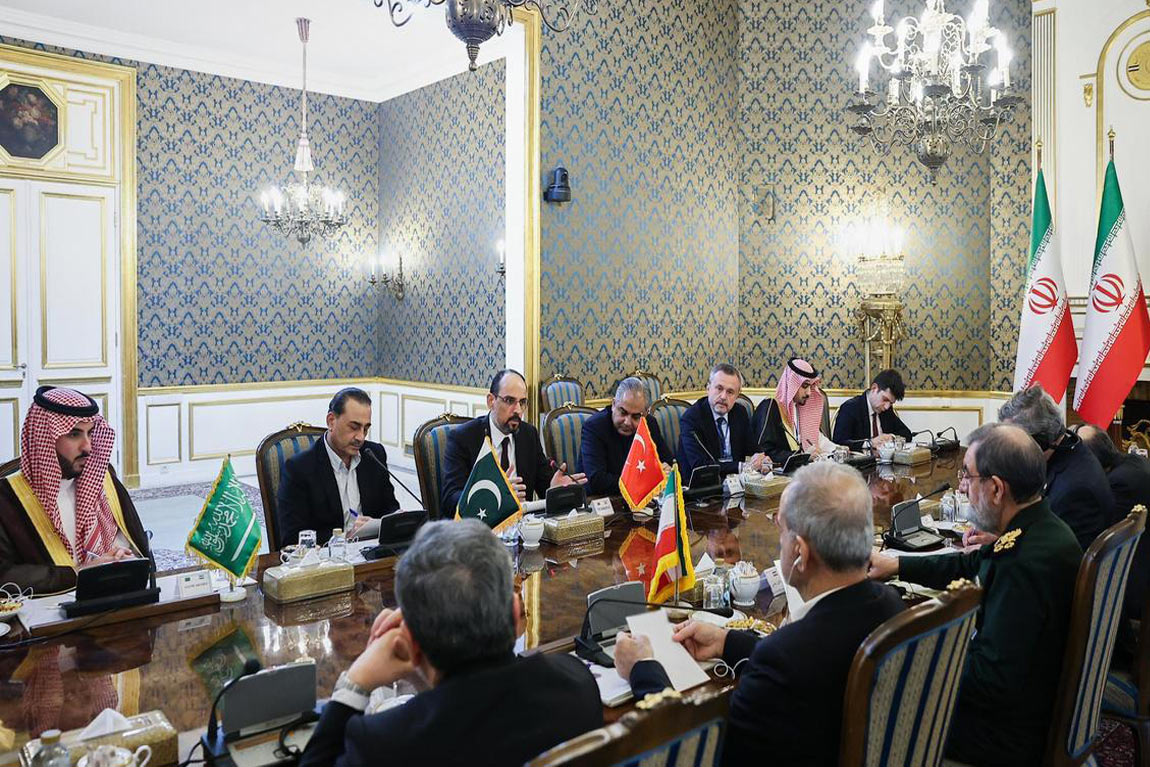
More than eight months after the United States and Israel launched strikes on Iran, West Asia remains on tenterhooks, as the United States, Israel, and Iran continue to flirt with a resumption of military hostilities. Elections in Israel as well as the U.S. midterm polls offered an interesting pause, even as war rhetoric remained high. Amid these tensions, an alliance of Saudi Arabia, Türkiye and Pakistan, known as the “Mecca Agreement”, arrived in Iran’s capital in October to discuss regional security.
A large part of Iran’s response since the U.S. and Israel began bombing the country in February 2026 has been to target American interests, including data centres, and military installations across the Gulf states. This forms part of Tehran’s strategy of asymmetric warfare, shaped by its view of the conflict as an existential threat to the Islamic Republic, particularly following the killing of Supreme Leader Ayatollah Ali Khamenei in an airstrike.
Why now
The Tehran visit was perhaps one of the most consequential diplomatic moves initiated. From Riyadh’s point of view, despite the official statement issued by its Foreign Ministry highlighting diplomatic efforts to disallow a return to military conflict in the region, the outreach had a singular aim: to prevent its conflict with the Houthis from escalating.
Riyadh’s airport has been largely shut since October 10, after Houthi-launched missile strikes. A Saudi-led coalition responded with air strikes, but with limited impact. The Houthis have since gained further territorial control in the embattled country, as Saudi Arabia looked clueless on what to do next. Air campaigns against the Houthis have yielded limited results since 2015.
The delegation in Tehran was not led by diplomats but by defence and intelligence leaders from the three countries. It included Pakistan’s Army chief, Asim Munir, a favoured military leader of U.S. President Donald Trump, who has also played a mediating role between Washington DC and Tehran. The main point of interest, however, was the Iranian delegation, led by Mohsen Rezaei took over the country’s powerful Supreme National Security Council (SNSC) in August, succeeding Mohammad Bagher Zolghadr, who had replaced Larijani after his death in March. Rezaei’s prominence in the talks also highlights where the nucleus of Iran’s emerging power structure lies. The Islamic Revolutionary Guard Corps (IRGC) has taken centre stage as the country remains on a wartime footing, with multiple power centres vying for influence following the death of the Ayatollah. The IRGC’s leading role is not surprising, given that it has always operated directly under the Supreme Leader’s authority.
Conflict into leverage
Saudi Arabia, Türkiye and Pakistan travelling to Iran for this exchange came as a surprise to many, given that Tehran had struck several Arab countries in response to American and Israeli aggression. However, Iran would have sought such an exchange, as it stands to benefit from it. It has made no bones about its support for newer, region-led securitisation taking precedence over those operating under American auspices. The Mecca Agreement, signed in August and tested to its limits by October, has shown little appetite for collaborative military action in the region, despite comparisons with the North Atlantic Treaty Organization. Following its signing, Iran supported the initiative, with some reports even suggesting that Islamabad might seek Tehran’s official membership. For Iran, however, being part of every forum and conversation about the future of West Asian security is exactly what it seeks. Tehran believes that the events of recent months, and its response to them — including the high-risk decision to target its Gulf neighbours — have created leverage that countries such as Saudi Arabia may now seek to address through dialogue. Iran’s access to the Houthis, whom it has helped strengthen, is what Riyadh hopes to mobilise for de-escalation, while Pakistan and Türkiye play supporting roles and consolidate their own positions in another iteration of the proverbial “new West Asia”.
The road ahead
Ultimately, for Iran, the crevasses created by a conflict that has not delivered the intended outcomes for the Trump administration present an opportunity to consolidate its position with the Gulf states. Many of its neighbours may grudgingly accommodate its demands because they have few alternatives. However, not all may agree with or support the Mecca Agreement’s outreach. This could lead to greater divisions over how to engage with Iran within the construct of a regional security architecture for the future, particularly as Tehran is now widely seen as an aggressor — a label the IRGC will not mind, as it seeks to project Iran as a regional power — and remains a geographic reality to contend with. Iran has previously said it is willing to meet its Gulf partners “anywhere” and on any platform to discuss regional security. Although this remains conjecture, the idea of hosting the talks in Tehran may well have originated with Iran itself.
The months ahead will remain tense in West Asia. Recalibrating a long-standing security order is often a chaotic process. The U.S. will not exit the region, but it may have to share space. Mr. Trump will be fine with this. Whether a U.S. accustomed to hegemonic dominance will accept it remains to be seen.
This commentary originally appeared in The Hindu.