 Global
Policy Briefs | 04 November, 2026 Download Report (PDF)
Addressing the Nuclear Question in India’s Climate Finance Taxonomy
Nuclear power is re-emerging globally as a low-carbon response to energy security and climate imperatives. India is pursuing a more-than-tenfold expansion of its nuclear capacity: from 8.88 gigawatts (GW) in 2025 to 100 GW by 2047. This ambitious goal will require mobilisation of private capital at scale. Climate finance taxonomies offer one route to such capital by signalling which activities are sustainable to investors. However, concerns regarding reactor safety and long-term radioactive waste management have historically kept nuclear energy out of most climate finance taxonomies. With nuclear energy slated for inclusion in India’s forthcoming taxonomy, this issue brief examines how capital can be channelled towards the nuclear activities that meet the highest standards of safety, accountability, and transparency to strengthen the credibility of both the sector and the taxonomy.
Attribution: Pranita Gupta, “Addressing the Nuclear Question in India’s Climate Finance Taxonomy,” ORF Issue Brief No. 905, Observer Research Foundation, November 2026.
Introduction
Global climate change challenges and rising energy security concerns, compounded by increasing load forecasts for artificial intelligence (AI) data centres, are placing new demands on the power sector. While coal continues to provide affordable, reliable, and constant power to meet energy consumption needs, renewable energy deployment is accelerating. Global capacity for renewable energy is expected to double between 2025 and 2030, driven by solar photovoltaic (PV) systems, which account for almost 80 percent of the increase.[1] However, challenges relating to intermittency, energy storage, and access to critical minerals necessitate a diversified energy basket.
Against this backdrop, nuclear power is experiencing a global resurgence. Nuclear power plants (NPPs) can provide stable and steady energy supply, while also producing the high temperatures needed for industrial processes in hard-to-abate sectors, such as cement and steel.[2] Moreover, nuclear power’s low lifecycle emissions strengthen the case for expanding its capacity worldwide.
Figure 1: Intensity of Greenhouse Gas (GHG) Emissions Intensity from Different Electricity Generation Methods (Tonnes CO2e/GWh)
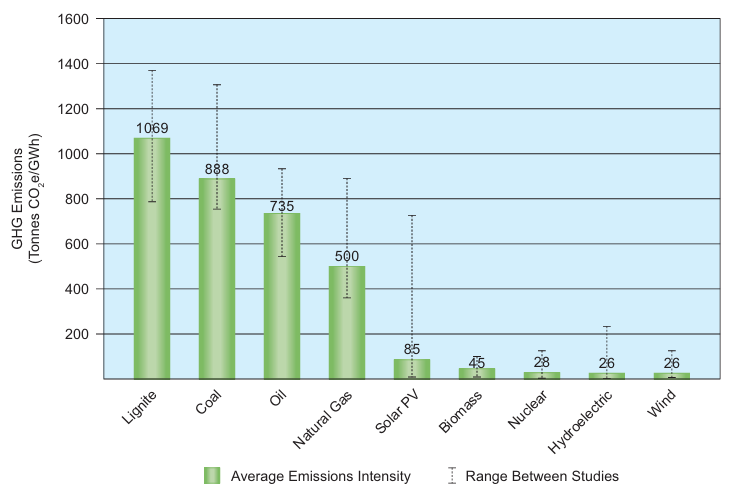
Source: World Nuclear Association[3]
As of June 2026, 38 countries had endorsed the Declaration to Triple Nuclear Energy by 2050, launched at the Conference of Parties (COP28) in 2023, which recognises the key role of nuclear energy in reaching net zero emissions.[4] Among them, South Korea has committed to increasing the share of nuclear power in its energy mix to over 30 percent by 2030,[5] while Japan has set a target for nuclear power to supply approximately 20 percent of its electricity by 2040.[6] The United Kingdom (UK) aims to reach 24 GWe (Gigawatts electric) of nuclear capacity by 2050,[7] and several European countries such as France and Poland have new nuclear projects in the pipeline.[8]
While India is not a signatory to the declaration, it plans to increase its nuclear capacity by more than tenfold: from 8.88 gigawatts (GW) as of 2025 to 100 GW by 2047.[9] This target is based on its need to keep pace with rising electricity demand, driven by a population of over 1.4 billion and the economic transformation envisioned under the Viksit Bharat@2047 initiative.[10]
Currently, coal dominates India’s energy mix, powering over 74 percent of the country’s electricity.[11] With updated plans to cut emissions intensity of its gross domestic product (GDP) by 47 percent below 2005 levels by 2035 and achieve net-zero emissions by 2070,[12] India requires an urgent shift to low-carbon sources. Nuclear energy promises a means to advance both energy security and economic growth, without compromising on long-term decarbonisation objectives.
Table 1: India’s Estimated Capacity Mix in 2047
| Sl. No | Source | Likely Installed Capacity (GW) |
Installed Capacity (GW) as on 30 April 2025 |
| 1 | Nuclear[a] | 100 | 8.88 |
| 2 | Coal | 235.3 | 212.72 |
| 3 | Gas | 10.4 | 20.13 |
| 4 | Biomass | 23 | 10.74 |
| 5 | Hydro[b] | 99 | 47.9 |
| 6 | Wind | 434.9 | 51.06 |
| 7 | Solar | 1186.8 | 107.94 |
| 8 | Total[c] | 2089.4 | 472.53 |
| 9 | PSP (GW/GWh) | 116.1/702.9 | – |
| 10 | ESS (GW/GWh) | 359.6/1983.9 | – |
Source: Ministry of Power[13]
One of the main barriers to nuclear expansion is securing adequate financing: nuclear projects require high upfront capital costs and long construction timelines, followed by lengthy payback periods. Mobilising private capital is emerging as a key requirement for bridging the sector’s financing gap, especially in India, which has traditionally relied on public finance or state budgetary support with limited private participation.[14] However, attracting private investment remains challenging. The International Energy Agency (IEA) identifies reputational risk as one of the primary barriers to private financing in the nuclear sector, reflecting concerns around sustainability considerations and public acceptance and issues such as radioactive waste and disaster risks.[15]
Currently, no global consensus exists on whether nuclear energy is sustainable. Some jurisdictions such as South Korea, Japan, Russia, China, and the European Union (EU) nations include nuclear energy in their climate finance taxonomies as a “green” or “transitional” activity.[d]
Taxonomies help investors identify credible sustainable investments and channel capital accordingly. With sustainable funds’ assets under management rising to a record US$4.13 trillion in 2025[16] and Environmental Social and Governance (ESG) assets projected to surpass US$40 trillion by 2030,[17] classification of activities within taxonomies is increasingly shaping access to climate finance.
In 2025, India’s Ministry of Finance released the Draft Climate Finance Taxonomy, outlining the objectives and principles for identifying climate-relevant activities.[18] The draft acknowledges nuclear energy’s role in achieving the vision of Viksit Bharat while balancing the country’s net-zero goals, and it is expected that the finalised taxonomy will include nuclear energy.[19]
This issue brief examines India’s nuclear energy sector and the financing constraints confronting its expansion. It analyses how climate finance taxonomies can mobilise capital, and identifies the safety, waste-management, and disclosure guardrails India must establish for nuclear energy to be credibly included in its taxonomy.
India’s Nuclear Energy Sector: An Overview
India’s nuclear energy programme stands at a pivotal moment, with the Union Budget 2025–26 targeting an installed nuclear capacity of at least 100 GW by 2047 under the Nuclear Energy Mission.[20]
India currently has 24 nuclear reactors across seven power plants in states such as Karnataka, Tamil Nadu, and Maharashtra.[21] Out of these, 20 are Pressurised Heavy Water Reactors (PHWRs) that use heavy water as both moderator and coolant, and natural uranium as fuel.[22] The remaining four are Boiling Water Reactors (BWRs) and Water-Water Energetic Reactors (VVERs), the latter a Russian-designed variant of Pressurised Water Reactors (PWRs). Both BWRs and VVERs use light water as moderator and coolant, and enriched uranium as fuel.[23] Additionally, as of 2026, eight reactors are under construction, including indigenously designed PHWRs and VVER-1000 PWRs being built with technical assistance from Russia, which also supplies enriched uranium for several reactors in India.[24]
Figure 2: Nuclear Reactors in India
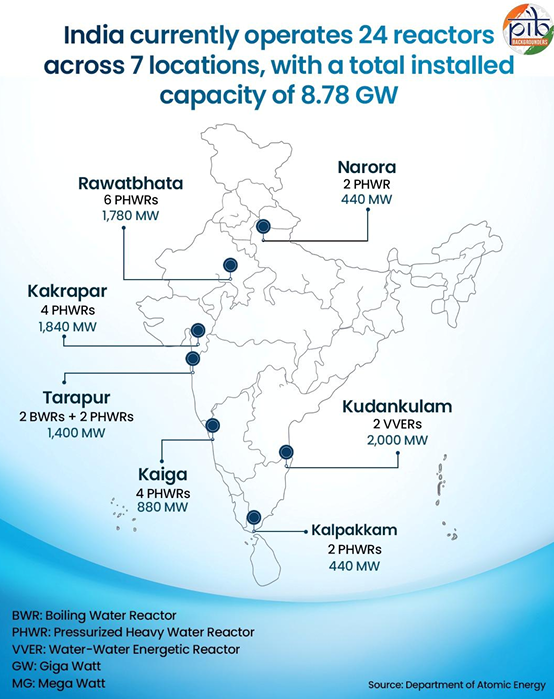
Source: Press Information Bureau.[25]
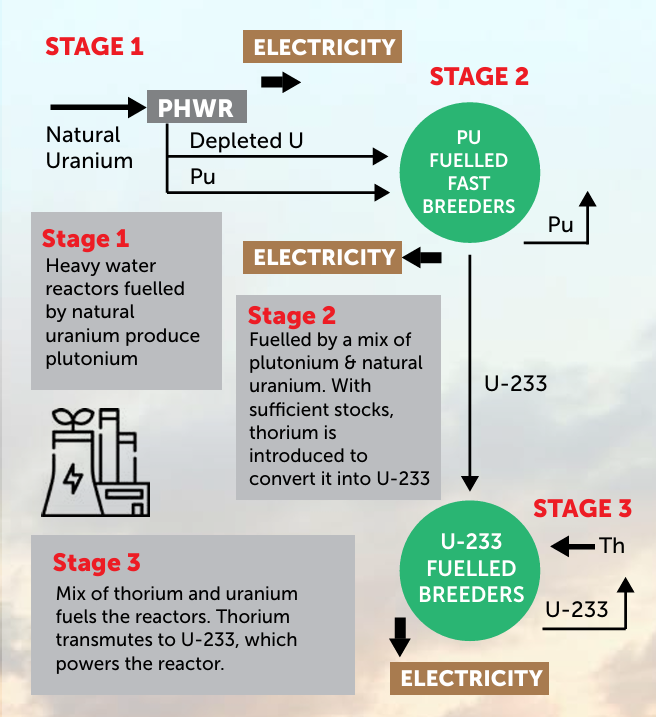
India has a three-stage indigenous nuclear programme based on a closed nuclear fuel-cycle, given its limited uranium but vast thorium reserves.[26] In Stage I, the PHWRs operating across the country use natural uranium as fuel to generate power. The spent fuel from these reactors produces plutonium, which becomes the primary fuel input for Stage II Fast Breeder Reactors (FBRs). In April 2026, India entered Stage II as the indigenously designed and built 500 MWe Prototype FBR reached its first criticality.[27] These FBRs consume plutonium and breed uranium-233 from thorium blankets, which in turn fuels Stage III thorium reactors, progressively drawing down the radioactive inventory that constitutes the waste burden.[28] India is among many countries, such as France, Russia, Japan, and China, that reprocess most of their spent fuel.[29]
Figure 3: India’s Three-Stage Nuclear Programme
Source: Bharat Heavy Electricals Limited[30]
India is also promoting Small Modular Reactors (SMRs) and Bharat Small Modular Reactors (BSMRs), with US$2.3 billion allocated in the Union Budget 2025–26 to support their development. SMRs have a power capacity of up to 300 MWe per unit, and their modular design allows them to be assembled in factories and then transported to installation sites, reducing construction times and costs.[31] BSMRs are based on the PWR technology and use slightly enriched uranium as fuel. They incorporate enhanced safety features to ensure nuclear safety during off-normal conditions.[32] While these reactors are currently not under construction, the Bhabha Atomic Research Centre (BARC) has initiated their design and development.[33]
Currently, India’s nuclear sector relies on state-led financing. The Nuclear Power Corporation of India Limited (NPCIL) serves as the principal developer and operator of nuclear power projects and owns all 24 of India’s reactors. Additionally, Bharatiya Nabhikiya Vidyut Nigam Ltd (BHAVINI)[34] owns the PFBR and Anushakti Vidhyut Nigam Ltd (ASHVINI)—a joint venture between NPCIL (51 percent) and National Thermal Power Corporation (49 percent)—has been approved to build, own, and operate NPPs in India.[35]
The NPCIL’s target to increase installed capacity from 8.88 GW to around 54 GW by 2047 will require a substantial increase in capital outlay, at a time when public resources face competing demands across multiple sectors.[36] Nuclear projects are typically financed through a debt-equity ratio of 70:30, the equity component is met primarily through government support and NPCIL’s internally generated reserves, and debt is raised primarily through bonds and commercial bank borrowing.[37] While this model has supported the gradual expansion of nuclear capacity so far, it is unlikely to be sufficient for the scale of growth envisaged going forward. Thus, the Ministry of Power’s Nuclear Energy Roadmap 2025 suggests a move away from balance-sheet financing and explores innovative financing instruments such as contracts for difference and public–private partnerships to fund new projects and retrofit existing ones.[38]
Institutional and Legal Architecture
The Atomic Energy Commission (AEC) is the policymaking body for India’s nuclear sector, and the Department of Atomic Energy (DAE) is the administrative body that executes and promotes the nuclear programme.[39] The DAE comprises research centres, such as BARC, which is responsible for reprocessing used fuel, as well as industrial organisations, such as NPCIL, BHAVINI, and ASHVINI. The Atomic Energy Regulatory Board (AERB) is the regulator, and its functions include licensing and framing safety regulations.[40]
India’s nuclear sector had long been constrained by the Atomic Energy Act, 1962, which mandated a strict Central government monopoly over the construction, ownership, and operation of nuclear facilities. Despite amendments made in 1986, 1987, and 2015— progressively widening eligibility to include government companies and joint ventures among public sector undertakings[41]—private Indian companies and foreign investment for nuclear power generation remained ineligible. Furthermore, India’s refusal to sign the 1968 Nuclear Non-Proliferation Treaty and its 1974 nuclear test excluded it from most international nuclear supply chains.[42]
To unlock private capital, the government introduced the Sustainable Harnessing and Advancement of Nuclear Energy for Transforming India (SHANTI) Act in December 2025.[43] Once operational, the SHANTI Act will supersede the Atomic Energy Act and the Civil Liability for Nuclear Damage Act.
The SHANTI Act permits private companies to build, own, operate or decommission an NPP or reactor, with foreign direct investment (FDI) of up to 49 percent currently under consideration.[44] They can also transport, acquire, possess, and import/export nuclear fuel, equipment, and technology or software. Fabrication of nuclear fuel, including refining and enrichment of uranium, is allowed up to a threshold value to be notified by the Central government.[45] The Act reserves sensitive activities such as enrichment and isotopic separation, heavy water production, mining of uranium and thorium, and management of spent fuel exclusively for the Central government or wholly owned entities.[46]
Furthermore, the SHANTI Act channels liability to the operators and limits their statutory right of recourse against suppliers, which has long deterred foreign vendors. Under the Civil Liability for Nuclear Damage Act, 2010, suppliers could be exposed to recourse claims arising from defective equipment or services, while operators remained vulnerable to additional liabilities beyond the statutory compensation framework through criminal proceedings, tort law, consumer protection, and environmental violations.[47] The SHANTI Act narrows supplier liability to cases involving explicit contractual provisions or intentional misconduct, and establishes defined liability caps for operators based on reactor size.[48] The Central government assumes liability exceeding the operator’s cap and may draw upon the supplementary compensation mechanism established under the Convention on Supplementary Compensation, which India ratified in 2016.[49]
While the SHANTI Act is yet to be operationalised as its implementation awaits the corresponding rules and regulations, interest for private sector participation is emerging from both sides: NPCIL has issued a Request for Proposals inviting “visionary Indian industries” to finance and build a proposed fleet of 220 MW BSRs,[50] while the Adani Group is reportedly in discussions to develop 8 SMRs of 200 MW in Uttar Pradesh.[51] Other leading conglomerates, such as the Tata Group, Reliance Industries Ltd., Larsen and Toubro, Vedanta, and the JSW Group, are also considering expanding into the nuclear sector.[52] Together, these developments indicate that legislative reforms are beginning to generate both project opportunities and private-sector appetite for investment in nuclear energy.
The growing prominence of sustainable finance presents a significant opportunity for sustaining private sector momentum in the sector. As climate finance taxonomies increasingly shape investment decisions and capital allocation, eligibility under these frameworks can enable nuclear projects to access green and sustainability-linked financing instruments.
Role of Taxonomies in Mobilising Capital
Climate finance taxonomies are classification systems that identify activities considered to be climate-aligned or green, based on their contribution to climate change mitigation or adaptation efforts. By providing a common scientific framework for assessing sustainability, they help capital providers identify eligible investment opportunities, thus broadening the investor base.[53]
The experience of the European Union (EU) demonstrates how taxonomy recognition can expand financing avenues for nuclear energy projects. In EU’s Taxonomy Regulation, eligible nuclear activities are categorised as “transitional” through the Complementary Climate Delegated Act to Accelerate Decarbonisation 2022.[54] This inclusion has allowed nuclear operators in the EU to tap into sustainable finance markets. In 2023, the first green bonds for nuclear energy were issued in Finland and France. Among the beneficiaries, Électricité de France (EDF) secured approximately 4 billion euros in green bonds and around 7 billion euros in green loans between 2022 and 2024.[55] The loans are being used to finance the life extension of EDF’s existing NPP fleet in France,[56] while the bond proceeds were allocated towards the construction of two reactors at Hinkley in the UK.[57] As of June 2026, Hinkley’s second reactor is under construction and the estimated cost of the project has risen from £18 billion (at 2016 prices) to £46 billion.[58]
Similarly, Canadian nuclear power players Bruce Power and Ontario Power Generation, as well as Constellation in the United States (US) have issued green bonds, using proceeds for maintenance, uprates, and life extensions of its existing NPPs.[59] Even countries that have experienced major nuclear accidents are increasingly adopting policy frameworks that facilitate investment in nuclear energy. Japan, associated with the Fukushima accident, has included nuclear energy in its transition finance taxonomy.[60]
Table 2: Green and Transition Bond Issuances for Nuclear Energy
| Type | Name | Country | Issue Date | Amount (US$ Million) |
Tenure (Years) |
Use of Proceeds |
| Green | Bruce Power | Canada | November 2021 | 370 | 6.9 | Life extension of existing reactors (refurbishment/increasing output of existing units). |
| March 2023 | 222 | 4.8 | ||||
| March 2023 | 222 | 9.8 | ||||
| March 2024 | 444 | 7.3 | ||||
| Green | Ontario Power Generation |
Canada | July 2022 | 222 | 10 | Life extension and major refurbishment of Darlington NPP. |
| Green | EDF | France | November 2023 | 1087 | 3.5 | Life extension of existing reactors. |
| June 2024 | 1087 | 7.0 | ||||
| September 2024 | 543 | 5.3 | ||||
| September 2024 | 707 | 8.0 | ||||
| September 2024 | 543 | 11 | ||||
| Green | Constellation | US | March 2024 | 900 | 30 | Existing reactors (maintenance, updates and life extensions). |
| Transition | Kyushu Electric Power |
Japan | June 2024 | 71 | 5 | Existing reactors (refinancing safety measures at existing plants). |
| June 2024 | 134 | 10 | ||||
| Transition | Kansai Electric Power |
Japan | June 2024 | 201 | 5 | Existing reactors (maintenance/renewal of aging transmission and distribution facilities). |
| June 2024 | 100 | 10 |
Source: Author’s own, using International Energy Agency and other sources. [61],[62]
However, despite the growing recognition of nuclear energy’s role in decarbonisation, its inclusion in taxonomies remains contested. Challenges relating to radioactive waste management, reactor safety, water use, and long-term environmental impacts have led many jurisdictions such as South Africa, Germany, and Austria to exclude or oppose the inclusion of nuclear energy in climate finance frameworks. [63],[64]
For India, the case for mobilising sustainable finance for nuclear energy will therefore depend not only on its decarbonisation potential but also on the credibility of the regulatory and institutional frameworks governing these challenges.
Challenges to Nuclear Inclusion
To include nuclear energy in India’s taxonomy, the government must confront three primary objections that have historically kept it out of most climate finance taxonomies.
Safety and Accountability
Safety concerns remain a primary barrier to nuclear expansion. Reactor accidents not only cause massive fatalities but also have severe long-term consequences for both human health and the environment. The 1986 Chernobyl nuclear accident, for example, led to an estimated death toll of as many as 50,000 people, in addition to the large-scale displacement of affected populations. These global precedents underscore the critical need for robust preventive safeguards.
While India has not witnessed incidents of such scale, it has experienced operational vulnerabilities, including several cases of heavy water and tritium[e] leakage in PHWRs due to heat exchanger failures or vibrations in coolant tubes, resulting in plant shutdowns.[65] The 2009 Kaiga NPP incident, in which approximately 50 workers accidentally ingested tritium-contaminated water after heavy water was added into the water cooler, demonstrates the importance of stringent operational monitoring.[66] As India introduces Stage II FBRs, which use liquid sodium, a highly reactive and difficult-to-handle coolant, the need for specialised operational expertise will be even more critical.[67] The central challenge thus lies in ensuring that the country’s regulatory and institutional framework is sufficiently independent, transparent, and vigilant to prevent accidents, ensure accountability, and respond effectively.
India’s Position
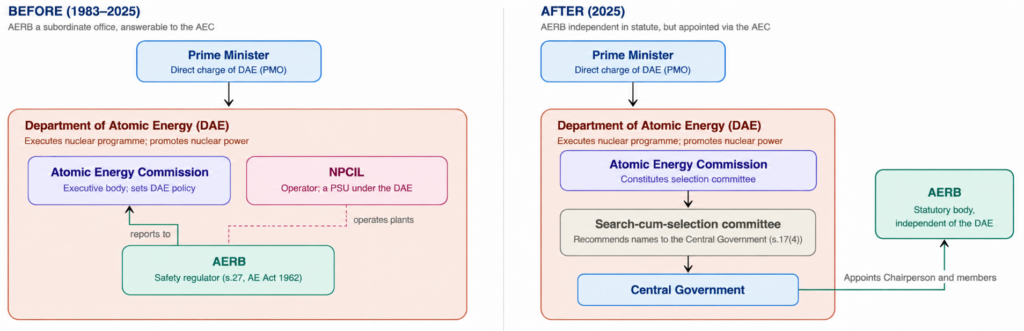
Functions related to nuclear safety rest with the AERB. Historically, the AERB was answerable to the AEC, whose chairman simultaneously served as secretary of the DAE, the body responsible for promoting nuclear power. The managing director of NPCIL, too, sat on the AEC.[68] The Comptroller and Auditor General’s 2012 report highlighted the flaw in this structure, finding that the AERB operated as a subordinate office exercising delegated powers of the Central government rather than as an independent regulator. It further noted that radiological surveillance of plants was handled by the operator (NPCIL) instead of the regulator.[69]
The SHANTI Act resolves this by granting statutory independence to the AERB. However, the conflict of interest persists. Under the Act, AERB’s chairperson and members are appointed by the Central government on the recommendation of a search-cum-selection committee constituted by the AEC. This allows the same authority to continue to promote nuclear expansion, issue licences, and underwrite liability while also appointing the regulator.[70]
Figure 4: Atomic Energy Regulatory Board
Source: Author’s own, using multiple sources.[71]
Furthermore, the Act empowers the Central government, with the prior approval of the AEC, to exempt any plant, facility, substance, equipment or technology from licensing requirements or any other provision of the Act if it deems the risk as ‘insignificant,’ without defining the criteria for such a determination. Accountability concerns are further exacerbated by restrictions on judicial recourse, as only officials authorised by the Central government or the AERB may initiate criminal proceedings for nuclear offences, excluding affected communities and civil society organisations.[72] Critics also contend that the compensation regime with the overall liability cap of US$300 million per nuclear incident is inadequate, given that the 2011 Fukushima disaster alone is estimated to have resulted in clean-up and compensation costs exceeding US$180 billion.[73]
Taxonomy Implications
While India’s taxonomy cannot substitute for gaps in nuclear governance, it can make access to sustainable finance contingent on robust safety standards prescribed under the AERB’s regulatory framework,[74] and any subsequent rules prescribed under the SHANTI Act. By placing the AERB on a statutory footing, the SHANTI Act strengthens the enforceability of these standards, allowing taxonomy-linked finance to be tied to legally enforceable safety requirements.
The EU follows a similar approach, by including nuclear activities in its taxonomy only if the member state fully complies with the Euratom safety directives.[75] It requires installations to implement “defence-in-depth” measures, undergo rigorous stress tests against extreme natural hazards, and obtain a commission opinion that satisfactorily addresses all concerns regarding nuclear safety and technical screening criteria.[76] South Korea’s classification system, K-Taxonomy, enforces a “Minimum Safeguards” principle, dictating that an activity must not violate safety, human-rights, labour, anti-corruption or cultural-heritage laws. This requirement is reinforced by a dedicated Nuclear Safety Act.[77] India’s taxonomy should similarly look beyond low-carbon attributes when certifying nuclear activities and instead make compliance with existing safety and liability frameworks an explicit eligibility criterion.
Radioactive Waste Management
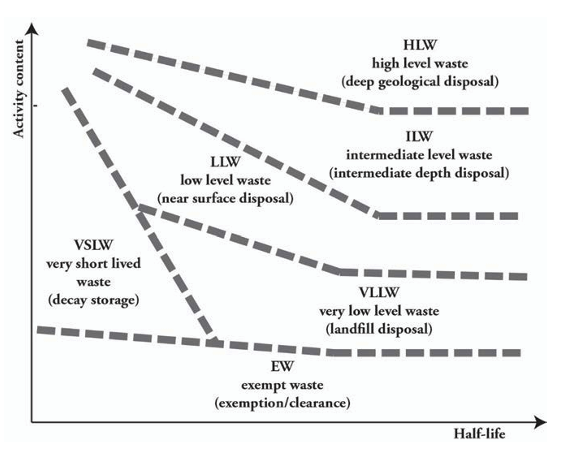
Nuclear power generates near-zero emissions, which is the principal argument for its inclusion in climate finance taxonomies. However, emissions alone do not determine sustainability. In the case of nuclear, waste management is a critical concern. Nuclear waste is classified according to its radioactivity: low, intermediate, and high level. Lightly contaminated waste makes up 90 percent of the total waste and contains only 1 percent of the total radioactivity. By contrast, high-level waste (HLW), mostly comprising spent fuel, accounts for just 3 percent of the total volume of waste, but contains 95 percent of the total radioactivity.[78] Given the long-term environmental and public health risks associated with HLW, eligibility for sustainable finance should be contingent upon demonstrable compliance with robust radioactive waste management practices.
India follows a ‘closed-fuel’ cycle, reprocessing spent fuel to recover uranium and plutonium, while the remaining radioactive waste is generated as high-level liquid waste (HLLW).[79] This waste is immobilised into an inert glass matrix by vitrification and placed in Solid Storage Surveillance Facilities for interim storage.[80] While reprocessing reduces the volume of HLW requiring final disposal, it does not eliminate it, creating the need to ensure secure long-term storage.
Figure 5: Nuclear Waste Classification
Source: International Atomic Energy Agency.[81]
India’s Position
Waste management sits within the DAE complex, with BARC responsible for treatment, conditioning, and storage of the radioactive waste. Low- and intermediate-level solid waste is sent to monitored near-surface facilities and effluents are discharged after treatment within regulatory limits.[82] One interim storage facility to store HLW is operational at Tarapur and a larger facility is under construction at Kalpakkam. India’s stated future policy is to partition and transmute minor actinides (radioactive elements) in fast reactors and to recover useful isotopes such as caesium-137 and strontium-90.[83] However, there is no deep geological disposal plan for long-term storage of HLW. Deep geological disposal in specifically designed underground facilities is the globally accepted method for safely isolating radioactive waste from the environment.[84]
India maintains that its current vitrified-waste volumes are too small to justify a Deep Geological Repository (DGR) and that transfer would be needed only after 2075.[85] This open-ended timeline is contentious. In the Kudankulam NPP case, the Supreme Court had directed that a DGR be set up “at the earliest,” and the NPCIL had indicated one would be built by 2018. However, eight years on, no DGR has been constructed.[86] Instead, the NPCIL has pursued an “Away from Reactor” (AFR) storage facility, which the Court directed be in place by April 2022.[87] These storage systems are functionally independent of the reactor operation, providing the role of interim storage until a further destination becomes available.[88] This proposal has faced local opposition, with the Kudankulam panchayat (local governing body) protesting its construction over environmental and safety concerns. Former Chief Minister of Tamil Nadu M.K. Stalin urged for the spent fuel to be returned to Russia or for a DGR to be constructed in an uninhabited area in 2022.[89]
Taxonomy Implications
India’s taxonomy must include guardrails to ensure proper waste management plans and capacity. The EU includes nuclear activities in its taxonomy only if the member state has waste-management and decommissioning funds in place, already operates disposal facilities for very low to intermediate-level waste, and has a documented plan with detailed steps for a HLW disposal facility to be operational by 2050.[90] Korea’s K-Taxonomy similarly requires detailed disposal planning. However, it sets no fixed deadline, a gap that has drawn criticism on grounds that it could undermine the credibility of the taxonomy and reduce it to a device for justifying domestic reactor construction.[91]
To make the inclusion of nuclear power credible, India should adopt guardrails adapted to its closed cycle: a ring-fenced waste-management and decommissioning fund and a documented HLW-disposal roadmap with a timeline. Similar to South Korea, the taxonomy could also include R&D in efficient waste management practices as eligible for ‘green’ finance, so that the classification helps channel funds towards the solution rather than merely certifying the status quo.
Disclosures and Transparency
Transparency is central to the credibility of a climate finance taxonomy. Taxonomies mobilise capital by providing investors with verifiable and comparable evidence that an activity meets defined sustainability criteria. Without robust disclosure, green or transition labels become difficult to substantiate, fuelling the risk of greenwashing. This is particularly important for nuclear energy, where disclosures relating to safety performance, incident reporting, waste management, and regulatory compliance are critical to assessing environmental risks, maintaining public trust, and supporting project viability.
India’s Position
The Atomic Energy Act, 1962 classified much of the information relating to the nuclear sector as “restricted.” The new SHANTI Act includes similar information-control provisions, prohibiting the unauthorised disclosure of restricted information and information obtained through official functions. Since there is no specific definition for “restricted information,” the Central government may declare as restricted any information it deems “detrimental to national security or public interest.”[92]
The Act also empowers the Central government to prohibit the publication “in any form whatsoever” of restricted and any other information it may specify.[93] Such information is also exempt from disclosure under the Right to Information (RTI) Act. Combined with the government’s discretionary power to not report incidents it considers insignificant and its ability to establish regulators outside the AERB framework, these provisions concentrate control over nuclear information in the executive, allowing the very authority promoting and underwriting nuclear expansion to determine what information is available to the public and investors. This places nuclear information beyond RTI’s reach and is viewed as a weakening of public oversight.[94]
Taxonomy Implications
Operationalising a taxonomy that includes nuclear energy requires India to establish disclosure categories necessary for investor due diligence and taxonomy compliance. These disclosures could include radioactive waste inventories and disposal plans, the status and funding of waste management and decommissioning obligations, and periodic reporting on safety performance and incidents. While restrictions on the disclosure of sensitive nuclear information are essential for national security, an appropriate balance is critical to ensure that legitimate safety, environmental, and governance information remains available, albeit on a need-to-know basis.
The EU requires undertakings to disclose, in a standardised template, the proportion of nuclear activities in their Key Performance Indicators (KPIs). It also mandates independent, conflict-free third-party verification.[95] Adopting comparable disclosure and assurance requirements will strengthen investor confidence and facilitate financial flows while enhancing domestic trust in the transparency and governance of India’s nuclear sector.
Conclusion
Nuclear energy’s near-zero operational emissions support the case for its inclusion in India’s climate finance taxonomy, but emissions alone cannot determine sustainability. Several jurisdictions have adopted a balanced approach that recognises its decarbonisation benefits while addressing environmental and safety concerns through conditional eligibility and transitional classifications. The European Commission approved the inclusion of nuclear energy under strict conditions, relying on a detailed assessment by the Joint Research Centre. Similarly, K-Taxonomy classifies electricity generation from new and existing NPPs as a “transitional” activity, while categorising activities that address the sector’s sustainability challenges, such as R&D for SMRs, and enhance plant safety and reliability, as “green.”[96]
In India’s case, the challenges relating to regulatory independence, long-term radioactive waste management, and transparency cannot be resolved through the taxonomy alone. However, the taxonomy can help convert each challenge into a precondition for access to sustainable capital by referencing existing legal benchmarks; conditioning the green or transition label on demonstrable safety, liability, and waste-management compliance; and requiring a defined tier of adequate disclosure. Thus, India’s climate finance taxonomy can direct capital towards nuclear activities that meet the highest standards of safety, accountability, and transparency, while also strengthening the credibility of both the sector and the taxonomy.
Pranita Gupta is Research Assistant, Centre for Economy and Growth, Observer Research Foundation.
The author acknowledges the use of Claude Sonnet 5 to conduct a preliminary literature survey, create Figure 4 (Atomic Energy Regulatory Board), and for language refinements prior to submission.
All views expressed in this publication are solely those of the author, and do not represent the Observer Research Foundation, either in its entirety or its officials and personnel.
Endnotes
[a] Includes BSR/BSMR/SMR for captive uses.
[b] Large hydro only.
[c] Includes small hydro, lignite, diesel, and waste to energy.
[d] Green activities include those that are already consistent with a net-zero trajectory. Transitional activities reduce emissions in hard-to-abate sectors but fall short of full climate neutrality and are therefore conditional to credible decarbonisation pathways.
[e] Tritium is a radioactive isotope of hydrogen.
[1] “Global Renewable Capacity Is Set to Grow Strongly, Driven by Solar PV,” International Energy Agency, October 2025, https://www.iea.org/news/global-renewable-capacity-is-set-to-grow-strongly-driven-by-solar-pv
[2] Central Electricity Authority, Ministry of Power, Roadmap for Achieving the Goal of 100 GW of Nuclear Capacity by 2047, June 2025, https://cea.nic.in/wp-content/uploads/notification/2025/10/Roadmap_Final_30062025.pdf.
[3] “Carbon Dioxide Emissions from Electricity,” World Nuclear Association, https://world-nuclear.org/images/articles/comparison_of_lifecycle1.pdf.
[4] “Four More Countries Join Global Commitment to Triple Nuclear Energy at Paris Summit,” World Nuclear Association, 10 March 2026, https://world-nuclear.org/news-and-media/press-statements/four-more-countries-endorse-global-declaration-to-triple-nuclear-energy
[5] “Nuclear Power in South Korea,” World Nuclear Association, 12 June 2026, https://world-nuclear.org/information-library/country-profiles/countries-o-s/south-korea
[6] “Cabinet Approves 7th Strategic Energy Plan, Plan for Global Warming Countermeasures, and GX 2040 Vision,” Agency for Natural Resources and Energy, Ministry of Economy, Trade and Industry, Government of Japan, 18 March 2025, https://www.enecho.meti.go.jp/en/category/special/article/energyissue2025_01.html
[7] “UK Releases Roadmap to Quadruple Nuclear Energy Capacity,” World Nuclear News, 11 January 2024, https://world-nuclear-news.org/articles/uk-releases-roadmap%C2%A0to-quadruple-nuclear-energy-ca
[8] David Dalton, “France / Macron Announces Ambitious Plans for Up to 14 New Nuclear Reactors,” NucNet, 10 February 2022, https://www.nucnet.org/news/macron-announces-ambitious-plans-for-up-to-14-new-nuclear-reactors; “Construction License Application Submitted for Poland’s First Nuclear Plant,” Nuclear News, American Nuclear Society, 2 April 2026, https://www.ans.org/news/2026-04-02/article-7903/construction-license-application-submitted-for-polands-first-nuclear-plant/
[9] Department of Atomic Energy, Government of India, https://www.pib.gov.in/PressReleasePage.aspx?PRID=2099244®=3&lang=2
[10] Ministry of Power, Government of India, Draft National Electricity Policy 2026, https://ourgov.live/wp-content/uploads/2026/01/draft-national-electricity-policy-2026.pdf
[11] Ministry of Coal, Government of India, https://www.pib.gov.in/PressReleasePage.aspx?PRID=2118788®=3&lang=2
[12] Union Cabinet, Government of India, https://www.pib.gov.in/PressReleasePage.aspx?PRID=2245209®=48&lang=2
[13] Central Electricity Authority, Roadmap for Achieving the Goal of 100 GW of Nuclear Capacity.
[14] Simon Taylor, “Nuclear Energy: The Quest for Green Finance,” University of Cambridge Judge Business School, https://www.jbs.cam.ac.uk/2024/nuclear-energy-the-quest-for-green-finance/
[15] “The Path to a New Era for Nuclear Energy,” International Energy Agency, January 2025, https://iea.blob.core.windows.net/assets/b6a6fc8c-c62e-411d-a15c-bf211ccc06f3/ThePathtoaNewEraforNuclearEnergy.pdf
[16] “Sustainable Fund Returns Slightly Below Traditional Peers in Second Half of 2025,” Institute for Sustainable Investing, Morgan Stanley, 11 March 2026, https://www.morganstanley.com/insights/articles/sustainable-fund-performance-second-half-2025
[17] Bloomberg Intelligence, “ESG AUM Set to Top $40 Trillion by 2030, Anchor Capital Markets,” Bloomberg, 22 February 2024, https://www.bloomberg.com/professional/insights/sustainable-finance/esg-aum-set-to-top-40-trillion-by-2030-anchor-capital-markets/
[18] Department of Economic Affairs, Ministry of Finance, Draft Framework of India’s Climate Finance Taxonomy, 2025, https://static.pib.gov.in/WriteReadData/specificdocs/documents/2025/may/doc202557551101.pdf.
[19] Central Electricity Authority, Roadmap for Achieving the Goal of 100 GW of Nuclear Capacity; Department of Economic Affairs, Draft Framework of India’s Climate Finance Taxonomy.
[20] Department of Atomic Energy, Government of India, https://www.pib.gov.in/PressReleasePage.aspx?PRID=2099244®=3&lang=2.
[21] Central Electricity Authority, Roadmap for Achieving the Goal of 100 GW of Nuclear Capacity.
[22] “Nuclear Power in India,” World Nuclear Association, 27 May 2026, https://world-nuclear.org/information-library/country-profiles/countries-g-n/india.
[23] Nikolay Belyakov, “Pressurized Water Reactor,” ScienceDirect, https://www.sciencedirect.com/topics/engineering/pressurized-water-reactor; J.M.K.C. Donev et al., “Boiling Water Reactor,” Energy Education, 2024, https://www.energyeducation.ca/encyclopedia/Boiling_water_reactor
[24] “Nuclear Power in India,” World Nuclear Association, 15 July 2026, https://world-nuclear.org/information-library/country-profiles/countries-g-n/india
[25] Press Information Bureau, Government of India, “The Sustainable Harnessing and Advancement of Nuclear Energy for Transforming India (SHANTI) Bill, 2025,” 19 December 2025, https://static.pib.gov.in/WriteReadData/specificdocs/documents/2025/dec/doc20251219739001.pdf
[26] Press Information Bureau, Government of India, https://www.pib.gov.in/PressReleasePage.aspx?PRID=2249783®=3&lang=1
[27] Department of Atomic Energy, Government of India, https://dae.gov.in/prototype-fast-breeder-reactor-at-kalpakkam-tamil-nadu-attains-first-criticality/
[28] Press Information Bureau, Government of India, https://www.pib.gov.in/PressReleasePage.aspx?PRID=2249783®=3&lang=1
[29] P.K. Wattal, “Back End of Indian Nuclear Fuel Cycle: A Road to Sustainability,” Progress in Nuclear Energy 101, Part A (November 2017): 133-145, https://www.sciencedirect.com/science/article/abs/pii/S0149197017300483
[30] “Nuclear Energy: Powering a Sustainable and Clean Future,” Bharat Heavy Electricals Limited, https://www.bhel.com/sites/default/files/Nuclear%20Brochure_%2010-04-2023.pdf
[31] Leyla Turayanova, “Big Aspirations for Small Modular Reactors: Understanding India’s Strategy on SMRs,” Issue Brief No. 870, Observer Research Foundation, 24 April 2026, https://www.orfonline.org/research/big-aspirations-for-small-modular-reactors-understanding-india-s-strategy-on-smrs.
[32] Department of Atomic Energy, Government of India, https://www.pib.gov.in/PressReleasePage.aspx?PRID=2198337®=3&lang=1
[33] Department of Atomic Energy, Government of India, https://www.pib.gov.in/PressReleasePage.aspx?PRID=2198337®=3&lang=1
[34] National Thermal Power Corporation, https://ntpc.co.in/media/press-releases/govt-accords-approval-npcil-ntpc-jv-company-ashvini-take-nuclear-power
[35] Bharatiya Nabhikiya Vidyut Nigam Limited, Department of Atomic Energy, Government of India, “Prototype Fast Breeder Reactor,” BHAVINI, https://bhavini.nic.in/en/custom/projects
[36] “Overview,” Nuclear Power Corporation of India Limited, https://www.npcil.nic.in/content/925_1_Overview.aspx
[37] Central Electricity Authority, Roadmap for Achieving the Goal of 100 GW of Nuclear Capacity.
[38] Central Electricity Authority, Roadmap for Achieving the Goal of 100 GW of Nuclear Capacity.
[39] The Sustainable Harnessing and Advancement of Nuclear Energy for Transforming India (SHANTI) Bill, 2025.
[40] “About DAE,” Department of Atomic Energy, https://dae.gov.in/about-dae/; The Sustainable Harnessing and Advancement of Nuclear Energy for Transforming India Act, 2025.
[41] Press Information Bureau, “The Sustainable Harnessing and Advancement of Nuclear Energy for Transforming India (SHANTI) Bill, 2025.”
[42] Mihir Sharma, “An Indian Nuclear Reactor Milestone Proves Doubters Wrong,” Bloomberg, 23 April 2026, https://www.bloomberg.com/opinion/articles/2026-04-22/an-indian-nuclear-reactor-milestone-proves-doubters-wrong.
[43] Press Information Bureau, “The Sustainable Harnessing and Advancement of Nuclear Energy for Transforming India (SHANTI) Bill, 2025.”
[44] Turayanova, “Big Aspirations for Small Modular Reactors: Understanding India’s Strategy on SMRs.”
[45] Press Information Bureau, “The Sustainable Harnessing and Advancement of Nuclear Energy for Transforming India (SHANTI) Bill, 2025.
[46] Hariharan, “The Big Picture: India Opens Nuclear Sector to Private Participation,” The Asia Group, https://theasiagroup.com/india-opens-nuclear-sector-to-private-participation/
[47] Hariharan, “The Big Picture: India Opens Nuclear Sector to Private Participation.”
[48] Hariharan, “The Big Picture: India Opens Nuclear Sector to Private Participation.”
[49] The Sustainable Harnessing and Advancement of Nuclear Energy for Transforming India (SHANTI) Bill, 2025; “India Joins the Convention on Supplementary Compensation for Nuclear Damage,” International Atomic Energy Agency, 4 February 2016, https://www.iaea.org/newscenter/news/india-joins-convention-supplementary-compensation-nuclear-damage
[50] “India’s NPCIL Seeks Proposals for Privately Funded Small Reactor Projects,” World Nuclear News, 2 January 2025, https://www.world-nuclear-news.org/articles/npcil-seeks-proposals-for-privately-funded-small-reactor-projects
[51] FE Business, “Adani Group in Talks with Uttar Pradesh to Set Up Nuclear Power Project: Report,” Financial Express, 19 December 2025, https://www.financialexpress.com/business/news/adani-group-in-talks-with-uttar-pradesh-to-set-up-nuclear-power-project-report/4082425/
[52] Turayanova, “Big Aspirations for Small Modular Reactors: Understanding India’s Strategy on SMRs”; Sweta Goswami, “India’s Nuclear Reset: SHANTI Bill Clears Private Plants, Caps Liability, Routes Foreign Participation via Indian Entities,” Moneycontrol, 19 December 2025, https://www.moneycontrol.com/news/business/india-s-nuclear-reset-shanti-bill-clears-private-plants-caps-liability-routes-foreign-participation-via-indian-entities-13734112.html
[53] Dr. Matt Bowen and Kat Guanio, “A Critical Disconnect: Relying on Nuclear Energy in Decarbonization Models While Excluding It from Climate Finance Taxonomies,” Center on Global Energy Policy, July 2023, https://www.energypolicy.columbia.edu/wp-content/uploads/2023/07/Nuclear-Taxonomies-Commentary_CGEP_062923-1.pdf
[54] Commission Delegated Regulation (EU) 2022/1214 (Complementary Climate Delegated Act), recitals and technical screening criteria, 9 March 2022, https://eur-lex.europa.eu/legal-content/EN/TXT/?uri=CELEX:32022R1214
[55] Matt Fisher, “New IAEA Report on Climate Change and Nuclear Power Focuses on Financing,” International Atomic Energy Agency, 18 October 2024, https://www.iaea.org/newscenter/news/new-iaea-report-on-climate-change-and-nuclear-power-focuses-on-financing
[56] David Dalton, “France/EDF Secures €5.8 Billion In ‘Green’ Loans For Nuclear Life Extensions,” Nucnet, 14 May 2024, https://www.nucnet.org/news/edf-secures-eur5-8-billion-in-green-loans-for-nuclear-life-extensions-5-2-2024
[57] “EDF Announces the Success of Its Senior Bond Issue for a Nominal Amount of £500 Million,” The EDF Group, 31 October 2024, https://www.edf.fr/en/the-edf-group/dedicated-sections/journalists/all-press-releases/edf-announces-the-success-of-its-senior-bond-issue-for-a-nominal-amount-of-ps500-million
[58] Leigh Boobyer, “Second Reactor Lifted into Place at Hinkley Point,” BBC, 1 June 2026, https://www.bbc.com/news/articles/c202wp104v1o
[59] “The Path to a New Era for Nuclear Energy”; “Constellation Issues First US Nuclear Green Bond,” World Nuclear News, 19 March 2024, https://www.world-nuclear-news.org/Articles/Constellation-issues-first-US-nuclear-green-bond
[60] Ministry of Economy, Trade and Industry, Japan Climate Transition Bonds Allocation Report for FY2023 Issuance, https://www.meti.go.jp/policy/energy_environment/global_warming/transition/climate.transition.bond.allocation.report.fy2023.eng.pdf.; “Russia Considers Qualifying Nuclear Energy as «Green» Source of Energy,” NeftegazRU, 19 March 2021, https://neftegazru.com/news/nuclear-power/671884-russia-considers-qualifying-nuclear-energy-as-green-source-of-energy/
[61] “The Path to a New Era for Nuclear Energy.”
[62] “Integrated Report 2024,” Kansai Electric Power Group, https://cdn.climatepolicyradar.org/navigator/JPN/2024/the-kansai-electric-power-co-inc-integrated-annual-report-2024_febe9da403dba9817b761f3fb9bd80cc.pdf?; Paul Day, “Constellation Issues First US Nuclear Green Bond”; “Bruce Power Bond Success Good News for Nuclear,” Reuters, 7 December 2021, https://www.reutersevents.com/nuclear/bruce-power-bond-success-good-news-nuclear; “OPG issues Inaugural Nuclear Green Bond,” Ontario Power Generation, 15 July 2022, https://www.opg.com/releases/opg-issues-inaugural-nuclear-green-bond/ ; “Kyushu Electric Power to Issue new Transition Bond,” Kyushu Electric Power, 1 May 2024, https://www.kyuden.co.jp/english/company/news/2024/h240501-1.html
[63] “Energy Efficiency in Green Finance Taxonomies,” United Nations Environment Programme, May 2023, https://unepccc.org/wp-content/uploads/2023/06/energy-efficiency-in-green-finance-taxonomies-brief.pdf
[64] Chloe Jardine, “Ministries Reject Nuclear Inclusion in EU Taxonomy,” Argus Media, 11 November 2021, https://www.argusmedia.com/en/news-and-insights/latest-market-news/2272872-ministries-reject-nuclear-inclusion-in-eu-taxonomy
[65] Kaveri Ashok, “Heavy Water Leakage at the Kakrapar Nuclear Power Plant,” ISSSP Reflections No. 43, National Institute of Advanced Studies, (June 2016), https://cms.nias.res.in/publications/heavy-water-leakage-at-the-kakrapar-nuclear-power-plant
[66] “Kaiga Incident: Wake Up Call or Tempest in Teapot?” The Hindu, 17 November 2021, https://www.thehindu.com/sci-tech/energy-and-environment/Kaiga-incident-Wake-up-call-or-tempest-in-teapot/article16851321.ece
[67] Sharma, “An Indian Nuclear Reactor Milestone Proves Doubters Wrong.”
[68] Aniruddh Mohan, “Nuclear Safety and Regulation in India: The Way Forward,” ORF Issue Brief No. 96, Observer Research Foundation, June 2015, https://www.orfonline.org/public/uploads/posts/pdf/20230913184006.pdf
[69] Comptroller and Auditor General of India, Report on Activities of Atomic Energy Regulatory Board for the year ended March 2012, https://cag.gov.in/webroot/uploads/download_audit_report/2012/Union_Performance_Atomic_Energy_Regulatory_Board_Union_Government_Atomic_Energy_Department_9_2012.pdf
[70] Puja Das, “India’s SHANTI Nuclear Bill Triggers Fears of Safety, Liability Dilution and Executive Overreach,” DownToEarth, 19 December 2025, https://www.downtoearth.org.in/energy/indias-shanti-nuclear-bill-triggers-fears-of-safety-liability-dilution-and-executive-overreach
[71] The Sustainable Harnessing and Advancement of Nuclear Energy for Transforming India Act, 2025; Mohan, “Nuclear Safety and Regulation in India: The Way Forward.”
[72] The Sustainable Harnessing and Advancement of Nuclear Energy for Transforming India Act, 2025.
[73] Das, “India’s SHANTI Nuclear Bill Triggers Fears of Safety, Liability Dilution and Executive Overreach.”
[74] Atomic Energy Regulatory Board, Government of India, “Acts and Regulations,” https://www.aerb.gov.in/english/acts-regulations/rules
[75] Commission Delegated Regulation (EU) 2022/1214 (Complementary Climate Delegated Act), recitals and technical screening criteria, 9 March 2022, https://eur-lex.europa.eu/legal-content/EN/TXT/?uri=CELEX:32022R1214
[76] Commission Delegated Regulation (EU) 2022/1214 (Complementary Climate Delegated Act)
[77] Korean Ministry of Environment, K-Taxonomy Guidelines, December 2022.
[78] “What Is Nuclear Waste, and What Do We Do With It?” World Nuclear Association, https://world-nuclear.org/nuclear-essentials/what-is-nuclear-waste-and-what-do-we-do-with-it
[79] Saurav Jha, “India’s Closed Cycle,” Nuclear Engineering International, 15 March 2018, https://www.neimagazine.com/advanced-reactorsfusion/indias-closed-cycle-6084799/?cf-view
[80] Department of Atomic Energy, Government of India, https://www.pib.gov.in/PressReleasePage.aspx?PRID=2220284®=3&lang=1
[81] “Status and Trends in Spent Fuel and Radioactive Waste Management,” IAEA Nuclear Energy Series, International Atomic Energy Agency, January 2022, https://www-pub.iaea.org/MTCD/Publications/PDF/PUB1963_web.pdf
[82] Bhabha Atomic Research Centre, “Radioactive Waste Management: Indian Scenario,” BARC, https://www.barc.gov.in/pubaware/nw.html
[83] Bhabha Atomic Research Centre, “Radioactive Waste Management: Indian Scenario.”
[84] Prateek Srivastava et al., “Swelling Clay Based Buffer Component of Engineered Barrier System of Waste Disposal Facilities,” BARC Newsletter, 2022, https://barc.gov.in/barc_nl/2022/2022010220.pdf
[85] Wattal, “Back End of Indian Nuclear Fuel Cycle-A Road to Sustainability.”
[86] Neelambaran A., “TN: Expansion and Proposed AFR Facility in Koodankulam Nuclear Power Plant Spark Debate,” News Click, 24 February 2022, https://www.newsclick.in/TN-expansion-poposed-AFR-facility-koodankulam-nuclear-power-plant-spark-debate
[87] PTI, “NPCIL Gets Time Till 2022 to Set Up Storage Facility,” Deccan Herald, 2 July 2018, https://www.deccanherald.com/amp/story/india%2Fnpcil-gets-time-till-2022-set-678424.html
[88] International Atomic Energy Agency, “Selection of Away-From-Reactor Facilities for Spent Fuel Storage,” September 2007, https://www-pub.iaea.org/MTCD/Publications/PDF/TE_1558_web.pdf
[89] Hariprasad Radhakrishnan, “Kudankulam Nuclear Power Plant Faces Renewed Protests Over Waste, Port, and Expansion Plans,” Land Conflict Watch, May 2022, https://www.landconflictwatch.org/conflicts/another-reason-for-locals-to-protest-the-kudankulam-nuclear-power-plant.
[90] Commission Delegated Regulation (EU) 2022/1214 (Complementary Climate Delegated Act).
[91] “South Korea Includes Nuclear in its K-Taxonomy,” Nuclear Engineering International, 23 September 2022, https://www.neimagazine.com/news/south-korea-includes-nuclear-in-its-k-taxonomy-10031333/?cf-view
[92] The Sustainable Harnessing and Advancement of Nuclear Energy for Transforming India Act, 2025.
[93] The Sustainable Harnessing and Advancement of Nuclear Energy for Transforming India Act, 2025.
[94] Das, “India’s SHANTI Nuclear Bill Triggers Fears of Safety, Liability Dilution and Executive Overreach”; Kavya Wadhwa, “The SHANTI Bill: India’s Nuclear Reforms and the Execution Challenge Ahead,” Observer Research Foundation, 23 December 2025, https://www.orfonline.org/expert-speak/the-shanti-bill-india-s-nuclear-reforms-and-the-execution-challenge-ahead.
[95] Commission Delegated Regulation (EU) 2022/1214 (Complementary Climate Delegated Act).
[96] Korean Ministry of Environment, K-Taxonomy Guidelines, December 2022.