 Global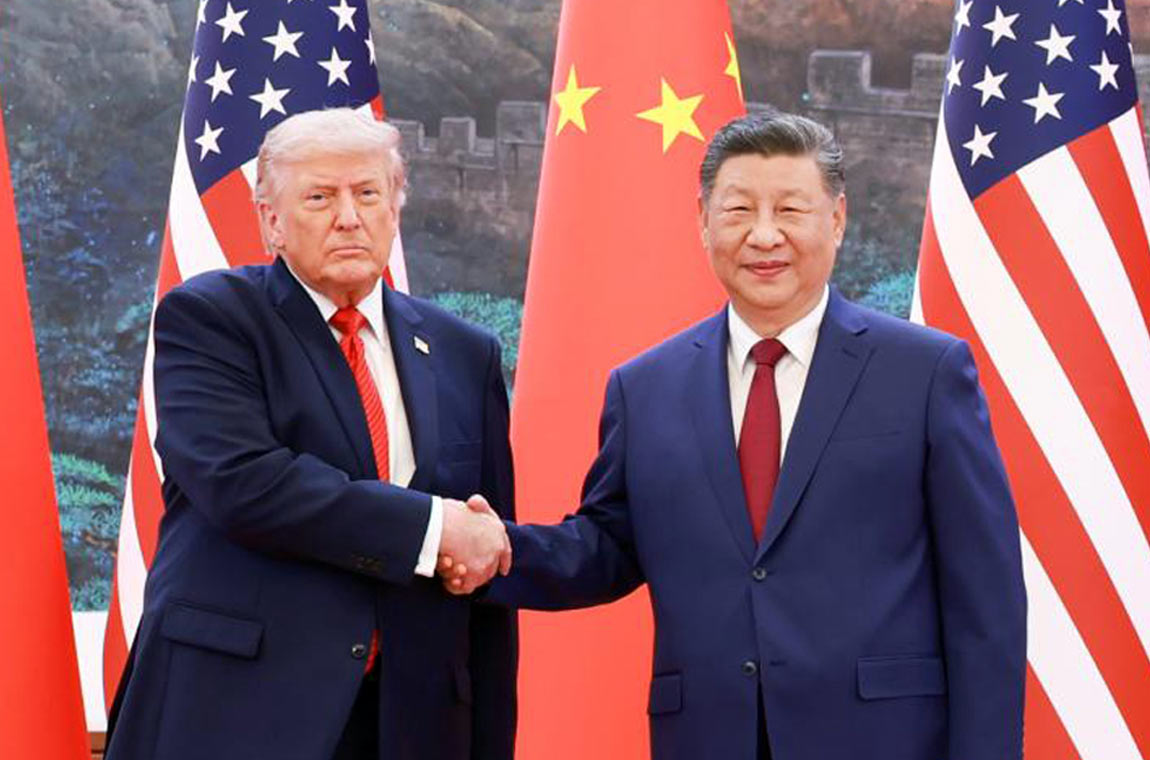
Expert Speak | 19 May, 2026
Chips without Architecture: Aftermath of the Trump-Xi meeting
Spotlight
- During Trump’s visit to Beijing, Washington licensed H200 accelerators to several of China’s largest cloud and platform firms and re-casted US export policy as a sales mechanism rather than a denial regime.
- With talks stopping at the level of trade, the deeper questions of how frontier AI is built, tested, and exported were deferred, leaving the global rule-set to be set by default rather than by agreement.
- A bilateral AI safety channel may emerge, but Washington’s stated willingness to engage is tied explicitly to its technological lead, thus making cooperation an instrument of competitive position rather than a safety obligation.
The recent meeting between Donald Trump and Xi Jinping in Beijing reflected a growing contradiction at the centre of the US-China technology relationship. On one hand, the Trump administration has embraced an aggressively expansionary “build, baby, build” approach to AI infrastructure, semiconductors and domestic manufacturing. On the other, the strategic realities of technological competition and, as the meeting demonstrated, selective cooperation with China are forcing renewed attention toward governance, standards, security and control.
Compute Monetised: the H200 Clearance
The composition of Trump’s accompanying delegation made this tension visible. Alongside a trade-focused agenda covering Taiwan, critical minerals, and tariffs – though messaging differed on the extent to which the latter was formally discussed – were some of the most influential figures in global technology and finance: Apple CEO Tim Cook, Tesla and SpaceX CEO Elon Musk, and Cisco CEO Chuck Robbins, with Nvidia CEO Jensen Huang added at the last moment. For many of these firms, China remains an enormous market opportunity; Huang himself recently described China as a potential US$ 50 billion opportunity for Nvidia. Yet these commercial incentives clash with US national security concerns, as reflected in the National Security Strategy and National Defence Strategy documents published by the last three US administrations, all of which consistently identified China as a top strategic competitor.
A consequential outcome to emerge in the hours following the meeting was the reported clearance of Nvidia H200 sales by the US Department of Commerce to roughly ten major Chinese technology firms, among them Alibaba, Tencent, ByteDance, and JD.com. The decision arrives at a moment when Huawei’s Ascend line of chips is securing meaningful domestic market share, and when Chinese frontier laboratories such as DeepSeek are pivoting toward domestic compute alternatives. The substitution that earlier rounds of export controls had been built to drive, finally, had begun driving itself. The licence interrupts that. Wedbush Securities analyst Dan Ives framed the stakes of the meeting to be about “the degree to which US chip leadership remains monetisable in China.” Read against the previously stated posture of the White House, the clearance signals a revealed preference for extraction over containment, and recalibrates the operative meaning of ‘AI export controls’ as a regulatory regime going forward.
Governance Deferred, Trade Resolved
For the global AI ecosystem, what the meeting did not produce is as significant as what it did. The highlights of the visit showed the two leaders “focused more on limited questions of trade, without reaching any agreement on the future of A.I.”. But while the transactional layer (chips, tariffs, rare-earth mineral supply, commercial market access) moved forward, the architectural layer did not. Key issues such as frontier model governance, training-data provenance, evaluations and safety thresholds, the status of open-weight diffusion, and the contours of a future sovereign AI compact were either deferred or omitted altogether. The omission is consequential because the standards-setting contest set out below operates at the architectural layer. A bilateral equilibrium that monetises near-frontier compute capacity while leaving governance underspecified amplifies the present asymmetry: the AI duopoly continues to set the commercial pace and AI development trajectory—the US with proprietary models and China with open-weight models and standard-setting—while middle powers contest over supply chain, model access, and governance of increasingly powerful frontier models.
Standards as a Strategic Terrain
The architectural layer the meeting left untouched is where the longer-run contest is being waged. China’s government-led initiatives that have come to be known as China Standards 2035, in addition to the country’s as yet unpublished Medium and Long-term strategy (MLP) for Science and Technology (2021-2035), place enormous emphasis on shaping international technical standards, particularly across AI, 5G, IoT and digital infrastructure. This suggests that Beijing increasingly views technical standards as a strategic tool of influence.
Standards determine the architecture of global digital systems: how networks communicate, what cybersecurity requirements are embedded into infrastructure, how data moves across borders, and which technologies become widely adopted internationally. Once standards become dominant, companies, governments and developers are often forced to build around them for reasons of compatibility and market access. For China, this has both economic and geopolitical value. Embedding Chinese standards into emerging technologies such as AI systems, telecommunications infrastructure and connected devices could expand the global reach of Chinese firms while reducing reliance on Western-controlled systems.
China’s push for international standardisation increasingly intersects with its broader Belt and Road Initiative (BRI) engagement, creating pathways for the diffusion of Chinese technical frameworks, governance practices and digital ecosystems across emerging markets. This linkage was made explicit in China’s October 2021 National Standardisation Development Outline, which stated that “through the promotion of synergistic cooperation with other Belt and Road countries in the field of standards,” China would strengthen engagement on standardisation with BRICS and APEC states. Xi Jinping has simultaneously sought to frame this approach in normative terms, repeatedly emphasising that artificial intelligence (AI) should develop in a “beneficial, safe and equitable” manner, allowing Beijing to position itself not only as a technological competitor, but also as an increasingly active participant in shaping the language and governance debates surrounding global AI development in the Global South – a region that has often occupied a more peripheral position within Trump’s AI strategy.
A Conditional Safety Track
Against this strategic backdrop, a partial counterweight to the earlier architectural vacuum emerged in the prospect of a recurring US-China dialogue on AI risks. Trump confirmed in a post-meeting interview that there was discussion about “possibly working together for guardrails” for AI. If the channel formalises, it would constitute the first material bilateral safety engagement between the two leading AI powers, while sitting alongside, without yet being integrated into the multilateral process running from Bletchley Park through Seoul, Paris, and the India AI Impact Summit. The framing offered by US Treasury Secretary Scott Bessent is instructive: the United States, he stated, can hold AI talks with China precisely because “we are in the lead.” Cooperation pegged to leading positions is cooperation pegged to a moving variable since that lead may narrow, widen or invert, and the dialogue’s character will move with it. Whether an engagement of this kind can produce durable guardrails or whether it functions principally as a signalling exercise based on the underlying technological gap remains an open question.
Questions Beyond the Duopoly
The implications of these outcomes extend well beyond the two principals. They affect a class of states, among them India, the Gulf, and several Southeast Asian economies, that have spent the past eighteen months aligning their AI strategies against an assumed US posture of containment. The architecture of the US AI diffusion framework and export controls has so far forced middle powers to calibrate their procurement strategies against a baseline in which advanced US compute would not flow freely to Chinese counterparts. The H200 clearance changes the equation. Middle powers that paid alignment costs in expectation of preferential access may reasonably ask what those concessions have purchased, and on what terms a ‘third pole’ in the global AI stack can now be assembled. For India-GCC cooperation specifically, the consequence is that complementarity at the infrastructure, talent, and standards layers becomes simultaneously more valuable and more difficult to secure. The case for a coordinated ‘third pole’ rests increasingly on whether such cooperation can be constructed faster than the bilateral equilibrium between Washington and Beijing solidifies.
Siddharth Yadav is Fellow, Emerging Technologies, ORF Middle East
Elizabeth Heyes is Junior Fellow, Emerging Technologies, ORF Middle East