 Global
Expert Speak | 27 May, 2026
Latin America: Navigating the Turbulence
The following excerpt is from Chapter 4 — ORF Global Quarterly: Disruption and Recalibration.
The Trump administration’s foreign policy toward Latin America sought to revitalise the Monroe Doctrine, originally issued by United States (US) President James Monroe in 1823 with the aim to prevent extra-regional powers from intervening in the Western Hemisphere.[1] The doctrine positioned the US as the guarantor of hemispheric autonomy, thereby implicitly asserting US supremacy in economic, diplomatic, and military affairs across the region.
What has been described as the ‘Donald Trump Corollary’ to the Doctrine, as articulated in the National Security Strategy of 2025, emphasised the need to “deny non-Hemispheric competitors the ability to position forces or other threatening capabilities, or to own or control strategically vital assets.”[2] Although no countries were explicitly identified, the corollary was primarily directed at China. The Biden administration had already characterised China as a great-power rival, posing threats to the US “economically, technologically, politically, and militarily;”[3] the Trump administration similarly frames its approach as one of deterrence and balancing against Chinese influence in the Western Hemisphere.[4]
China’s economic and military presence in Latin America is expanding, prompting the US to pursue countermeasures. It is too early to predict whether US policies in Latin America aimed at curbing Chinese influence will succeed. Other extra-regional actors, ranging from the European Union (EU), a supranational entity, to countries such as India, are simultaneously deepening their engagement with the region. The US could strategically leverage these relationships to reinforce its own position.
China’s Expanding Presence in Latin America
China has expanded its presence and influence in Latin America across multiple domains ranging from trade and infrastructure to defense cooperation and arms supplies. It has become South America’s leading trading partner and the second largest after the US in Latin America (which includes Mexico and Central American countries). By 2024, in addition to importing oil from Venezuela and Brazil, China sourced 98 percent of its total imports of lithium carbonate; critical for green energy, from Latin American countries, as well as 75 percent of its soybean imports.[5] In return, China exports electric vehicles, machine tools, telecommunications equipment, and consumer electronics to the region.[6] Although the China Development Bank has provided loans for a variety of projects against future sales of minerals and agricultural products, the overall amounts have declined sharply, falling from a peak of US$24.5 billion in 2010 to zero in 2024 and 2025, according to data from the Inter-American Dialogue.[7]
Twenty-three Latin American and Caribbean countries have joined China’s Belt and Road infrastructure initiative (BRI) between 2018 and 2025.[8] According to a 2025 report by the Center for Strategic and International Studies, Chinese state-owned and private enterprises modernised and acquired ownership stakes in several Latin American ports in Peru, Mexico, Panama, and Jamaica, developments that could reshape hemispheric commerce in China’s favour.[9] Notable examples close to the US include the partial construction of the Tren Maya in southern Mexico by the state-owned China Communications Construction Company, particularly the segment linking Chiapas, Tabasco, and Campeche,[10] as well as Chinese financing the upgrade of the Santiago de Cuba port.[11] Figure 1 illustrates the scope of China’s infrastructure projects in Latin America.
Figure 1: China’s Infrastructure Footprint in Latin America
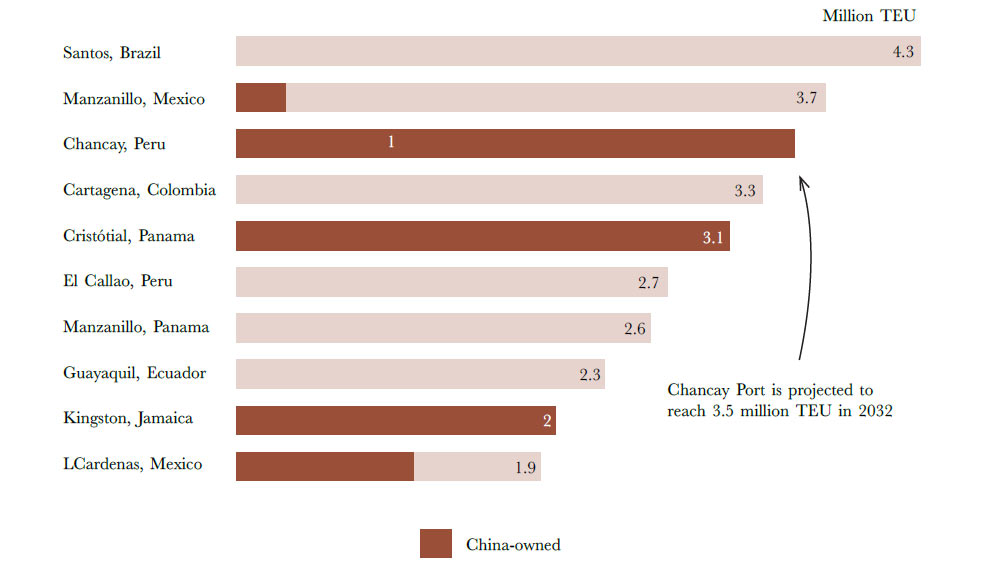
Source: Center for Strategic and International Studies[12]
China’s growing profile in Latin America extends beyond the economic sphere to include security dimensions. In terms of defence facilities, China has established a military-run space station in Argentina’s Nequén province which enables monitoring of space-related activities, including those of the US.[13] Closer to mainland US, China has developed signals intelligence collection centres in Cuba by modernising older sites such as Bejucal and Calabazar and constructing new facilities at Wajay and El Salao, the latter located near the US base at Guántanamo.[14] These installations are capable of monitoring US telecommunications as well as maritime, air, and land traffic, ranging from ships and aircraft to missile systems. China’s defence cooperation also encompasses officer education anVasabjit Banerjeed exchange programmes with Latin American countries (see Figure 2).[15]
Figure 2: China’s Military Exchanges with Latin America and the Caribbean (2022-2025)
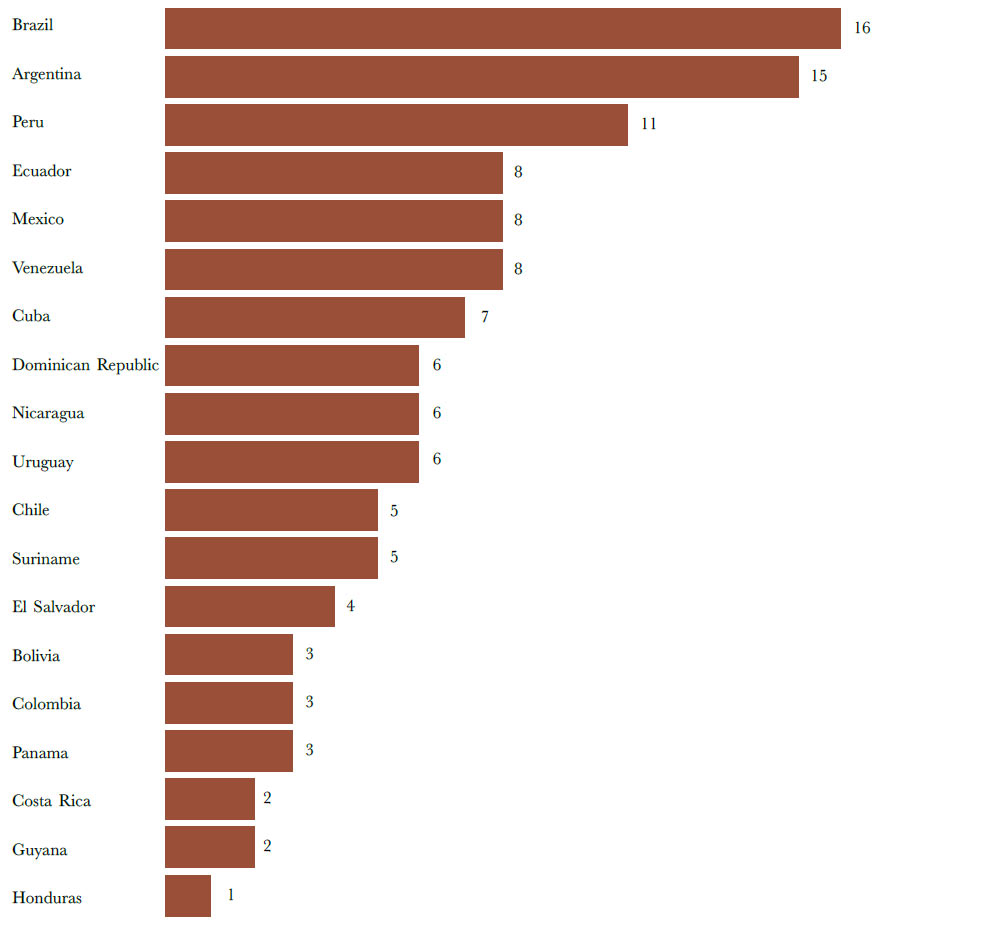
Source: Americas Quarterly[16]
China has also established a foothold in arms exports to Latin America.[17] While Venezuela has been the primary recipient, other countries including Bolivia, Ecuador, Peru, Argentina, and Brazil, have also procured Chinese weaponry. In addition, China has donated non-lethal defence equipment to Guyana, Colombia, the Dominican Republic, and Costa Rica, further broadening its security engagement with the region.[18]
US Efforts to Reassert its Economic and Military Dominance
Latin American policies under the Biden administration (2021-2025) and both Trump administrations (2017-2021 and 2025-present) have sought to address China’s multidimensional penetration of Latin America, while simultaneously balancing US domestic politics imperatives. Although their approaches have exhibited superficial differences, underlying similarities point to a more assertive stance centred on trade, infrastructure, counter-narcotics, and defence policy.
On the one hand, the industrial demands of great-power competition and need to generate revenues to address rising budget deficits and resultant debt have led the Trump administration to impose tariffs on goods and services from Latin American countries. In contrast, US efforts at ‘friendshoring’, introduced under the Biden administration,[19] sought to secure supply chains in sectors such as green energy, thereby strengthening Latin American economies and binding them more closely to the US.[20] While Trump administration’s tariffs initially reduced overall exports from Latin America to the US, subsequent bilateral trade agreements with El Salvador, Argentina, Ecuador, and Guatemala suggest that the broader objective was to secure more equitable access for US goods and services rather than to block imports outright.[21]
As a caveat, there remains some uncertainty regarding trade policy. A January 2026 ruling by the US Supreme Court invalidating tariffs imposed by the Trump administration has facilitated an increase in Latin American exports. At the same time, the administration’s subsequent imposition of 10 percent global tariffs, potentially rising to 15 percent, has introduced uncertainty and diminished the relative advantage of Latin American exports compared to those from Asia and Europe.[22]
The Trump administration has also sought to curtail China’s infrastructure projects in Latin America. It pressured the Panamanian government to compel the Hong Kong-based CK Hutchison subsidiary, Panama Ports Company, to divest from its Panama Canal holdings, specifically the cargo terminals of Balboa and Cristóbal.[23] The Panamanian government permitted Balboa to be operated by the Danish company Maersk and Cristóbal by Switzerland’s Mediterranean Shipping Company.[24] Similarly, the Trump administration has exerted pressure on Peru to remove the Chinese state-owned Cosco from its control of the Chancay port, citing the extra- territorial rights granted to China that limit the Peruvian government’s authority over “regulation, supervision, oversight and sanction.”[25] Notably, these measures build upon assessments produced during the Biden administration, which have identified China’s expanding access to and control over regional infrastructure.
Defence and security cooperation by the Trump administration has focused on renewed efforts to train and assist local forces in counternarcotics operations and providing defence equipment. A prominent example is the US-Ecuadorian joint military operations against drug cartels in the country initiated under agreements signed in February 2026.[26] However, an earlier agreement to cooperate on “law enforcement and the justice sector” aimed at combating criminal networks and strengthening internal security was signed in August 2023 during the Biden administration, underscoring the bipartisan consensus in the US on these issues.[27]
Latin American policies under the Biden and two Trump administrations have sought to address China’s multidimensional penetration of Latin America, while simultaneously balancing US domestic politics imperatives.
The most prominent example of defence equipment imports was also bipartisan: the sale of 24 refurbished F-16A/B fighter jets to Argentina from Denmark approved under the Biden administration in 2024,[28] with deliveries scheduled between 2025 and 2028 under the Trump administration. The agreement reached with the pro-American Argentinian President Javier Milei effectively blocked the procurement of China’s JF-17 fighter jet, which has been favoured by the preceding Alberto Fernández administration.[29] A key element of the deal was the US decision to replace British components—given Britain’s opposition to Argentina’s procurements of fighter jets due to the Falklands Islands/Las Malvinas dispute— while imposing technological limitations consistent with British concerns.[30] In addition, the US agreed in 2025 to supply Peru with F 16 V, Block 70 fighter jets manufactured at its Greenville, South Carolina plant,[31] a significant development given that Peru’s ageing fleet currently consists of Russian-origin MiG-29 A and French-origin Mirage 2000P aircraft.
The synergy between trade and defence objectives was evident in US actions following the removal by US special forces of Venezuelan President Nicolás Maduro in January 2026. For more than two decades, Venezuela’s one-party authoritarian regime, reliant on a complicit military had opposed US economic and security interests in the region.[32] Economically, it funded alternative regional organisations such as the Alianza Bolivariana para los Pueblos de Nuestra America (ALBA) founded in 2004 and PetroCaribe, an energy-based initiative for the Caribbean launched in 2005. In the security domain, Venezuela provided shelter and assistance to Colombian left-wing insurgent groups, including the Fuerzas Armadas Revolucionarias de Colombia (FARC) and the Ejército de Liberación Nacional (ELN),[33] while also issuing credible threats of annexation against its tiny oil-rich neighbor Guyana in 2024-2025.[34] Maduro’s successor, acting President Delcy Rodriguez has reshuffled senior military leadership[35] and is cooperating with US economic demands centred on petroleum[36] and gold[37] exports.
Extra-Regional Paths to Leverage US Initiatives in Latin America
Although initial outcomes appear promising, it is too early to assess the overall success of the new US policy toward Latin America, which currently enjoys support from Congress and President Trump. The Venezuelan regime has become more receptive to meeting US energy demands, while Guyana and its petroleum resources are more secure than prior to the change in Venezuelan leadership. At the same time, key elements of the Chavista regime remain intact and continue to assert claims over Guyana’s Essequibo region. In the infrastructure domain, control of key projects in Panama has reverted from Chinese to Panamanian management, whereas projects in Peru and Mexico remain under Chinese influence. The US is assisting Ecuador in its fight against narco-terrorists, and pressuring Mexico to confront its own cartels, though both initiatives face domestic opposition. Finally, the US reentered the Latin American arms supply market by facilitating transactions such as Denmark’s transfer of F-16 fighter jets to Argentina.
Several extra-regional actors illustrate how trade and defence relations with Latin America can provide a path forward in the region’s contested and evolving foreign and domestic policy environment. The EU concluded a preferential trade agreement with the most prominent trading bloc in South America, Mercosur/Mercosul[38] in December 2024. The agreement addresses trade-related issues in multiple ways: lowering barriers between the EU and Mercosur states, granting EUbased companies preferential access to raw materials, supporting supply chain integration, and promoting collaboration on sustainable development that incorporates climate change and labour standards.[39] In terms of bilateral relations, India has advanced its trade ties with Brazil, including a petroleum supply agreement in 2026 between Brazil’s Petrobras and India’s Bharat Petroleum Corporation.[40] India and Brazil are also engaged in negotiations on defence procurement[41] and the co-production of defence equipment.[42]
The overlap between EU and NATO membership, as well as India’s strategic partnership with the US, ensures that Washington faces no potential national security threats from these actors. This suggests that successful relations with Latin America are possible for extra-regional powers if they acknowledge the prevailing political consensus in the US to return to what has long been considered an essential trait of US foreign policy: control of the Western Hemisphere.[43] In this context, the US can leverage such extraregional actors as force-multipliers, enabling it to contain and reduce China’s influence in Latin America.
Vasabjit Banerjee, PhD, is Assistant Professor, Department of Political Science, University of Tennessee, Knoxville; and Non-Resident Fellow, ORF America.
Endnotes
[1] President James Monroe, “The Monroe Doctrine: A Portion of President James Monroe’s Seventh Annual Message to Congress,” December 2, 1823, https://www.oas.org/sap/peacefund/VirtualLibrary/MonroeDoctrine/Treaty/ MonroeDoctrine.pdf.
[2] President Donald J. Trump, National Security Strategy of the United States of America, White House, 2025, https://www. whitehouse.gov/wp-content/uploads/2025/12/2025-National-Security-Strategy.pdf.
[3] Jim Garamore, “Official Talks DOD Policy Role in Chinese Pacing Threat, Integrated Deterrence,” Department of Defense, June 2, 2021, https://www.war.gov/News/News-Stories/Article/Article/2641068/official-talks-dod-policyrole- in-chinese-pacing-threat-integrated-deterrence/.
[4] President Donald J. Trump. National Defense Strategy, White House, 2026, https://media.defense.gov/2026/ Jan/23/2003864773/-1/-1/0/2026-NATIONAL-DEFENSE-STRATEGY.PDF.
[5] Margaret Myers, “China’s New Playbook for Latin America,” Americas Quarterly, October 14, 2025, https://americasquarterly.org/article/chinas-new-playbook-in-latin-america/.
[6] Myers, “China’s New Playbook for Latin America”.
[7] “Chinese Loans to Latin America and the Caribbean Database,” The Dialogue, 2025, https://www.thedialogue.org/ MapLists/#/Policy/List/year.
[8] Antigua and Barbuda (2018), Argentina (2022), Barbados (2019), Bolivia (2018), Chile (2018), Colombia (2025), Costa Rica (2018), Cuba (2019), Dominica (2018), Dominican Republic (2019), Ecuador (2018), El Salvador (2018), Grenada (2018), Guyana (2018), Honduras (2023), Jamaica (2019), Nicaragua (2022), Panama (2025), Peru (2019), Suriname (2018), Trinidad and Tobago (2018), Uruguay (2018) and Venezuela (2018), “Countries of Belt and Road Initiative (BRI),” Green Finance and Development Center, May 2025, https://greenfdc.org/countries-of-the-belt-and-road-initiative-bri/.
[9] Ryan C. Berg, Christopher Hernandez-Roy and Henry Zimmer, “China-owned Chancay Port Set to Become Latin America’s Third Largest,” CSIS, February 2025, https://www.csis.org/analysis/china-owned-chancay-port-set-becomelatin- americas-third-largest.
[10] “Track Laying Starts on Mexico’s Mayan Train Project,” China Communications Construction, May 13, 2022, https://en.ccccltd.cn/xwzx/ztbd/202205/t20220524_172223.html.
[11] Cuba Business Report Staff, “Chinese-Funded Terminal at Port of Santiago Opens,” May 15, 2019, https://cubabusinessreport.com/chinese-funded-terminal-at-port-of-santiago-opens/.
[12] Ryan C. Berg, Christopher Hernandez-Roy, and Henry Ziemer, “China-Owned Chancay Port Set to Become Latin America’s Third Largest,” Center for Strategic and International Studies, February 25, 2025, https://www.csis.org/ analysis/china-owned-chancay-port-set-become-latin-americas-third-largest.
[13] Germán Padinger, “Qué sabemos sobre la estación del Espacio Lejano que China opera en la Patagonia argentina?,” April 6, 2024, https://cnnespanol.cnn.com/2024/04/06/que-sabemos-estacion-espacio-lejano-china-patagonia-argentinaorix.
[14] Matthew P. Funaiole, Aidan Powers-Riggs, Brian Hart, Henry Zeimer, Joseph S. Burmudez Jr., Ryan C. Berg, and Christopher Hernandez-Roy, “China’s Intelligence Footprint in Cuba: New Evidence and Implications for U.S. Security,” CSIS, December 6, 2024, https://www.csis.org/analysis/chinas-intelligence-footprint-cuba-new-evidenceand- implications-us-security.
[15] Ryan Berg et al., “Beijing’s Military Diplomacy is Making Major Gains,” October 14, 2025, https://americasquarterly. org/article/beijings-military-diplomacy-is-making-major-gains/.
[17] R. Evan Ellis, “China’s Security Engagement in Latin America and the Caribbean,” The Diplomat, February 23, 2024, https://thediplomat.com/2024/02/chinas-security-engagement-in-latin-america-and-the-caribbean/.
[18] Ellis, “China’s Security Engagement in Latin America and the Caribbean”.
[19] Fatima Hussien and Josh Boak, “The Biden Administration Pushes for More US-Latin America Trade, Seeking to Lessen Chinese Influence,” Associated Press, November 2, 2023, https://apnews.com/article/yellen-latin-america-interamericandevelopment- bank-china-e32078c94b6e71ffb3b4f50f222ef4f3.
[20] William Maloney, “How Latin America and the Caribbean Can Benefit from Foreign Direct Investment and Reshoring,” World Economic Forum, February 19, 2024, https://www.weforum.org/stories/2024/02/latin-america-and-thecaribbean- reshoring/.
[21] “Fact Sheet: President Donald J. Trump Announces Historic Trade Deals with Western Hemisphere Trading Partners,” White House, November 13, 2025, https://www.whitehouse.gov/fact-sheets/2025/11/fact-sheet-president-donald-jtrump- announces-historic-trade-deals-with-western-hemisphere-trading-partners/.
[22] AQ Editors, “Reaction: How Trump’s 15% Tariff Move Impacts Latin America,” Americas Quarterly, February 23, 2024, https://www.americasquarterly.org/article/reaction-how-trumps-15-tariff-move-impacts-latin-america/.
[23] Elida Moreno, “Panama’s President Reject ‘Outrageous’ Claims by CK Hutchison Over Cancelled Port Contracts,” Reuters, March 19, 2026, https://www.reuters.com/world/china/panama-rejects-ppc-claimscanceled- port-contracts-2026-03-20/?link_source=ta_first_comment&taid=69bd1f7c21f0bd00017f052a&utm_ campaign=trueAnthem:+Trending+Content&utm_medium=trueAnthem&utm_source=facebook&fbclid=IwY2xjaw RIWaxle HRuA2FlbQIxMABicmlkETFNaHVoUkcyUkZvTUZaNUNJc3J0YwZhcHBfaWQQMjIyMDM5MTc4ODI wMDg5MgABHhAAUwbPV2IsH0AquoxZ-y6_HJ2HrXzDQgvZnTFvsEzZKpEcFDvA6iowWHpT_aem_YE1-ep5lhS90RIh0zOWAg.
[24] Anniek Bao, “Panama Cancels China-Linked Port Deal, Hands Canal Terminals to Maerst, MSC,” CNBC, February 24, 2026, https://www.cnbc.com/2026/02/24/panama-officially-voids-annuls-ck-hutchison-contracts-interim-controlmaersk- msc-canal-dispute.html.
[25] Laura Kelly, “US Warns China Costing Peru its Sovereignty,” The Hill, February 12, 2026, https://thehill.com/policy/ international/5735194-peru-port-chinese-control/.
[26] Alfie Parnell, “US and Ecuador Launch Joint Military Action Against Drug Trafficking,” Latin America Reports, March 4, 2026, https://latinamericareports.com/us-and-ecuador-launch-joint-military-action-against-drug-trafficking/13746/.
[27] “U.S. and Ecuador Extend Cooperation Agreement in Counternarcotics, Law Enforcement,” U.S. Mission Ecuador, August 16, 2023, https://ec.usembassy.gov/u-s-and-ecuador-extend-cooperation-agreement-in-counternarcotics-lawenforcement- and-justice-sector-cooperation/.
[28] Ryan Finnerty, “Argentina Takes Delivery of Initial Six F-16 Fighters from Denmark,” FlightGlobal, December 8, 2025, https://www.flightglobal.com/fixed-wing/2025/12/argentina-takes-delivery-of-initial-six-f-16-fighters-from-denmark/.
[29] Cecelia Degl’Innocenti, “Argentina’s F-16 Deal Signals a Strategic Pivot Toward Washington,” Argentina Reports, January 23, 2026, https://www.argentinareports.com/argentinas-f-16-deal-signals-a-strategic-pivot-towardwashington/ 4166
[30] “Argentina’s F-16s Said to Have Limited Capacities Due to UK Concerns,” MercoPress, July 15, 2025, https://en.mercopress.com/2025/07/15/argentina-s-f-16s-said-to-have-limited-capacities-due-to-uk-concerns.
[31] “Peru – F-16 Aircraft,” Defense Security Cooperation Agency, Transmittal No. 25-96, September 15, 2025, https://www.dsca.mil/Press-Media/Major-Arms-Sales/Article-Display/Article/4304541/peru-f-16-aircraft.
[32] Vasabjit Banerjee and Maria I. Puerta Riera, “Venezuela’s Military Won’t Surrender Its Privileges Easily,” Foreign Policy, January 7, 2026, https://foreignpolicy.com/2026/01/07/venezuela-military-army-strikes-politics/.
[33] Staff, “ELN in Venezuela,” InSight Crime, January 13, 2026, https://insightcrime.org/venezuela-organized-crime-news/ eln-in-venezuela/.
[34] Vasabjit Banerjee and Prashant Hosur, “Resolving the Essequibo Crisis: Security Cooperation Against Venezuelan Threats,” FAO Journal of International Affairs, July 28, 2025, https://faoajournal.substack.com/p/resolving-the-essequibocrisis- security.
[35] Florantino Singer and María Martín, “Delcy Rodríguez Renueva El Alto Mando Militar Tras La Destitución de Padrino Como Ministro de Defensa,” El País, March 19, 2026, https://elpais.com/america/2026-03-20/delcy-rodriguez-renuevael- alto-mando-militar-tras-la-destitucion-de-padrino-como-ministro-de-defensa.html.
[36] Sheila Dang, “Oil Sales Under US-Venezuela Deal to Reach $2 Billion by End of February, US Says,” Reuters, February 26, 2026, https://www.reuters.com/business/energy/oil-sales-under-us-venezuela-deal-expected-reach-2-billion-by-endfebruary- us-2026-02-27/.
[37] Marc Caputo, “Scoop: Trump Officials Broker Massive U.S.-Venezuela Gold Deal,” Axios, March 4, 2026, https://www.axios.com/2026/03/05/trump-us-venezuela-gold-deal.
[38] Spanish: Mercado Común del Sur; Portuguese: Mercado Comum do Sul. Full member states are: Argentina, Bolivia, Brazil, Paraguay, and Uruguay. Associated states: Chile, Colombia, Ecuador, Guyana, Peru, and Suriname. Observer states: Mexico and New Zealand. Venezuela is a suspended full member state. “EU-Mercosur Agreement,” European Commission, https://policy.trade.ec.europa.eu/eu-trade-relationships-country-and-region/ countries-and-regions/mercosur/eu-mercosur-agreement_en.
[39] “Questions and Answers on the EU-Mercosur Partnership Agreement,” EU Commission, January 16, 2026, https://ec.europa.eu/commission/presscorner/detail/en/qanda_24_6245.
[40] “India Says State-Run BPCL to Sign Oil Deal with Brazil’s Petrobras,” Reuters, January 23, 2026, https://www.reuters. com/business/energy/india-says-state-run-bpcl-sign-oil-deal-with-brazils-petrobras-2026-01-23/.
[41] Rojoef Manuel, “India, Brazil Weigh Barter Deal for Military Aircraft,” The Defense Post, October 7, 2025, https://thedefensepost.com/2025/10/07/india-brazil-barter-aircraft/.
[42] Victor Barriera and Jon Grevatt, “India, Brazil Pursue Defence Equipment Collaboration,” Janes, October 21, 2025, https://www.janes.com/osint-insights/defence-news/air/india-brazil-pursue-defence-equipment-collaboration.
[43] Paul Poast, “Trump’s Approach to Latin America Is Not Such an Outlier,” Global Affairs, December 8, 2025, https://globalaffairs.org/commentary/analysis/trumps-approach-latin-america-not-such-outlier.