 Global
Expert Speak | 11 June, 2026
Indonesia’s Middle East Gambit: Free, Active, and Overextended
Spotlight:
- Prabowo Subianto’s outreach to Donald Trump, conducted through Middle East policy instruments such as the Board of Peace, UNIFIL peacekeepers in Lebanon, and the pledged ISF deployment to Gaza, has provoked domestic backlash that now constrains his maneuvering space.
- Jakarta’s initial commitments on the Board of Peace have quietly reversed, driven less by geopolitical calculation than by domestic public scepticism the government can no longer contain.
- Like his predecessors, Prabowo has stretched Indonesia’s bebas aktif (independent and active) tradition to its limits and now faces mounting economic pressures at home, particularly those intensified by the Iran conflict.
Almost two years into his presidency, Prabowo Subianto’s overseas visits have drawn growing scepticism over their tangible domestic returns, with the latest trip to Paris yielding primarily defence‑sector agreements. Critics have increasingly questioned the transparency, urgency, and concrete benefits of his frequent foreign engagements as Indonesia grapples with mounting economic headwinds. The unease sharpened when, on 18 May, the rupiah slid to a record low of 17,670 per dollar — already under investor pressure before the Middle East conflict, and further strained by Indonesia’s position as a net oil importer for whom a weaker rupiah means a more expensive barrel. Into this climate landed Prabowo’s now-viral remarks at Nganjuk on 16 May: a dismissal of the rupiah’s slide on the grounds that “villagers don’t use dollars,” and reassuring that the public need only observe whether the Finance Minister is smiling. The remarks captured a presidency that has consistently prioritised the optics of global engagement over domestic economic legibility.
What initially appeared as engagement on the Gaza file has revealed itself as a broader, multi-instrument courtship of Washington — and specifically of President Donald Trump.
The deeper concern, however, lies in the Middle East strategy that sits alongside these pressures. What initially appeared as engagement on the Gaza file has revealed itself as a broader, multi-instrument courtship of Washington — and specifically of President Donald Trump. Prabowo’s predecessors managed the US relationship without comparable personal investment; none staked their presidency’s identity on foreign policy to this degree. That ambition now faces its hardest test. The US military campaign against Iran has placed every instrument of Prabowo’s Middle East engagement — the Board of Peace (BoP), the troop commitment to Gaza, the defence partnership — under severe domestic strain, driven not only by the region’s evolving realities but also by an Indonesian public that is both economically exposed and politically activated by what it is watching.
The Trump Courtship: A Pattern of Overtures
Prabowo’s courtship of Trump began within days of his inauguration in October 2024, when he posted footage of a phone call congratulating Trump on his re-election in which he offered to travel “wherever you are” to meet him — adding, “all my training is American, Sir.” The overture fell flat as the hoped-for visit to Mar-a-Lago went unanswered. What followed was a pivot from personal appeal to strategic substance: a sequence of commitments to Trump’s Middle East agenda designed to build the relationship through deeds rather than charm.
The most prominent was Indonesia’s decision to join the Board of Peace at Davos in January 2026. The commitment was announced before key domestic stakeholders were consulted, with civil society and Muslim groups invited to discuss a decision that had effectively already been made. The move sits awkwardly alongside Indonesia’s non-alignment tradition and its standing as the world’s largest Muslim-majority democracy — a tension Prabowo sought to manage by framing participation as leverage for Palestinian statehood rather than accommodation of Washington. The framing did not hold. Critics pointed out that Indonesia, which does not recognise Israel and maintains no diplomatic ties, risked treating a shared table with Netanyahu as de facto recognition. Prabowo’s own comments at the UN General Assembly in September 2025 — that an independent Palestine must be accompanied by guarantees for Israel’s safety and security — had already signalled a quiet but significant shift in Indonesia’s narrative on the conflict, one that registered poorly at home.
The suspension of BoP discussions was telling, not as a withdrawal from the Trump relationship, but as the first public signal that Prabowo’s Middle East commitments were running ahead of what the domestic political environment could absorb.
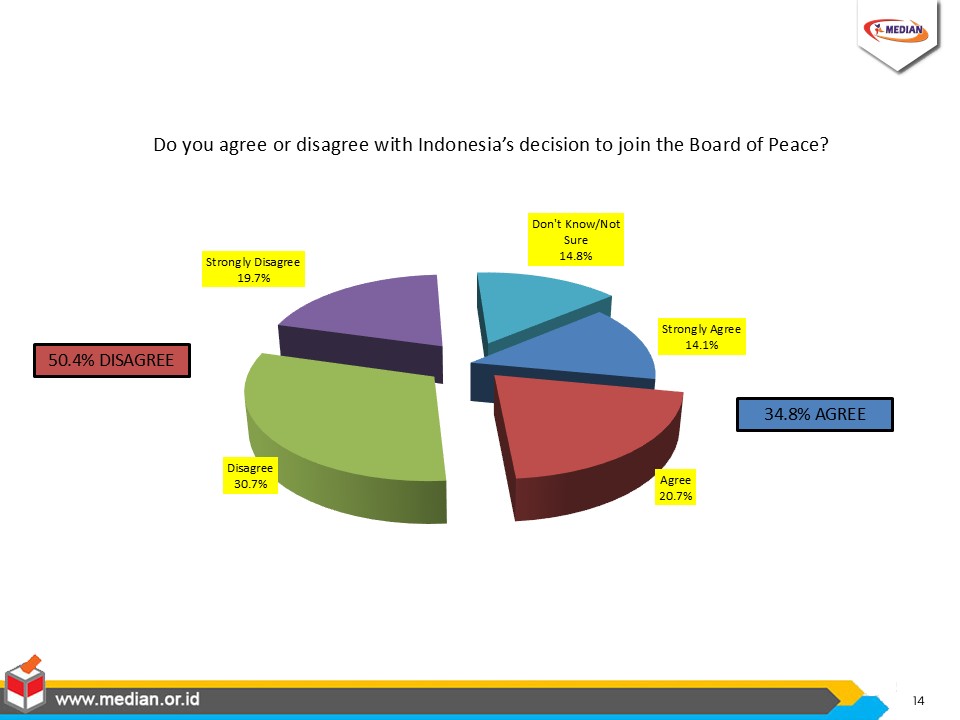
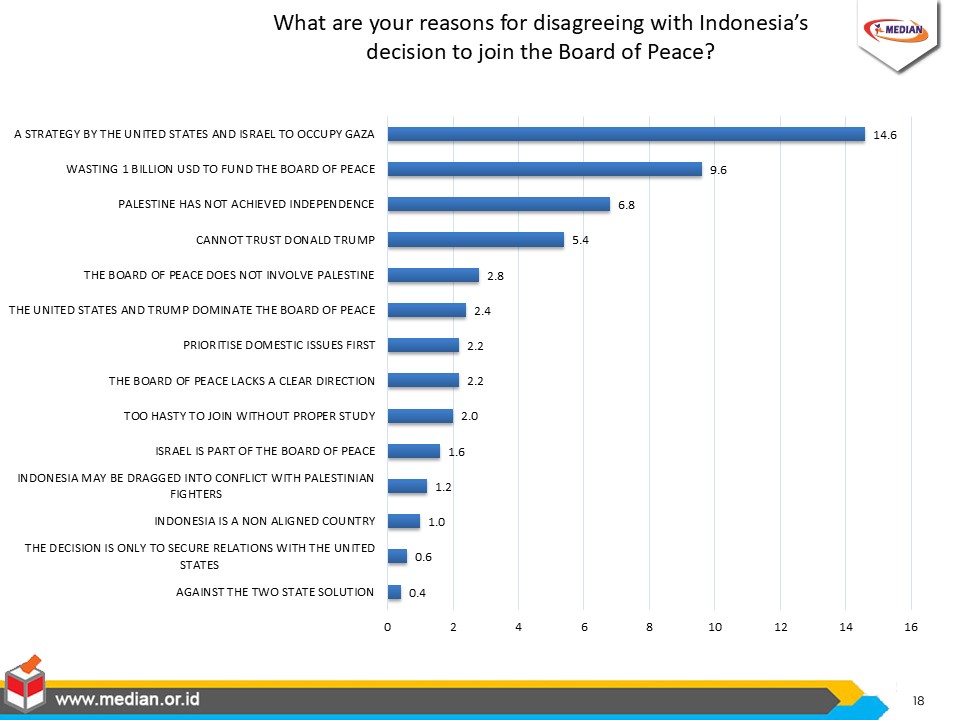
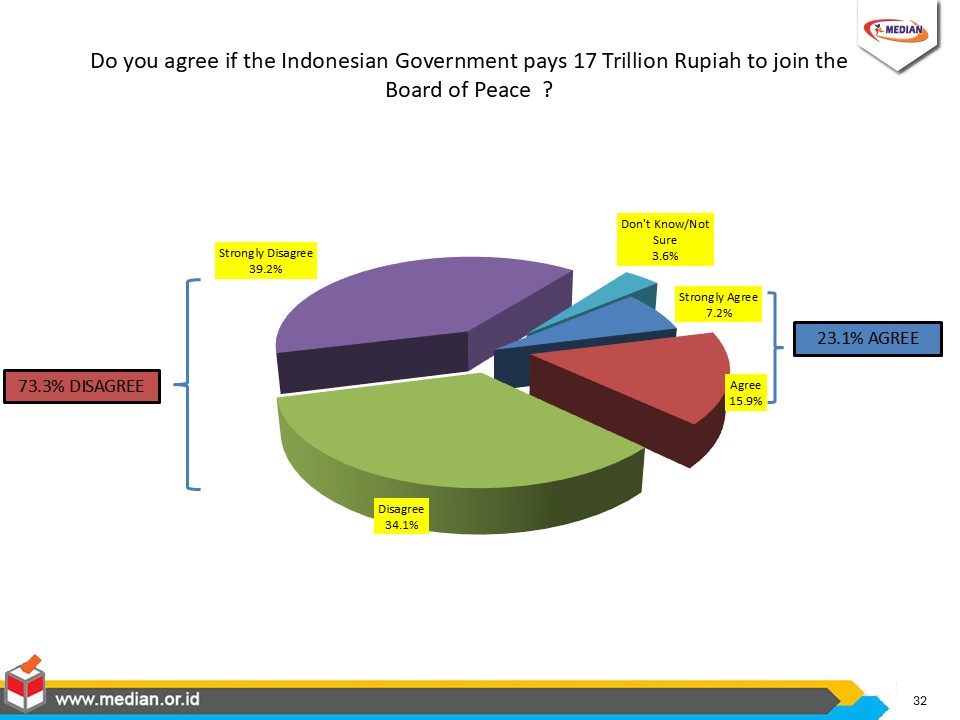
The financial terms of BoP membership added another layer of domestic exposure. Initial statements from the Finance Ministry suggested membership costs would be absorbed by the defence budget, before Prabowo publicly denied any pledge of the US$1 billion permanent membership fee. The simultaneous warning that Jakarta would quit the board if it failed to deliver for Palestinians read less as principled foreign policy than as retroactive damage control. By March, the Foreign Ministry confirmed that all BoP discussions were formally suspended. Public surveys captured the domestic mood: 50.4 percent of respondents disagreed with Indonesia’s BoP membership, citing fears that the board serves as a US-Israeli strategy to occupy Gaza, that participation does not help advance Palestinian statehood, and that Trump cannot be trusted as an honest broker (see charts below). Opposition to the financial commitment was starker: 73.3 percent rejected paying the 17-trillion-rupiah membership fee outright. The suspension of BoP discussions was telling, not as a withdrawal from the Trump relationship, but as the first public signal that Prabowo’s Middle East commitments were running ahead of what the domestic political environment could absorb.
Peace, Defence, or Both?
Prabowo’s cards at the BoP are, in reality, limited. Indonesia’s primary value to Trump is its branding — the political weight of the world’s largest Muslim-majority democracy lending legitimacy to an initiative that has otherwise struggled for credibility. Where Jakarta has a more concrete contribution to offer is through the International Stabilization Force (ISF): a pledge of 8,000 troops, a deputy commander role, and training already under way at Sentul in Bogor Regency — signalling that the commitment was, at least initially, intended seriously rather than symbolically.
But the pledge carries its own complications. Indonesian participation was conditioned on the force operating under a UN Security Council mandate, with funding routed through the UN rather than Jakarta’s state budget — a distinction that matters both fiscally and politically. The Trump administration’s adversarial posture toward international institutions has left the ISF’s financial and logistical architecture unresolved, making Indonesia’s commitment harder to operationalise. The second complication is domestic. Public opinion on the mission is genuinely divided — not simply along pro-Palestinian lines, but along a more specific fault line: a significant strand of Indonesian sentiment views the ISF not as a protection force for Palestinian civilians but as a mechanism to disarm and displace Hamas, whom many Indonesians regard as a resistance movement rather than a militant organisation. The deaths of Indonesian peacekeepers in southern Lebanon — caught in the crossfire between Israel and Hezbollah — have done little to reassure a public already uncertain about the wisdom of sending troops into a theatre shaped by Washington’s objectives rather than Jakarta’s.
For Prabowo who has staked Indonesia’s identity on foreign policy ambition, the gap between what is signed abroad and what can be defended at home is narrowing. His government has tried to manage it through conditional language — reassuring the public that peacekeeping contributions remain contingent on political circumstances. Further, the announcement of a US-Indonesia Major Defense Cooperation Partnership on 13 April illustrated the problem in miniature: signed the same day Prabowo was in Moscow meeting Putin to secure Russian oil supplies due to the Hormuz closure, the partnership landed as a symbol of strategic overstretch rather than strategic autonomy. The controversy deepened when a US request for blanket overflight access for American military aircraft was tabled. A letter of intent was signed before the Defence Minister moved to walk back any suggestion of firm commitment. The episode was again characteristic of an agreement reached that later required rapid public reassurances.
The Squeeze from the Iran Conflict
The US military campaign against Iran has significantly tightened Prabowo’s room for manoeuvre — and exposed the limits of Indonesia’s bebas aktif (independent and active) foreign policy tradition in a moment of acute geopolitical polarisation. Such a doctrine has historically afforded Jakarta the flexibility to engage all sides without binding commitment. Under Prabowo, that flexibility has been stretched to its breaking point. The peacekeeper deployment has been suspended “until an undetermined time.” A fuel price freeze — maintained despite the energy disruption caused by the Hormuz closure — is straining the state budget, while a shrinking middle class continues to cloud GDP growth prospects. Domestically, Prabowo has leaned into populist measures: the free meals programme and expanded social safety nets have sustained approval ratings above 70 percent, but they speak to a political survival logic rather than a foreign policy one. Five cabinet reshuffles and the appointment of a labour union chief as environment minister signal a presidency managing dissent as much as governing. The domestic floor is holding — but it is being actively maintained, and not taken for granted.
The US military campaign against Iran has significantly tightened Prabowo’s room for manoeuvre — and exposed the limits of Indonesia’s bebas aktif (independent and active) foreign policy tradition in a moment of acute geopolitical polarisation.
What is clearer is that bebas aktif cannot resolve the contradiction at the heart of Prabowo’s current posture. He is attempting to court Trump without losing the Muslim public, advance Palestinian statehood without alienating Washington, and preserve strategic autonomy while committing to a US-backed architecture. The question for Prabowo’s remaining term is not whether he will recalibrate — events will compel it — but how costly the adjustment will be. The longer the contradiction goes unaddressed, the less room he has to resolve it on his own terms.
Survey data above courtesy of Media Survei Nasional (MEDIAN), a Jakarta-based survey company, and its founder, Rico Marbun
Clemens Chay is Senior Fellow, Geopolitics, ORF Middle East.