
 Global
Expert Speak | 31 July, 2026
Operationalising the India–Japan Cooperative Biogas for Growth Initiative
Spotlight
- The India–Japan Cooperative Biogas for Growth Initiative marks a shift from isolated compressed biogas (CBG) projects towards a strategic partnership that leverages their contribution to energy security, waste management, and rural development.
- Japan can complement India’s biomass resources with advanced purification technologies, production management expertise, and patient capital.
- The Initiative’s success will require complementary Indian reforms in feedstock aggregation, pipeline connectivity, and operational data disclosure.
Energy resilience was one of the key discussion points during the 16th India–Japan Annual Summit in July 2026, reflecting both countries’ shared vulnerability as major energy-consuming nations. India’s (51 percent) and Japan’s (over 90 percent) continued reliance on imported natural gas has increased their strategic interest in developing low-emission gaseous fuels, including biogas.
One of the summit’s most notable outcomes, therefore, was the launch of the India–Japan Cooperative Biogas for Growth Initiative to construct 1,000 biogas plants in India and create a market for 2.5 million compressed natural gas (CNG) vehicles powered by biogas.
The intended partnership reflects the complementary strengths of the two countries: India has significant untapped biomass resources, while Japan brings advanced biogas technologies and expertise.
One of the summit’s most notable outcomes, therefore, was the launch of the India–Japan Cooperative Biogas for Growth Initiative to construct 1,000 biogas plants in India and create a market for 2.5 million compressed natural gas (CNG) vehicles powered by biogas.
Biogas sits at the intersection of energy security, waste management, and rural livelihoods. This article examines how the Initiative can scale India’s biogas sector and identifies the reforms needed to operationalise it, in a manner that is mutually beneficial to both nations.
India’s Biogas Sector
Biogas comprises a mixture of primarily methane and carbon dioxide, produced through the anaerobic decomposition of organic matter, including animal and poultry waste, agricultural residue, and municipal solid waste. After methane is purified to over 97 percent, it becomes biomethane and has properties similar to natural gas. It can be injected into existing gas infrastructure for blending with piped natural gas (PNG) for domestic use or compressed to form compressed biogas (CBG) as an alternative fuel for CNG-powered vehicles. The process also yields fermented organic manure (FOM), which can reduce dependence on chemical fertilisers.
In 2018, the Indian Ministry of Petroleum and Natural Gas (MoPNG) launched the Sustainable Alternative Towards Affordable Transportation (SATAT) scheme, marking the first prominent market-development programme for CBG. Under this, public sector undertaking (PSU) oil marketing companies invite Expressions of Interest from entrepreneurs to establish commercial-scale CBG plants and make CBG commercially available for automotive fuel use.
Biogas comprises a mixture of primarily methane and carbon dioxide, produced through the anaerobic decomposition of organic matter, including animal and poultry waste, agricultural residue, and municipal solid waste. After methane is purified to over 97 percent, it becomes biomethane and has properties similar to natural gas.
The SATAT Scheme’s target was to establish 5,000 CBG plants by 2023. However, as of July 2026, India has commissioned only 217 units.
In 2018, the Galvanizing Organic Bio-Agro Resources-Dhan (GOBAR-Dhan) was launched to support biodegradable waste recovery by incentivizing Gram Panchayats to convert cattle dung and solid agricultural waste into biogas and bio-slurry. As of 2026, financial assistance up to INR 5 million per district is available to set up biogas plants under Phase II of the scheme.
Figure 1: Biomethane Production by Use and Status of Plant Capacities in India (2025)
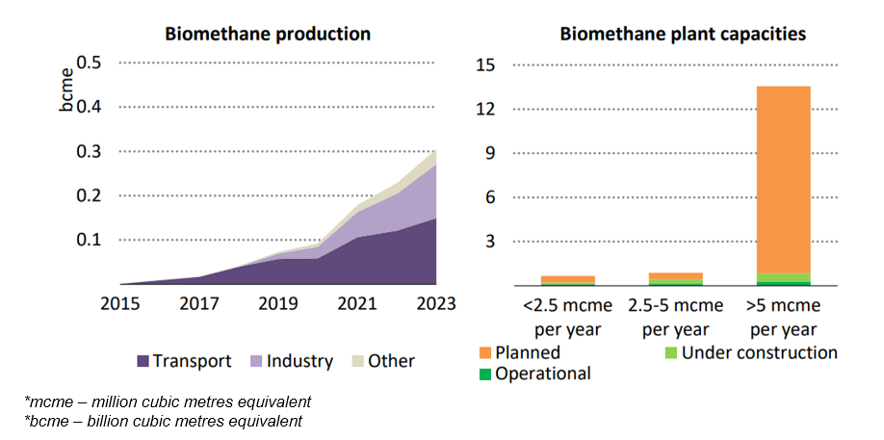
Source: International Energy Agency
Recent policy developments reflect a shift towards a more robust framework for CBG, where financial incentives are complemented by mandatory regulatory measures. The Compressed Biogas Obligation converts SATAT’s voluntary approach into a compliance framework, mandating blending of CBG in CNG and PNG segments and setting the blending rate at 1 percent for Financial Year (FY) 2025–26, which will increase to 5 percent from FY 2028–29.
The CBG-CGD Synchronisation Scheme explores integrating CBG into the city gas distribution (CGD) network, mandating the Gas Authority of India Limited (GAIL)—a PSU under the MoPNG—to supply CBG mixed with domestic gas at uniform base price to authorised CGD entities.
The SATAT Scheme’s target was to establish 5,000 CBG plants by 2023. However, as of July 2026, India has commissioned only 217 units.
In 2025, the MoPNG revised the Biomass Aggregation Machinery (BAM) Scheme to provide financial assistance of INR 9 million to CBG plants with a minimum capacity of 2 tonnes per day that use over 50 percent biomass as feedstock.
Additionally, a new programme is reportedly under preparation to increase the offtake price of CBG and offer financial subsidies and expand the operational fleet to 700 plants.
Scope for India–Japan Cooperation
Given the renewed domestic momentum towards CBG, the India–Japan Cooperative Biogas for Growth Initiative is both timely and significant.
While Japan’s biogas market is modest in scale, valued at US$2.09 billion in 2025 against India’s at US$1.89 billion, it possesses advanced technological capabilities. In 2024, Toyota, Suzuki, and Nissan launched the world’s first biomethane engine that could utilise agricultural waste to fuel their vehicles. Asahi Kasei introduced a biogas purification system at the Kojima Sewage Treatment Plant in 2025, which achieved more than 99.5 percent recovery yield and 97 percent methane purity, suitable for injection into the CGD network or use as compressed fuel.
Instead of relying on imported equipment, this Initiative can enable India to localise advanced Japanese technologies through joint ventures and technology licensing. Once technologies such as Asahi Kasei’s system become available for licensing from 2027, they can be integrated into India’s existing manufacturing ecosystem to improve gas quality while reducing equipment costs.
Such technologies are particularly relevant for India, where maintaining consistent gas quality remains an operational challenge. For instance, in Haryana, Metro Fuels inadequate gas purity led to lower sales and heavy losses before it upgraded its purification system. The Bureau of Indian Standards (BIS) now requires CBG to meet quality specifications of ~95 percent methane purity for commercial offtake; therefore, wider deployment of efficient upgrading technologies and skilled operators is essential.
The Initiative builds on existing collaboration. Beginning in 2024, Suzuki Motor Corporation and its subsidiary Suzuki Research and Development Centre India (SRDI), in partnership with the National Dairy Development Board (NDDB) and dairy cooperatives, committed to establish five biogas plants in Gujarat that combine Japanese biogas technologies and production management expertise with India’s cooperative dairy ecosystem. As of July 2026, two plants are already operational.
This model integrates CBG production with adjacent gas stations, organic fertiliser distribution through dairy cooperatives, carbon credit monetization, and capacity building for plant operators and farmers. In July 2026, Purabi Dairy, NDDB, and SRDI signed a memorandum of understanding (MoU) to replicate the model in Assam.
Japan is also well positioned to provide the long-term capital needed to expand India’s CBG sector, where high-capital expenditure remains a barrier to deployment. Japanese trading house Sojitz invested in IOC GPS Renewables, a venture of Indian Oil Corporation (IOC) and GPS Renewables, which has planned to establish 30 biomethane plants producing 160,000 tonnes annually by FY 2027–28, with total project outlay above US$400 million. The produced biomethane will be supplied to Indian gas firms for blending with conventional city gas. It is likely to also provide the Japanese company environmental benefits under the Joint Crediting Mechanism.
The foundations for deeper financial cooperation to scale India’s renewable and circular economy were laid with the launch of the US$600 million India–Japan Fund in 2023, which can be extended to CBG projects.
In the long term, these initiatives could support a bilateral biomethane supply chain, enabling Japan to supplement its domestic gas network with India-produced biomethane, and complementing the existing Japanese overseas procurement strategies being pursued by Osaka Gas, Tokyo Gas, and Mitsui, which are sourcing biomethane from the United States.
Domestic Reforms for Effective Implementation
The Initiative’s potential will be fully realised only if India addresses its domestic constraints, especially feedstock availability and pipeline connectivity.
India has high feedstock potential for biogas production, which is currently lost due to under-mechanised collection mechanisms and the absence of pricing guidelines for dung and crop residues. Additionally, while the GOBARdhan scheme provides financial assistance for setting up community and cluster biogas plants, it does not offer direct incentives to farmers to collect or supply biomass, leaving feedstock mobilisation dependent on private commercial arrangements. A Centre for Science and Environment report notes that paddy straw prices in Punjab can rise from INR 1.7 to INR 2.5 per kg within a single harvesting season, making production cost estimation difficult, leading to plants operating at 10–50 percent capacity with persistent financial losses and limited offtake.
India needs to incentivise biomass collection, facilitate standardised long-term procurement agreements between producers and feedstock suppliers, develop indicative pricing frameworks for cattle dung and agricultural residues, and expand support under the BAM scheme to lower collection and transportation costs.
Inadequate pipeline connectivity also raises operational costs, as plants have to move gas by truck-mounted cascades, while the byproduct market for FOM is constrained by licensing under the Market Development Assistance Scheme, which authorises only certain plants to sell it directly in bulk.
Therefore, improving CBG project economics will require enhanced gas-grid connectivity, streamlining licensing procedures, incentivising farmers, increasing FOM market uptake, and diversifying plant revenues.
The GOBARdhan portal, which currently mentions gas, feedstock, and byproduct capacities for large-scale plants, can be expanded to disclose plant-level operational data, including actual production and utilisation rates, for enhanced transparency.
Therefore, improving CBG project economics will require enhanced gas-grid connectivity, streamlining licensing procedures, incentivising farmers, increasing FOM market uptake, and diversifying plant revenues.
The Way Forward
India’s challenge is not a lack of biomass resources or low policy ambitions, but the ability to translate these into commercially viable projects at scale. The India–Japan Initiative can bridge this implementation gap by combining Japanese technological expertise and long-term financing with India’s manufacturing capabilities, cooperative institutions, and enabling policy framework.
If supported by clear timelines, transparent monitoring, and targeted reforms to feedstock, pipeline connectivity and by-product markets, this Initiative can position CBG as a commercially viable pillar reinforcing energy security and the circular economy. In the longer term, it can provide a foundation for India to emerge as a reliable biomethane supplier for Japan.
Parul Bakshi is Fellow, Energy and Climate, ORF Middle East.
Pranita Gupta is Research Assistant, Centre for Economy and Growth, Observer Research Foundation.