 Global
Expert Speak | 18 June, 2026
Hydrocarbons at the Epicentre of the Hormuz Crisis
The following excerpt is from “From Hormuz to Households: The Impacts of the Middle East Crisis on the Indian Economy,” ORF Special Report No. 310, Observer Research Foundation, June 2026.
The conflict may be unfolding in West Asia, but India sits uncomfortably close to its economic epicentre. Until the recent conflict, substantial shares of Indian imports—45 percent of crude oil[1],, 60 percent of natural gas[2], and 90 percent of liquefied natural gas (such as liquified petroleum gas [LPG] [3] —have historically travelled through the Strait of Hormuz, a critical maritime chokepoint., Disruptions in the narrow waterway have already triggered global supply shortages. Cumulative, global crude oil supply losses have touched more than a billion barrels since the conflict began on 28 February[4], and a potential 120 billion cubic metre loss in natural gas supplies is anticipated between 2026 and 2030.[5] Given India’s dependence on Middle East energy, the exposure is profound and vulnerabilities are multi-sectoral.
Hydrocarbons are foundational to all modern economies. Rising prices of oil and gas imports are easily transmitted and felt by consumers, but the real danger lies beyond the first-order effects. When supply chains are fractured, the consequences cascade across sectors—powering transport; fuelling industries such as aluminium, petrochemicals, and steel; fertilising agriculture; and supporting essential domains from household energy consumption to tourism, banking and logistics. What may begin as an energy shock can quickly turn systemic.
Macroeconomic Fault Lines
Prime Minister Narendra Modi’s recent appeals—urging citizens to work from home or use public transport, avoid gold purchases for a year, and defer unnecessary foreign travel[6]—may seem unrelated, but they reflect an attempt to contain mounting external vulnerabilities and a widening current account deficit (CAD).
Fuel costs, amounting to US$118 billion last year,[7] constitute the largest share of India’s import bill. Estimates suggest that for every US$10 per barrel increase in crude oil prices, India’s annual import bill will rise by approximately US$13–15 billion and widen CAD by 0.4–0.5 percent of gross domestic product (GDP).[8] With Brent crude prices rising from US$65 to US$120 per barrel, CAD has already widened by 2 percent of the GDP in a matter of few weeks.[9]
At the same time, India imports more than 90 percent of the gold consumed in the country.[10] This, taken along with outbound foreign spending, contributes to capital outflows, further straining the balance of payments. Moreover, rising energy prices will weigh on the Indian currency from a foreign exchange (forex) perspective as well, creating a double bind: a weaker currency makes imports more expensive, which in turn will worsen CAD, further fuelling depreciation pressures.
While the Reserve Bank of India (RBI) does hold significant forex reserves and has intervened through dollar sales, the monetary policy, however, will only offer limited and short-term respite. This is largely a supply driven shock, rather than a demand-led inflation. Policymakers, therefore, face a delicate balancing act of managing demand and prices, without triggering ‘stagflationary’ pressures.
Energy Dependence and Uneven Vulnerabilities
Figure 1: India energy imports from Middle East as % share of total energy imports (2024)
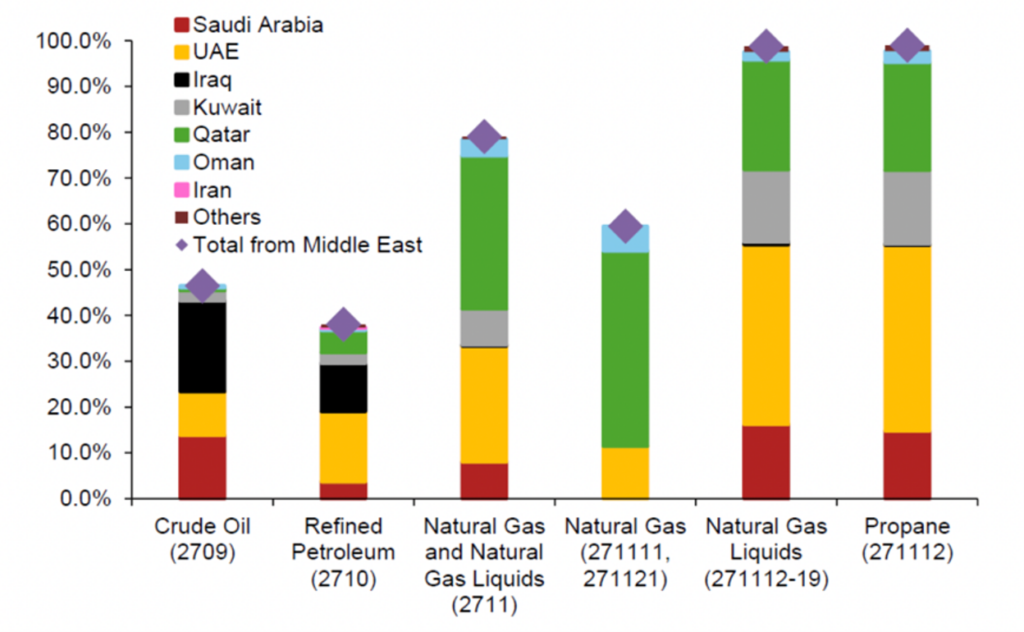
Source: MUFG Research[11]
Table 1: Total Energy Supply by Fuel in India (%) (2024)
| Coal | Oil | Natural Gas | Solar &
Wind |
Hydro | Nuclear |
| 59 | 28 | 7 | 3 | 1 | 2 |
| Electricity Generation by Fuel in India (%) (2024) | |||||
| Coal | Oil | Natural Gas | Solar &
Wind |
Hydro | Nuclear |
| 75 | 0 | 3 | 12 | 8 | 3 |
Source: Author’s own, using data from Energy Institute[12]
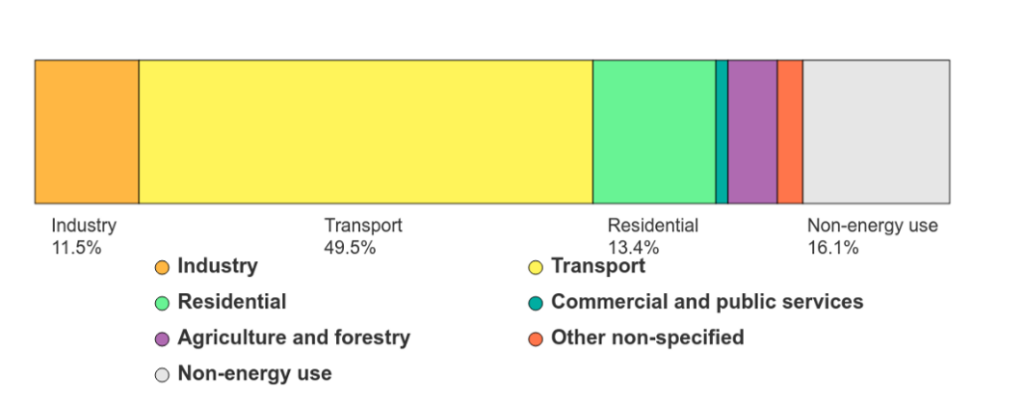
Crude Oil : India imports nearly 90 percent of its crude-oil needs[13], (roughly 5.64 million barrels per day [bpd] in 2024[14]), with almost half of it transiting through the Strait of Hormuz[15]. While the country has diversified its supplies from 27 countries in 2006–07 to over 40 today,[16] yet countries in the Middle East—Saudi Arabia, Iraq and the United Arab Emirates (UAE), respectively—remain its key suppliers after Russia. While oil remains negligible in India’s power generation due to high costs, it is critical for transport (50 percent), industry (12 percent), residential use (13 percent) and agriculture (5.5 percent).
India hosts one of the largest refineries in the world, and the crude shortages have already triggered a 15 percent drop in inventory and forced declines in processing rates.[17] India’s efforts to source crude from Russia, West Africa, and the Americas have already reduced reliance on the Hormuz chokepoint; 70 percent of crude imports are now routed outside the Strait of Hormuz, compared to 55 percent previously.[18] Strategic stockpiles and a diversified base for crude imports offers some flexibility to the oil markets, unlike in the case of natural gas and LPG.
Figure 2: Oil products final consumption by sector, India, 2023
Source: IEA[19]
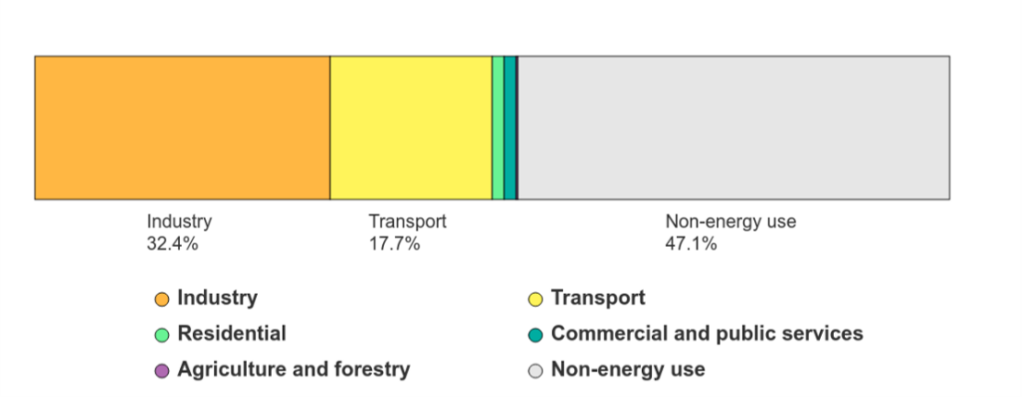
Natural Gas: India’s exposure to natural gas supply chains presents a more complex challenge. Unlike oil, gas is difficult to store and transport, making prolonged disruptions particularly damaging. India imports roughly 50 percent of its natural gas needs[20], of which approximately two-thirds comes from the Middle East[21], primarily Qatar.[22] Although the share of natural gas in India’s overall energy mix is only 7 percent, its importance in fertilisers (around 30 percent usage),[23] transport (compressed natural gas [CNG]) and household consumption (piped natural gas [PNG]) makes it economically sensitive. Industries such as refineries, steel, and petrochemicals are also heavily reliant on natural gas.
Piped Natural Gas: In FY 2023–24, PNG accounted for almost 20 percent of India’s total gas demand.[24] While the government has since been prioritising PNG and CNG infrastructure, progress remains slow. About 16 million PNG connections exist today, of which 10 million are active, despite a target of 120 million; 8,600 CNG stations are operational, compared to a target of 17,500. Infrastructure constraints thus limit the short-term impact of PNG.[25]
Figure 3: Final consumption of gas by sector, India, 2023
Source: IEA[26]
Liquefied Petroleum Gas: serves as the primary cooking fuel for 330 million households and over 3 million businesses.[27] It, therefore, sits at the intersection of energy policy and welfare, and represents the most immediate and socially sensitive risk. Pradhan Mantri Ujjwala Yojana (PMUY), a scheme that provides to over 100 million low-income households access to subsidised LPG,[28] limits the government’s ability to transfer price increases. Beyond cooking, LPG is also widely used across small and medium (SME) manufacturing sectors.
Recent measures, including the LPG Control Order (March 2026), have raised domestic production targets, while a one year agreement to import 2.2 million tonnes annually from the United States (US), aims to stabilise immediate supply.[29] However, these interventions are unlikely to offset short-term shocks.
Managing the Crisis: Policy Trade-offs
The government’s response so far reflects a tight balancing act between securing supply, ensuring affordability, protecting consumers and maintaining macroeconomic stability. The Essential Commodities Act (1955),[30] invoked by the government, allows the reallocation of natural gas across priority sectors while curtailing supply to non-essential industrial consumers, and manages price spikes amidst tendencies toward hoarding. Oil marketing companies have been asked to prioritise the utilisation of propane and butane streams for LPG production. Subsidies have been used to shield consumers from price hikes, particularly in LPG. At the same time, fuel prices in pumps have remained steady with state entities absorbing some of the shock.
However, these measures come at a cost, adding fiscal pressure and straining state-owned refineries and enterprises. Moreover, import substitution strategies— such as ramping up coal-based power generation, or fuel switching to kerosene—may ease pressure on LPG demand initially, but will exacerbate environmental and logistical challenges that could range from higher emissions to strained transport networks.
Rethinking India’s Energy Security Architecture
The Hormuz crises represents a moment of reckoning, forcing countries to rethink and recalibrate their energy security architecture.
- Strategic Securitisation of Energy Systems
Energy security is a matter of national security. In a world with growing geopolitical tension, energy infrastructure should be protected physically and digitally against both kinetic and cyber-attacks. Furthermore, strengthening strategic reserves and stockpiling will become central to energy security frameworks. Existing arrangements have already demonstrated their value. For instance, the UAE’s storage of approximately 5.86 million barrels of crude in the Mangalore Strategic Petroleum Reserve (SPR) facility in Karnataka,[31] turned out to be a significant buffer for India during the ongoing crises. Building on this, Prime Minister Modi’s visit to the UAE on 15 May 2026, marked an important step forward, with both sides committing to expand storage capacity by as much as 70 percent, to 30 million barrels.[32] These developments offer a strong template for deeper collaboration and expanded storage capacity with trusted allies and partners.
- Building Resilience: Diversification, Domestic Capacity, and Decarbonisation
Countries are increasingly willing to pay a ‘sovereignty premium’ to reduce external dependencies. This will drive: (a) diversification across suppliers, routes, fuels, and technologies; and, (b) domestic development and international co-development. Both factors (a) and (b), will increase reliance on local energy resources alongside expanding investments in oil, gas, renewables and critical minerals—in exploration as well as in sustainable extraction. This shift will likely expand to projects and even geographies that may have previously been considered financially or politically unviable. The third factor, (c) is transition.
(c) Transition to clean energy is no longer a climate imperative, but an economic necessity. Renewables, gas, nuclear, and hydrogen—though requiring high upfront capex investments—can eventually reduce long-term vulnerability to global price volatility and supply disruptions. However, transition risks remain. Without adequate domestic capacity in manufacturing clean energy and processing critical minerals, India only risks replacing one dependency with another. Building resilient supply chains, investing in storage and grid infrastructure, and strengthening distributed energy systems will be essential.
Mannat Jaspal is Director and Fellow, Climate and Energy, ORF Middle East.
Endnotes
[1] Ministry of Petroleum & Natural Gas, Government of India, https://www.pib.gov.in/PressReleasePage.aspx?PRID=2239021&®=3&lang=2
[2] Michael Wan, India – Strait of Hormuz closure: Not just about oil prices for INR, MUFG Bank, Ltd, March 12, 2026, https://www.mufgresearch.com/fx/india-strait-of-hormuz-closure-not-just-about-oil-prices-for-inr-12-march-2026/
[3] Ministry of Petroleum & Natural Gas, Government of India, https://www.pib.gov.in/PressReleasePage.aspx?PRID=2238525®=3&lang=1
[4] IEA, Oil Market Report , 2026, https://iea.blob.core.windows.net/assets/2b89a47b-34a2-40e0-90ff-68f7ccd80715/-13MAY2026__OilMarketReport_publicversion.pdf
[5] “IEA says war led to 120 bcm losses of global LNG supply through 2030,” Argaam, May 07, 2026, https://www.argaam.com/en/article/articledetail/id/1903468
[6] “Avoid buying gold, work from home: PM Modi’s 7 big appeals to cushion India from soaring energy costs amid Iran war,” Mint, May 11, 2026, https://www.livemint.com/news/india/work-from-home-wfh-avoid-buying-gold-pm-modis-7-big-appeals-to-cushion-crude-oil-prices-economic-impact-of-iran-war-11778470722187.html
[7] Atul Mathur, “West Asia Crisis Hits March Crude Imports, but India End FY26 on Growth Path,” The Times of India, April 29, 2026, https://timesofindia.indiatimes.com/business/india-business/west-asia-crisis-hits-march-crude-imports-but-india-ends-fy26-on-growth-path/articleshow/130615837.cms
[8] Wan, “India – Strait of Hormuz closure”.
[9] Shivangi Acharya, “India’s trade gap widens as crude imports surge due to Mideast war,” Reuters, May 15, 2026, https://www.reuters.com/world/india/indias-april-merchandise-trade-deficit-2838-billion-reuters-calculation-shows-2026-05-15/
[10] Dheeraj Kumar, “How dependent is India on imported gold? Here’s why PM Modi wants buying to slow,” Firstpost, May 11, 2026, https://www.firstpost.com/business/india-imported-gold-dependence-modi-gold-buying-imports-forex-pressure-14009832.html
[11] Wan, “India – Strait of Hormuz closure”
[12] Energy Institute, Statistical Review of World Energy 2025, London, 2025, https://www.energyinst.org/statistical-review
[13] “Explainer: How persistently high oil prices could impact India’s vulnerable economy,” Reuters, March 12, 2026, https://www.reuters.com/business/energy/how-persistently-high-oil-prices-could-impact-indias-vulnerable-economy-2026-03-12/
[14] Himanshu Thakur, “India to lead global oil demand growth by 2030 on economic expansion: IEA,” Business Standard, June 17, 2025, https://www.business-standard.com/economy/news/india-global-oil-demand-growth-2030-economic-expansion-iea-125061700997_1.html
[15] “Explainer: How persistently high oil prices could impact India’s vulnerable economy”
[16] Ministry of Petroleum & Natural Gas, Government of India, https://www.pib.gov.in/PressReleasePage.aspx?PRID=2239021®=3&lang=2
[17] Sanjeev Choudhary, “India’s crude oil stocks drop 15% amid Iran conflict, raising supply concerns,” The Economic Times, May 15, 2026, https://economictimes.indiatimes.com/industry/energy/oil-gas/indias-crude-oil-stocks-drop-15-amid-iran-conflict-raising-supply-concerns/articleshow/131105689.cms?from=mdr
[18] Ministry of Petroleum & Natural Gas, Government of India, https://www.pib.gov.in/PressReleasePage.aspx?PRID=2238525®=3&lang=1
[19] IEA, India, https://www.iea.org/countries/india/oil
[20] Parul Bakshi, Assessing India’s energy vulnerabilities amid the Gulf crisis, The Oxford Institute for Energy Studies, March 2026, https://www.oxfordenergy.org/wpcms/wp-content/uploads/2026/03/Comment-Assessing-Indias-energy-vulnerabilities-amid-the-Gulf-crisis.pdf
[21] “Asia’s Oil and LNG Dependence on the Middle East,” Reuters, March 2, 2026, https://www.reuters.com/business/energy/asias-oil-lng-dependence-middle-east-2026-03-02/
[22] Bakshi, “Assessing India’s energy vulnerabilities amid the Gulf crisis”
[23] Priya Jestin, “India invokes measures to ensure gas, fertilizer availability,” Independent Commodity Intelligence Services, March 09, 2026, https://www.icis.com/explore/resources/news/2026/03/09/11186750/india-invokes-measures-to-ensure-gas-fertilizer-availability/
[24] Bakshi, “Assessing India’s energy vulnerabilities amid the Gulf crisis”
[25] Bakshi, “Assessing India’s energy vulnerabilities amid the Gulf crisis”
[26] International Energy Agency, India, https://www.iea.org/countries/india/natural-gas
[27] Bakshi, “Assessing India’s energy vulnerabilities amid the Gulf crisis”
[28] Pradhan Mantri Ujjwala Yojana, https://www.pmuy.gov.in/
[29] Bakshi, “Assessing India’s energy vulnerabilities amid the Gulf crisis”
[30] The Gazette of India, ‘MoPNG Order’, Government of India, https://static.pib.gov.in/WriteReadData/specificdocs/documents/2026/mar/doc2026310819601.pdf
[31] “ADNOC Signs Agreement For 5.86m Barrels Strategic Crude Oil Reserve in India,” Abu Dhabi National Oil Company, https://www.adnoc.ae/en/news-and-media/press-releases/2017/adnoc-signs-agreement-for-strategic-crude-oil-reserve-in-india
[32] Atul Mathur, ”Abu Dhabi to ramp up cold storage, India’s reserves may go up 70%”, The Times of India, May 16, 2026, http://timesofindia.indiatimes.com/articleshow/131128309.cms?utm_source=contentofinterest&utm_medium=text&utm_campaign=cppst