 Global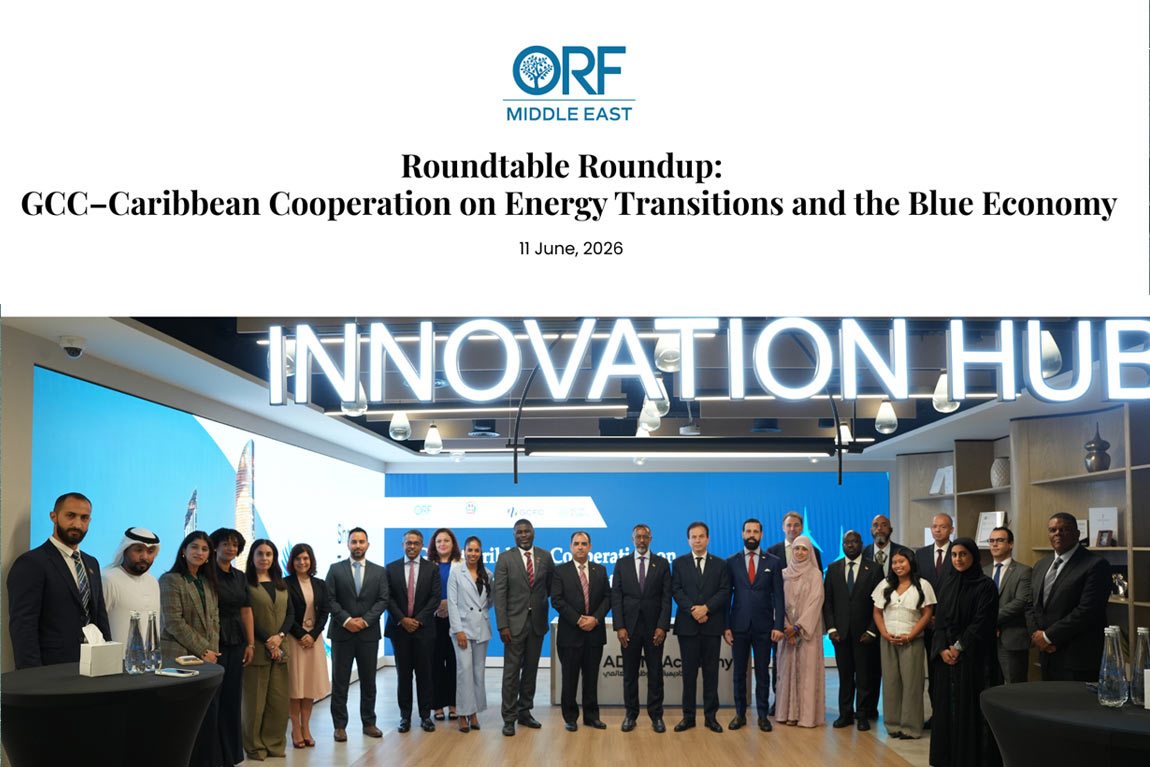
Event Reports | 29 July, 2026
Roundtable Roundup: GCC–Caribbean Cooperation on Energy Transitions and the Blue Economy
Observer Research Foundation (ORF) Middle East and the Embassy of the Dominican Republic to the United Arab Emirates, in collaboration with the Global Climate Finance Center (GCFC), and Abu Dhabi Global Markets (ADGM) Academy, co-hosted a closed-door dialogue in the United Arab Emirates (UAE) to facilitate knowledge exchange and South–South collaboration between the Caribbean and Gulf states to advance joint interests in energy transition efforts and blue economy development.
Key Discussion Points
Rationale for GCC–Caribbean Cooperation
The Association of Caribbean States and the Gulf Cooperation Council (GCC) states are at critical inflection points regarding energy security and resilience. The Caribbean nations rely on costly fossil fuel imports for over 85 percent of electricity generation. Despite an abundance of renewable energy resources such as solar, wind, and hydropower, infrastructure limitations, investment challenges, and regulatory barriers impede technology deployment and adoption. The historically fossil-dependent Gulf states are actively seeking to diversify their economies and energy resources, setting ambitious renewable energy targets and investing in energy- and water-intensive industries such as artificial intelligence (AI) and data centres. Similar to the Caribbean, the Gulf states have weathered renewable technology deployment and scaling challenges.
The Caribbean and GCC states aim to bolster coastal ecosystem restoration while generating socioeconomic benefits. The blue economy refers to the promotion of economic growth, social inclusion, livelihood improvement, and environmental sustainability in oceans and coastal areas. Currently, blue-economy activities contribute minimally to the GCC’s gross domestic product (GDP) output, largely due to fragmented planning, governance, and coordination. Several GCC countries are aiming to change this narrative, centering blue economy prospects within broader Vision 2030 objectives. States such as Saudi Arabia and the UAE, for instance, have established blue economy strategies, aiming to advance ports and logistics, aquaculture, fisheries, coastal tourism, and shipping. Meanwhile, the Caribbean excels in its regional leadership and progress in establishing marine governance frameworks and innovative blue financing mechanisms. However, both regions face similar climate and pollution challenges, which harm marine biodiversity and hinder blue economy prospects.
Given recently reaffirmed interests in advancing regional GCC–Caribbean cooperation, the roundtable evaluated challenges and bottlenecks across blue finance for both regions, clean energy transitions, and marine governance, offering strategic pathways for GCC–Caribbean collaboration.
Challenges and Bottlenecks
Blue Finance Limitations
Although capital is largely available, channeling it towards innovative climate and energy projects in the Caribbean remains challenging due to small project ticket sizes, investor risk aversion towards low early-stage profitability, flawed vulnerability metrics, and blue taxonomy limitations.
First, climate and energy projects experience scale and capacity challenges. Island energy systems operate within spatial constraints, resulting in higher project costs and limited scalability. The supply–demand mismatch contributes to delayed investments for critical infrastructure, such as battery energy storage systems (BESS). Furthermore, sargassum or the accumulation of brown algae on Caribbean shores harms marine life, tourism, and coastal and energy infrastructure. While closed-cycle, multi-stream biorefinery models exist to transform sargassum into high-value pharmaceutical, bioenergy, and agricultural products, solutions remain nascent. Additionally, nature-based solutions take time to yield visible returns, resulting in chronic underfunding. Scientists and entrepreneurs may also lack the administrative capacity to translate raw scientific output into commercial documentation. Low early-stage profitability, supply-demand mismatches, and administrative challenges result in difficulties attracting funding.
Furthermore, Caribbean countries face a financing paradox. The region experiences annual hurricane seasons that inflict economic damage, forcing countries into repeated cycles of disaster recovery. Since international aid dissemination relies on income-based metrics such as GDP, many Caribbean islands are categorised as high-income, rendering them ineligible for Official Development Assistance (ODA). Due to this, any temporary wipe-out of annual GDP and critical economic infrastructure during natural disasters exposes these countries to challenges financing reconstruction and resilience.
Structural Constraints and Climate Vulnerabilities
Mirrored climate extremes threaten to destabilise technology expansion and grid modernisation ambitions in the GCC and the Caribbean. In both regions, intense extreme heat events increase electricity demand, placing pressure on ageing or outdated grid infrastructure, necessitating shifts towards resilient infrastructure, planning, and financing.
The Caribbean’s energy transition is limited by a lack of usable land. To overcome this challenge, the region is exploring alternative energy supply solutions such as floating solar photovoltaic technologies, geothermal energy, integration of demand-side energy efficiency measures, and strengthening grid optimisation.
GCC energy systems are projected to face additional strain on electricity grids due to the increasing energy intensity of desalination facilities, cooling, and future data centre infrastructure. While GCC countries are comparatively better equipped to build, finance, and scale large-scale technology and infrastructure, the region can similarly benefit from strengthening demand-side energy regulations.
Regulatory and Institutional Roadblocks
Outdated regulatory frameworks, siloed governance policies, and differing political structures across both regions inhibit joint coordination and regional market integration.
The Caribbean experiences technical and regulatory constraints, preventing renewable projects from taking off. For example, the Commonwealth of Dominica and Saints Kitts and Nevis exhibit immense geothermal potential. However, establishing a regional energy hub and interconnectivity through marine sub-cables remains a complex process. A lack of regulatory harmonisation prevents the Caribbean from establishing unified standards for cost-effective solar panels, transformers, and grid equipment. This is exacerbated by domestic capacity constraints, compromising energy planning, forecasting, and grid optimisation.
Conversely, the GCC countries have established synergies between internal meteorology, energy, and utilities ministries and enforceable emissions penalties. For example, the UAE Federal Decree-Law No. 11 of 2024 notably shifts towards a legally binding mandatory enforcement model to ensure compliance with measuring Scope 1 and Scope 2 emissions. However, state legislation can still improve to mandate explicit climate-resilient engineering standards for infrastructure.
In terms of marine governance, the Caribbean’s unified regional ocean policy (CROP) contrasts with the GCC countries’ nascent and siloed strategies. CROP successfully expanded small-scale marine spatial policies and interstate coordination while ensuring sovereign representation. The GCC currently governs marine conservation through the Regional Organization for the Protection of the Marine Environment (ROPME), which aims to protect fragile marine ecosystems from oil spills, hazardous emergencies, and pollution. However, the institution has historically struggled to fulfil its mandate due to geopolitical tensions, weak enforcement mechanisms, varying levels of financial commitment, and a lack of community involvement and cross-boundary data-sharing.
Policy Recommendations to Strengthen GCC–Caribbean Cooperation
Leverage Blue Finance Synergies to Enable Capital Flows to Underfinanced Projects
The Caribbean excels in structuring innovative blue finance, such as blue bonds and parametric insurance, while the GCC possesses extensive capital deployment capabilities. To bridge the gap between the Caribbean’s small-scale projects and the GCC’s large-ticket investment requirements, both regions should engage in project de-risking, transition taxonomy harmonisation, and maximising the suite of sustainable finance tools.
Given the recent January 2026 launch of large-ticket blue bonds and bankable project shortages in the GCC, developing a South–South financing facility with GCC financial and technical contributions may assist with de-risking projects in the Caribbean. Providing dedicated technical assistance to project owners would help facilitate commercial bank documentation, while aggregating small-scale Caribbean innovations into larger investable asset classes would help transfer capital flows to underfunded projects. The UAE now has multiple entry points to support Caribbean projects through blue investments, with DP World as one of the first corporate blue bond issuers in the Middle East and Emirates NBD’s recent dual-tranche blue-green bond launch.
Additionally, both regions can collaborate to advocate for the inclusion of nascent innovations such as sargassum into blue economy taxonomies, multilateral adoption of the Bridgetown Initiative, and changes within multilateral development bank operations. The Bridgetown Initiative urges the adoption of a Multidimensional Vulnerability Index to ensure consideration of nations’ structural exposure to climate shocks when disseminating development aid. Jointly advocating multilateral development banks to merge fragmented green and blue taxonomies into unified transition frameworks may help lower transaction costs and unlock scale.
Both regions can leverage each other’s respective strengths in parametric insurance and Islamic blue finance. The Caribbean has deployed parametric insurance schemes to safeguard against natural disasters and flooding, and the Gulf can replicate these measures to protect coastal infrastructure against extreme heat events, oil spills, or piracy. Likewise, GCC countries could explore the deployment of Islamic finance for blue economy projects. Islamic finance is grounded in risk-sharing, equitable wealth distribution, and environmental stewardship principles. Thus, commercial, waqf (endowment), and zakat (charitable) funds offer unharnessed capital options for conservation and coastal resilience. For instance, the UAE, Saudi Arabia, and Qatar are actively deploying green sukuk (Sharia-compliant financial certificate) or large-scale renewable projects and sustainable infrastructure. However, the focus can be expanded to finance blue biotechnology and provide protection against extreme events.
Establish South–South Research and Development Partnerships for Technology Transfer, Energy Efficiency, and Grid Integration
Given their shared challenges across energy planning and grid optimisation in extreme environments, the GCC can offer the Caribbean technical expertise in grid management, district cooling, and regional connectivity. The UAE–Africa Space42 initiative is an example of Gulf expertise in satellite integration, remote sensing, and AI supporting grid resilience and efficiency in Africa. A similar knowledge exchange framework can be adapted and replicated within the Caribbean to build grid resilience and disaster response preparedness.
Pooled procurement can also help harmonise standards and requirements for resilience-focused procurement. For example, the Caribbean Centre for Renewable Energy and Energy Efficiency and IRENA are developing a pool procurement mechanism to strengthen supply chain resilience, reduce costs, and minimise duplication.
Lastly, the Gulf and the Caribbean can explore opportunities to elevate waste-to-value supply chains and build circular economies. Gulf economies are increasingly adopting large- and small-scale waste-to-energy facilities, while the Caribbean aims to transform sargassum into a multi-stream value chain. For example, the Dominican Republic is exploring how to pivot from closed-cycle integrated biorefinery models to a multi-stream chain that would create multiple markets for sargassum. Both regions can exchange expertise on how to extract monetary and physical value from waste products.
Institutionalise Marine Governance and Community-Led Frameworks
While the Caribbean has developed a regional ocean policy to incentivise coordinated development of marine frameworks, the GCC’s blue economy efforts remain largely siloed, prioritising economic revenue over social and environmental concerns. GCC countries can adopt social protection interventions from the Caribbean to ensure that revenue from tourism and port industries is reinvested into local public services as well as to standardise marine conservation and renewable energy skills training.
Conclusion
Given the distinct strengths of and shared challenges between the GCC countries and the Caribbean, there are unharnessed opportunities for deeper South–South cooperation. While the GCC brings extensive capital and technical expertise in energy planning, the Caribbean has experience in marine governance, parametric insurance, and blue bond structuring. Together, both regions can leverage knowledge and finance to strengthen their respective energy transition and blue finance trajectories.
Speakers
- Mohammed Shalo, ADGM Academy Board Member
- Omar Saif, Vice President, Global Climate Finance Centre
- HE Norberto Carlos Escalona Carillo, Ambassador of Cuba to the UAE
- HE Tony Salim Joudi, Ambassador of the Commonwealth of The Bahamas to the UAE
- HE Theon Ali, Ambassador of Antigua and Barbuda to the UAE
- Andre Padmore, Deputy Chief of Mission of Barbados to the UAE
- Carlino Gonzalez, Counselor for Energy, Climate and Environmental Affairs, Embassy of the Dominican Republic to the UAE
- Maha Alkenaee, Second Secretary, Kuwait
- Nadia Mohammed, IRENA Programme Officer—SIDS Lighthouses
- Ahmed ElSafty, Economic Advisor and Research Director, Emirates Center for Strategic Studies and Research
- Naveen Raza, Head of Net Zero Transition | MENAT Sustainability, HSBC
- Jonathan Keyes, Head of Sustainable Solutions Group—Middle East, ING
- Joywin Mathew, Partner, Squire Patton Boggs (MEA) LLP
- Diana Francis, Professor of Atmospheric and Climate Science, Khalifa University, UAE
- Beatriz Garcia, Associate Professor and Sustainability Officer, Department of Law, Economics and Management, Sorbonne University, Abu Dhabi
- Hessa Al Nuaimi, Researcher, Trends Group
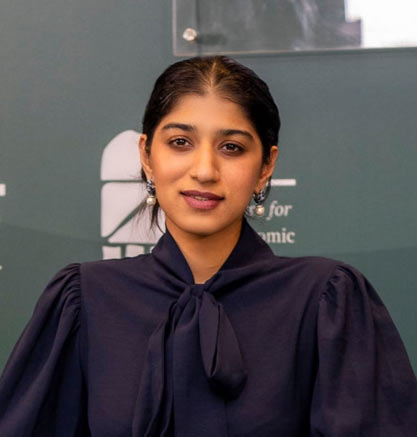
The Diplomatic Roundtable session was moderated by Mannat Jaspal, Fellow, Climate and Energy, ORF Middle East. The Expert Roundtable session was moderated by Leigh Mante, Junior Fellow, Climate and Energy ORF Middle East.