 Global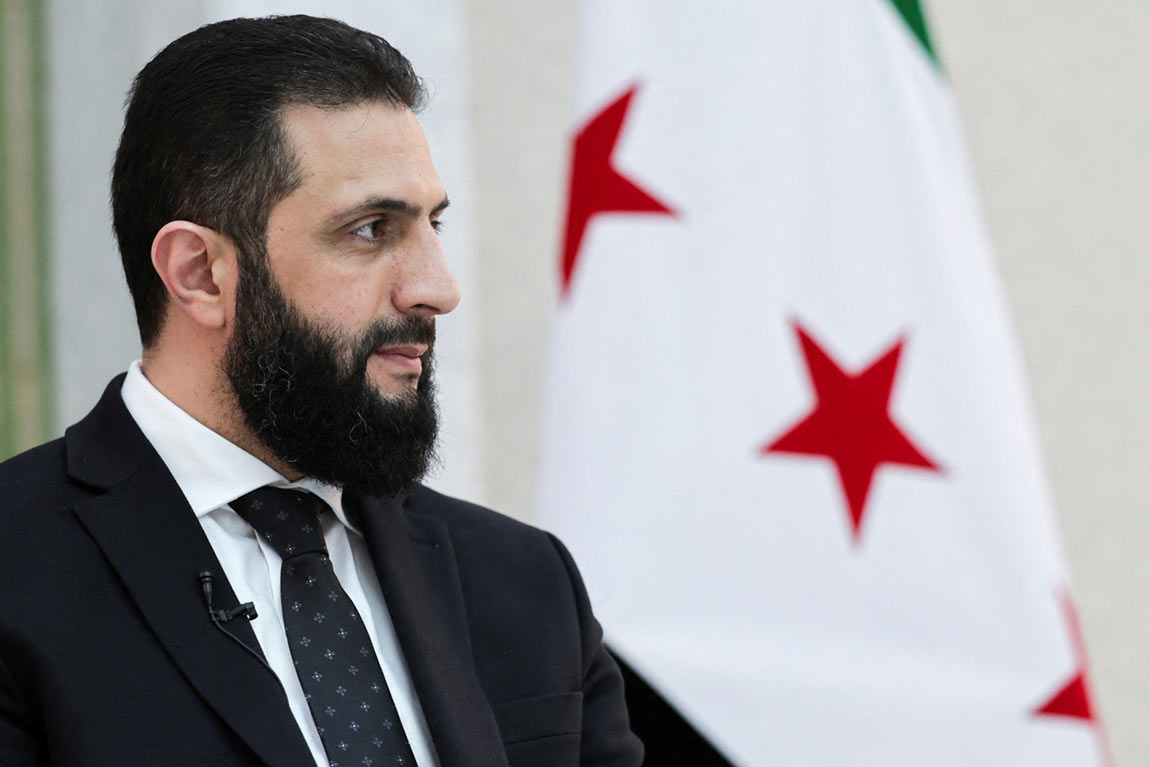
Expert Speak | 24 September, 2026
Syrian President Ahmed al-Sharaa’s Pursuit for Legitimacy
Spotlight
- President Ahmed al-Sharaa has reoriented Syria from the Iran–Russia axis towards Washington and the Gulf, producing a remarkably rapid diplomatic rehabilitation.
- Sanctions relief, foreign investment, and diplomatic recognition have supplied resources and credibility that Syria’s weakened domestic institutions could not initially provide.
- Al-Sharaa is betting on borrowed international legitimacy converting into domestic legitimacy and prosperity before Syria’s internal weaknesses start undermining its external gains.
Most new regimes develop strategies based on what their predecessor lacked. When Syrian President Ahmed al-Sharaa assumed power in January 2025, he inherited a state deficient in nearly every conventional source of power: capital, functioning institutions, a monopoly over violence, and international legitimacy. However, it had one unusual asset: Western and regional desire for a Syria that was stable and detached from Iran and Russia.
The defining move of al-Sharaa’s presidency has been to convert that geopolitical interest into political capital by using the state’s external repositioning as a substitute for the domestic capacity his government does not yet possess. Eighteen months later, that strategy has succeeded on its own terms: the United States (US) has removed Syria from the ‘State Sponsors of Terrorism’ list; international sanctions have been repealed; al-Sharaa was welcomed by United States (US) President Donald Trump to the White House; and even French President Emmanuel Macron visited Syria (18 years after the last visit by a French president, Nicolas Sarkozy in 2008).
The defining question of his presidency is whether he can convert external recognition into durable internal legitimacy before the conditions attached to it begin to unravel.
However, the recognition al-Sharaa has won abroad has not translated domestically, where prosperity and an inclusive political order remain elusive. Therefore, the defining question of his presidency is whether he can convert external recognition into durable internal legitimacy before the conditions attached to it begin to unravel.
The Mechanisms of Repositioning
President al-Sharaa’s foreign policy has operated through four principal instruments. The first is personal rehabilitation. After working with the Jabhat al-Nusra (now Hay’at Tahrir al-Sham [HTS]), once al-Qaeda’s Syrian affiliate, he progressively shed the symbols, language, and political identity of jihadism. This included dropping the pseudonym Abu Mohammed al-Jolani, which was associated with his jihadist past, and using his real name, Ahmed al-Sharaa; changing his wardrobe from traditional militant attire to Western suits; and adopting a more moderate tone by casting himself as a champion of pluralism and tolerance.
The second—and possibly the most consequential—is strategic realignment. Al-Sharaa has reoriented Syria from the Iran–Russia axis towards Washington and the Gulf. His government curbed Iranian smuggling networks, ended Russian management of the Tartus in favour of the United Arab Emirates (UAE), and signed Syria into the US-led coalition against the Islamic State (ISIS). The effectiveness of this strategy lies in his recognition that every prospective patron had something different to gain. For the Gulf states, Syria offers a reconstruction market and a counterweight to Tehran. Further, the Gulf capitals are interested in a stable Syria as it would lead to greater regional stability. For Washington, it offers a counter-ISIS partner and the possibility of permanently distancing Syria from Iran’s and Russia’s strategic orbit. This was crucial as under former President Bashar al-Assad, Syria was part of Iran’s axis of resistance and an important logistics node for the axis’s operations. President al-Sharaa identified the foreign powers’ interests with considerable precision, aligned them with Syria’s aspirations of reconstruction, and priced Syrian cooperation accordingly.
The third instrument is economic diplomacy: the conversion of access into legitimacy and capital. Under al-Sharaa, ports and power infrastructure became diplomatic currency. The catalytic moment came in Riyadh in May 2025, where President Trump, after meeting al-Sharaa and persuaded by Saudi leaders, announced that the US would lift sanctions imposed on Syria and spoke about normalisation of relations with the nation. A cascade of executive orders followed, along with an inflow of foreign capital. A US$800-million development deal with Dubai’s DP World to operate the Port of Tartus, the France’s logistics group CMA CGM signing a 30-year deal to develop the Latakia port, and a US$7 billion Qatari-led energy deal were each simultaneously commercial transactions and diplomatic endorsements. Most importantly, these investments created stakes for foreign governments and corporations in Syria’s future success.
Seen strictly as an exercise in strategic positioning, the campaign has been an unambiguous success.
The fourth is the performance of statehood. It began with a constitutional declaration that establishes a five-year transitional period, at the end of which national elections are envisaged to take place, and conducting indirect elections for a new Parliament. However, there are limits to this ‘performance’ while dealing with a fractured state and people (as elaborated in the next section). Nonetheless, it constituted a carefully choreographed demonstration that Syria had re-entered the community of legitimate states.
These transformational strategies ultimately acquired formal international recognition through the removal of international sanctions on Syria, combined with al-Sharaa’s state visits. This culminated in al-Sharaa becoming the first Syrian president to address the United Nations General Assembly (UNGA) after nearly six decades in 2025.
Seen strictly as an exercise in strategic positioning, the campaign has been an unambiguous success. Washington revoked the Foreign Terror Organization designation for HTS, repealed the Caesar Act, and removed Syria from its State Sponsors of Terrorism list after 47 years, arguably one of the fastest rehabilitations of a pariah state in recent memory.
The Domestic Price of External Legitimacy
The heaviest cost of al-Sharaa’s strategy could be domestic. The exact characteristics of the emerging Syrian order that reassure his foreign patrons, such as a strong executive, an aggressive pursuit of monopoly over violence, and a five-year unelected transition, could lead to an elite capture and unchecked consolidation of power. The effects of domestic and international consolidation of power land in opposite directions. Externally, centralisation makes Syria appear more governable: it produces a single interlocutor capable of enforcing security commitments, controlling borders, disciplining armed groups, and delivering on agreements. However, at home, the same concentration of authority can narrow political participation, weaken institutional checks, and deepen the mistrust of communities that fear being subordinated rather than incorporated into the new state.
The most evident win of this consolidation has been the absorption of the Kurdish-led Syrian Democratic Forces into the Syrian army and the extension of central state authority across the northeastern part of the state. However, its failures have been considerably bloodier, with reports of involvement of government forces in widespread violence. In March 2025, sectarian violence along Syria’s coast killed more than 1,700 people, most of them members of the Alawite minority. In July 2025, clashes in the Druze city of Sweida left about 2,000 people dead. The violence also prompted Israeli airstrikes in Damascus in support of the Druze community. These episodes exposed the distance between the government’s rhetoric of coexistence and the use of violence to achieve it. However, their consequences extend beyond the humanitarian sphere. Sectarian violence also threatens the external positioning on which the government’s economic and diplomatic strategy depends. A massacre that invites foreign bombardment, undermines confidence in state authority, and unsettles investors, is a foreign policy liability.
These fissures are also beginning to impact public sentiment. The accountability that al-Sharaa assured after successive episodes of sectarian bloodshed is yet to reassure the communities most directly affected by them. Syrians appear to register this divergence. A mid-April 2026 survey found that while 49 percent were satisfied with public services in February 2026, by April, this number had declined to 25 percent and only 13 percent believed that the government was doing enough to address increasing prices. During the same period, confidence in safety measures fell from 67 percent to 38 percent.
Currently, external legitimacy perhaps outweighs internal trust. That divergence matters because the relationship is not unidirectional. The loop can reverse, especially as studies have shown that the Syrian government does not currently have a complete monopoly over violence. Therefore, al-Sharaa faces a credible commitment problem. Much of the recognition he has secured ultimately rests on behaviour that the Syrian state cannot yet fully guarantee: protection of minorities, promotion of human rights, institutional reform, an eventual accommodation with Israel, and most importantly, a stable Syria. Until these problems remain unsolved, the fate of Syria under President al-Sharaa remains uncertain.
The Wager
The al-Sharaa presidency can be best understood as a wager: could a leader who inherited a fractured legitimacy at home borrow legitimacy and capital abroad and convert external resources into the institutions, prosperity, and pluralism needed domestically, eventually rendering the borrowing unnecessary?
As an exercise in positioning, the wager has paid off with a speed few anticipated. However, as statecraft, it remains unproven. Positioning is a bridge, not a destination. International recognition has bought al-Sharaa time and access to capital. It has restored Syria to diplomatic rooms from which the nation had long been excluded. However, it has not yet produced a self-sustaining economy or an inclusive political order. Therefore, the principal danger may not be of collapse but stagnation: the emergence of a Syria permanently suspended in the process of conversion. It might be solvent enough to survive, strategically useful enough to be courted, and internationally recognised enough to appear legitimate, yet neither sufficiently prosperous nor plural to consolidate the transition at home. Whether al-Sharaa can complete that conversion before Syria has to pay for its borrowed legitimacy is the question on which the country’s transition now rests.
Samriddhi Vij is Associate Fellow, Geopolitics, at ORF Middle East.
The author acknowledges the use of Google Gemini 3.1 Pro for research purposes for this article.