 Global
Expert Speak | 22 October, 2026
Why the World’s Future Electro- and Petro-Energy Systems Need South Africa
Spotlight
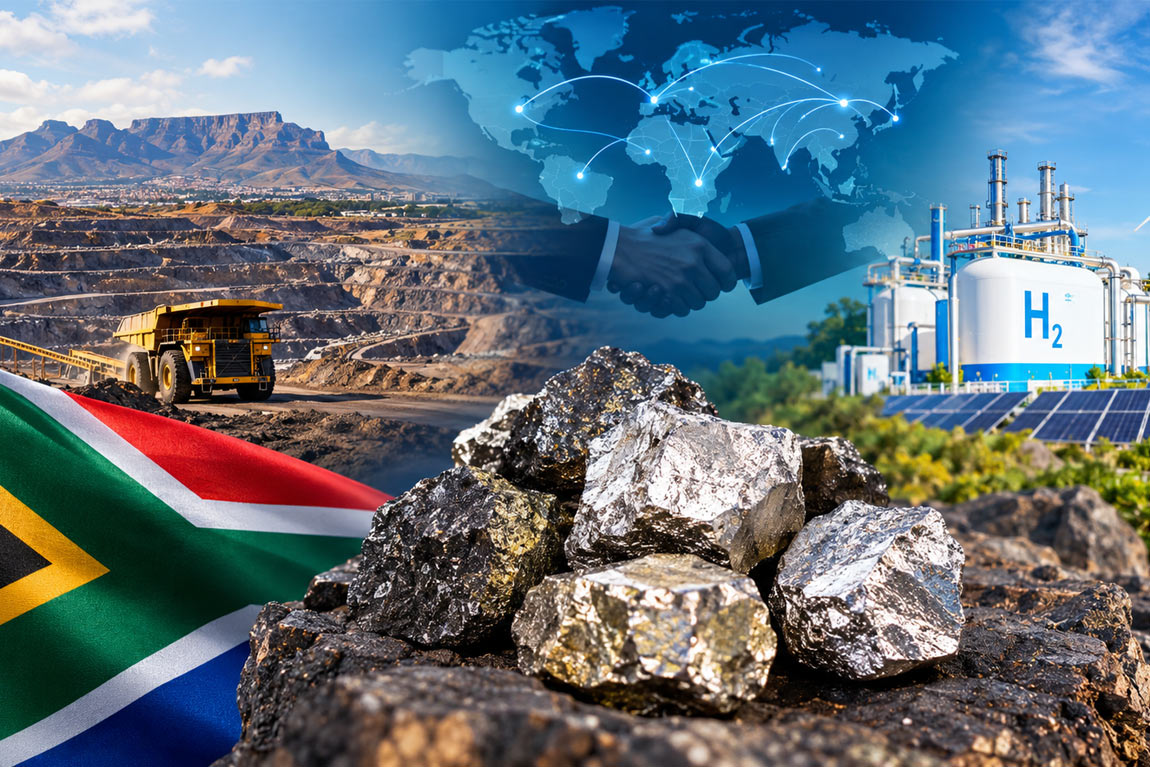
- South Africa’s platinum-group metals (PGMs) give it a strategic advantage as competing hydrocarbon- and electrification-based energy systems reshape global power.
- Pretoria must leverage its mineral wealth and international partnerships to attract investment, deepen industrial capabilities, and capture more value from emerging energy technologies.
- Translating these critical-mineral endowments into lasting geopolitical influence will require a sharper approach towards economic diplomacy, domestic reform, and regional industrial partnerships.
The global energy transition was supposed to offer a relatively clear story. Hydrocarbons would gradually lose ground, electrification would gather pace, and a new group of countries, companies, and commodities would emerge on top. Instead, the world today is building two energy systems simultaneously.
South Africa’s platinum-group metals (PGM) endowment places it at the intersection of energy security and industrial policy.
This messy transition matters for South Africa because it has a foot in both worlds. South Africa’s platinum-group metals (PGM) endowment places it at the intersection of energy security and industrial policy, as well as the search for more resilient supply chains. Its strategic relevance is rising, even as its relationships with some major powers become more complicated.
An Enviable Position Straddling Both Energy Systems
South Africa’s PGMs are embedded in the industrial architecture of the hydrocarbon economy. They are used in auto-catalysts, petroleum refining, petrochemicals, and industrial emissions control. Hybrid vehicles may sustain this demand for longer than many expected as consumers and governments globally adopt fully electric vehicles (EVs) at different speeds.
PGMs also feature in hydrogen electrolysers, fuel cells, advanced manufacturing, specialised electronics, and several technologies associated with a more electrified and digitally intensive economy.
This breadth gives South Africa an unusual strategic advantage. The country holds much of the world’s known PGM reserves and accounts for most of its production. It also has decades of mining expertise, high refining and processing capacity, established financial institutions, and an industrial base built around its mining sector.
Whichever energy system advances faster, South Africa will have relevance and be a key source of bargaining power against the backdrop of a fluid international system in which major powers are scrambling to assert dominance over competing energy systems. The United States (US) is producing oil and gas at scale. Russia remains an energy power despite sanctions. Gulf states are investing heavily in new hydrocarbon capacity, while placing large bets on renewables and hydrogen. China has established an enormous lead in many technologies that underpin the emerging clean-energy economy, including solar panels, batteries, EVs, grids and critical mineral processing.
This is sharpening a geopolitical contest between petro-states—whose influence rests heavily on the production and financing of hydrocarbons—and electro-states—that are accumulating power through clean technologies—and the associated industrial base necessary for greater electrification.
However, the dividing lines are blurred between states leading either energy ecosystem. China still consumes vast quantities of coal, oil, and gas. The US and Gulf states are significant investors in clean energy. Most big powers are trying to preserve their strengths in the existing system while acquiring a stake in whatever comes next.
The energy transition has accordingly moved well beyond the realm of climate negotiations. It is increasingly a competition over industrial power: who finances infrastructure, controls processing, sets standards, develops technology, and secures access to the critical minerals on which the system depends.
These decisions will continue to shape commercial relationships for decades. Energy infrastructure is expensive and difficult to replace. The equipment, financing, technical standards, and maintenance networks chosen today will influence where countries buy, borrow, and build tomorrow.
Against this backdrop, South Africa’s value proposition is evident, given its room for manoeuvre. The US and Europe are looking for secure mineral supply chains that will reduce their exposure to China and Russia. China wants continued access to resources, markets, and infrastructure. Gulf countries are searching for new investment opportunities and a role in the hydrogen economy. Japan brings deep experience in automotive and fuel-cell technologies, while India offers a rapidly growing industrial market.
South Africa has relationships with all of them. Yet, it has often struggled to translate its diplomatic reach into coherent economic propositions.
The country’s foreign policy debates tend to be consumed by alignment: whom South Africa supports, which bloc it appears closest to, and the interpretation of each diplomatic gesture. While these questions matter, they can obscure the more practical issue of what South Africa wants from these relationships.
Strategic non-alignment only has economic value when it creates room for competing investment offers, wider market access, and deeper technology partnerships.
South African diplomacy has yet to exploit this commercial opportunity fully.
Strategic non-alignment only has economic value when it creates room for competing investment offers, wider market access, and deeper technology partnerships. Geopolitical relationships should be judged partly by whether they strengthen the domestic productive economy.
From Mineral Endowment to Industrial Capability
PGMs give this diplomacy a commercial focus. Instead of approaching each external partner with a general appeal for investment, South Africa can offer participation in a sophisticated mineral and industrial ecosystem relevant across established and emerging energy technologies.
Access to ore should come with research, processing, manufacturing, and technical partnerships. The precise opportunity will differ by partner and technology. American and European firms may prioritise secure supply and specialised manufacturing. Chinese companies bring scale, infrastructure, and links into clean technology value chains. Gulf capital could support energy, logistics, and hydrogen projects. Japanese partnerships may deepen automotive and fuel-cell capabilities.
The recent agreement by Alcoa to acquire South32’s aluminium portfolio, including the Hillside smelter, is instructive. While the wider transaction is global and remains subject to approval, a leading American industrial company could gain a new foothold in South Africa through an internationally competitive asset. At a time of considerable political tension between Pretoria and Washington, it proves that commercial interests can still move in a more constructive direction. Economic diplomacy should build on such deals, connecting South African resources and industrial capacity with global companies’ strategic priorities.
This requires sharper coordination of foreign, mining, trade, energy, and industrial policy. International partnerships are frequently announced without any clear view of how they connect to the capabilities South Africa already possesses or the industries it hopes to build. The result is plenty of diplomatic activity with limited economic accumulation.
Valterra is at the centre of this opportunity. As one of the world’s leading PGM producers, with deep mining, processing, and market expertise, it sits at the meeting point of South Africa’s geological advantage and global industrial demand.
Its value will increasingly come from developing markets as well as supplying metal. It can help develop new markets for PGMs, deepen partnerships with technology and manufacturing companies, and strengthen the links between established applications and emerging uses. Valterra can thus help South Africa shift from responding to global demand to shaping future demand.
South Africa already has a substantial base. Its mining and refining capabilities took decades to develop and cannot be easily replicated elsewhere. Universities, research institutions, specialist suppliers, and financial services add further depth. This creates opportunities in areas such as catalyst production, recycling, advanced materials, and components linked to hydrogen and fuel-cell technologies.
South Africa will need to choose where it can compete credibly. It cannot occupy each part of every value chain. The language of beneficiation has too often encouraged grand ambitions without sufficient attention to commercial viability. The better approach is to identify the areas where existing capabilities, future demand, and international partnerships reinforce one another.
The established PGM economy should therefore receive attention. New applications are important, but their scale and timing remain uncertain. Auto-catalysts, industrial uses, refining, and chemicals will continue to underpin demand in the near term. The income, capabilities, and relationships generated by today’s market should help prepare for tomorrow’s changes.
Developing a Regional Platform for PGM Leadership
None of this will carry much weight if the domestic operating environment continues to weaken. Electricity, rail, ports, and water determine whether South Africa’s geological advantage reaches the market competitively. Regulatory delays and declining exploration gradually undermine the sector’s longevity, while skills and research constraints limit movement into higher-value activities.
These are now questions of foreign policy as much as domestic reform. Global partners seek secure and resilient supply chains. Reliability shapes where they commit capital, locate production, and build long-term relationships. South Africa’s diplomatic leverage will ultimately depend on whether it can deliver consistently at home.
A regional strategy could extend this advantage. Regional projects and partnerships can diversify supply, expand markets, and connect South African capabilities to a larger mineral base. The value lies in creating complementary infrastructure, processing, and industrial capacity across the region. Expanding reach without addressing the same energy, logistics, and policy constraints merely reproduces existing vulnerabilities.
Mineral abundance provides influence, but the durability of that influence depends on what is built around the resource.
South Africa can remain essential to the global PGM market while capturing a diminishing share of the economic value created around it. Countries that control technology, intellectual property, standards, manufacturing, and customer relationships tend to capture the largest rewards. Mineral abundance provides influence, but the durability of that influence depends on what is built around the resource.
The emerging energy order will take time to settle. Hydrocarbons will remain important, electrification will continue, and new technologies will develop unevenly across regions and industries. That period of overlap suits South Africa because PGMs have applications across both systems.
The opportunity now is to connect its mineral endowment, industrial capabilities, and international relationships more effectively. Economic diplomacy can attract capital, technology, and market access. Domestic reform will determine whether South Africa remains a reliable and competitive partner.
South Africa does not need to predict which energy system will prevail; it needs to ensure that its metals, companies, and capabilities matter regardless.
Ronak Gopaldas is Director at Signal Risk and Non-Resident Fellow at ORF Middle East. He is also Visiting Fellow at the London School of Economics.
The author acknowledges the use of ChatGPT-6 to provide a preliminary scan of authoritative online resources relating to ongoing global debates between electro- and petro-states and the future of the world’s energy systems.