 Global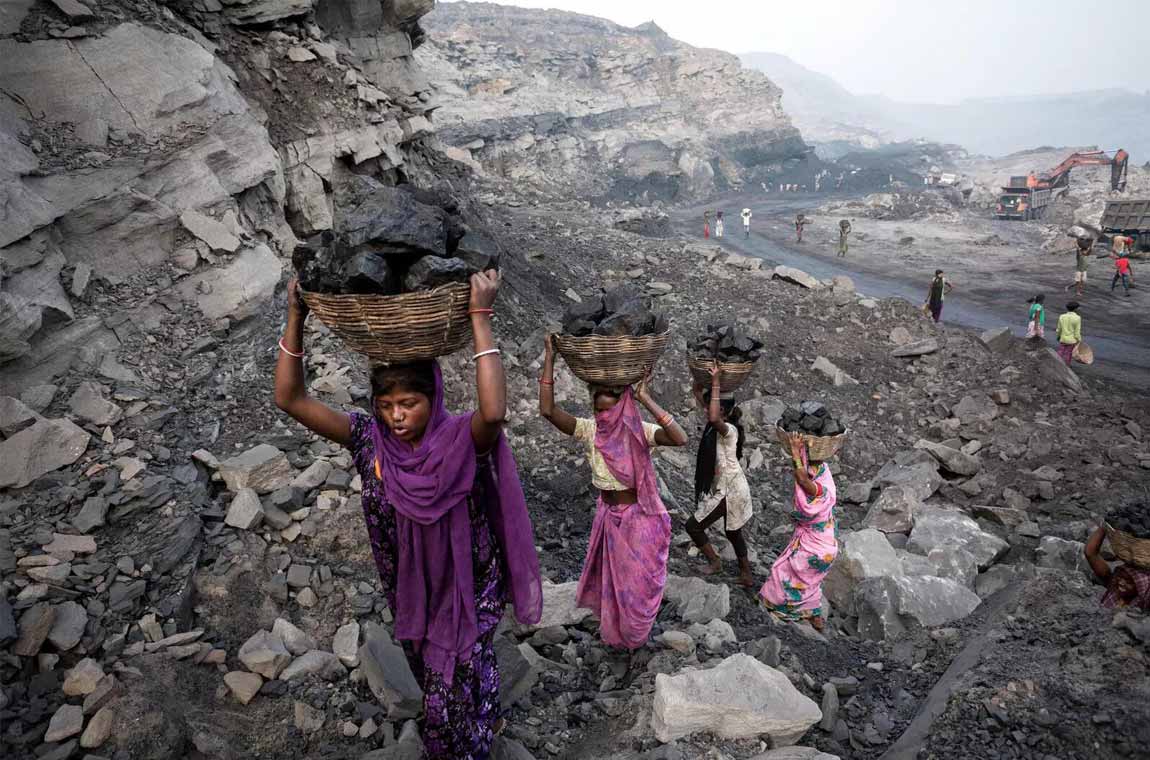
Expert Speak | 17 August, 2026
Advancing Gender-Responsive Just Transitions in India’s Coal Belt
Spotlight
- Despite growth in renewables, coal remains central to India’s energy security, making planning for coal-dependent regions an energy resilience imperative.
- Women bear a disproportionate share of coal transition risks while remaining largely invisible within formal energy governance, labour statistics, and transition planning.
- India already possesses much of the institutional architecture for a just transition, but stronger gender-responsive implementation can transform it from a welfare mechanism into an engine of inclusive growth.
As the Middle East conflict unsettles global energy markets, energy import-dependent countries are recalibrating their energy security strategies. Recent reports suggest that India is boosting coal-fired power generation to offset disruptions in liquefied natural gas (LNG) supplies.
India’s energy transition involves gradual system restructuring where coal continues to play a stabilising role even as cleaner technologies expand. It remains the backbone of India’s power system, generating more than 70 percent of electricity, and is the most reliable buffer against supply shocks and price volatility.
The Central Electricity Authority estimates that while coal’s share in installed capacity could fall from around 47 percent in 2026 to roughly 33 percent by 2029–30, it will still account for approximately 54 percent of electricity generation because of its centrality in meeting baseload demand.
In coal-dependent regions, structural change is already underway as economic diversification, evolving energy investment, and gradual shifts in employment are reshaping local economies. Women often shoulder the highest economic and environmental costs of such transformation while being mostly excluded from transition planning.
The Central Electricity Authority estimates that while coal’s share in installed capacity could fall from around 47 percent in 2026 to roughly 33 percent by 2029–30, it will still account for approximately 54 percent of electricity generation because of its centrality in meeting baseload demand.
Gender responsive transition planning for coal-dependent regions must therefore begin now, before structural adjustments intensify, as the social and economic impacts of change are already emerging.
India’s Coal Belt and Social Geography
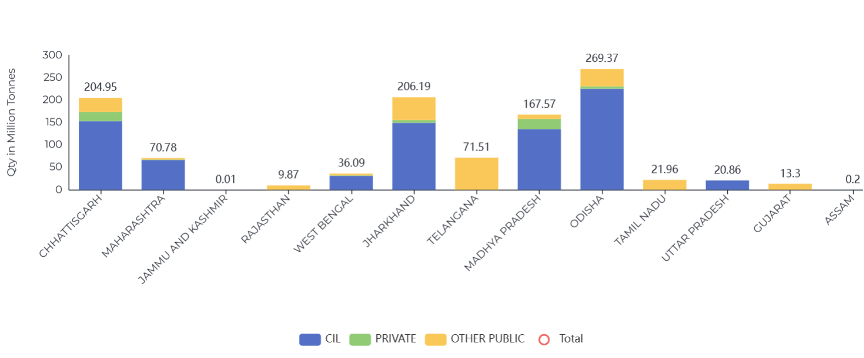
India’s coal reliance is concentrated in its eastern coal belt, particularly in the states of Jharkhand, Chhattisgarh, and Odisha. Together, these states account for nearly 65 percent of the country’s coal production and approximately 73 percent of its geological coal resources.
Figure 1: Domestic Coal Production by State (2024–25)
Source: NITI Aayog
For millions of Indian households, coal is not only an energy resource but also a source of employment, local revenue, and regional economic stability, shaping land-use patterns, livelihoods, and community structures. As India continues to expand renewable energy capacity and improves grid flexibility, structural adjustments in the coal sector will affect employment patterns, ancillary industries, and local governance systems.
While women constitute only about 6.7 percent of Coal India Limited’s formal workforce, they comprise a large part of the informal coal economy, which accounts for an estimated 70 percent of coal-related labour.
Crucially, these changes are not gender neutral. While women constitute only about 6.7 percent of Coal India Limited’s formal workforce, they comprise a large part of the informal coal economy, which accounts for an estimated 70 percent of coal-related labour. Women participate in activities such as coal sorting, head loading, and ancillary processing, forms of labour that are typically informal and highly vulnerable to shifts in the coal economy. Periods of mine contraction or closure can lead to job losses and intensify economic stress within households. This is often associated with higher alcoholism in their spouses and increased domestic violence, further heightening women’s insecurity.
Environmental impacts compound these vulnerabilities. Acid mine drainage contaminates water sources, contributing to musculoskeletal disorders, while dust from open-cast mining exacerbates respiratory illnesses, such as fluorosis and Black Lung Disease. Weak rural healthcare infrastructure amplifies these risks, particularly for women responsible for household water, food provisioning, and caregiving.
Women are also underrepresented in decision-making structures within coal governance and the broader energy sector. Despite rapid growth in renewable energy, they account for 11 percent of India’s clean energy workforce, compared to the global average of 32 percent, and remain concentrated in non-technical roles. This limited representation means that those most affected by the structural change have the least influence over how transition policies are designed and implemented.
As a result, the social consequences of change in coal regions risk being unevenly distributed unless gender-responsive measures are integrated into transition planning.
India’s Just Transition Architecture
India has already laid the foundations for managing long-term transitions in coal regions through a set of policy instruments intended to support mining-affected communities and reinvest mineral revenues in local development. Among the key policies are the District Mineral Foundations (DMFs), the Pradhan Mantri Khanij Kshetra Kalyan Yojana (PMKKKY), and the revised Mine Closure Guidelines.
Established through the 2015 amendment to the Mines and Minerals (Development and Regulation) Act, DMFs were created as district-level trusts that reinvest mineral revenues into development programmes in mining-affected areas. DMF implementation reviews have found that women’s representation within governing councils is often minimal, reducing their ability to influence local spending priorities.
The PMKKKY guides the allocation of these funds, identifying priority areas such as healthcare, education, sanitation, skill development, and women and children welfare. This makes it one of the few national policy frameworks that explicitly recognises women as beneficiaries of mining revenues, in principle. In practice, however, spending patterns remain heavily skewed toward physical infrastructure such as roads, administrative buildings, and water supply systems, while investments in women’s livelihoods, skilling, or care infrastructure remain limited. In Odisha, DMF spending has largely supported health, education, drinking water, and other local development programmes. Chhattisgarh’s independent assessments indicate that investments have been concentrated in education and physical infrastructure, with comparatively less attention to livelihoods, healthcare, and participatory planning.
Similarly, the revised Mine Closure Guidelines emphasise community welfare and post-mining land restoration, supported by a Just Transformation corpus that is funded by 10 percent of the final mine closure deposit. However, they stop short of requiring gender-disaggregated data or gender audits of closure plans.
Jharkhand became the first state to establish a Task Force on Sustainable Just Transition in 2022, mandated to develop a road map to manage the socioeconomic impacts of the energy transition. Although stakeholder consultations have begun, limited engagement with women’s groups and self-help collectives risks perpetuating existing inequalities.
Taken together, these experiences suggest that while existing frameworks support welfare and local development, comparatively less emphasis has been placed on women’s economic empowerment and participation in transition planning. However, without stronger gender-responsive implementation, monitoring, and accountability mechanisms, existing frameworks may struggle to fully address the social dimensions of coal-region development.
Advancing Gender-Responsive Just Transitions
The following recommendations can help strengthen the resilience of coal-dependent communities by ensuring that women are fully integrated into transition planning, governance, and emerging economic opportunities:
Institutionalise Gender Accountability In Transition Governance
Mandating gender-responsive audits, sex-disaggregated data collection, and impact assessments across coal transition programmes would ensure that policy design reflects the differentiated impacts of structural change. Applying these to DMF spending, mine closure plans, and skilling programmes could help redirect resources toward women’s livelihoods, health services, and social infrastructure.
Programmes such as Odisha’s Solar Didi Initiative demonstrate how women’s collectives can play an active role in transition pathways. Similar approaches have been recommended in gender-just transition assessments by organisations such as The Energy and Resources Institute (TERI) and the International Labour Organization (ILO).
Leverage Transition Finance for Inclusive Regional Development
A pooled financing mechanism drawing on DMF resources and escrow funds from mine-closure planning (Just Transformation Fund) could help support gender-responsive transition initiatives. This could prioritise livelihood diversification, care infrastructure, and women-led enterprises, helping coal-dependent districts build alternative sources of economic resilience.
Strengthen Women’s Participation in Local Transition Governance
India’s extensive network of self-help groups (SHGs)—particularly through initiatives such as Mission Shakti in Odisha, which supports about seven million women—offers an institutional platform for embedding women’s voices in local economic planning and transition governance. Integrating SHGs into district-level transition planning bodies could help ensure that policies reflect the realities of coal-dependent communities.
Expand Women’s Participation in Emerging Clean-Energy Sectors
Women represent roughly 40 percent of trainees under the Pradhan Mantri Kaushal Vikas Yojana, India’s flagship national skilling programme, but their participation in energy-related fields remains around 10 percent. Targeted training programmes for women in renewable energy installation, repair services, and decentralised energy enterprises could help bridge coal-dependent livelihoods with emerging green sectors.
Initiatives such as the Jyoti—Rising Together, Leading the Way programme, along with Bharat Coking Coal Limited’s women-led solar and light-emitting diode (LED) maintenance centre in Dhanbad, demonstrate how technical training can help integrate women into emerging energy value chains. Strengthening round-the-clock renewable energy systems will also depend on coal-rich regions that anchor grid stability, making workforce diversification in these areas important.
Align Coal Transition Planning with National and International Frameworks
India has begun exploring broader policy frameworks for managing coal transitions, such as NITI Aayog on regional just transition strategies. Integrating district-level planning, DMF spending, and state transition initiatives within a national framework could help develop coordinated transition road maps for high-risk coal regions. These efforts can also align with emerging global frameworks, such as the Belém Gender Action Plan under international climate negotiations, which emphasises gender-responsive climate and energy governance.
Leverage Multilateral Cooperation for Knowledge Sharing and Transition Support
International cooperation can also help accelerate gender-responsive transition planning. Multilateral platforms such as the Quad offer opportunities for cross-learning on community benefit frameworks, transition finance, and gender mainstreaming in energy policy. India’s coal regions could serve as pilot spaces to demonstrate how inclusive transition planning can align energy security with social resilience.
Energy transitions are often framed in technological and financial terms, but in coal-dependent regions, they also lead to social transformation. As India balances energy security with long-term decarbonisation, embedding gender-responsive planning into coal region development and transition frameworks, from governance and finance to skilling and livelihoods, will be critical for building resilient local economies and ensuring that the benefits and burdens of change are shared more equitably.
Parul Bakshi is Fellow, Energy and Climate, ORF Middle East.
This analysis draws on the author’s contribution to the Indo-Pacific Outlook. The full paper can be accessed here.