 Global
Expert Speak | 11 May, 2026
India and the Gulf: A New Strategy for Water, Energy, Food, and Ecosystem Security
This article is the part of “Policy Pathways for Food and Water Security in the MENA Region
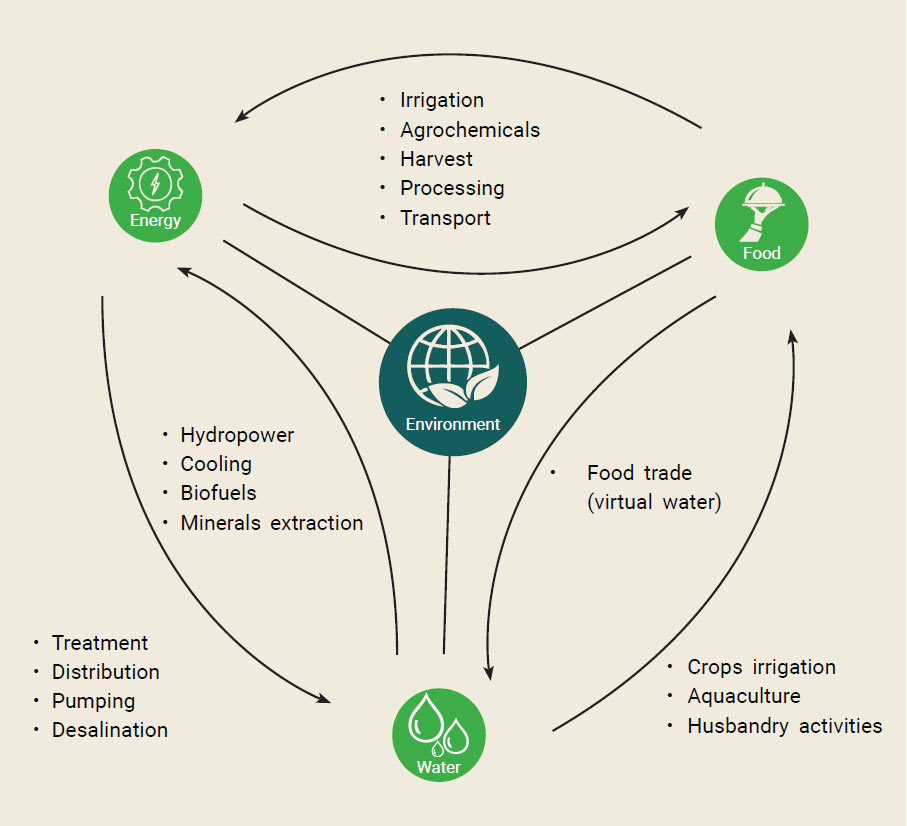
Water, energy, food, and ecosystems (WEFE) are deeply interconnected, and these linkages sit at the core of today’s most critical global security challenges. With climate pressures intensifying, cities expanding, and populations growing, the interconnections among agrifood system transformation, energy transition, integrated water management, and land governance are not parallel agendas. They shape each other’s risks and opportunities in ways that determine whether communities move toward resilience or deeper vulnerability. Within an interdependent nexus, stresses in water, energy, or food systems reinforce one another through feedback loops, translating localised shocks into power shortages, agricultural disruption, and food insecurity, and underscoring the need for integrated governance and resource-efficient practices (Figure 1). Recognising and operationalising this interdependence in planning, management, and investment is therefore essential for navigating an increasingly complex and uncertain resource landscape.[1], [2], [3]
Despite the clear need for addressing these WEFE challenges as a nexus, policy signals and investments often remain in silos. Such fragmentation amplifies systemic vulnerability, producing cascading cross-sectoral failures while undermining opportunities for coordinated, resilience-building interventions.
Figure 1: The WEFE Nexus
Source: Salmoral et al. (2019)[4]
Building on this foundation, this article discusses India and the Gulf countries of Bahrain, Kuwait, Oman, Qatar, Saudi Arabia, and the United Arab Emirates (UAE). Both regions face mounting pressures across WEFE systems, though the nature of these pressures differs in ways that are structurally complementary rather than symmetrical.[5]
India, for one, must manage food production for a large and growing population under increasing water stress, groundwater depletion, and climate variability, while simultaneously navigating energy access, affordability, and emissions constraints within a complex, multi-level governance landscape.[6], [7] Meanwhile, the Gulf countries are confronting extreme physical water scarcity that severely limits domestic agricultural potential, yet they possess abundant energy resources, high fiscal capacity, and globally significant infrastructure for desalination logisticsa and trade. Food security in the Gulf is therefore intrinsically tied to energy-intensive water supply systems and to reliable international supply chains, making the region highly exposed to shocks across energy markets, maritime trade, and climate-sensitive food production elsewhere.[8],[9] These contrasting WEFE profiles create a shared vulnerability to systemic risk, but also a clear basis for cooperation grounded in complementary resource endowments, production capacities, and governance strengths. The article argues that India and the Gulf can benefit from a shared yet context-specific WEFE strategy, rooted in comparative advantage and improved resilience through partnership and trade that is grounded in a systems nexus approach.
From a WEFE perspective, deeper cooperation between India and the Gulf countries reflects a rational alignment of comparative advantage rather than a trade-off between self-sufficiency and security. India retains relative advantages in food production due to its agro-ecological diversity, labour availability, and expanding capacity in water-efficient and climate-smart agriculture, whereas the Gulf’s extreme water scarcity fundamentally constrains domestic food production despite substantial energy resources. For water-scarce, energy-abundant economies, importing food grown in more resource-productive contexts, supported by energyenabled logistics, cold chains, and strategic trade agreements and investment frameworks, can be more sustainable than pursuing water-intensive domestic production.
Existing frameworks such as the India–UAE Comprehensive Economic Partnership Agreement (CEPA) provide an institutional basis for re-orienting food and energy trade through a WEFE lens, enabling both regions to reduce pressure on stressed water systems while enhancing supply-chain resilience.[10] When governed through integrated WEFE strategies that account for embedded (virtual) water, energy use, and ecosystem impacts, such cooperation strengthens regional and global food security by aligning production, trade, and energy systems with longterm resource sustainability.[11], [12], [13], [14]
Within this shared context, the rest of this article outlines three priority I’s for further strengthening a practical roadmap for sustainable development: integrate, innovate, impact. First is to identify and integrate key policy priorities across sectors to manage the WEF nexus effectively. Second is to innovate methodologies (tools and analysis) for holistic and systemic WEF management. Third is to map the impacts for future courses of action.
A first step is to integrate thematic focus on the nexus. India and the Gulf region share the challenge of coordination across complex institutional landscapes, where policies for water, energy, and food are often managed within separate ministries in India, while the governance is more centralised in Gulf nations with high government capacity and substantial financial resources to invest in high-cost solutions. Further, a lack of standardised integrated data collection and sharing mechanisms across the sectors to accurately model and manage the trade-offs (e.g., quantifying the energy used to pump water for a specific crop) is a challenge. To overcome this obstacle, there is a need for new ways of thinking about integrated governance at multiple levels and through multiple lenses.
Second, the transition toward sustainable WEFE security in both India and the Gulf requires moving beyond traditional sectoral planning by adopting innovative methodological approaches to unlock more coherent and effective planning. These methods focus on holistic coverage of WEFE systems and are critical for understanding complex trade-offs and identifying synergies. To achieve integrated planning, policy coherence driven by collective action is the essential foundation for sustainable development. SDG Target 17.14 identifies policy coherence as a critical mechanism to advance the entire 2030 Agenda through integrated partnerships and collective action. In this process, “simplexity”—the ability to simplify complex issues into actionable insights without losing nuance—is pivotal.[15] Simplexity works by distilling the drivers and tradeoffs within WEFE systems into forms that decision-makers can use, such as scenario pathways, hotspots analyses, and clear option spaces. It enables stakeholders to see where coordinated action is most feasible, which leverage points matter, and how different interventions interact across systems. By turning complexity into structured, decision-ready insight, simplexity creates the practical foundation needed for coherent planning and action.
For the Gulf, this may involve advanced systems modelling to optimise the costly desalinationenergy nexus, integrating future climate change impacts with renewable energy deployment schedules and resource pricing mechanisms. As the Gulf’s food resilience is linked to the stability of a high-tech energy chain considering desalination serves as the primary metabolic input for both human consumption and food production, and energy requirements for intense cooling required for climate-controlled agriculture. This creates a unique vulnerability where energy market volatility or grid disruptions translate directly into immediate water and food insecurity, requiring a transition toward renewable-powered desalination and circular brine management.[16]
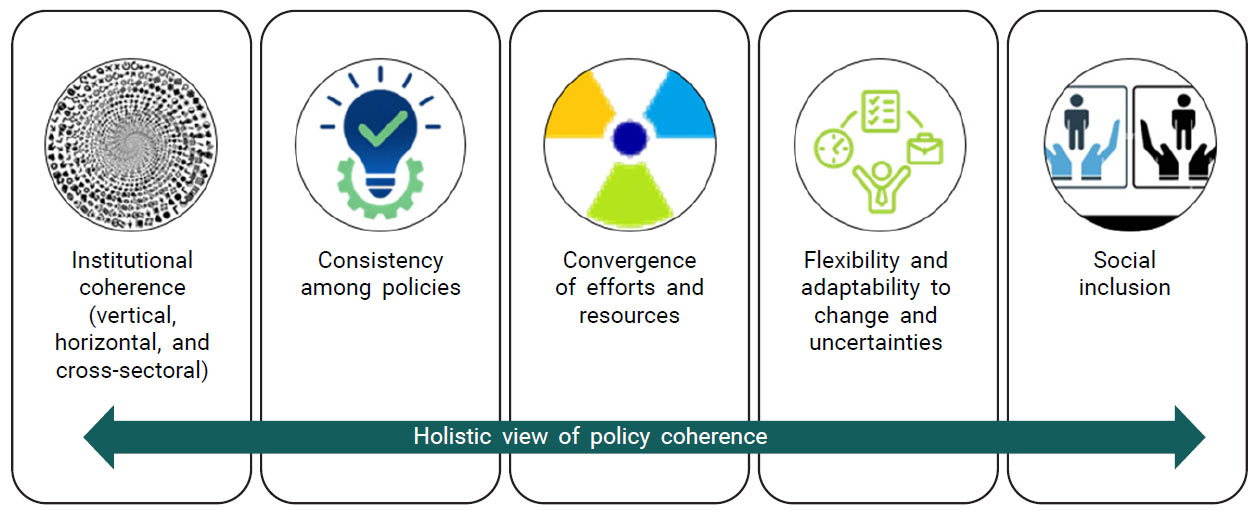
In India, it refers to the use of remote sensing and geospatial analysis to accurately map groundwater depletion driven by subsidised energy use, alongside data-driven policy coherence frameworks (like the five-dimensional model in Figure 2). An important consideration would be a holistic outlook to plan alignment of policy actions across federal, state, and local governance levels. By leveraging these computational and integrated governance tools, both regions can effectively analyse the entire resource chain, allowing policymakers to design flexible and adaptive strategies that manage scarcity, enhance efficiency, and minimise adverse cross-sectoral impacts while advancing inclusivity.
Figure 2: A Multidimensional Framework for Synchronising WEFE Policy Coherence
Source: CEEW and IWMI (2023)[17]
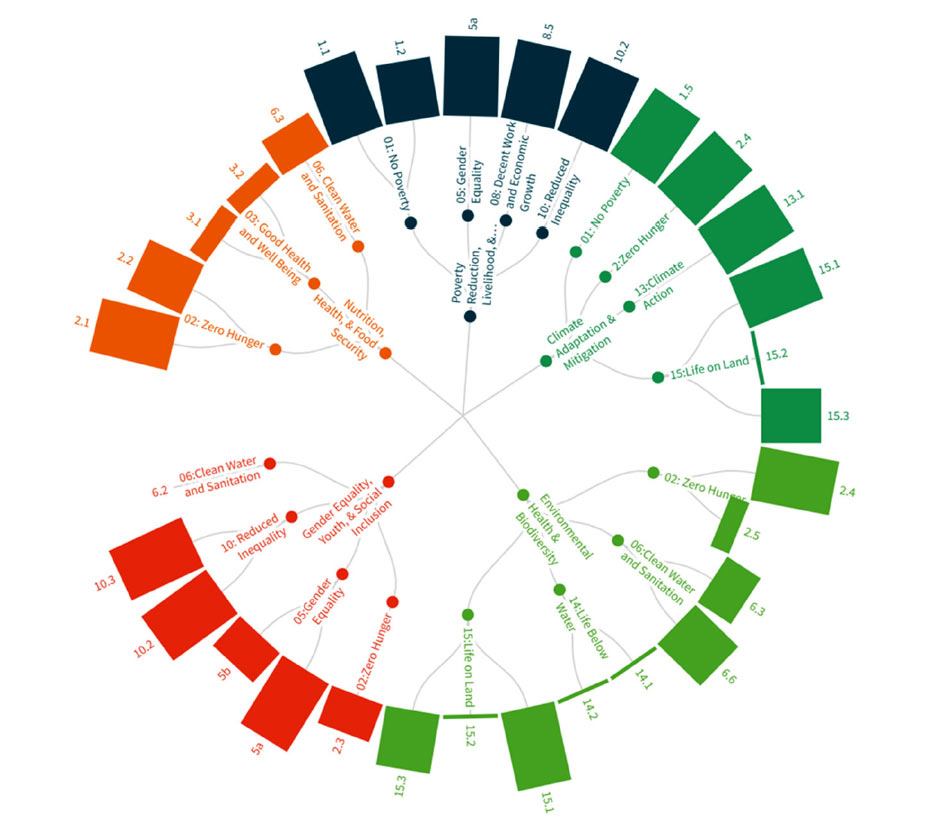
Third, mapping the impact of key policy interventions is critical in demonstrating how national initiatives advance SDGs, a crucial element to inform policy actions for positive impact. For example, microirrigation, a climate-smart and water-saving technology, is promoted in India through the ‘Per Drop More Crop’ (PDMC) initiative. Policy actors from the national and state departments of agriculture, and representatives of research institutes confirm that it has had a positive impact on multiple SDGs targets.[18] The core value proposition of PDMC—enhancing water use efficiency—drives strong linkages with SDG 6 (Clean Water and Sanitation) by ensuring sustainable utilisation, and supports SDG 2 (Zero Hunger) by increasing productivity and promoting sustainable agriculture (Figure 3). Further, it improves farm-level incomes and reduces input costs (through efficient fertiliser and water use), contributing to SDG 1 (No Poverty) and SDG 8 (Decent Work and Economic Growth). Such impact mapping offers granular evidence needed to transition from reactive crisis management to proactive, climateresilient scaling.
Figure 3: SDG Impact Mapping: The Reach of the ‘Per Drop More Crop’
Source: CEEW and IWMI (2024)[19]
Note: The bar height indicates the intensity of linkage with SDG targets.
In conclusion, strategic alignment between India and the Gulf represents a learning space for solving the world’s most pressing security challenges. There is a wide landscape of collaborative opportunities between India and the Gulf that could be mutually beneficial. This article identifies technology transfer, policy exchange, and joint research as instrumental avenues to build and strengthen collaboration.
- What India can learn from the Gulf: India could learn from the Gulf’s expertise in high-tech, large-scale infrastructure that has led to a spectrum of solutions to regional water security and water-efficient agriculture. Specifically, the Gulf’s global leadership in desalination and smart-grid integration offers a roadmap for India’s coastal urban centres and industrial hubs to achieve water and energy security independent of erratic monsoon cycles.
- What the Gulf can learn from India: India’s experience in coordinating policy action across multiple levels of government offers relevant perspectives on managing crosssectoral priorities. Approaches that link national objectives with state- and local-level implementation highlight ways to support coherence across systems and scales. These perspectives may complement the Gulf’s established strengths in infrastructure and technology, particularly in efforts to integrate ecosystem considerations and stakeholder engagement within ongoing resource planning processes.
As both regions play important roles in global food and energy systems, closer collaboration can support collective efforts to anticipate and manage systemic risks. Joint WEFE-oriented initiatives, spanning research, technology exchange, and policy dialogue, can contribute to more resilient supply chains and more informed resource planning. By framing WEFE security as a shared governance opportunity and integrating data, analytical tools, and outcome-oriented indicators, India and the Gulf can jointly advance a model of collaborative resource leadership that supports climate resilience, ecosystem stewardship, and sustainable development in the Global South.
Endnotes
[1] Rabi H. Mohtar and Bassel Daher, “Water, Energy, and Food: The Ultimate Nexus,” in Encyclopedia of Agricultural, Food, and Biological Engineering (Boca Raton: CRC Press, 2012).
[2] Bassel Daher et al., “Modeling the Water-Energy-Food Nexus: A 7-Question Guideline,” in Water-Energy- Food Nexus: Theories and Practices, ed. Salam et al. (2017).
[3] Suparana Katyaini et al., “Water–Food Nexus through the Lens of Virtual Water Flows: The Case of India,” Water 13, no.6 (2021), https://www.mdpi.com/2073-4441/13/6/768.
[4] Gloria Salmoral et al., “Water Diplomacy and Nexus Governance in a Transboundary Context: In the Search for Complementarities,” Science of The Total Environment 690 (2019), https://www.sciencedirect. com/science/article/pii/S0048969719330864.
[5] Mohsen Sherif et al., “Water Resources Availability, Sustainability and Challenges in the GCC Countries: An Overview,” Heliyon 9, no.10 (2023), https://www.sciencedirect.com/science/article/pii/ S2405844023077514.
[6] Food and Agriculture Organization of the United Nations, The State of Food and Agriculture 2023: Revealing the True Cost of Food to Transform Agrifood Systems, 2023, FAO, https://doi.org/10.4060/ cc7724en.
[7] CEEW and IWMI, Improving Policy Coherence in Food, Land, and Water Systems to Advance Sustainable Development in India: A Case Study of Rajasthan, 2024, Colombo: IWMI, 2024, https://cgspace.cgiar.org/ items/26b98d0a-1ba5-46a7-ac3e-3e2aa25711f0.
[8] Sherif et al., “Water Resources Availability, Sustainability and Challenges in the GCC Countries: An Overview.”
[9] Food and Agriculture Organization of the United Nations, The State of Food and Agriculture 2023: Revealing the True Cost of Food to Transform Agrifood Systems.
[10] UAE Ministry of Economy and Tourism, “UAE-India Comprehensive Economic Partnership Agreement,” https://www.moet.gov.ae/en/cepa_india.
[11] “Improving Policy Coherence in Food, Land, and Water Systems to Advance Sustainable Development in India: A Case Study of Rajasthan.”
[12] “The State of Food and Agriculture 2023: Revealing the True Cost of Food to Transform Agrifood Systems.”
[13] Suparana Katyaini et al., “Science-Policy Interface on Water Scarcity in India: Giving ‘Visibility’ to Unsustainable Virtual Water Flows (1996-2014),” Journal of Cleaner Production 275, (2020), https://www.sciencedirect.com/science/article/abs/pii/S0959652620341044.
[14] Carole Dalin et al., “Groundwater Depletion Embedded in International Food Trade,” Nature 543 (2017), https://doi.org/10.1038/nature21403.
[15] Bassel Daher, “Simplexifying Sustainability,” Nature Sustainability (2025), https://doi.org/10.1038/s41893- 025-01650-5.
[16] Mohammad Al-Saidi and Sally Saliba, “Water, Energy and Food Supply Strategies in the Gulf Cooperation Council (GCC) Countries—Contextualizing Resilience,” Water, 11, no.3 (2019), https://www. mdpi.com/2073-4441/11/3/455.
[17] CEEW and IWMI, Evaluating Policy Coherence in Food, Land, and Water Systems: Evidence from India (Colombo: IWMI, 2023), https://cgspace.cgiar.org/items/d1e630a7-56a3-4d1e-8ae2-c944a9b5210b.
[18] “Improving Policy Coherence in Food, Land, and Water Systems to Advance Sustainable Development in India: A Case Study of Rajasthan.”
[19] “Improving Policy Coherence in Food, Land, and Water Systems to Advance Sustainable Development in India: A Case Study of Rajasthan.”