
 Global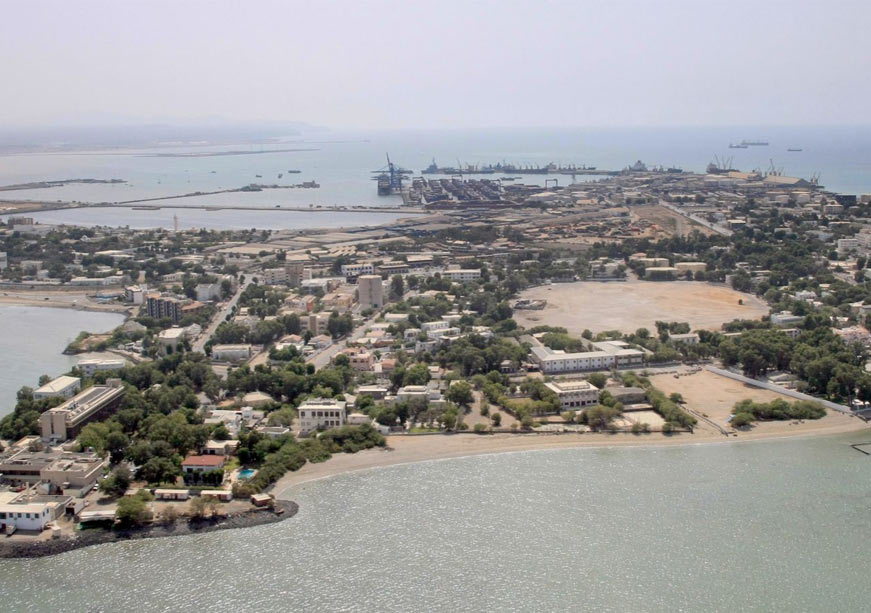
Expert Speak | 12 February, 2026
Djibouti’s Location Curse: Escaping Strategic Rent Dependence
Djibouti’s "Location Curse" shows how the state’s rentier model — extracting wealth from foreign bases and transit fees — has fractured the social contract, deprioritising capacity building and leading to gaps in human capital accumulation
In development economics, the “resource curse” is a well-worn paradox: nations blessed with abundant natural resources often stagnate, held back by weak institutions and a failure to invest in human capital. Djibouti presents a fascinating and troubling variation of this dynamic — not a curse of resources, but of location.
For decades, Djibouti has monetised its geostrategic position on the Bab el-Mandeb strait, a maritime chokepoint through which roughly 12 percent of global seaborne oil trade passes, by extracting rents from world powers. Hosting military bases for the United States, China, France, Germany, Italy, and Japan, the state effectively functions as a landlord to the world’s armies. The revenues are not insignificant: approximately US$70 million annually from the US Camp Lemonnier alone, around US$40 million from France, and a reported US$20 million from China’s base — with total base-lease income estimated at over US$125 million a year.
Yet, to these external actors, Djibouti is less a sovereign nation to be developed and more a security asset to be stabilised. Their primary interest is continuity of access and the safety of shipping lanes — not the democratic flourishing or economic diversification of the people who actually live there. For regional powers like the Gulf states, the calculus has shifted further still: the Horn of Africa has evolved from being a peripheral neighbour into a critical node of their own national security architecture. Control over the Red Sea coast is seen as essential for power projection and food security, effectively reframing Djibouti from a neutral logistics hub into a strategic frontier.
This wealth endowment has revealed a profound structural disconnect: strategic rents have not translated into meaningful human capital development, leaving socio-economic mobility deeply fractured for ordinary Djiboutians.
This rentier model dynamic, where the state acts as a landlord and derives its solvency from external rents, is further entrenched by the international port, which serves as the exclusive commercial gateway for landlocked Ethiopia and alone accounts for 86 percent of public revenue. Cumulatively, around 70 percent of Djibouti’s economy is built on port activities and related services, reflecting a striking concentration of fiscal dependence on external transit.
Nevertheless, this wealth endowment has revealed a profound structural disconnect: strategic rents have not translated into meaningful human capital development, leaving socio-economic mobility deeply fractured for ordinary Djiboutians. The numbers are stark. As of 2023, the Human Development Index Value was at just 0.513, well below the global average of 0.756, with Djibouti ranking 175th out of 193 countries. Youth unemployment stands at 77 percent, and expected years of schooling — a telling proxy for long-term opportunity — is a dismal 3.95. These figures carve out a sharp and damning dichotomy between the nation’s geopolitical value and its internal developmental reality.
Djibouti, it seems, is structurally unable to leverage its greatest asset — its location — to build prosperity for its own people. That is the essence of the location curse.
Mechanisms of the Curse
In most non-rentier economies, the government must cultivate a tax base by fostering a competitive private sector, investing in education, and lowering the cost of doing business. In Djibouti, the state bypasses this difficult work entirely — because it has a guaranteed income stream unrelated to domestic productivity. This is what could be termed “fiscal decoupling”.
Typically, a functioning economy produces an implicit bargain between state and citizen — what political economists call the “fiscal social contract.” The state taxes the citizenry to fund its operations; in return, citizens demand accountability, infrastructure, and the services that facilitate their own economic output. This creates a powerful incentive structure: the state is motivated to invest in human capital — education, healthcare, vocational training — because a more productive citizen is, ultimately, a more taxable one.
In Djibouti, however, this feedback loop is severed. Tax revenue accounted for a little over 11 percent of GDP in 2023, well below the global average of roughly 17 percent in 2024. This is a far cry from countries like France, where the tax-to-GDP ratio stood around 45 percent in 2023. The Djiboutian government’s solvency, in other words, is not derived from the productivity of the average citizen, but from the geopolitical anxiety of Washington, Beijing, and Paris. The population, as a result, ceases to be seen as an economic engine and is instead reduced to a fiscal liability.
The incentive to invest in broad-based industrialisation or educational reform erodes, because simply managing the port and the bases proves profitable enough.
This dynamic quietly — albeit decisively — reshapes government priorities. The incentive to invest in broad-based industrialisation or educational reform erodes, because simply managing the port and the bases proves profitable enough. The bulk of government expenditure is instead channelled toward logistics infrastructure or funnelled into State-Owned Enterprises (SOEs), which have accounted for 80 percent of external borrowings since 2013. These SOEs are, by most accounts, poorly governed — weak board oversight, limited accountability, and little in the way of performance monitoring. The resulting financial mismanagement has driven up debt service costs, squeezing fiscal space and putting long-term debt sustainability under strain. As the World Bank’s Country Economic Memorandum notes, this escalating debt burden has crowded out spending in social sectors: education and health account for just 15 percent and 8 percent of the government budget respectively, while infrastructure absorbs 30 percent.
Critically, even this infrastructure investment has failed to deliver the one thing Djibouti most needs: jobs. Modernised port facilities, for all their efficiency, are inherently labour-light since automation does much of the heavy lifting. Thus, while Djibouti posted cumulative real GDP growth of over 35 percent between 2015 and 2021, the job intensity of that growth actually declined. The economic boom of the last decade, bluntly put, directly benefited only about 1 percent of Djiboutians of working age.
The problem is further compounded by how vulnerable Djibouti’s location makes it to shocks it has no control over. By tying macro-fiscal stability to the fluidity of the Bab el-Mandeb strait, the country has effectively imported the geopolitical volatility of the wider Middle East into its own balance sheet. The events of 2025 laid this fragility bare: as regional tensions destabilised Red Sea shipping lanes, port traffic contracted by roughly 10 percent in the first half of the year alone — an immediate and sharp fiscal blow.
Djibouti now faces something close to an existential challenge: it has built an entire national strategy around a monopoly that is on the verge of disappearing, leaving it exposed to both the unpredictability of global conflict and the strategic recalculations of its single largest client.
The outlook is tightening further. Ethiopia is aggressively developing alternative trade corridors to reduce its dependence on Djibouti’s facilities through which 95 percent of its cargoes transit. With over 75 percent of Djibouti’s GDP tied to transport services for Ethiopia, the country’s economic stability is structurally bound to its landlocked neighbour. Djibouti now faces something close to an existential challenge: it has built an entire national strategy around a monopoly that is on the verge of disappearing, leaving it exposed to both the unpredictability of global conflict and the strategic recalculations of its single largest client.
Breaking the Curse
To its credit, the Djiboutian state has not been entirely blind to these vulnerabilities. Under the banner of Vision 2035, the government has launched an aggressive capital expenditure strategy aimed at diversifying the economy beyond transit. A critical look, however, reveals that this strategy remains limited in its impact largely due to two interconnected reasons: a continued fixation on physical infrastructure, and an outsized public sector presence that crowds out the private economy.
The most illustrative example is the Djibouti International Free Trade Zone (DIFTZ), widely championed as one of the flagship achievements of this era. On paper, it represents progress. In practice, the DIFTZ is structured squarely around transportation, bonded warehousing, logistics, and distribution — aligning it firmly with freight and trade facilitation rather than broad-based manufacturing. In other words, it expands the volume of the rentier model without altering its nature. This is what economists would call “vertical diversification” — adding more steps along an existing value chain rather than branching into entirely new productive sectors. What Djibouti needs is “horizontal diversification,” which can help absorb its vast idle labour force.
To break this curse, Djibouti must pivot from investing in physical infrastructure towards building institutional capacity.
The economy is further constrained by State-Owned Enterprises that hold near-monopolies across telecommunications, energy, media, and logistics, effectively stymying private innovation. The financial data tells the story plainly: bank credit to the private sector made up 23.1 percent of GDP in 2024 — less than half the global average of roughly 52 percent. The financial system, in short, would rather lend to the state or established trading houses than back a domestic entrepreneur. The result is a profound mismatch between the economy’s demands and the country’s capabilities. The port needs specialised engineers and logisticians, but the education system cannot produce them. Investors, therefore, import skilled labour. Meanwhile, youth unemployment remains stubbornly high.
The location curse, ultimately, is not something geography imposed on Djibouti, but the result of policy choices. To break this curse, Djibouti must pivot from investing in physical infrastructure towards building institutional capacity. That shift is what would restore the broken social contract: a state that derives its solvency not from the geography of its coastline, but from the productivity of its own people.
Samriddhi Vij, Associate Fellow, Geopolitics, ORF Middle East.