 Global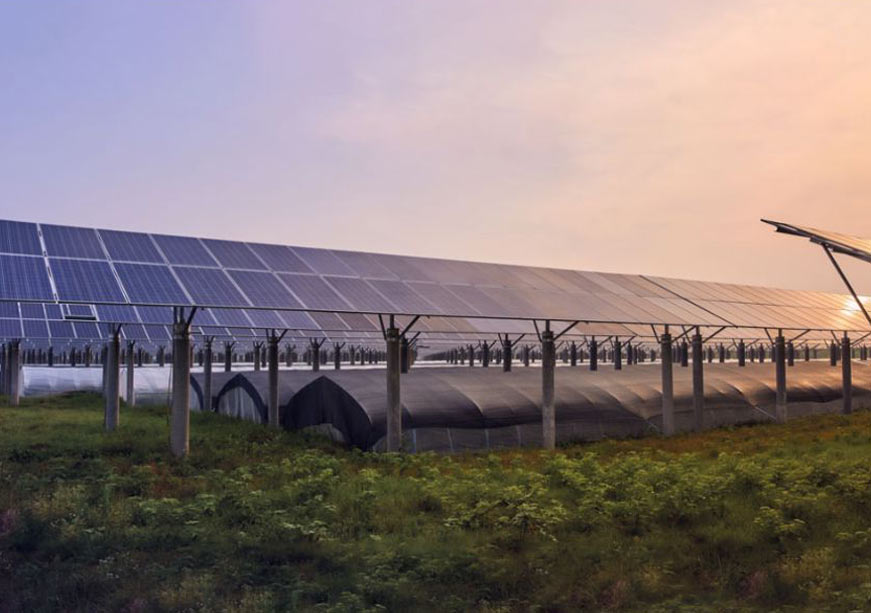
Expert Speak | 19 February, 2026
Dual-Use, Triple Gain: Scaling Agrivoltaics in MENA
Embedding solar panels on agricultural land through agrivoltaics offers a “triple-gain opportunity” across the food-energy-water nexus, but scaling it requires localised evidence, co-creation, policy alignment, and targeted financing.
The abundance of solar irradiation in the Middle East and North African (MENA) countries is both a blessing and a curse. The sun’s heat can be converted into solar energy, but also puts pressure on food production and water availability. Concurrent efforts to pursue clean energy targets and strengthen food and water security intensifies competition over scarce land. This is because commercial-scale solar facilities occupy large amounts of space, displacing land meant for agriculture.
Agrivoltaics (AV), the practice of co-locating solar panels on agricultural land, offers an intriguing and all-encompassing solution. Hovering just above the land, AV panels can protect crops and livestock from the heat, increasing water savings and agricultural productivity while generating electricity and income.
Agrivoltaics (AV), the practice of co-locating solar panels on agricultural land, offers an intriguing and all-encompassing solution.
In a region with a solar surplus, coupled with rising water and energy pressures, agrivoltaics can be a viable strategy to build resilient water, energy, and food systems and bolster local livelihoods. This article assesses the region’s enabling environment and gaps shaping the adoption of AV and outlines policy recommendations to bolster its scaled-deployment.
An Opportunity to Synchronise Water-Energy-Food Systems
The prospective agricultural, income, and energy benefits of AVs are significant. Evidence from studies evaluating AV applications in other settings show how solar panel shades create cooler microclimates for crops, improving soil moisture retention and reducing heat stress on photovoltaic modules. This reduces irrigation needs and promotes water efficiency. Farmers can sell the generated energy back to the grid, creating additional income as a buffer against erratic crop yields. Once scaled, AV improves energy independence for rural communities, with the potential to power irrigation and desalination systems and contribute to close-looped systems.
For instance, covering half of Jordan’s tomato fields with solar PV panels could meet the nation’s 50 percent renewable energy target and save over 8percent of the country’s total water budget.
While the evidence of AV’s physical feasibility in the MENA region looks promising, its implementation remains few and far between. To illustrate, AV has the potential to increase land productivity by 35 to 73 percent, but few MENA countries have tapped into these benefits. Among the 12 MENA countries assessed, progress varies, ranging from feasibility studies forecasting AV potential in Jordan, Kuwait, Morocco, Saudi Arabia and Qatar to early-stage pilots underway in Algeria, Egypt and Lebanon (See Table). For instance, covering half of Jordan’s tomato fields with solar PV panels could meet the nation’s 50 percent renewable energy target and save over 8percent of the country’s total water budget. Likewise, in Kuwait, pairing AV systems with solar-powered desalination is projected to increase net profit by US$1.1/m2 and reduce water usage by over 5 percent.
| Country | AV Study, Pilot, and Commercial |
| Algeria | Pilot: AV farm in Cherchell, Algeria (2023) |
| Bahrain | Commercial: General Poultry Company and Mumtalakat agreement to install a 1.5 MWp rooftop solar farm in Hamala, Bahrain (2025) |
| Egypt | Pilot: Early-stage AV greenhouses in Qena, Menia, and Kaf El Sheikh, funded by Japan (2023) |
| Jordan | Study: 9.5 percent of Jordan’s land is suitable for AV. Potential to save between 4 and 8.6 percent of the country’s total water budget.
Pilot: MINARET Project in Karak Governorate includes a 3-MW solar plant providing local energy for the grid and nursery |
| Kuwait | Field-Scale Pilot Case Study: Integrated solar desalination and AV systems projected to increase net profit by $1.1/m2 and reduce water usage by 5.4 percent. |
| Lebanon | Pilot: 82kW AV pilot Zahle, Lebanon led by the UN (2023-2025) |
| Morocco | Study: Berkane (1.02 GWh/yr) and demonstrates 1.02 GWh/yr Kissane. Projected to be highly profitable due to feed-in-tariffs |
| Oman | Commercial: Agri-solar farming project with tech support from Singapore company (2025) |
| Qatar | Study: Potential for 15% of farmable land to help meet 4GW target and reduce water consumption by 10% and lettuce crop shading |
| Saudi Arabia | Study: AAV Tech demonstrates viability in Eastern Saudi Arabia with estimated levelised electricity and crop yield costs of 0.048 $/kWh and 0.50 $/kg for agrivoltaic system |
| Tunisia | – |
| United Arab Emirates | Pilot: Fujairah, UAE (field data indicates reliability and soil improvement) (2025)
Commercial: Masdar and Elite Agro Holding AV Project in Al Ain, UAE (2026) |
Source: Author’s Own
What’s Keeping the Deployment of Agrivoltaics?
Piloting and scaling AVs not only requires contextualised planning, it involves aligning the needs of local farmers and solar PV developers, meeting the market demands, and compliance with national and municipal policies. This analysis thus reveals key gaps and roadblocks to creating an enabling environment – 1) lack of localised planning 2) siloed policies and 3) insufficient financing available for farmers and PV developers.
From a technical perspective, the initial barrier is predominantly due to the absence of localised studies that examine AV’s impacts on regionally-grown crops, climate, and soil conditions. This is because not all crops can thrive under shaded conditions. For food and energy production to exist in tandem, AV requires complicated system designs and customised solar panel configurations. While research exists quantifying crop-PV compatibility in Europe, the US and China, further work is needed to develop a nuanced understanding on how solar irradiation levels, PV system height, water stress levels, and local crops interact, particularly for crops prioritised within the national food security strategies of Qatar, Saudi Arabia, and the broader GCC. Such research would help calculate optimal solar PV design configurations to prevent loss of crop yield. Co-creating designs with local farming communities will be paramount to assimilate traditional farming patterns and promote collective acceptance.
AV adoption also relies on regulatory clarity and synergies between policies around land-use, energy, and agriculture to succeed, but such frameworks operate in silos in MENA. For instance, Morocco’s Green Generation 2020-2030 Strategy supports farmers to shift towards renewable energy by subsidising solar irrigation adoption and encouraging resilient agricultural practices. However, existing land policies do not address whether solar PV and agricultural production can exist on the same land. Without clear dual land-use policies, conflict between solar developers and farmers can occur when re-distributing profits, since developers seek returns on infrastructure investment and farmers want improved agricultural productivity.
Without favorable energy policies and adequate financing incentives, AV deployment will prove costly, especially for lower to middle-income MENA countries. Although solar costs have declined significantly, constructing agrivoltaic systems tends to cost between 4 to 52 percent more compared to conventional PV solar installations due to added requirements for customised parts. To illustrate, AVs in Morocco’s Kissane, are projected to be highly profitable due to feed-in-tariffs, while heavily subsidised fossil-fuel based power reduces AV cost feasibility in Bouda, Algeria. In contrast, partnerships between farming companies and sovereign wealth funds in the Gulf have unlocked recent partnerships to build commercial-scale AV systems in Bahrain, Oman, and the UAE.
Recommendations to Nurture an Enabling Environment
Between 2025 and 2031, the MENA agrivoltaics market is projected to grow from US$1.4 billion to US$6.9 billion, but seizing this opportunity requires coordination between technical, policy, and financing considerations.
Technical: Develop cooperative stakeholder systems based on local research and that involves development institutions, farming communities, solar PV developers, and municipal government bodies. Encourage co-designing processes centered around farmer concerns. Integrate locally-rooted farming strategies to assess ecosystem impacts, inform and identify compatible solar PV designs, which will boost long-term farmer adoption, crop productivity, and energy generation. Regional institutes practicing such an approach include the International Center for Agricultural Research in the Dry Areas and King Abdullah University of Science and Technology. Liaising between MENA and other regions to establish field-validation frameworks that can measure impacts across different crop types and climatic zones would ease concerns around their adoption.
Policy: Stronger integration across agriculture, water, energy, and finance ministries would help to develop policy frameworks that streamline permitting processes and evaluate tradeoffs and opportunities within food, water, and energy planning. Policy frameworks could include mandates delineating the process and conditions for dual farm and agrivoltaic land-use. Legally recognising AV as a permitted dual land-use strategy would bring in regulatory certainty and draw in private sector investment.
With adequate localised research and mapping of joint capacity building efforts, policy synchronisation, and targeted financing incentives, the MENA region will not have to choose between land and light as it can start harvesting both.
Finance: Establish public financing incentives to encourage AV implementation and attract large-scale private finance. Integrating feed-in-tariffs or subsidies for AV equipment is a good starting point. These can be further supplemented with creating revenue and risk-sharing mechanisms between Agri-PV ventures and farmers to address early-stage financial uncertainty. This would allow profits to either be redistributed to local farmers or pooled into a fund to finance village-level services. Instituting policy mechanisms that allows farmers to sell solar back to the grid will also help increase farmer interest and assure compensation. Establishing public-private partnerships with firms in other countries, such as Singapore and Japan, who have successfully spearheaded AV initiatives would facilitate financing flows and technical knowledge transfer.
Achieving the Triple Synergy
Given the region’s increasing emphasis on energy independence and strengthening food and water security, agrivoltaics offers a compelling solution to synergise between the water-energy-food trifecta by transforming resource competition into system circularity. With adequate localised research and mapping of joint capacity building efforts, policy synchronisation, and targeted financing incentives, the MENA region will not have to choose between land and light as it can start harvesting both.
Leigh Mante, Junior Fellow, Climate and Energy, ORF Middle East