 Global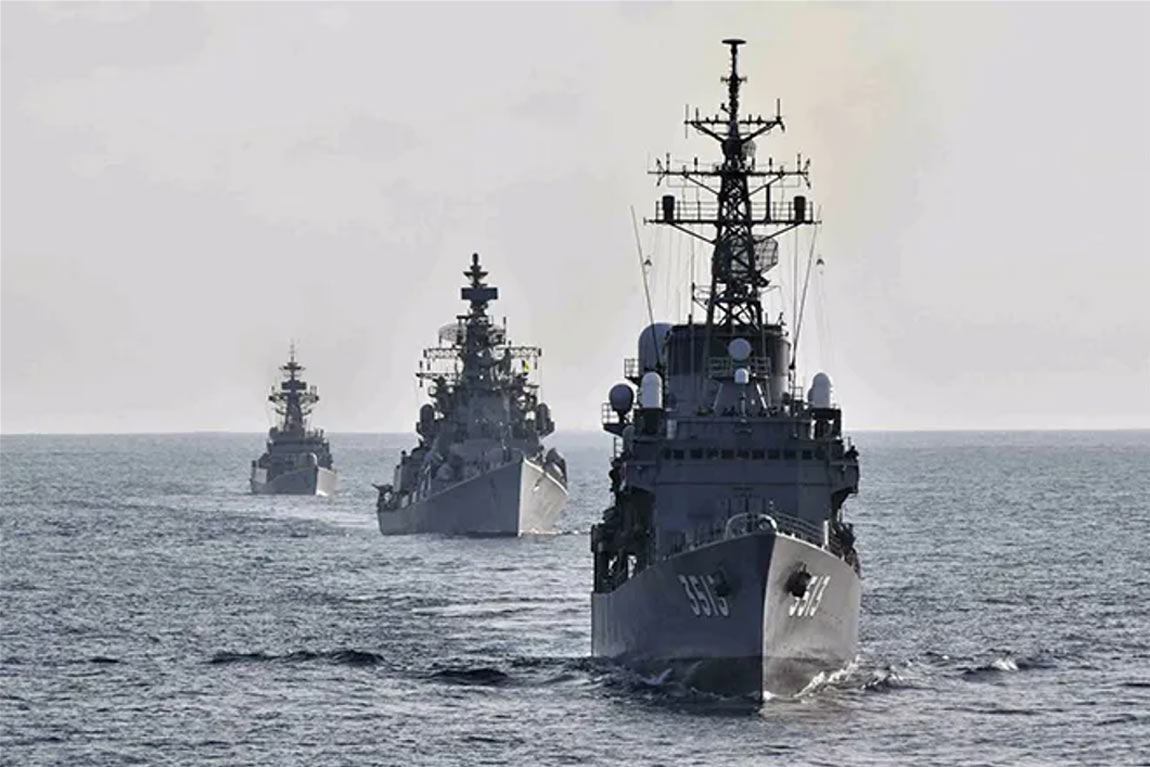
Expert Speak | 07 April, 2026
India’s Quiet Maritime Turn in Middle Eastern Waters
Spotlight
- India is expanding from episodic anti-piracy deployments to a more persistent and geographically broader maritime presence in the western Indian Ocean.
- Through frameworks like the Combined Maritime Forces and deeper Gulf partnerships, New Delhi is incrementally positioning itself as a security contributor.
- Despite progress, uneven engagements and limited institutionalisation continue to constrain the long-term coherence and scalability of India’s regional role.
The return of Somali piracy since late 2023 has reintroduced a familiar but dangerous variable into the western Indian Ocean’s security landscape. As international naval attention shifted toward missile and drone threats in the Red Sea, following Houthi attacks on commercial shipping, gaps in maritime surveillance emerged. Somali pirate networks exploited these openings, reviving hijacking attempts and deploying captured vessels as “mother ships” to extend their operational reach into the Arabian Sea. This resurgence has coincided with broader instability around the Arabian Peninsula, including heightened tensions in the Gulf and disruptions to key maritime chokepoints.
For India, whose trade and energy security depend on these sea lanes, these pressures have created both a strategic incentive and a political opening. New Delhi has significantly expanded its maritime activity west of the subcontinent, translating its deep commercial ties into a more visible, though still cautious, security presence. Long perceived by Gulf states primarily as an economic partner, India is now positioning itself — through anti-piracy deployments, multinational frameworks, and deepening naval partnerships — as a stabilising maritime actor in the western Indian Ocean.
Responding to Piracy’s Return
India’s current activism builds on nearly two decades of anti-piracy operations. Since 2008, the Indian Navy has periodically deployed assets in the Gulf of Aden, escorting merchant vessels and responding to distress calls during the peak years of Somali piracy. The recent resurgence, however, has required a more sustained and geographically expansive response.
The Indian Navy has periodically deployed assets in the Gulf of Aden, escorting merchant vessels and responding to distress calls during the peak years of Somali piracy.
In January 2024, the destroyer Chennai intervened after the bulk carrier MV Lila Norfolk reported an attempted hijacking east of Somalia. Indian marine forces boarded the vessel, and secured all 21 crew members. A more complex operation followed in March 2024, when the destroyer Kolkata intercepted the hijacked cargo ship MV Ruen. After tracking the vessel for weeks, Indian forces compelled 35 pirates to surrender and rescued its crew.
These operations illustrate India’s capacity for rapid response, long-range tracking, and coordinated maritime interdiction. Importantly, they also highlight a broader shift: rather than episodic deployments, India has maintained a more persistent naval presence across key sea lanes — one that has become increasingly consequential as others have thinned out their patrol density. Where it stops short of direct involvement, India nonetheless plays a safeguarding role — the Red Sea corridor being one such instance.
From Participation to Greater Responsibility
India’s expanding operational footprint has been accompanied by deeper engagement in multinational maritime frameworks. Although the Indian Navy had long cooperated informally with the Combined Maritime Forces (CMF), a US-led maritime partnership comprising 47 member states, New Delhi formally joined the US-led partnership in November 2023. Since then, India has moved toward more substantive operational contributions. In April 2024, the frigate Talwar participated in a CMF counter-narcotics mission, seizing 940 kilograms of illicit drugs in the Arabian Sea.
Beyond operations, India has increased its involvement in training and capacity-building initiatives. In September 2025, an Indian naval flotilla, comprising the destroyer Mormugao and the frigates Tarkash and Tabar, conducted a port call in Manama, Bahrain. There, crews interacted with personnel from Task Force 154, the CMF unit responsible for training and capacity building, with engagements including simulated drills on boarding operations, afloat medical assistance, and damage control procedures.
A notable milestone came in February 2026, when an Indian naval officer assumed command of Task Force 154. Shortly after, the Indian-led staff conducted its first training activity aboard the destroyer Surat, bringing together over 20 participants from 10 partner countries. These developments reflect growing confidence in India’s ability to contribute to multinational maritime security efforts, positioning itself as a capable and reliable partner willing to shoulder greater responsibility.
The Indian Ocean Naval Symposium, an Indian-led forum, has provided a platform for naval dialogue and confidence-building with Gulf partners, including Saudi Arabia and Iran.
India’s engagement also extends to regional maritime institutions. Through the Indian Ocean Rim Association, New Delhi has supported maritime safety and security initiatives involving Gulf countries, chiefly the United Arab Emirates (UAE) and Oman. Similarly, the Indian Ocean Naval Symposium, an Indian-led forum, has provided a platform for naval dialogue and confidence-building with Gulf partners, including Saudi Arabia and Iran. While these mechanisms remain consultative rather than operational, they reinforce India’s broader effort to embed Gulf actors within Indian Ocean security architectures. These multilateral engagements are, however, only part of the picture: alongside them, India has pursued a parallel track of bilateral naval partnerships with individual Gulf states — relationships that reveal both the ambition and the limits of New Delhi’s regional security role.
Naval Partnerships with the Gulf: Depth and Limits
India’s bilateral maritime partnerships with Gulf states have expanded steadily, though their evolution has been uneven. While the trajectory points toward greater institutionalisation, a closer look reveals persistent challenges related to consistency, scale, and strategic alignment.
Among Gulf partners, Oman remains India’s most established naval counterpart. The Naseem Al-Bahr exercise, launched in 1993, is one of India’s longest-running bilateral naval engagements. During its most recent iteration, conducted off Goa in 2024, the Indian frigate Trikand and the Omani patrol vessel Al Seeb tested key naval warfare capabilities, including surface gunnery against simulated targets, close-range anti-aircraft firing, and at-sea replenishment operations.
Logistics cooperation has also deepened, particularly through a series of agreements granting India’s access to the port of Duqm since 2018. These arrangements enable forward-deployed Indian naval units to sustain critical upkeep operations without returning to domestic shipyards.
Yet even this mature partnership has exhibited periodic gaps in activity. While operational familiarity is high, the relationship has not fully translated into broader multilateral coordination or joint maritime initiatives beyond exercises and logistics.
India’s naval cooperation with the UAE has followed a similar trajectory of gradual deepening. Early interactions, dating back to 2014, centered primarily on training Emirati naval cadets. Beginning in 2018, however, the relationship took on a more structured form with the launch of the Zayed Talwar naval exercise, later renamed Gulf Waves. Over successive iterations, the exercise has expanded in scope to include counter-piracy and interdiction operations. Trilateral cooperation with France in 2023 has added a minilateral dimension, signaling convergence between Indo-Pacific and Gulf security frameworks.
High-level naval diplomacy complements these operational engagements, as underscored by the official visit by the Commander of the UAE Naval Forces, Major General Humaid Mohammed Abdullah Alremeithi, to India in mid-2025. However, these engagements remain irregular rather than institutionalised on a fixed schedule.
With Saudi Arabia, naval cooperation is more recent. The Al-Mohed Al-Hindi exercise, first conducted in 2021, marked an important step toward bilateral maritime engagement. Since the inaugural drill, two iterations have taken place, with the most recent in 2023 featuring a significant number of platforms, including four surface combatants, maritime patrol aircraft, and drones. At the same time, the inconsistency of engagements; evidenced by the absence of the 2025 exercise iteration, highlights the fragility of these emerging partnerships. That year, cooperation was limited to a port call at Jeddah by two Indian warships and a passage exercise with Saudi naval units.
Beyond joint exercises, the relationship has also expanded to include training and maritime information-sharing. Since 2023, several batches of Saudi cadets have undertaken training programmes in India. Participants attend modules on key maritime capabilities, fostering professional networks and early-career familiarity between future naval officers. In 2025, a Saudi naval delegation visited the Information Fusion Centre – Indian Ocean Region in Gurugram, India’s regional hub for maritime domain awareness.
Taken together, India’s bilateral naval relationships in the Gulf region reflect a pattern of incremental progress constrained by uneven implementation. Exercises, port calls, and training programs have expanded the scope of engagement, but their irregular frequency and limited institutionalisation raise questions about long-term sustainability. For both sides, the challenge lies not only in expanding cooperation but in ensuring its continuity and strategic coherence.
A Cautious but Consequential Role
India’s expanding maritime role in the western Indian Ocean remains deliberately calibrated. Rather than projecting power in a traditional sense, India is building a reputation as a reliable security contributor.
At the same time, recent developments suggest a growing degree of operational readiness. During the recent disruption of transits through the Strait of Hormuz, the Indian Navy has deployed escorts in the Arabian Sea to protect Indian-flagged and associated merchant vessels as they transit contested waters. These escort missions, combined with sustained anti-piracy patrols and rapid-response interventions, demonstrate an ability to operate effectively across a spectrum of maritime contingencies.
Conclusion
In an operational environment marked by the resurgence of Somali piracy and broader instability, India has moved from episodic contributor to a more consistent maritime presence in the western Indian Ocean. The question is whether that presence can be consolidated: translating irregular exercises and port calls into durable, institutionalised partnerships will determine whether India’s role deepens or plateaus. New Delhi’s ability to close this gap; enabling durable frameworks, will equally help address and, indeed, outlast crisis and exercise cycles.
As maritime threats become more complex and geographically diffuse, India’s ability to maintain a persistent presence, respond rapidly to crises, and coordinate with like-minded countries will be increasingly tested. Without adopting an overt leadership posture, New Delhi is nonetheless emerging as a credible, capable contributor to maritime security in the western Indian Ocean.
Leonardo Jacopo Maria Mazzucco is a PhD Candidate in Institutions and Politics at the Catholic University of Milan, specialised in Gulf security.