 Global
Expert Speak | 14 July, 2026
India’s Renewable Energy Moment in Uzbekistan
Spotlight:
- Uzbekistan’s renewable energy transition is reshaping Central Asia’s energy landscape, creating new openings for international investment and technology partnerships.
- India has the technological capabilities and institutional frameworks to become a long-term renewable energy partner, but must accelerate project-level engagement.
- A more proactive commercial strategy, including industry partnerships, financing mechanisms, and technology transfer, could position India as a key player in Uzbekistan’s clean energy transition.
Uzbekistan’s energy sector is in the middle of a quiet but consequential transformation, emerging as one of Central Asia’s fastest-growing renewable energy markets. From a base of just 1,883 MW of installed renewable capacity in 2016, the country has scaled to over 10,000 MW by end-2025, a more than fivefold increase in under a decade with solar now accounting for more than half of that total.
The country has committed to sourcing 50 percent of its electricity from renewables by 2030 and achieving net zero by 2050. Progress towards these objectives has been driven by competitive international tenders and foreign investment. Uzbekistan has attracted over US$35 billion in energy-sector investment in recent years while actively tendering large-scale renewable projects.
The foreign capital inflow has been from the Gulf and China. The United Arab Emirates’ Masdar entered Uzbekistan in 2019 and has since developed five solar plants with a combined capacity of 1,247 MW alongside a 500 MW wind facility and a 63 MW energy storage system. Saudi Arabia’s ACWA Power, also active since 2019–2020, has built a project pipeline worth approximately US$15 billion and is targeting US$25 billion by decade’s end. The Belt and Road Initiative investments in Uzbekistan’s solar and wind sectors amounted to roughly US$1.4 billion in 2023 alone, with Chinese firms also financing and building the country’s first utility-scale solar project, a 400 MW photoelectric plant in the Andijan region.
Together, Gulf and Chinese firms have become the principal external drivers of Uzbekistan’s renewable buildout, combining finance, Engineering, Procurement, and Construction (EPC) expertise, and large-scale project execution at a pace few other partners have matched.
India, by contrast, has yet to translate its strong diplomatic engagement with Uzbekistan into comparable project-level participation in the renewable energy sector. This disparity highlights one of the most significant opportunities for India’s expanding renewable energy diplomacy.
Uzbekistan’s Structural Energy Drivers
The scale and urgency of Uzbekistan’s renewable push are best understood against its structural energy vulnerabilities. The country’s energy system is overwhelmingly gas-dependent: natural gas accounts for 83 percent of its total energy mix and 82 percent of electricity generation. Driven by rapidly increasing domestic demand, Uzbekistan shifted from being a net energy exporter to a net importer as recently as 2020.
Between 2019 and 2023, the export value of refined fossil fuels dropped by more than half from around US$2.5 billion to approximately US$1 billion, while import costs more than doubled, rising from US$0.9 billion to US$2.68 billion over the same period. The energy trade balance turned negative in 2020 and has continued to deteriorate. Much of Uzbekistan’s power infrastructure, including 66 percent transmission lines and 74 percent substations, is more than three decades old, a legacy of chronic Soviet-era underinvestment that the current buildout is racing to address.
Figure 1: Uzbekistan’s Power Sector Overview
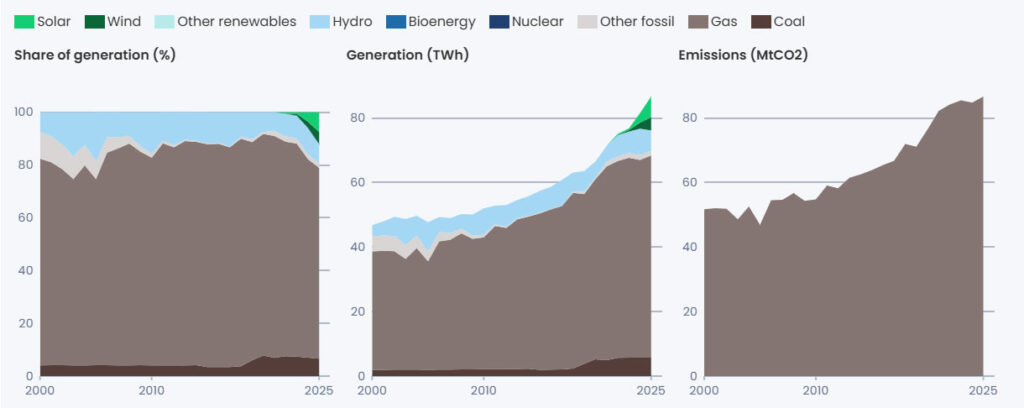
Source: Ember
The renewable push is therefore driven as much by energy security and economic resilience as by climate ambition. The government has set a target of adding 12 GW of variable renewable energy by 2030, comprising 7 GW of solar, 5 GW of wind, and 1.5 GW of hydropower.
In the first half of 2026 alone, Uzbekistan’s solar and wind plants generated 5 billion kWh of electricity, a 28 percent increase over the same period the previous year, while combined renewable output including hydro reached 8.12 billion kWh, conserving an estimated 2.1 billion cubic metres of natural gas and avoiding over 4.6 million tonnes of emissions.
The pace of deployment underscores both Uzbekistan’s ambitions and its continuing need for international partners capable of delivering finance, technology, and project execution at speed, creating a significant opportunity for India.
A further 16 solar, wind, thermal, and hydro power plants with a combined capacity of 3,500 MW are under development across four regions, with full commissioning expected to push annual green energy output to 23 billion kWh, enough to meet the country’s entire annual electricity needs.
The pace of deployment underscores both Uzbekistan’s ambitions and its continuing need for international partners capable of delivering finance, technology, and project execution at speed, creating a significant opportunity for India.
Renewable Push for Collaboration
For India, Uzbekistan occupies an increasingly important place within its broader Central Asia engagement. As one of Central Asia’s largest electricity markets, a rapidly expanding renewable energy destination, and a gateway to wider connectivity initiatives under the India–Central Asia Dialogue, Uzbekistan offers India an opportunity to combine energy diplomacy with commercial expansion.
Solar: Solar remains the most immediate area for cooperation, where India combines deployment scale with an increasingly competitive manufacturing base. Under its Production Linked Incentive (PLI) scheme, India has built over 120 GW of operational solar module capacity and 29.3 GW of cell capacity as of mid-2025, a more than threefold increase in cells and a 216 percent increase in modules since 2022. India’s cumulative installed solar capacity now exceeds 150 GW, and the country added a record 37.9 GW of new solar in 2025 alone.
Indian commercial engagement is already visible on the ground. In May 2026, Adani Group‘s CEO for International Energy held direct talks with Uzbekistan’s Minister of Investment, Industry, and Trade, covering hydropower, infrastructure, and energy cooperation. National Thermal Power Corporation (NTPC) is participating in solar PV tenders and consultancy assignments for gas projects in the country. Reliance Industries has held high-level discussions with Shokhrukh Gulyamov, Uzbekistan’s Deputy Minister of Investment on Energy and Digital Infrastructure.
The opportunity extends beyond project deployment to include the transfer of manufacturing capability. The 2021 MoU between India’s National Institute of Solar Energy (NISE) and Uzbekistan’s International Solar Energy Institute (ISEI) explicitly covers manufacturing of solar photovoltaic equipment, storage technologies, and technology transfer, with both institutes mandated to identify pilot projects together.
India could help Uzbekistan develop downstream solar PV assembly and module production capacity, even in a context where wafers remain predominantly Chinese, mirroring India’s own trajectory of building assembly and cell capacity while managing upstream dependencies. A solar agriculture pilot in Kashkadarya, referenced in the bilateral cooperation framework, provides a concrete entry point to scale.
The 2021 NISE-ISEI MoU has remained largely dormant at the institutional level. Revitalising the MoU through a time-bound agenda on module assembly, technology transfer, and pilot deployment would give the partnership a concrete industrial dimension. India could also encourage Uzbekistan’s accession to the International Solar Alliance, complementing bilateral cooperation with a wider platform for solar capacity building and technical collaboration.
Wind: India, with a manufacturing base of around 18,000 MW per annum in wind turbine generators and world’s fourth-largest wind installed capacity, is well positioned to supply turbine technology and EPC expertise. The opportunity is reinforced by Uzbekistan’s expanding wind programme; wind has surged from 1 MW to 1,652 MW between 2016–2025. Masdar‘s 500 MW Zarafshan wind project, Central Asia’s largest, is already operational and a new 1 GW Masdar wind park was announced at COP29. India’s experience in manufacturing turbines suited to low-wind-speed conditions aligns well with Uzbekistan’s geographical conditions, creating opportunities in future auction rounds.
Beyond generation, India’s experience in transmission planning, grid digitalisation, and battery storage deployment could also help address one of the principal constraints on Uzbekistan’s next phase of renewable expansion.
Beyond generation, India’s experience in transmission planning, grid digitalisation, and battery storage deployment could also help address one of the principal constraints on Uzbekistan’s next phase of renewable expansion.
Critical minerals: Uzbekistan holds the second-largest reserves of critical raw materials in Central Asia: copper, molybdenum, gold, and other transition-relevant minerals, with only 16 of 71 identified mineral deposits currently being mined. This positions Uzbekistan not just as a market for renewable deployment but as a potential upstream partner in the supply chains that make the energy transition possible. India’s National Critical Minerals Mission and the broader push for supply chain diversification give institutional weight to what has until now been a declaratory interest.
At the 14th session of the India-Uzbekistan Intergovernmental Commission in June 2026, India explicitly identified critical minerals supply as a priority area for bilateral energy cooperation, noting that its fast-growing digital economy requires reliable access to clean energy inputs.
At the 14th session of the India-Uzbekistan Intergovernmental Commission in June 2026, India explicitly identified critical minerals supply as a priority area for bilateral energy cooperation, noting that its fast-growing digital economy requires reliable access to clean energy inputs. Uzbekistan’s mineral resources could strengthen India’s clean-energy supply chains while supporting Uzbekistan’s ambition to move further up the critical minerals value chain. A dedicated minerals cooperation track with Indian public sector entities like KABIL or private players engaged in joint exploration and offtake discussions, would convert a policy signal into a supply chain asset.
The Strategic Case for Moving Faster
The diplomatic scaffolding for deeper energy cooperation is already in place. India and Uzbekistan have maintained a Strategic Partnership since 2011, bilateral trade reached US$1.32 billion, and continues to rise alongside growing Indian investment. The 4th India-Central Asia Dialogue held in New Delhi in June 2025, attended by the foreign ministers of all five Central Asian republics, the joint statement explicitly referenced support for a solar alliance, joint rare earth exploration, and backing for Uzbekistan’s International North-South Transport Corridor (INSTC) membership, linking energy cooperation directly to the broader connectivity agenda.
India’s commercial presence remains modest relative to both Uzbekistan’s ambitions and the positions already secured by Gulf and Chinese firms. The case for moving faster is therefore less about geopolitical competition than about timing: partnerships forged during Uzbekistan’s current renewable expansion are likely to shape its energy landscape for decades. Regular India–Uzbekistan renewable energy business forums, dedicated Business-to-Business (B2B) matchmaking, and greater use of credit lines or blended financing could help reduce entry barriers for Indian developers and manufacturers seeking to participate in Uzbekistan’s renewable energy auctions.
Converting diplomatic goodwill into commercially meaningful partnerships will require stronger business facilitation, financing support, and institutional follow-through. If achieved, India would not only secure a greater role in one of Central Asia’s fastest-growing clean energy markets, but also demonstrate that its renewable energy diplomacy can translate into lasting economic partnerships across the region.
Parul Bakshi is Fellow, Energy and Climate, Observer Research Foundation Middle East.