 Global
Expert Speak | 24 November, 2026
Iran and Bahrain: Between Escalations and Resilience
Spotlight
- Iran’s hostility towards Bahrain encompasses territorial claims, attempted coups, support for terror groups, recruitment of spies, and more recently, direct military aggression.
- Tehran has combined its hostilities with disinformation campaigns that seek to instrumentalise segments of Bahrain’s Shiite population.
- Bahrain’s resilience will depend on strengthening national unity and identity, as well as deepening regional and international partnerships.
Introduction: An Escalatory Trajectory
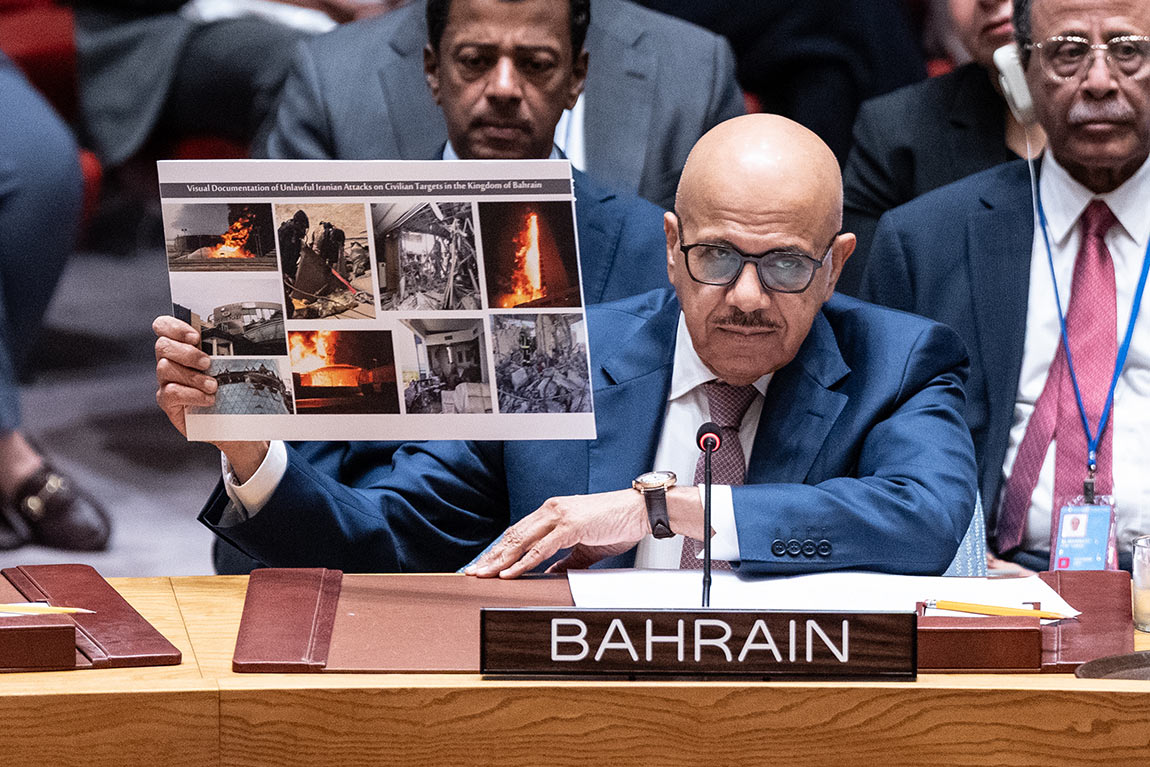
Bahrain has been consistently targeted by over 800 Iranian attacks, even during months of de-escalation, since the United States (US)–Israel–Iran conflict broke out on 28 February 2026. In November alone, Bahraini interlocutors expressed their shock in conversations with the author, after seeing shelter warnings issued multiple times when it was hoped that the conflict could be simmering down. On 21 November, interception debris from an Iranian attack targeting an industrial facility set fire to it, resulting in two injuries. However, the Iranian threat against Bahrain is not just from missiles and drones in the skies. Bahrain’s foreign ministry issued two statements on 17 November 2026: one condemning kinetic attacks from Iran and another rejecting the Iranian foreign ministry’s domestic interference into the verdicts of a recent trial that convicted members of an Iran-linked sleeper cell in Bahrain.
The Bahrain–Iran dynamic therefore should not be ignored; its trajectory is dangerous and circumstances are not yet conducive to restoring normal bilateral ties.
This range of Iranian hostilities, encompassing projectiles, cells, and narratives, compounds the dangers that Tehran has posed to Bahrain’s national security over several decades. The threat has accumulated over the course of their bilateral relations. In the early decades of the twentieth century, Iran had repeatedly “tried to make groundless claims of sovereignty over Bahrain” that carry over to this day; since then, Bahrain has linked Iran to several attempts to overthrow its government, with the last attempt being in 2011. Bahrain also cut ties completely in 2016 due to the collapse of Saudi–Iran ties, and has not restored them since. The repercussions have spilled over into the 28 February 28 conflict during which, through missile and drone strikes, Iran appears to almost single out Bahrain (and Kuwait) in its regional escalations, even when it de-escalates elsewhere. The Bahrain–Iran dynamic therefore should not be ignored; its trajectory is dangerous and circumstances are not yet conducive to restoring normal bilateral ties.
Unmistakable Iranian Interference
Before the 1979 revolution, the Shah of Iran renounced his country’s claim to sovereignty over Bahrain after a United Nations report said that Bahrainis favour independence over rule by Britain or Iran. However, the Islamist government of post-1979 Iran has consistently refused to validate this renunciation. The newspaper Kayhan, whose editor-in-chief is close to the office of the Supreme Leader, makes territorial claims over Bahrain to this day, as do Iranian parliamentarians. While such rhetoric was often dismissed as extremist and fringe during peacetime, its ramifications are considerably more dangerous during war. Moreover, the combination of sustained justifications made for Iran’s aggression and simultaneous contrasting silence over such territorial rhetoric by Iranian officials makes it harder for Iran-backed Bahraini groups, such as Al-Wafaa or Al-Wefaq, to decouple themselves from long-standing accusations that they serve Iran’s expansionist agenda.
The evidence of Iranian interference is becoming increasingly difficult to dismiss. Intelligence reports from the 1980s had linked the Iranian government to a Bahraini faction of Hezbollah. A 1981 failed coup attempt was also linked to Tehran. Since the 2011 overthrow attempt, Bahrain uncovered arms shipments and bomb-making facilities linked to various new violent groups, such as the US Foreign Terrorist Organization and Specially Designated Global Terrorist-designated Al Ashtar Brigades, also supported by Iran. Due to scrutiny over Bahrain’s human rights record, the evidence it presented was sometimes viewed as hyperbole, even when these groups conducted some attacks successfully. Such interference is now harder to dismiss as Iran openly attacks Bahrain, with the same Iran-linked groups predictably propagating Tehran’s justifications to their followers.
The legal case in Bahrain that Iran appears concerned about in November 2026 is one pertaining to an organisation created by various Shiite clerics and some of their confidants, linked to Iran’s Islamic Revolutionary Guard Corps (IRGC). The Bahrain High Criminal Court ordered the confiscation of more than BD 8 million (US$21.2 million) they had kept for financing their activities. The case’s evidence has not been made public, and the sentences mostly extend to life terms in prison, leading to human rights concerns raised by activists, some of whom perceive the authorities as punishing regular Shiite religious practice. This cell is one out of various Iran-linked cases against individuals and groups uncovered by Bahrain since regional escalations began in 2026, and while Bahrain has, by its own admission, struggled to hold the full scale of its bureaucracy to the highest human rights standards in the past, it would be remiss to dismiss such national security concerns as fabrication, especially with sustained and deliberate progress on human rights in the country. According to the Bahrain government, the latest allegations of human rights violations have been investigated.
Disinformation and Subversion Battles
From 2022, there were clear signs of a potential rapprochement between Iran and Bahrain that peaked in 2024 when, in October that year, Abbas Araghchi became the first Iranian foreign minister to visit Bahrain in 17 years. However, Iranian aggression has scuppered any attempts at reconciliation between the two nations. That momentum has broken down to the point that Bahrain refused a collective Gulf Cooperation Council (GCC) meeting in September 2026 with Iranian counterparts in Salalah, Oman, to discuss an arrangement regarding the Strait of Hormuz.
For Iran, this disinformation war is as important as taking kinetic action. Yet, while Iranian subversion has been prolific, it has ultimately failed to generate unrest in Bahrain during the war.
Unlike other countries that can differentiate the positive rhetoric by moderate factions, Bahrain sees fewer divides between moderate and extremist currents within the Iranian elite, because they all largely take a hawkish line vis-à-vis the Kingdom. In November 2026, it was the target of Iranian media, from the government-aligned Islamic Republic News Agency (IRNA) to the IRGC-aligned Tasnim News Agency, for what is portrayed by Iran as anti-Shiite policies. The objective is to deploy sectarian narratives across social media networks to sow divisions in Bahrain. The same divide-and-conquer logic frames Iran’s attacks on Bahrain as specifically against US assets and the Islamic Republic as a protector of Bahraini civilians. Tehran is thus deflecting blame when in reality Iranian missiles and drones have led to casualties and injuries across all the kingdom. For Iran, this disinformation war is as important as taking kinetic action. Yet, while Iranian subversion has been prolific, it has ultimately failed to generate unrest in Bahrain during the war.
With such subversion in mind, the Middle East war has created momentum for a longer journey ahead that is complex and expands beyond cases of espionage, financing, or weapons training by Iran. In the immediate term, travel to Iran and Iraq has been banned by Bahrain because of security concerns. Beyond this, educational, religious and cultural institutions once tolerated in the Kingdom, which have since been proven to propagate allegiance to Iran, are also being tackled. “We are confronting an ideology that demands obedience to Iran’s leadership above Bahrain’s sovereign authority,” Lieutenant General Tariq Al Hassan, head of Bahrain’s Public Security Agency, reportedly said. Moreover, Shiite public commentators such as Jaffar Salman have become the leading advocates for boosting social awareness around this and calling for the removal of the grip of Tehran-backed groups over factions of the Bahraini Shiite community. Reducing Iran’s influence on Bahraini society, however, is a process that will likely take years.
Conclusion: Strengthening Bahrain’s Resilience
While Bahrain’s refusal to attend the Salalah meeting surprised observers who recognise the economic importance of reopening the Strait of Hormuz, the Kingdom appears to be waiting for signs of Iranian goodwill. In the meantime, it is banking on GCC economic support and coordination, including through the GCC railway and other connectivity initiatives. Bahrain also does not suggest that it will oppose GCC-brokered initiatives towards a diplomatic resolution with Iran. However, non-aggression and the restoration of bilateral relations appear to be prerequisites before discussing wider regional issues, such as the Strait of Hormuz. As Bahrain’s foreign ministry put it, “… the security and stability of the region cannot be built on turning a blind eye to attacks.” For the Kingdom, a stern approach to Iran remains paramount, given the unique and multi-pronged threats it faces.
Given Iran’s attempts to exploit domestic divisions, social cohesion would be an increasingly important component of national security.
Despite Tehran seemingly viewing the Kingdom as the GCC’s weakest link, Bahrain has demonstrated considerable resilience. Successful interceptions, effective public warning systems, and the continued convening of international events such as the Manama Dialogue and Gateway Gulf have helped maintain public trust in institutions and some sense of normalcy. Citizens have also demonstrated solidarity through volunteering and other forms of civic participation, so much so that a national committee was convened to document the phenomenon. Looking ahead, Bahrain could build on this resilience by reigniting pre-war efforts towards national consultation for a Vision 2050, incorporating lessons from the conflict, and placing greater emphasis on national unity and identity. Given Iran’s attempts to exploit domestic divisions, social cohesion would be an increasingly important component of national security.
Equally, Bahrain’s resilience will depend on sustaining its external security partnerships. Iran’s use of Bahrain’s relationship with the US as justification for its aggression is unlikely to alter the Kingdom’s strategic calculus. Bahrain will instead seek further assurances of Washington’s commitment to its security, while maintaining cooperation through its joint air command and participation in the United States Central Command’s (CENTCOM) attack drone task force, even while the US naval base in Bahrain is damaged. Other security partnerships, including those with the United Kingdom (UK), Israel, and France, will remain key to Bahrain’s broader security posture.
Mahdi Ghuloom is Junior Fellow, Geopolitics, ORF Middle East.
The author acknowledges the use of ChatGPT (GPT-6) for minor grammatical refinements.