 Global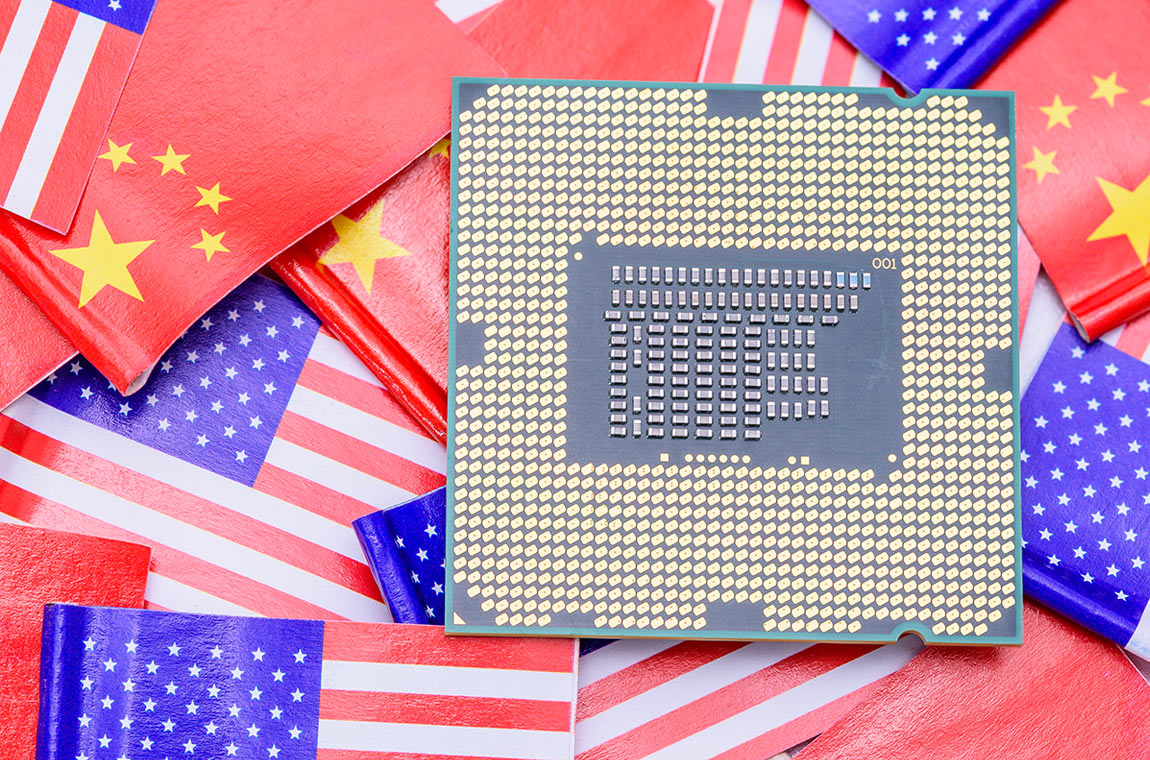
Expert Speak | 05 September, 2026
Sanctions, Tariffs, and the Tech Economy
Spotlight
- The United States’ position in global finance, semiconductor design, cloud computing, manufacturing, and advanced software gives it exceptional power to restrict the technological development of other countries.
- States with strong domestic capabilities, resources, and alternative networks are better positioned to withstand technological-economic coercion from other states.
- Repeated impositions of tariffs, sanctions, and export controls can lead to reciprocal costs, encouraging middle powers to pursue greater digital and technological autonomy, a phenomenon known as ‘digital non-alignment.’
Introduction
The United States’ (US) position in global finance, semiconductor design, cloud computing, manufacturing, and advanced software gives it exceptional power to restrict the technological development of other countries. This is deployed through sanction regimes, export controls, and tariffs on foreign states to influence their behaviour and capabilities such that it reduces their competitiveness with the sanctioning power. Technological industries and digital economies have been targeted via ranking systems that govern access to advanced semiconductors or impose tariffs on imported technologies and components. However, developments in Iran and China suggest that technological isolation has been less effective than intended. Iran has acquired significant drone and cyber capabilities despite decades of sanctions, while China has “effectively closed” the frontier artificial intelligence (AI) performance gap with the US.
This article examines how the tech industries and digital economies of these two countries resist coercion. It considers the role of local capital, skills, raw materials, industrial capacity, and means to obtain financing through alternative networks. These workarounds can weaken restrictions, encourage technological sovereignty, and hinder the sanctioning country’s innovation and competitiveness.
How Targeted States Finance, Source, and Develop Technology
The effectiveness of sanctions, export controls, and tariffs depends not only on their severity, but also on the targeted country’s ability to adapt to them. States with large domestic markets, established industrial bases, strategic resources, or alternative finance are better placed to absorb these pressures as they are less dependent on individual suppliers. Further, they can encourage local governments and firms to invest more heavily in domestic substitutes, third-country production, and financial networks, reducing their exposure to future coercion.
China illustrates this distinction. In 2018, US Section 301 tariffs applied a 25 percent duty on Chinese goods worth up to US$550 billion, with semiconductors a prominent category among the affected imports. Three years before this trade war began, China had been the US’s largest single-end market for semiconductors, with over half of its total annual requirement imported from the latter. After the imposition of Section 301, direct imports declined by 72.3 percent by 2021. Given the US’s leadership in semiconductor quality and China’s reliance on these imports, one might have expected downstream technological development to slow. Yet, China’s technology competitiveness increased across several metrics.
The performance gap between US and Chinese frontier AI models was estimated at an average of 6.3 years in 2018,[1] but has now been reduced to effective parity. Further, Chinese statistics on the production outputs of industrial robotics and new-energy vehicles, which depend on semiconductors, increased over fivefold and twelvefold respectively between 2018 and 2025 despite restrictions—although growth might have been faster without them.
Similarly, sanctions have cut off Iran from most direct access to US trade, technology, finance, and investment. However, they have not prevented the development of a substantial drone and cyber-industrial and operational base in the country, the scale and capabilities of which have drawn international concern since the Strait of Hormuz conflict began in 2026. The sanctions regime that started in 1979 with the US–Iran hostage crisis intensified in 1983 after Iran-linked Hezbollah bombed US and French forces’ barracks in Beirut, resulting in further restrictions on dual-use exports to Iran. This was followed by an even more comprehensive technology embargo in 1995, aimed at preventing Iran from developing nuclear technologies and weapons of mass destruction (WMDs). Despite this, the country has built an impressive indigenous defence-industrial base that can produce low-cost Shahed drones for around US$20,000–50,000 per unit, while US and European manufacturers scramble to meet similar price points. State-linked Iranian hackers also claimed to have infiltrated critical infrastructure operating systems, notably those of the Bowman Avenue Dam in New York and, in May 2026, Fujairah Port in the United Arab Emirates (UAE).
To explain how Iran’s and China’s tech ecosystems moderate the effects of export controls, it is useful to look to the interaction between domestic capabilities and access to alternative external markets, suppliers, and financial networks in these nations. China’s dominance in critical minerals extraction and processing, its industrial manufacturing base, and state-backed investment ecosystem are structural advantages built over decades. While US restrictions may have constrained access to certain research and components, China’s own end-to-end capabilities ensure the integrity of its supply chain. Moreover, since the state controls major sources of industrial finance through state-owned banks and government guidance funds, it is far easier for China to direct its research towards reducing foreign supply-chain dependencies by developing local capacity to produce components like semiconductors, for example. This is more difficult in the US, where the private sector funds most research and development (R&D), a factor that probably contributed to China surpassing the US in total R&D spend in 2024.[2]
For Iran, oil, gas and petrochemical product exports to non-sanctioning countries such as China form a large portion of state revenues. This allows continued procurement of foreign tech components despite the financial pressures of the US’s and allies’ asset freezes and blocking of Iran from the global banking system. Blockchain technology and other digital assets add another route for finance by allowing Iran to move wealth without relying on traditional banking systems, and obscuring the origin and ultimate destination of the funds to avoid seizure or restrictions. Despite Iran’s sanctioned status making procurement of certain parts illegal via secondary networks,[3] it has managed to access essential chips and other components used in drones and even ballistic missiles via unwitting intermediaries, including Canada, Hong Kong, and France, by misrepresenting licence requirements and origin of the goods.
Regarding the local research and technical skills necessary to develop and commercialise domestic technologies, a United Nations Development Programme (UNDP) analysis suggests that the absence of international competitors in the technology marketplace has allowed Iranian startups to innovate in their more receptive local market.
It is also unsurprising that when blocked from established trade and research networks, restricted countries commonly find alternative partners in each other. Iran and China have developed a strong technology trade and research relationship through vehicles such as the China–Iran Trade Promotion Center and the newly established Beijing branch of the Iran House of Innovation and Technology (iHiT) to facilitate technology transfers.
As global markets face uncertainty over the pricing and availability of Chinese and US products, the concept of “digital non-alignment” can be seen as increasingly guiding technology and trade policy among global middle powers.
Reciprocal Costs and the Rise of Digital Non-Alignment
Conventional economic statecraft has not halted technological development in the affected countries, while unintended costs are accumulating for the sanctioning nations. These costs can hurt both the wider economy and the industries that restrictions seek to protect. For example, it is estimated that without the trade war initiated by the US in 2017, US exports to China would have contributed an additional US$90 billion annually to its economy. China also imposed retaliatory tariffs and export controls on critical minerals following the US’s imposition of tariffs in February 2025. Tariff rates continued to escalate reciprocally to over 100 percent on some goods following Trump’s “Liberation Day” announcement in April 2025, lasting through to May 2025, leading to a price hike of 5.2 percent in components using minerals restricted by China.
However, the longer-term consequence may extend beyond rising costs for raw materials and tech components. As global markets face uncertainty over the pricing and availability of Chinese and US products, the concept of “digital non-alignment” can be seen as increasingly guiding technology and trade policy among global middle powers. This approach involves states proactively steering the development of their digital economies in a way that reduces their exposure to similar coercion. In this way, they can remain diplomatically agile while pursuing their own economic and strategic priorities.
Smaller states need not reproduce India’s scale: by pooling expensive infrastructure regionally or specialising in certain technological niches, for example, they can pursue practical sovereignty through shared capacity rather than self-sufficiency.
India illustrates this emerging preference well. Its domestically governed India Stack provides open, interoperable infrastructure for identity, payments, and data-sharing, reducing reliance on systems controlled exclusively by US or Chinese firms. Additionally, India’s participation in multiple bilateral and multilateral forums (such as Brazil, Russia, India, China, South Africa [BRICS], India–Middle East–Europe Economic Corridor [IMEC], and Comprehensive Economic Partnership Agreements [CEPAs] with tech powerhouses Japan and South Korea, among others) expands its network to access materials and components through diverse supply chains and reduces the risk inherent in relying on any single supplier. Of course, India’s ability to pursue such strategic autonomy is greatly helped by the economic weight of its large domestic market and vast population that provides extensive data for training local artificial intelligence (AI) systems—advantages that smaller states cannot easily replicate. However, smaller states need not reproduce India’s scale: by pooling expensive infrastructure regionally or specialising in certain technological niches, for example, they can pursue practical sovereignty through shared capacity rather than self-sufficiency, an approach that would equally reduce the asymmetrical bargaining ability of great tech powers.
The longer these measures endure, the more they have the potential to reshape the wider system, with states that perceive themselves at risk of future restrictions localising critical capabilities or adjusting their suppliers.
Conclusion
Sanctions, tariffs, and export controls can raise the cost of technological development, particularly where they target scarce physical inputs, but rarely lead to lasting isolation. China and Iran have shown how domestic capabilities, alternative finance, intermediary supply routes, and state-directed investment can preserve progress while shifting it onto more sovereign foundations. The longer these measures endure, the more they have the potential to reshape the wider system, with states that perceive themselves at risk of future restrictions localising critical capabilities or adjusting their suppliers. These coercive trade measures are increasingly ineffective in an era of globalised and diversified technology supply chains. In fact, while their repeated use may secure short-term leverage, it can also weaken the market access, network centrality, and third-country confidence on which that leverage ultimately depends.
Elizabeth Heyes is Junior Fellow in Emerging Technologies, ORF Middle East.
The author acknowledges the use of ChatGPT 5.5 to aid background research and for language refinements prior to submission.
[1] This estimate was based on analysis of AI research quality rather than tested model performance.
[2] Spend was calculated with adjustments to reflect purchasing power parity, ensuring that the values are not skewed by the exchange-rate value of the country’s currency. Instead, they are measured using the price of specific goods as benchmarks.
[3] ‘Secondary networks’ refer to when an item is purchased from a ‘middleman’ country rather than directly from the producer.