 Global
Expert Speak | 18 November, 2026
The EU, the GCC, and Maritime Security: Beyond the Hormuz Crisis
The following excerpt is from Chapter 6 — Hormuz: Breaking the Insecurity Continuum
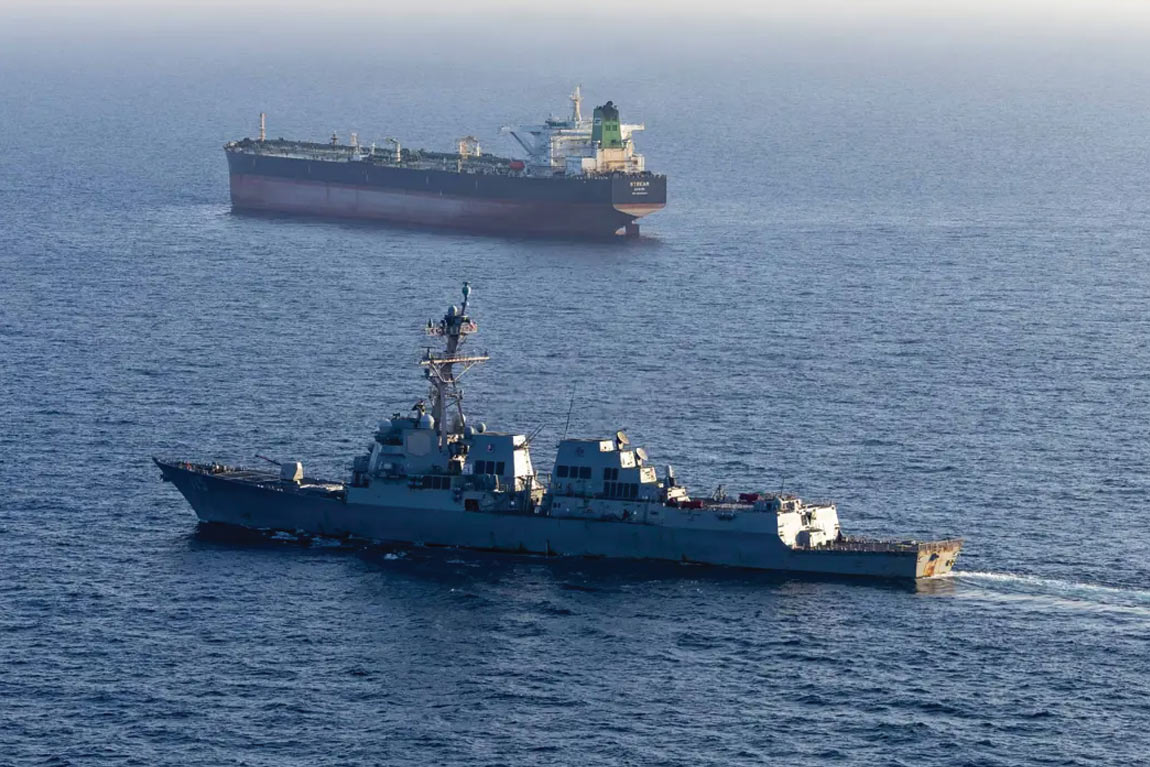
The Hormuz shipping crisis exposed a structural mismatch between the European Union’s (EU) strategic ambitions in the Gulf and its operational and political readiness to act. While EU countries extended bilateral defence support to Gulf Cooperation Council (GCC) partners, no dedicated European naval response materialised, reflecting both capability constraints and concerns of entrapment in a US-Iran confrontation. Understanding this predicament requires situating it within the EU’s broader institutional trajectory in regional waters: from the European Maritime Awareness Strait of Hormuz (EMASoH) mission to Operation Aspides, before turning to what a long-term, sustainable European approach towards Gulf maritime security should look like.
Before the Hormuz Crisis
Mapping the EU’s Maritime Engagement
The EU first institutionalised its maritime engagement in the waters off the Arabian Peninsula in 2022[1] by establishing a Maritime Area of Interest (MAI) in the north-western Indian Ocean and applying the Coordinated Maritime Presence (CMP) concept to the region.a Similarly, its focus on maritime security in the Gulf region is relatively recent. Its commencement can be traced to the European Commission’s Joint Communication on A Strategic Partnership with the Gulf in 2022, the first EU-level document to formally introduce maritime security cooperation into the EU-GCC agenda. It also called for a cooperation mechanism that focused on deconfliction channels, information sharing, and codes of conduct, building on existing European naval deployments in regional waters.[2] The EU’s growing institutional attention to Gulf waters was further reflected in the 2023 EU Maritime Security Strategy, which called for greater synergy among European naval presences in the region, particularly around the Strait of Hormuz.[3]
Initial efforts to translate political convergence into tangible initiatives took shape at the 27th GCC-EU Joint Council in October 2023, which advocated exploring inter-bloc coordination under the CMP framework and establishing a joint working group on maritime security.[4] A navalfocused working group has yet to be formalised; however, maritime security has continued to rank high on the EU-GCC agenda, including across subsequent iterations of the Regional Security Dialogues, a senior official-level grouping,[5] and the first-ever EU-GCC Joint Summit in 2024, which endorsed efforts towards a coordinated approach to maritime security in the Red Sea.[6] Progress on the working group, however, has remained limited, with only a two-day joint maritime security seminar in 2025 as a concrete achievement so far.[7]
EMASoH (2020 to mid-2024)
Launched in 2020,[8] EMASoH was an ad-hoc minilateral partnership for Gulf maritime security established by a coalition of like-minded European countries in response to deteriorating maritime shipping conditions in the Strait of Hormuz in 2019 and the lack of consensus in Brussels to launch a formal EU naval operation.b Operating from 2020 to mid-2024, it aimed to uphold freedom of navigation and safeguard commercial shipping by improving maritime security awarenessc (MSA) in regional waters. EMASoH relied on a dual-track approach,d which combined Operation Agénor— the military component providing a continuous maritime presence—with a diplomatic track focused on confidence-building and engagement with key stakeholders.[9]
At the operational level, EMASoH coordinated closely with the International Maritime Security Construct (IMSC), a US-led naval coalition established in mid-2019 to secure Gulf maritime routes,[10] while keeping a distinct strategic posture that prioritised de-escalation over deterrence. This showcased its capacity to pursue interoperability with other naval actors without geopolitical alignment.[11] Although the deployment of naval and aerial assets contributed to a visible deterrent presence along shipping routes, EMASoH’s primary function was reassurance rather than coercive signalling.[12] By sustaining an independent maritime presence in the Gulf, it provided both operational experience and a model that later helped lay the foundations of Operation Aspides.
While it succeeded in reassuring commercial shipping and supporting confidence-building, EMASoH lacked the scale, mandate, and capabilities required to respond to a sudden military escalation at sea, and it fell short of altering the broader security dynamics of the Gulf. Ultimately, EMASoH entered a vigilant state in June 2024 as its contributing countries diverted resources to Operation Aspides.[13]
Operation Aspides (2024-ongoing)
Unlike EMASoH, Operation Aspides is a fully fledged EU initiative developed within the Common Security and DefencZe Policy (CSDP) framework, the institutional vehicle enabling EU civilian and military operations overseas. Launched in February 2024,[14] Operation Aspides reflects the EU’s preference for an autonomous response, from the US-led Operation Prosperity Guardian to mounting maritime insecurity across the Red Sea basin triggered by the Houthi antishipping campaign.[15]
Predicated on a defensive posture, Operation Aspides pursues three objectives: protecting civilian shipping, escorting merchant vessels through regional chokepoints, and enhancing MSA across sea routes. Its area of operations spans the Red Sea, the Arabian Sea, and the Gulf.[16] UN Security Council Resolution 2722, which called for the cessation of Houthi attacks and reaffirmed the right of self-defence against such threats,[17] provided the legal basis for the operation’s mandate.
Operation Aspides draws contributions from 21 EU member states, either through military assets or personnel assigned to the operational headquarters in Larissa, Greece. The initial footprint of five surface combatants has gradually adjusted as the intensity of Houthi attacks subsided, with two warships remaining on station. Maritime patrol aircraft and surveillance drones have complemented naval operations from Beyond its core mandate, Operation Aspides has undertaken activities spanning the broader spectrum of naval engagement. At the medium end, these include search-and-rescue (SAR) and safety-of-life-at-sea (SOLAS) missions,f while confidence-building measures are at the lower end.g
Table 1: ‘Operation Aspides’ in Numbers
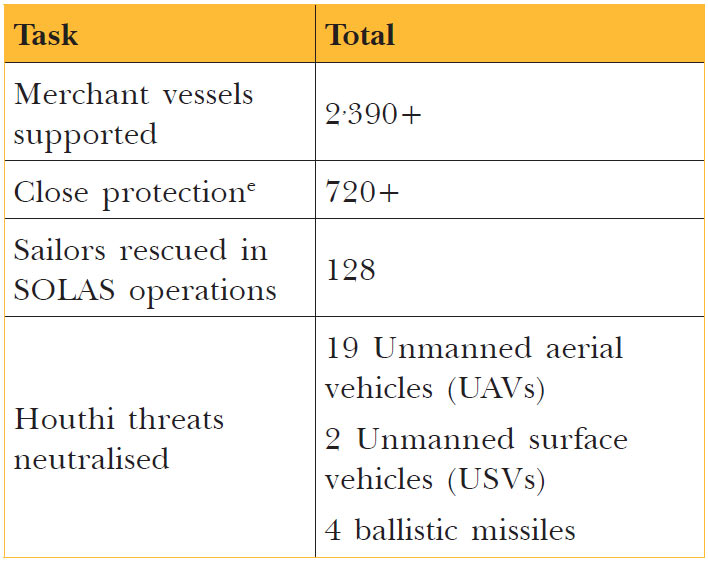
Source: EEAS, data elaborated by the author.[18]
Europe’s Response to the Hormuz Crisis
Constraints
Stronger EU-GCC maritime security cooperation confronts two orders of constraints. Some stem from the limited resources allocated to advancing intra-bloc naval cooperation, while others reflect structural institutional differences between the two organisations. Yet, both affect how quickly political convergence can translate into practical exercises. Despite a long track record in naval operations, maritime exercises conducted under the EU flag are a recent development. It was only in 2024 that the Union launched MARSEC, its annual maritime security exercises.[19]
MARSEC remains largely geared toward lowto medium-intensity scenarios, focusing on the protection of critical undersea infrastructure (CUI) and combating illegal, under-reported, and unregulated (IUU) fishing.[20] Likewise, intra- GCC naval drills have been sporadic. Following the launch of the Ittihad (Union) series in 2015,[21] naval drills appear to have stalled during the 2017-2021 Qatar blockade crisis before resuming only in 2025.[22] Besides, GCC countries have often prioritised bilateral exercises with regional neighbours or foreign security partners over a dedicated bloc framework. Second, despite both being regional blocs, the EU and the GCC rest on markedly different decision-making structures, institutional prerogatives, and degrees of autonomy.[23]
Whereas the EU retains some independence from member states in formulating policy in selected areas, the GCC Secretariat acts primarily as a coordination platform rather than a directive body, with Gulf governments maintaining tighter national control over its decision-making. Interbloc understanding has advanced considerably; however, these institutional asymmetries risk slowing implementation. While distinctive decision-making processes are structural, their effects can be partially mitigated through sustained senior-official engagement, such as the Regional Security Dialogue format, and dedicated technical platforms, reinforcing the urgency of operationalising the joint maritime security working group.
The EU’s Response
The Hormuz shipping crisis highlighted a mismatch between Europe’s maritime ambitions and its operational readiness to assume a more prominent security role in the Gulf. At the outbreak of the conflict, the EU lacked both the political cohesion and military bandwidth to mount a dedicated naval response to protect international shipping and support GCC partners against Iranian attacks.
However, the crisis also revealed growing political alignment between the two blocs. The Union provided diplomatic backing through high-level visits to the region, support for the UK-France “Hormuz Coalition”, and statements at the United Nations.[24] Shortly after the onset of hostilities, the two blocs also convened an extraordinary ministerial meeting to coordinate their positions, condemn Iranian attacks, and agree to joint diplomatic efforts to end the escalation.[25] Political convergence on the principle of freedom of navigation across Hormuz was further reinforced at the High-Level Forum in mid-July 2026.[26]
Some EU member states supplemented political support through bilateral defence assistance, primarily by providing air assets and ammunition to GCC partners.[27] However, unlike previous maritime security crises in regional waters, no dedicated European naval initiative emerged. This restraint reflected both tactical and strategic considerations, including the shortage of military assets to sustain deployments in the Red Sea and the Gulf, and concerns about entrapment in a US-Iran conflict. Notably, GCC partners did not negatively perceive the EU’s measured response,[28] but rather as a reflection of their own preference for avoiding escalation.[29]
Lessons Following the Hormuz Crisis
Progress on EU-GCC maritime security cooperation in the Gulf will mostly depend on the durability of US-Iran de-escalation efforts. However, both blocs should seek to insulate their engagement from future outbreaks of tensions in the Strait of Hormuz. Three measures can be considered to this end.
First, the Union should, along with GCC partners, explore extending Operation Aspides more actively throughout Hormuz. Although the operation’s mandate already covers the Gulf, its activities have remained largely confined within the Red Sea basin. Aspides could contribute with MSA, reassurance calls, and close protection for merchant vessels transiting the Strait, while providing a practical framework for cultivating structured intelligence-sharing channels, operational coordination, and confidence building.
Any Hormuz-specific role for Aspides should remain grounded in the operation’s defensive posture. The EU’s measured response during US Operation Epic Fury demonstrated some strategic restraint that may facilitate Tehran’s acquiescence to a limited European naval presence.h However, political and operational constraints remain considerable, particularly regarding force generation and the willingness to sustain deployments in an increasingly demanding strategic environment.
Second, the two blocs should accelerate the operationalisation of low-political-commitment mechanisms for dialogue, starting with the joint maritime security working group. A dedicated platform for regular exchanges would facilitate information sharing, policy coordination, and the gradual development of common operating procedures. This aligns with the GCC’s traditional approach to security cooperation that privileges non-binding arrangements that progressively develop the habits of working together.
Officer exchange programmes should also be explored. Embedding military and civilian personnel within respective institutions and operations would improve familiarity with command structures, strengthen institutional memory, and build professional relationships. Such an initiative would render channels for inter-bloc engagements less vulnerable to future geopolitical fluctuations. Finally, the EU and GCC should translate political convergence into operational practice through joint maritime exercises. Given the region’s threat environment and the sensitivities surrounding military cooperation, drills should focus initially on low- to medium-intensity scenarios rather than high-end warfighting. By drawing on existing EU exercise frameworks, activities should be tailored to the requirements of GCC navies and coast guards, while gradually expanding to address both traditional and hybrid maritime security threats.j
Given that GCC naval forces rarely operate outside regional waters, forward-deployed EU assets could support these training activities. Maritime exercises could initially adopt an ad hoc format, leaving national participation voluntary, before gradually evolving into a more structured framework as familiarity, interoperability, and trust deepen.
Conclusion
The EU is increasingly willing to position itself not only as a security contributor and a de-escalatory actor, but also as an active capacity-building force in the waters surrounding the Arabian Peninsula, as reflected by the decision to expand Aspides’ mandate to include training activities with Djiboutian maritime forces and cooperation with the Yemeni Coast Guard.[30] This trajectory suggests that the EU’s strategic attention to maritime security off the Arabian Peninsula need not be measured merely by warships on station, but by the depth and scope of partnerships it is willing to sustain over time. Whether these efforts translate into a more active naval presence in Hormuz will depend less on the Union’s intent and more on the broader trajectory of US-Iran de-escalation.
However, the capacity of the EU and the GCC to advance institutional and operational cooperation on maritime security will now determine their ability to insulate bilateral engagements from future regional crises and act jointly when they arise.
Leonardo Jacopo Maria Mazzucco is a PhD Candidate in Institutions and Politics at the Catholic University of the Sacred Heart of Milan, Italy.
Grammarly was used for language refinements prior to submission.
[1] European Council, “Coordinated Maritime Presences: Council extends implementation in the Gulf of Guinea for two years and establishes a new Maritime Area of Interest in the North-Western Indian Ocean,” February 21, 2022, https://www.consilium.europa.eu/en/press/pressreleases/ 2022/02/21/coordinated-maritime-presencescouncil- extends-implementation-in-the-gulf-of-guineafor- 2-years-and-establishes-a-new-concept-in-the-northwest- indian-ocean/.
[2] European External Action Service, “Joint Communication on a ‘Strategic Partnership with the Gulf,’” May 18, 2022, https://www.eeas.europa.eu/eeas/joint-communication- %E2%80%9Cstrategic-partnership-gulf%E2%80%9D_en.
[3] European Council, “Maritime Security: Council Approves Revised EU Strategy and Action Plan,” October 24, 2023, https://www.consilium.europa.eu/en/press/pressreleases/ 2023/10/24/maritime-security-council-approvesrevised- eu-strategy-and-action-plan/.
[4] European Council, “Co-Chairs’ Statement of the 27th GCC-EU Joint Council and Ministerial Meeting,” October 10, 2023, https://www.consilium.europa.eu/en/ press/press-releases/2023/10/10/co-chairs-statement-ofthe- 27th-gcc-eu-joint-council-and-ministerial-meeting/.
[5] European External Action Service, “GCC: First Regional Security Dialogue with the EU Held in Riyadh,” January 25, 2024, https://www.eeas.europa.eu/eeas/gcc-firstregional- security-dialogue-eu-held-riyadh_en; European External Action Service, “EU-GCC: Second Meeting of the EU-Gulf Cooperation Council Regional Security Dialogue,” May 24, 2025, https://www.eeas.europa. eu/eeas/eu-gcc-second-meeting-eu-gulf-cooperationcouncil- regional-security-dialogue_en.
[6] European Council, “First European Union-Gulf Cooperation Council Summit – Joint Statement,” October 16, 2024, https://www.consilium.europa.eu/en/press/ press-releases/2024/10/16/first-european-union-gulfcooperation- council-summit-joint-statement/.
[7] European Council, “Joint statement following the 29th GCC-EU Joint Council and Ministerial Meeting,” October 6, 2025, https://www.consilium.europa.eu/en/ press/press-releases/2025/10/06/joint-statement-of-the- 29th-gcc-eu-joint-council-and-ministerial-meeting/.
[8] Danish Ministry of Defence, “European Maritime Awareness in The Strait of Hormuz (EMASOH),” https:// www.fmn.dk/en/topics/operations/ongoing-operations/ hormuz/.
[9] Leonardo Jacopo Maria Mazzucco, “Gulf maritime security: Seeking stability in the era of precarious détente,” Trends Research & Advisory, October 4, 2022, https://trendsresearch.org/insight/gulf-maritimesecurity- seeking-stability-in-the-era-of-precariousdetente/.
[10] “US-led coalition launches operation to protect Gulf waters,” Al Jazeera, November 19, 2019, https://www. aljazeera.com/news/2019/11/7/us-led-coalition-launchesoperation- to-protect-gulf-waters. Max Colchester and Isabel Coles, “Britain, U.S. to Protect Shipping Through Strait of Hormuz From Iranian Threats,” The Wall Street Journal, August 5, 2019, https://www.wsj.com/ articles/britain-u-s-to-protect-shipping-through-strait-ofhormuz- from-iranian-threats-11565026612.
[11] Mazzucco, “Gulf Maritime Security”
[12] Cinzia Bianco and Matteo Moretti, “Europe’s role in Gulf maritime security,” Middle East Institute, May 9, 2022, https://www.mei.edu/publications/europes-role-gulfmaritime- security.
[13] European Maritime Awareness in the Strait of Hormuz (@EMASOH_AGENOR), “Today the Sunset Ceremony of EMASoH Operation AGENOR took place. The ceremony marked the end of the 12th rotation and the start of the vigilant state of EMASoH. EMASoH carried out 291 accompaniments conducted by 47 naval ships that spent 1320 days at sea,” X post, June 27, 2024, https://x.com/EMASOH_AGENOR/ status/1806270447849181409?s=20.
[14] European Council, Security and freedom of navigation in the Red Sea: Council launches EUNAVFOR ASPIDES, February 19, 2024, https://www.consilium.europa.eu/en/ press/press-releases/2024/02/19/security-and-freedomof- navigation-in-the-red-sea-council-launches-new-eudefensive- operation/.
[15] Cinzia Bianco and Emily Tasinato, “Taking Stock of ‘Aspides’: A Step Forward in Europe’s Geopolitical Role in the Red Sea?,” Brussels International Center, May 27, 2024, https://www.bic-rhr.com/research/taking-stockaspides- step-forward-europes-geopolitical-role-red-sea.
[16] European External Action Service, “EUNAVFOR Operation ASPIDES,”, November 20, 2025, https:// www.eeas.europa.eu/eeas/eunavfor-operation-aspides_ en?s=410381.
[17] United Nations Security Council, Resolution 2722 (2024), January 10, 2024, https://unscr.com/en/resolutions/2722/.
[18] European External Action Service, “EUNAVFOR ASPIDES Mandate,” August 24, 2026, https://www. eeas.europa.eu/eunavfor-aspides/eunavfor-aspidesmandate- 1_en?s=410381; European External Action Service, “EUNAVFOR ASPIDES: Operation in Numbers,” May 16, 2026, https://www.eeas.europa.eu/ eunavfor-aspides/eunavfor-aspides-operation-numbers_ en?s=410381.
[19] European External Action Service, “MARSEC EU 24: Live Maritime Security Exercise Boosts EU-Wide Cooperation at Sea,” June 3, 2024, https://www.eeas.europa.eu/eeas/ marsec-eu-24-live-maritime-security-exercise-boosts-euwide- cooperation-sea_en.
[20] European External Action Service, “EU Maritime Security Exercise Strengthens Protection of Fisheries and Critical Infrastructure,” July 7, 2025, https://www.eeas. europa.eu/node/454461_fr.
[21] “GCC joint naval exercise Union 17 begins,” Khaleej Times, March 3, 2015, https://www.khaleejtimes.com/uae/ gcc-joint-naval-exercise-union-17-begins?_refresh=true.
[22] “Joint Gulf Naval Exercise “Ittihad 25” Concludes in Kuwait,” Al Defaiya, December 17, 2025, https://www. defaiya.com/news/Defense%20News/Asia/2025/12/17/ joint-gulf-naval-exercise-ittihad-25-concludes-in-kuwait.
[23] Christian Koch, “Constructing a viable EU-GCC partnership,” London School of Economics and Political Science, January 14, 2014, https://eprints.lse. ac.uk/55282/.
[24] European External Action Service, “Media Advisory: HR/ VP Kallas Travels to the United Arab Emirates,” April 9, 2026, https://www.eeas.europa.eu/eeas/media-advisoryhrvp- kallas-travels-united-arab-emirates_en; European External Action Service , EU Statement – UN General Assembly: Use of the veto (Maritime Security in the Strait of Hormuz), April 16, 2026, https://www.eeas.europa. eu/delegations/un-new-york/eu-statement-%E2%80%93- un-general-assembly-use-veto-maritime-security-straithormuz_ en; “EU Diplomatic Arm Proposed Naval Mission Take ‘Primary Role’ in Clearing Strait of Hormuz Mines, Document Shows,” Al-Monitor, June 3, 2026, https://www.al-monitor.com/originals/2026/06/eudiplomatic- arm-proposed-naval-mission-take-primaryrole- clearing-strait-hormuz.
[25] European External Action Service, “Joint Statement by GCC-EU Ministers’ Meeting on Recent Developments in the Middle East: Iran’s Attacks against GCC States,” March 5, 2026, https://www.eeas.europa.eu/eeas/jointstatement- gcc-eu-ministers%E2%80%99-meeting-recentdevelopments- middle-east-iran%E2%80%99s-attacksagainst- gcc_en.
[26] European External Action Service,, “Co-chairs Statement by the High Representative and the Kingdom of Bahrain as Presidency of the Gulf Cooperation Council on the Strait of Hormuz and Freedom of Navigation,” July 13, 2026, https://www.eeas.europa.eu/eeas/co-chairsstatement- high-representative-and-kingdom-bahrainpresidency- gulf-cooperation-council_en.
[27] Angelo Amante, “Italy likely to send military aid to Gulf states, sources say,” Reuters, March 4, 2026, https://www. reuters.com/business/aerospace-defense/italy-likely-sendmilitary- aid-gulf-states-sources-say-2026-03-04/; Vassilis Nedos, “Athens bolsters Gulf air defenses,” Ekathimerini, April 1, 2026, https://www.ekathimerini.com/politics/ foreign-policy/1299741/athens-bolsters-gulf-airdefenses/; “France deploys fighter jets over UAE to protect its military bases,” Le Monde, March 1, 2026, https:// www.lemonde.fr/en/france/article/2026/03/03/francedeploys- fighter-jets-over-uae-to-protect-its-militarybases_ 6751041_7.html?srsltid=AfmBOoq6NclZH5_pu6 qhBteB9iCrIOCN4xuQmtRT5LvmadMFW_20S-vu.
[28] Abdel Aziz Aluwaisheg, “GCC and EU more in sync politically than ever,” Arab News, May 21, 2026, https:// arab.news/jt9sb.
[29] “Saudi Arabia calls for de-escalation, free navigation in Strait of Hormuz,” Saudi Gazette, May 5, 2026, https:// saudigazette.com.sa/article/661088/saudi-arabia/saudiarabia- calls-for-de-escalation-free-navigation-in-hormuz.
[30] European Council, “Maritime security: Council updates mandates of EU naval operations ASPIDES and ATALANTA.”