 Global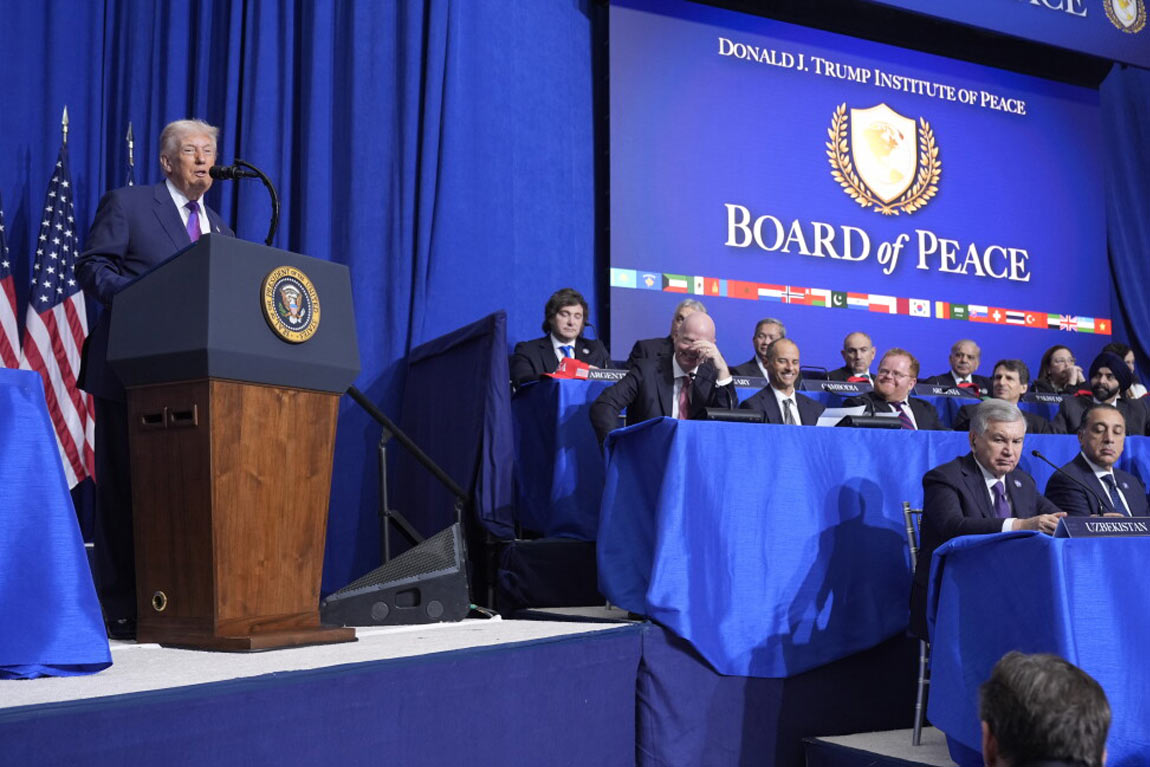
Expert Speak | 25 June, 2026
The Peace Board: Can Money and Muscle Forge Peace?
The following excerpt is from Chapter 1 — Whither the Board of Peace? Perspectives from Washington and the Gulf.
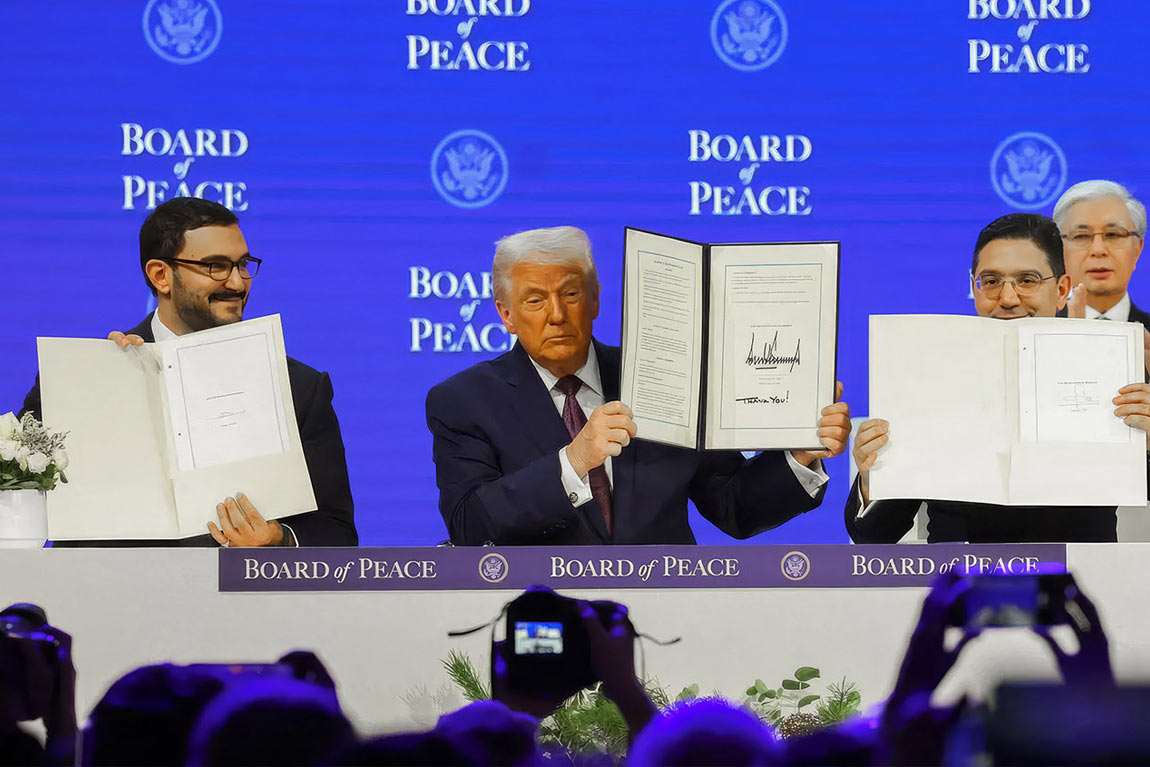
The inaugural meeting of the Board of Peace (BoP) on 19 February 2026 was quintessentially Trump: heavy on the headlines and light on the details. The launch unveiled “more than US$7 billion” in pledged funding for a Gaza “relief package” from nine countries: Kazakhstan, Azerbaijan, the United Arab Emirates (UAE), Morocco, Bahrain, Qatar, Saudi Arabia, Uzbekistan, and Kuwait.[1] The World Bank, according to its president Ajay Banga, will serve as a “limited trustee” to manage donor contributions under the BoP’s direction.[2]
A peacekeeping component has also materialised after months of ambiguity over its mandate fuelled widespread reluctance.[3] At the launch, Indonesia, Morocco, Kazakhstan, Kosovo, and Albania announced troop commitments to the International Stabilization Force (ISF), supplementing ongoing Egyptian and Jordanian efforts to train Palestinian police personnel.
The BoP follows the 20-point peace plan unveiled in September 2025 and adopted two months later under UN Security Council Resolution 2803.[4] In January, at Davos, President Donald Trump announced the Peace Board’s founding members while boasting that his administration had “settled eight wars” with another “coming pretty soon”—a reference to Gaza advancing from the fragile ceasefire of Phase One towards the demilitarisation, governance, and reconstruction of Phase Two.[5]
Yet, despite the lofty claims and spectacle of the BoP’s first meeting, it faces not only tremendous obstacles to achieving peace in Gaza and beyond. It also conveys a more troubling message that the American vision for the global order now rests on money and muscle alone.
How Strong Is the Monetised Mandate?
For all the superlatives that Trump deployed to describe the BoP—“most consequential,” “most prestigious”—questions linger over its financial and political backing.[6] Of over 60 invitations issued, 28 countries have joined at the time of writing this article, indicating tepid global support. What stands out is the rejection by key American allies—France, Germany, and the United Kingdom (UK)—while others like Japan and Australia prefer to keep their distance.[7] These countries may not be joining the Board, but have agreed to participate in a different role. Japan, for example, did not formally sign, but has agreed to contribute to peacekeepers to the ISF. Trump’s warning to nations not to “play cute” reveals as much: countries are willing to defy him, and coercion has become necessary precisely because persuasion is failing.[8]
As for financial contributions, President Trump—the BoP’s chairman—has demanded US$1 billion in membership fees from countries seeking permanent seats, effectively monetising Gaza’s reconstruction. This vision was on full display at the World Economic Forum in Davos when Jared Kushner, Trump’s son-in-law, presented renderings of the Strip’s coast filled with skyscrapers.[9] By April 2026, this vision had moved beyond presentation: the BoP held discussions with DP World, the UAE-based state logistics giant, about privatising Gaza’s infrastructure through new ports and free-trade zones.[10] Yet the BoP’s charter makes no reference to Gaza itself, nor to the United Nations (UN)—though Trump ironically announced that the UN Office for the Coordination of Humanitarian Affairs is raising US$2 billion in support for Gaza.[11]
The silver lining may be that the BoP’s launch has spurred separate fundraising efforts: Japan will lead an initiative with participation from South Korea, the Philippines, and Singapore, according to Trump.[12] Still, the US$7 billion pledged by the BoP’s 20+ member states remains woefully inadequate. A joint European Union (EU), UN, and World Bank assessment now places Gaza’s total recovery and reconstruction needs at US$71.4 billion over 10 years, with US$23 billion needed in the next 18 months alone.[13]
Even Trump’s promise of an additional US$10 billion from Washington remains uncertain without Congressional approval—and faces further doubt following the Supreme Court’s recent rejection of his global tariffs. The funding situation became more contentious in March when the State Department reportedly reallocated US$1.25 billion from disaster relief and peacekeeping budgets to the Peace Board without Congressional approval, prompting Senate Democrats to introduce legislation blocking the transfer.[14]
Gaza’s Sticking Points
Beyond funding uncertainties, the BoP confronts formidable obstacles in Gaza itself. Three unresolved issues threaten any prospect of sustainable peace. First, Hamas has not been disarmed. When the ceasefire began, the group deployed fighters and police throughout Gaza to consolidate control,[15] resulting in rival armed factions—some of them Israeli-backed—competing for dominance.[16] Despite Trump’s prediction that Hamas would surrender its arsenal, no progress has been made. The absence of any disarmament this far into the truce signals trouble ahead.
Second, Israeli forces were supposed to make a temporary pullback to what is known as the “yellow line”, reducing their control from over 80 percent to roughly half of Gaza’s territory.[17] Yet, they now control approximately 58 percent, indicating continued territorial encroachment beyond the agreed line.[18] Israel’s top general has called this demarcation a “new border,” while evidence suggests that Israeli troops have shifted boundary markers further westward into areas meant for Palestinian control.[19] Worse, Israel approved measures in February resuming land registration in the West Bank and nullifying restrictions on non-Palestinian land purchases— moves that Israeli officials acknowledge amount to “de facto sovereignty” blocking any Palestinian state.[20]
Third, and compounding the above challenges, is the limited role granted to Palestinians themselves. The National Committee for the Administration of Gaza comprises 15 technocrats led by former Palestinian Authority official Ali Shaath, tasked with restoring essential services— electricity, water, healthcare, and education— alongside stabilising public administration.[21] Questions of political authority, security arrangements, and long-term governance fall outside their purview entirely. The committee answers to the Board of Peace, not to Gazans, leaving reconstruction in external hands. As for the ISF, although troop commitments have materialised, participating countries remain wary of mission creep—concerned that they may be pressured to disarm Hamas beyond traditional peacekeeping.
Is the Board Really About Peace?
Ultimately, the Board of Peace is not about “peace” as traditionally understood—it is about what Trump calls “peace through strength,” which amounts to coercion through military might. On 28 February, Trump launched Operation Epic Fury against Iran—combat operations that included strikes on military sites, the assassination of Supreme Leader Ali Khamenei, and an ongoing war that has disrupted global trade through Iran’s closure of the Strait of Hormuz and retaliatory strikes across the Middle East.
This followed Trump’s deployment of what he calls a naval “armada” to the Middle East— two aircraft carriers and 14 surface warships, the largest American presence in the region since the 2003 invasion of Iraq—which he referenced during the BoP’s inaugural meeting to reinforce that his approach prioritises muscle over diplomacy.[22] This pattern extends beyond the Middle East: since September, American military strikes on alleged drug boats in the Caribbean Sea and Pacific Ocean have killed more than 181 people.[23] UN officials have condemned such operations as “extrajudicial executions,”[24] although Trump prefers to focus on national security and the toppling of Venezuela’s leader, Nicolás Maduro.
Yet the board’s foundational logic—that money and muscle alone can forge peace—has already proven hollow. Russia has yet to yield to any peace deal despite extensive pressure. Iran continues to project defiance in its retaliation throughout Operation Epic Fury, closing the Strait of Hormuz and launching strikes across the Middle East rather than capitulating to American force. And Gaza, the BoP’s supposed showcase, remains mired in violence and deadlock. The BoP’s constraints compound these failures. Secretary of State Marco Rubio insists that Gaza is “impossible to solve under orthodoxy,”[25] yet the structural imbalances —most glaringly, Palestinian underrepresentation relative to Israeli influence, alongside the threat of renewed violence between Israeli strikes and Hamas defiance—threaten to derail the very peace process that the BoP claims to advance.
The Board’s first formal report in May 2026 blamed Hamas for stalled implementation, citing refusal to disarm as “the principal obstacle.”[26] While the High Representative for Gaza, Nickolay Mladenov, acknowledged violations occur and cause civilian deaths, his Security Council briefing[27] conspicuously avoided addressing Israeli territorial violations—including encroachment beyond the yellow line that has expanded Israel’s control well past agreed boundaries.
Whether the Peace Board actually aims to supplant the UN remains debatable, but its trajectory poses dangers regardless. By marginalising established multilateral institutions, the BoP risks normalising a ‘might is right’ approach to international disputes while destabilising regions where the UN’s presence, however imperfect, provides crucial coordination. The irony is sharp: by sidelining the UN, Trump risks creating the very overextension he campaigned against, as allies prove unwilling to support American-led initiatives that lack in international legitimacy.
Endnotes
[1] Amy Walker and Tom Bateman, “Trump’s Board of Peace Members Pledge $7bn in Gaza Relief,” BBC, February 20, 2026, https://www.bbc.com/news/articles/cp8rke05kv4o.
[2] “World Bank to Manage Gaza Reconstruction Fund: Ajay Banga,” Gulf News, February 20, 2026, https:// gulfnews.com/world/mena/world-bank-to-manage-gazareconstruction- fund-ajay-banga-1.500449373.
[3] “US Presses 70 Countries to Join Gaza Stabilization Force,” The New Arab, January 15, 2026, https://www. newarab.com/news/us-presses-70-countries-join-gazastabilisation- force.
[4] United Nations Security Council, Resolution 2803, November 17, 2025, https://docs.un.org/en/s/ res/2803(2025).
[5] Rev, “Board of Peace transcript,” January 22, 2026, https://www.rev.com/transcripts/board-of-peace.
[6] Rev, “Board of Peace.”
[7] Maya Yang, “What Is Trump’s Board of Peace and Who Is Involved?,” The Guardian, February 19, 2026, https://www.theguardian.com/world/2026/feb/19/what-istrumps- boards-of-peace-and-who-is-involved.
[8] “‘They’re Playing Cute’: Trump Calls Out Major US Allies Who Have Not Yet Joined His Board of Peace,” AP News, February 19, 2026, https://apnews.com/ video/theyre-playing-cute-trump-calls-out-major-usallies- who-have-not-yet-joined-his-board-of-peace- 79cf2056d1ff4337adbc8e2d95aa1e2b.
[9] Patrick Kingsley and Vivian Yee, “Trump’s Vision for Gaza: Skyscrapers and a ‘Little Riviera,’” The New York Times, January 22, 2026, https://www.nytimes. com/2026/01/22/world/middleeast/us-gaza-peace-trumpkushner- davos.html.
[10] Sana Khan, “Trump’s ‘Board of Peace’ Eyes Gaza Rebuild with DP World as $70 Billion Challenge Looms,” Modern Diplomacy, April 21, 2026, https://moderndiplomacy. eu/2026/04/21/board/.
[11] Patrick Wintour, “Dispute Over Future of Gaza as Trump’s Board of Peace Sidelines EU and UN,” The Guardian, February 13, 2026, https://www.theguardian. com/us-news/2026/feb/13/dispute-future-of-gaza-trumpboard- of-peace-eu-un.
[12] Tiago Ventura, “Five Key Takeaways from Trump’s First Gaza Board of Peace Meeting,” TIME, February 19, 2026, https://time.com/7379788/trump-gaza-board-of-peacefirst- meeting-takeaways/.
[13] Heba Saleh, “Gaza Reconstruction to Cost More than $70bn, Officials Say,” Financial Times, April 20, 2026, https://www.ft.com/content/9bc43c2f-cb41-498d-bb8c- 8ea756e04a82?syn-25a6b1a6=1.
[14] Michael Mattler, “Questions for Congress About Funding the Board of Peace,” Just Security, April 13, 2026, https:// www.justsecurity.org/136200/questions-congress-boardof- peace/.
[15] Jason Burke, “Hamas Deploys Armed Fighters and Police Across Parts of Gaza,” The Guardian, October 13, 2025, https://www.theguardian.com/world/2025/oct/13/hamasdeploys- armed-fighters-and-police-across-parts-of-gaza.
[16] “Israel-Backed Militia Kill Two Hamas Operatives in Gaza, Militia Says,” Reuters, January 7, 2026, https://www. reuters.com/world/middle-east/israel-backed-militia-killtwo- hamas-operatives-gaza-militia-says-2026-01-07/.
[17] Toqa Ezzidin and Julia Frankel, “Israeli Troops kill Palestinians for Crossing a Vague Ceasefire Line that’s Sometimes Unmarked,” AP News, January 18, 2026, https://apnews.com/article/gaza-ceasefire-yellow-line- 062f3a55d737cc83607c0ddacf312df0.
[18] Seham Tantesh and Julian Borger, “Gaza’s Yellow Line Creeps Forward as Israeli Forces Expand Zone of Control,” The Guardian, April 22, 2026, https://www. theguardian.com/world/2026/apr/22/gaza-yellow-linecreeps- westwards-israel.
[19] Emma Graham-Harrison, “Yellow Line That Divides Gaza Under Trump Plan Is ‘New Border’ for Israel, Says Military Chief,” The Guardian, December 8, 2025, https:// www.theguardian.com/world/2025/dec/08/yellow-linethat- divides-gaza-under-trump-plan-is-new-border-forisrael- says-military-chief.
[20] Jerry Fisayo-Bambi, “UN Security Council Warns Israeli West Bank Plans Threaten Gaza Truce,” Euronews, February 19, 2026, https://www.euronews. com/2026/02/19/un-security-council-members-berateisraels- west-bank-expansion-plans.
[21] “Who Is Ali Shaath, Head of Board of Peace Gaza Committee?,” The New Arab, January 16, 2026, https:// www.newarab.com/news/who-ali-shaath-head-boardpeace- gaza-committee.
[22] Mark F. Cancian and Chris H. Park, “US Military in the Middle East: Numbers Behind Trump’s Threats Against Iran,” Center for Strategic and International Studies, February 24, 2026, https://www.csis.org/analysis/usmilitary- middle-east-numbers-behind-trumps-threatsagainst- iran.
[23] Malek Fouda, “US Military Strike on Alleged Drug Boat Kills At least Three People in the Caribbean Sea,” Euronews, April 20, 2026, https://www.euronews. com/2026/04/20/us-military-strike-on-alleged-drug-boatkills- at-least-three-people-in-the-caribbean-sea.
[24] Tiago Rogero, “13 Men Killed by US Military Boat Strikes Identified: ‘These Were Flesh-and-Blood People’,” May 15, 2026, https://www.theguardian.com/us-news/2026/ may/15/us-military-airstrikes-caribbean-pacific-victimidentities.
[25] US Department of State, “Secretary of State Marco Rubio at the Board of Peace Event,” February 19, 2026, https://www.state.gov/releases/office-of-thespokesperson/ 2026/02/secretary-of-state-marco-rubio-atthe- board-of-peace-event.
[26] Julian Borger, “Board of Peace Focus on Hamas Risks Return to War in Gaza, Critics Say,” The Guardian, May 23, 2026, https://www.theguardian.com/world/2026/ may/23/board-of-peace-focus-on-hamas-risks-return-towar- in-gaza-critics-say.
[27] United Nations, Board of Peace High Representative for Gaza briefs the Security Council, May 21, 2026, https://www. un.org/unispal/document/high-representative-for-gazanickolay- mladenovs-briefing-to-the-security-council/.