 Global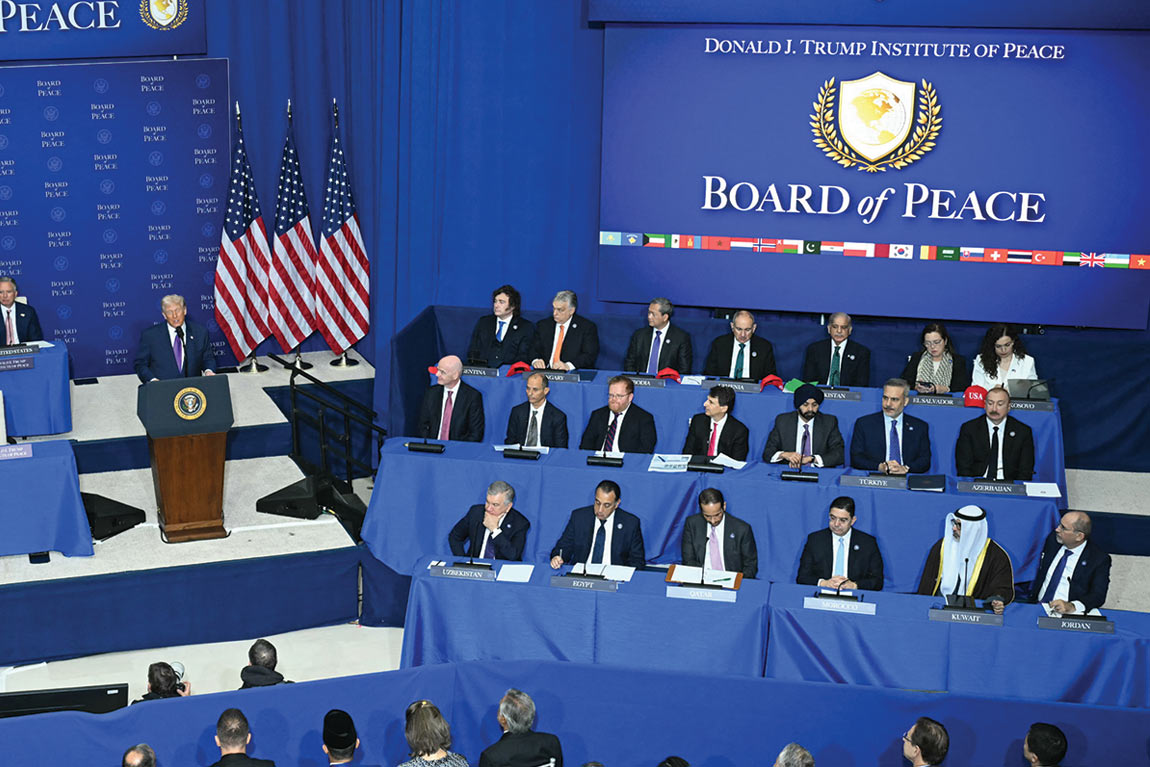
Special Reports | 12 June, 2026 Download Report (PDF)
Whither the Board of Peace? Perspectives from Washington and the Gulf
Attribution: Clemens Chay, “Whither the Board of Peace? Perspectives from Washington and the Gulf,” ORF Special Report No. 309, Observer Research Foundation Middle East, June 2026.
Editor’s Note
The Board of Peace (BoP), launched in January 2026 at Davos under United States (US) President Donald Trump’s chairmanship, represents an unprecedented experiment in conflict resolution: an American-led multilateral framework operating outside the United Nations system, funded through membership fees, and premised on the (unstated) principle that money and military strength can forge peace where diplomacy has failed.
The BoP emerged from Trump’s 20-point peace plan for Gaza, adopted under UN Security Council Resolution 2803 in November 2025. Trump signed the Board’s founding charter on 22 January 2026 at the World Economic Forum in Davos, with representatives from 28 countries. At its inaugural meeting on 19 February 2026 in Washington, DC, the Peace Board unveiled over US$17 billion in pledges from nine countries and secured troop commitments for an International Stabilization Force. Despite these pledges, however, the initiative faces a severe cash crunch. News reports reveal that the BoP has received only a tiny fraction of the US$17 billion promised, effectively stalling reconstruction and preventing the US-backed National Committee for the Administration of Gaza from entering the Strip. Compounding these financial troubles are various other obstacles, including Hamas’s refusal to disarm, Israeli territorial encroachment beyond agreed boundaries, and marginalised Palestinian representation in governance decisions. Most strikingly, the BoP’s launch coincided with Operation Epic Fury—Trump’s war against Iran—raising fundamental questions about whether peace can be pursued through military might.
This volume examines the BoP from perspectives across Washington and the Gulf Cooperation Council (GCC) states. The aim is to assess whether Trump’s initiative offers a genuine pathway to reconstruction or primarily serves as a geopolitical realignment that marginalises Palestinians. Contributors to this special report analyse how the BoP intersects with their respective national interests and foreign policy strategies, revealing the calculations behind participation, or otherwise refusal, and the domestic pressures shaping each state’s position. Trump had promised, as he campaigned for a second term around late-2022, to end wars; he has also on various occasions openly expressed his desire for a Nobel Peace Prize. The Board of Peace may yet represent an erosion of those stated ambitions rather than their fulfilment.
Clemens Chay opens the volume with an assessment of the Board’s foundational contradictions, examining whether money and military muscle can forge peace where diplomacy has failed. Trump’s initiative monetises reconstruction through US$1-billion membership fees while operating outside UN frameworks, yet faces hurdles, including a critical cash crunch and Hamas’s refusal to disarm. Most strikingly, the BoP was launched amidst Operation Epic Fury against Iran, exposing the hollowness of American coercion as Russia, Iran, and Gaza resist.
Xavier Guignard begins the analysis of GCC states’ approaches by examining Saudi Arabia’s defensive positioning in joining the Board despite institutional reservations. Riyadh’s participation reflects strategic calculation: avoiding marginalisation while preserving access to Washington. This chapter reveals Saudi discomfort with a framework that sidelines Palestinian agency, concentrates power in Trump’s hands, and fails to prevent the Iran war. For Saudi Arabia, the Board represents hedging against an initiative unlikely to outlast the current US administration.
In the third chapter, Sumaiya Al-Wahaibi analyses Oman’s decision to remain an observer as a reaffirmation of its “positive neutrality”, which rejects prioritising reconstruction over Palestinian statehood. The subsequent Iran war validated Oman’s caution, positioning Muscat as a viable interlocutor regardless of conflict outcomes—because it never staked credibility on US stewardship.
Saoud Al-Eshaq then traces Qatar’s shift from independent mediator to risk-sharing participant following Israel’s 2025 missile attack on Doha. Qatar’s selective commitment—financial contributions without troop deployments—reduces exposure while maintaining relevance and positioning the country for post-Trump administrations, while recognising that meaningful progress requires US leverage over Israel.
Mahdi Ghuloom, in his essay, explores Bahrain’s enthusiastic embrace, driven by King Hamad’s coexistence values and desire to institutionalise US ties beyond the controversial Abraham Accords. The Board’s diverse membership allows marketing participation as multilateral engagement to Bahrain’s anti-normalisation public, though economic austerity constrains contributions.
Hamdah Al Kindi rounds off the Gulf-wide analysis by examining UAE participation through Abu Dhabi’s “connectivity agenda” pursuing sustainable stability. The Board extends the logic of the Abraham Accords, yet raises critical questions: whether the UAE’s peace perception shifts as Israel, an Accords partner, wages regional war, including against Iran; and how Abu Dhabi reconciles tolerance promotion with its normalisation partner’s operations.
Ghaith al-Omari brings the volume full circle with Washington’s perspective, demonstrating how ambitious global mandates collided with lost momentum and Iran war distraction. The inaugural meeting revealed neither unified disarmament positions nor sustained US attention. Unless the BoP produces visible progress, it will struggle to demonstrate credibility and fulfil its original mission.
Together, these contributions illuminate the Peace Board’s contradictions: monetising reconstruction, pursuing peace amidst war against Iran, and raising hopes for Palestinian futures even as structural challenges—particularly excluded Palestinian voices—persistently undermine them.
Read the report here.
Clemens Chay is Senior Fellow, ORF Middle East.
All views expressed in this publication are solely those of the authors, and do not represent the Observer Research Foundation, either in its entirety or its officials and personnel.