 Global
Expert Speak | 14 April, 2026
Food and Water Security as an Element of National Security: Strategies for the Gulf
This article is the part of “Policy Pathways for Food and Water Security in the MENA Region“
In 2020, when the COVID-19 pandemic disrupted global supply chains and closed borders across the world, the movement of food and agricultural goods slowed down. Two years later, in 2022, the Russia-Ukraine war further challenged the supply of grain (mainly wheat and barley fodder)[1] and sunflower seed oil, to the Gulf. For Gulf states, which import more than 85 percent of food commodities,[2] these crises served as a test of food supply resilience and logistical preparedness.
Another challenge emerged in 2023, when the Bab el-Mandeb Strait, a vital maritime trade corridor linking Europe, the Middle East, and Asia, was affected by vessel attacks by Houthis just off the coast of Yemen.[3] The rerouting of vessels around the Cape of Good Hope extended delivery times and raised transport costs while also putting at risk the Gulf’s food supply route. These disruptions were a reminder to Gulf countries that food security is a matter of national security and can easily be interrupted by both regional conflicts and global events.
From Hyper-Arid Climate to High Food Security Index
The Arabian Peninsula’s environment presents a challenge to agricultural self-sufficiency. With hyper-arid conditions, minimal rainfall, water scarcity, and less than 2 percent of land suitable for farming,[4] the Gulf’s ecosystems naturally put a limit to traditional agriculture.
Although advanced systems that are designed to use less water, such as vertical farms and high-tech greenhouses, are rapidly expanding, they remain energy-intensive. Balancing technological progress, sustainability, and energy transition goals is still a shared challenge across the region and one that requires integrated planning.
Conflicts in neighbouring countries such as Syria, Yemen, and Iraq, compounded by environmental degradation and climate change,[5] could further trigger regional migration and instability with a spillover effect into the Gulf. To overcome this, countries have turned to diplomacy, innovation, and strategic planning.
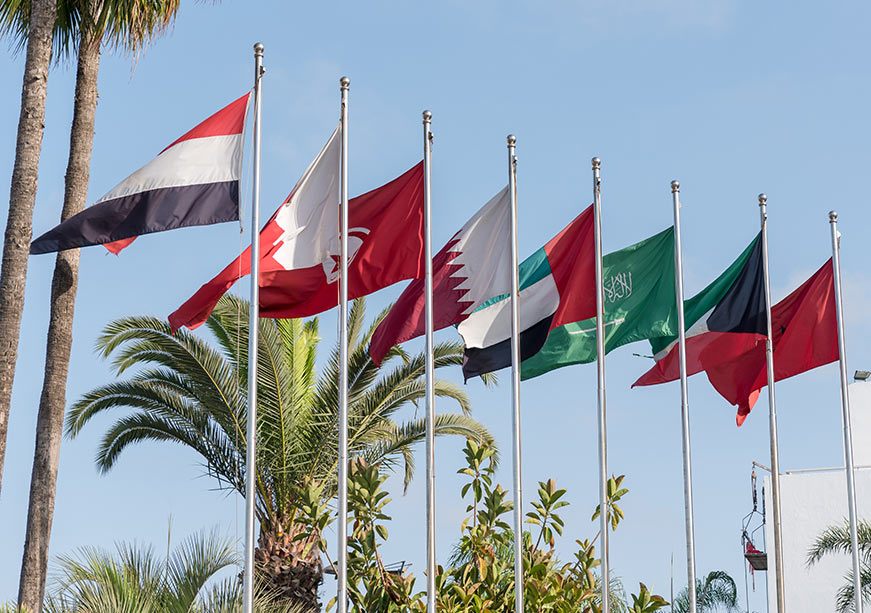
For example, the Gulf Cooperation Council (GCC) has recognised that these environmental challenges are continuing to impact food and water security and, as such, need to be addressed as part of a wider security strategy. The Council published the Gulf Cooperation Council Vision for Regional Security in 2024 in which food and water security was named one of the grouping’s cooperation objectives.[6]
Food Security Policies and Strategies in the Gulf
GCC governments have placed food and water security at the heart of their national agendas. This is reflected in their strong performance on the Global Food Security Index,[7] where all GCC members rank above the world average. The Index, which assesses availability, affordability, quality, and safety of food supplies, ranks the UAE highest at 23rd place, followed by Qatar at 30th and Oman at 35th.
Each country has tailored its approach towards food and water security based on its national priorities and circumstances. The Kingdom of Saudi Arabia (KSA), Sultanate of Oman, and the United Arab Emirates (UAE) are focusing more on achieving higher self-sufficiency through increased domestic food production. For its part, Qatar is relying on innovation, such as alternative proteins, to strengthen its food security. In addition, the UAE and the KSA are focusing their efforts on overseas land acquisition in case domestic production falls short.
Saudi Arabia has integrated food and water security into the Vision 2030 Strategy,[8] and its National Aquaculture Policies and Practices[9] and 2030 National Strategy for Agriculture[10] have helped strengthen food production and self-sufficiency in key products such as dairy and eggs. The agricultural sector’s growing contribution to GDP, reaching US$30.4 billion in 2024,[11] demonstrates the effectiveness of Saudi Arabia’s policy planning and implementation.
The UAE has adopted a comprehensive long-term approach through the 2051 National Food Security Strategy,[12] which promotes diversification of import sources, technology-driven local production, reduction of food waste, and enhanced resilience in supply chains, underpinned by specific targets. The UAE has also designated food as a priority within its new National Cluster Strategy,[13] connecting food systems to economic diversification. Meanwhile, Oman’s Sustainable Agriculture and Rural Development Strategy (SARDS) 2040[14] and National Nutrition Strategy[15] were developed in partnership with the Food and Agriculture Organization (FAO) of the United Nations with the aim of promoting rural development and environmental sustainability.
For Qatar, once it became challenging to import food through Saudi Arabia several years ago, it turned to other countries for its food imports. The experience exposed Qatar’s vulnerability as a result of relying on a single-entry point for its food imports and underscored the value of domestic production and supply diversification. Qatar’s National Food Security Strategy 2030[16] thus continues to focus on resilience, sustainable consumption, and international partnerships. Similarly, Kuwait and Bahrain are advancing initiatives aligned with their own national visions. Kuwait Vision 2035[17] and Bahrain’s first national food security strategya,[18] contain plans to strengthen local agriculture, advance agritech, and develop long-term food reserves.
Water Security as a Strategic Priority
Water scarcity is another theme that is central to the region’s long-term security planning. Groundwater resources such as the shared Umm er Radhuma–Dammam aquifer system covering 680,000 km2 support the majority of agricultural production across Saudi Arabia, the UAE, and Oman. Because of its connection to food production, sustainable management of this resource is critical, and requires coordination between countries to prevent overextraction and improve resource quality.
To meet rising demand caused by population growth, GCC states have turned to technology to meet their water demands and have become global leaders in the desalination processes. In the UAE, the majority of drinking water comes from desalination[19] and in Saudi Arabia, desalinated water meets roughly 60 percent of urban needs.[20] Although states are investing in new and more efficient technology, climate change and environmental degradation of coastal ecosystems are still likely to increase energy usage. This is particularly challenging as the Gulf is looking to diversify its economy and transition away from fossil fuels while increasing food production.
The UAE’s Water Security Strategy 2036[21] aims for sustainable access to water under both normal and emergency conditions, establishing storage capacity benchmarks and conservation programmes. Saudi Arabia’s National Water Strategy 2030[22] envisions a sustainable and efficient water sector that safeguards natural resources while maintaining service quality. Meanwhile, Kuwait, Bahrain, and Qatar are expanding desalination and wastewater recycling— critical capacities given their near-total reliance on desalination.[23]
For their part, Jordan, Tunisia, and Israel have all developed wastewater policies that allow them to treat and reuse their water for agriculture and groundwater recharging. GCC countries still have a long way to go in wastewater reuse and it could be a significant resource for food production, thus further easing their reliance on energy-intensive desalination while preserving important natural capital.
Public-Private Partnerships and Agritech Investments
Given their constraints in natural resources, the Gulf countries have turned to innovation as a core element of their food and water security agenda. One of the results is the significant amounts of public and private sector investments in agritech. These efforts are important for enhancing self-sufficiency and are positioning the Gulf as a hub for agricultural innovation.
Across the GCC, more than US$3.8 billion has already been invested in food technologies,[24] with agritech expected to contribute US$30.5 billion to the Gulf economy. Large-scale projects such as Oman’s Saham Agricultural City,[25] Saudi Arabia’s Jeddah Food Cluster,[26] and the UAE’s Food Tech Valley,[27]
are designed to integrate research, production, and logistics, creating ecosystems that link innovation to national security goals. The International Center for Biosaline Agriculture (ICBA[28]) is a valuable example of how region-contextualised scientific research can help solve food security challenges by developing new techniques for growing crops in saline and arid conditions.
Adding another dimension to food security is overseas agricultural investments. Saudi Arabia’s SALIC and the UAE’s Al Dahra have acquired agricultural land and ownerships in agricultural companies across continents, ensuring reliable access to essential commodities like grain and meat. As these portfolios expand, particularly into the Global South, their long-term benefits will increasingly depend on integrating geopolitical sensitivities, climate resilience, biodiversity stewardship,[29] and engagement with local communities, as part of their investment strategies.
Looking Ahead
1. Regional Cooperation: GCC countries face similar challenges when it comes to food and water security. They are all considered strong and stable economies and harnessing cooperation to tackle common problems is only expected. Shared initiatives can enhance food and water security through joint research, harmonised policies, and coordinated crisis management. The GCC Vision for Regional Security already recognises food and water security as essential to the region’s collective stability. Furthermore, the GCC is showing greater interest in a harmonised GCC-wide Food Security Strategy, especially following COVID-19 where such regional cooperation[29] has proven to be beneficial to these countries in times of crisis.
A GCC-wide approach could also help manage future risks linked to climate change and trade disruptions. Coordinated efforts to diversify import sources, standardise emergency reserves, and develop regional food corridors could further strengthen resilience. Joint investments in renewable-powered desalination and climate-smart agriculture could reduce costs and accelerate sustainability goals.
2. National Strategies: As the Gulf moves into a new era shaped by climate change and new geopolitics, revisiting and updating national strategies becomes increasingly important. Many existing food and water policies are several years old and refreshing them to reflect current environmental realities and technological advances will ensure that they remain effective and forward-looking. Comprehensive and modernised water policies are needed to promote sustainable management of transnational aquifers, and regional cooperation in replenishing those essential groundwater resources through joint efforts.
Some states have already made substantial progress with data to show it,b while others are still developing frameworks that translate intent into concrete, measurable outcomes. Strengthening institutional capacity and aligning national efforts with scientific research will be beneficial. Locally driven science and research tailored to Gulf conditions can provide the evidence base needed to guide policy decisions and innovation.
Although domestic production in this region is increasingly relying on technology to produce yields, agriculture still remains the biggest user of fresh water. For example, in the UAE, 73 percent of freshwater[31] is used for agriculture. Domestic production in this region comes at a cost, either by depleting critical natural resources such as soil and water or by increasing the demand for energy, as it is the case with the vertical farming systems.
Although the food-water nexus is acknowledged within some of the food security strategies, the GCC countries could benefit from further integrating their water, food, and energy policies.
3. Investment in innovation and new technologies: The Gulf’s strong appetite for innovation will continue to play a pivotal role in shaping the next stage of its food and water security. By investing in knowledge, skills, and homegrown expertise, countries can ensure that technology serves long-term sustainability.
The Gulf’s experience demonstrates that food and water security are not isolated development issues—they are integral to economic diversification, social well-being, and long-term national stability. The region has already made notable progress in turning challenges into opportunities for innovation. Continued investment in technological advancement and global partnerships will be essential to sustain this momentum. AI-powered technologies such as precision agriculture, Internet of Things (IoT), smart irrigation, vertical farming, and renewablepowered desalination can help balance environmental stewardship with desired productivity.
The path forward will likely build on the Gulf’s proven ability to adapt. Over the recent decades, the region has transformed its deserts into global centres of business, technology and innovation. The same drive that powered this transformation is also being directed toward securing its most fundamental resources—food and water. The momentum created by hosting climate COP28 in 2023,[32] the yearly Abu Dhabi Food Security Summit,[33] and the upcoming United Nations Water Conference in 2026,[34] all offer an ideal opportunity to spearhead the food and water security agenda with sustainability at its core.
Endnotes
[1] Anna L. Jacobs, “The Ukraine Crisis Deepens Food Insecurity Across the Middle East and Africa,” Arab Gulf States Institute, April 11, 2022, https://agsi.org/analysis/the-ukraine-crisis-deepens-foodinsecurity- across-the-middle-east-and-africa/.
[2] “The GCC imports 85% of its food – here’s how it is increasing food security through innovation,” World Economic Forum, February 14, 2025, https://www.weforum.org/stories/2025/02/gulf-foodsecurity- innovation/.
[3] Ahmad Ghaddar, “Houthi attacks in the Bab al-Mandab Strait hit global trade,” Reuters, December 19, 2023, https://www.reuters.com/world/bab-al-mandab-shipping-lane-target-israel-fightshamas- 2023-12-12/.
[4] Agricultural land (% of land area), in World Bank Open Data, https://data.worldbank.org/.
[5] International Committee of the Red Cross and Norwegian Red Cross, Making adaptation work – Addressing the compounding impacts of climate change, environmental degradation and conflict in the Near and Middle East, April 2023, Gland, Switzerland, International Committee of the Red Cross, https://www.icrc.org/en/document/report-impact-climate-change-and-armed-conflict-near-and-middleeast.
[6] The Cooperation Council for the Arab States of the Gulf Secretariat – General, Gulf Cooperation Council Vision for Regional Security, (Political Affairs and Negotiations (Second Edition), 2024), in the Digital Library, https://gcc-sg.org/ar/MediaCenter/DigitalLibrary/Documents/27848330-555a-4a7d- 9a6c-206b797fd2f9.pdf;Digital Library, https://www.gcc-sg.org/ar/MediaCenter/DigitalLibrary/Pages/ default.aspx.
[7] Economist Impact, Global Food Security Index 2022, The Economist Group, 2022, https://impact. economist.com/sustainability/project/food-security-index/explore-countries.
[8] Kingdom of Saudi Arabia, Council of Economic and Development Affairs, Vision 2030, (Council of Economic and Development Affairs, 2016), https://www.vision2030.gov.sa/media/quudi5wq/vision- 2030-overview.pdf.
[9] Kingdom of Saudi Arabia, Ministry of Environment, Water and Agriculture, National Aquaculture Policies and Practices, (Ministry of Environment, Water and Agriculture (2nd Edition), 2018), https:// faolex.fao.org/docs/pdf/sau207920E.pdf.
[10] Kingdom of Saudi Arabia, Ministry of Environment, Water and Agriculture, The National Agriculture Strategy for Year 2030, (Ministry of Environment, Water and Agriculture, 2020), https://faolex.fao.org/ docs/pdf/sau208110.pdf.
[11] Kingdom of Saudi Arabia, Council of Economic and Development Affairs, Vision 2030 Annual Report, (Council of Economic and Development Affairs, 2024), https://www.vision2030.gov.sa/media/ r3ij40wu/en-annual-report-vision2030-2024.pdf.
[12] Government of the United Arab Emirates, National Food Security Strategy 2051, 2018, https://u.ae/en/ about-the-uae/strategies-initiatives-and-awards/strategies-plans-and-visions/environment-and-energy/ national-food-security-strategy-2051.
[13] Ministry of Economy and Tourism, Government of the United Arab Emirates, “Food Cluster: The First Step in Cluster Strategy Implementation,” https://www.moet.gov.ae/en/food-sector.
[14] Government of the Sultanate of Oman, Sustainable Agriculture and Rural Development Strategy towards 2040 (SARDS 2040), 2016, https://faolex.fao.org/docs/pdf/oma214204E.pdf.
[15] World Health Organization, Regional Office for the Eastern Mediterranean, Nutrition Country Profile, Oman, World Health Organization, 2023, https://applications.emro.who.int/docs/WHOEMNUT301Eeng. pdf.
[16] State of Qatar Government, Ministry of Foreign Affairs, National Food Security Strategy 2030, 2024, https://www.gco.gov.qa/en/media-centre/top-news/prime-minister-launches-the-national-food-securitystrategy- 2030/.
[17] State of Kuwait Government, Ministry of Foreign Affairs, Kuwait Vision 2035 “New Kuwait, https:// www.mofa.gov.kw/en/pages/kuwait-vision-2035.
[18] Government of Bahrain, National Strategy to Achieve Food Security, 2025, https://bahrain.bh/wps/ portal/en.
[19] U.A.E., Government of the United Arab Emirates, “Water, Water Security Strategy 2036,” https://u.ae/ en/information-and-services/environment-and-energy/water-and-energy/water.
[20] Kingdom of Saudi Arabia, Ministry of Energy, Water and Agriculture, “National Water Strategy,” https:// www.mewa.gov.sa/en/Ministry/Agencies/TheWaterAgency/Topics/Pages/Strategy.aspx.
[21] U.A.E., “Water, Water Security Strategy 2036.”
[22] Kingdom of Saudi Arabia, Ministry of Environment, Water and Agriculture, “National Water Strategy.”
[23] “Qatar strengthens water security through strategic planning, global partnerships,” Zawya, July 28, 2025, https://www.zawya.com/en/business/energy/qatar-strengthens-water-security-through-strategicplanning- global-partnerships-d7etfuqi.
[24] “GCC to ensure food security through a unified strategy,” Arab News, April 3, 2024, https://arab.news/ ph6a3.
[25] “Oman: MHUP holds forum on draft master plan for Saham Agricultural City,” Zawya, February
26, 2025, https://www.zawya.com/en/economy/gcc/oman-mhup-holds-forum-on-draft-master-plan-forsaham- agricultural-city-j6ywoq0p.
[26] Modon, “Food Industries Cluster,” https://modon.gov.sa/en/Products/FoodClustring/Pages/default. aspx.
[27] Food Tech Valley, “Reimagining the potential of food,” https://www.foodtechvalley.ae/.
[28] ICBA, “About Us,” https://www.biosaline.org/.
[29] Maja Kent, “Climate, Biodiversity and Food Security Risks: Global Perspectives and Solutions for the UAE,” Anwar Gargash Diplomatic Academy, October, 2025, https://www.agda.ac.ae/research/ publications-multimedia-events/publication-details/climate-biodiversity-and-food-security-risks-globalperspectives- and-solutions-for-the-uae.
[30] Oxford Business Group, “At the source: Ensuring food supply is proving a promising area for investment – Analysis,” July 5, 2022, https://oxfordbusinessgroup.com/at-the-source-ensuring-foodsupply- is-proving-a-promising-area-for-investment/.
[31] Ahmed A. Murad, Hind Al Nuaimi and Muna Al Hammadi, “Comprehensive Assessment of Water Resources in the United Arab Emirates (UAE),” Water Resource Management 21, 1449–1463 (2007), https://doi.org/10.1007/s11269-006-9093-4.
[32] COP28, “UAE Consensus,” https://www.cop28.com/en/
[33] Global Food Security Summit, “Unlock New Opportunities and Drive Sustainable Growth,” https:// www.gfss.ae/.
[34] United Arab Emirates, Ministry of Foreign Affairs, “Preparations for 2026 UN Water Conference Accelerate with Adoption of Six Interactive Dialogue Themes,” July 10, 2025, https://www.mofa.gov. ae/en/mediahub/news/2025/7/10/10-7-2025-uae-un.