 Global
Expert Speak | 15 April, 2026
Transboundary Water Management in the MENA: Politics and Prospects
This article is the part of “Policy Pathways for Food and Water Security in the MENA Region“
Water, whether surface or underground, is transboundary by nature; cooperation between riparian countries is an imperative. In an arid region like the Middle East and North Africa (MENA), the lack of freshwater resources and competition over transboundary water resources, in addition to political tensions and armed conflicts, could become a major source of instability in the region.
According to the United Nations,[1] MENA is one of the most water-scarce regions globally, with many countries approaching or exceeding water stress thresholds as shown in Table 1. Furthermore, mega-trends such as climate change, urbanisation, and changing lifestyles across the region increase the demand for water. At the same time, these challenges can incentivise efforts to jointly manage the transboundary water resources in order to meet the growing water needs.
Table 1: Mean Annual Precipitation, Select MENA Countries
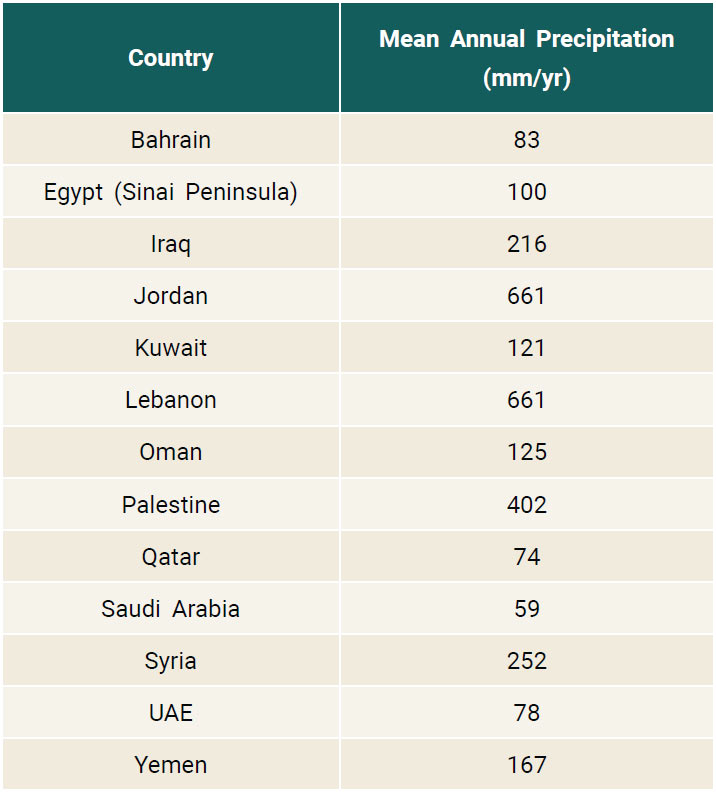
Source: Water Inventory2
Shared Underground Water Resources
Typically, disproportionate interest and attention is given to surface water, but the MENA region, and specifically the GCC countries, largely rely on shared groundwater resources. At the time of writing this article, no multilateral agreement exists to govern shared underground water resources in the region. For instance, in the West Asian region, the total renewable groundwater resources are estimated at 15.5 bcm.[2] Jordan, Palestine, Yemen and the six GCC countries rely on renewable groundwater sources. These are supplemented by extensive non-renewable groundwater reserves and, in particular in the case of the GCC, desalinated water sources.[4]
Sustainable Development Goal (SDG) 6
Sustainable Development Goal (SDG)-6—‘Ensure availability and sustainable management of water and sanitation for all’—is off-track to being met in the MENA region by the 2030 deadline. Progress on key targets is insufficient, with the region facing the highest levels of water stress in the world and a host of mounting challenges such as climate change impacts, unsustainable water use, infrastructure gaps, financial constraints, and poor governance. According to the UN 2023 SDG Report,[5] without intensified efforts, investments, and good governance, the MENA region may not fully meet SDG 6 by 2030.
Water Cooperation and Hydropolitics
Transboundary water management interacts with energy and food security through a complex interplay of resource allocation, infrastructure, and ecological factors as well as political dynamics. The need for water for irrigation (food security) and for hydropower (energy security) often creates competition among riparian states. Coordinated management is necessary to balance these competing demands, ensuring the sustainable management and use of shared water resources.[6]
Water resources in the MENA region are unevenly distributed and under immense pressure. Approximately two-thirds of the Arab world’s surface water supplies are transboundary, making regional cooperation not a luxury, but a necessity for human and economic development. This is especially true in the MENA region which experiences high water stress due to extensive aridity and a reliance on shared water sources: over 60 percent of the freshwater flows across national boundaries.
Ineffective transboundary governance exacerbates water scarcity issues, causing agricultural vulnerability for downstream countries and the inability to meet domestic food production needs due to water scarcity that forces many MENA countries to rely heavily on global food imports. Effective management is crucial for balancing energy and food security demands across the region’s shared basins.
Long-standing regional political instability has hindered effective cooperation over shared water resources as security considerations are prioritised. Peace is therefore, in most cases, a precondition for cooperation between countries in any field, especially for sharing an essential resource. The inverse is also true: depleted, polluted and degraded transboundary water supplies themselves have the potential to cause social unrest, triggering conflicts within and between countries.
Hydropolitics—or the strategic use and control of water as a political tool—is a key feature of the region’s geopolitical landscape. Upstream countries often exploit their geographic location to gain influence, while downstream countries have historically used economic or military force to protect their interests. The desire for water dominance can lead to either cooperation or conflict, depending on the strategies employed and the shifting balance of power.
The Nile Basin Case (the Grand Ethiopian Renaissance Dam)
There is a long-standing dispute between Egypt, Ethiopia, and Sudan regarding the utilisation of Nile waters, representing one of the most complex and potentially destabilising transboundary water issues in the region. The core of the conflict lies in the clash between Ethiopia’s developmental aspirations and Egypt’s and Sudan’s historical water rights.
Despite numerous rounds of negotiations, mediated by entities such as the African Union, a comprehensive, legally binding agreement remains elusive. Ethiopia has proceeded with the unilateral filling and operation of the dam’s reservoir, leading to continued diplomatic tensions and accusations from Egypt and Sudan of violating international law.[7] On paper, there is enough water in the Nile basin for all countries and all uses. It is a matter of political will, however, to reach a shared vision and strategy on how best to utilise the available water resources.
The Tigris–Euphrates Case
Tigris–Euphrates tensions emerge from a significant and ongoing transboundary water conflict in the Middle East, primarily between upstream riparian Turkey and the downstream nations of Syria and Iraq. The core of the dispute revolves around Turkey’s large-scale water development projects on the rivers’ headwaters, specifically the Southeastern Anatolia Project (GAP). Unpredictable water flows from rivers like the Nile and Tigris-Euphrates negatively impact agriculture by decreasing crop yields due to floods and droughts, which in turn raises food prices.
Despite numerous bilateral and multilateral negotiations since the mid-20th century, a legally binding comprehensive agreement for the equitable sharing of the rivers’ waters has not been reached. The lack of a formalised cooperative framework, exacerbated by political instability, civil conflict in Syria and Iraq, and climate change, has left the conflict unresolved.
GCC-Shared Groundwater Resources
The primary natural conventional water resource in the GCC is groundwater, with limited supply, along with the deep, non-renewable fossil aquifers that constitute the bulk of the resource. The region shares several major aquifer systems, including the Saq, Tabuk, Wajid, Minjur-Dhruma, Wasia-Biyadh, Um Er Radhuma, and Dammam.
Despite these shared groundwater resources, there is no agreement that governs their utilisation and management, making the region highly vulnerable to potential conflicts over climate change impacts, water depletion, and/or pollution. Groundwater depletion in the GCC countries severely impacts long-term food production and livelihood resilience by directly causing water scarcity, increased extraction costs, reduced crop yields, soil degradation, and increased dependence on vulnerable food imports.
While the political landscape in the MENA region often complicates transboundary water management, there are many avenues for cooperation, discussed in turn in the following paragraphs.
Water Diplomacy
International water law offers some guidance for the common management of shared water resources. However, it will not solve all shared water resources issues alone. A full resolution calls for water diplomacy to fill the gaps by offering means for all riparian countries to benefit from their shared water resources.
Water diplomacy is an important tool for preventing conflict and promoting cooperation as it can promote cooperation, stability, and peace through the management of shared water resources, conflict prevention and resolution, sustainable water management, and improved regional integration.
Nexus approach
Adopting the water-energy-food-climate nexus approach enables countries to address interconnected challenges holistically. For example, the projects supported by the Food and Agriculture Organization (FAO) aim to help countries in the region develop water strategies that are resilient to climate change.
Improved water governance
There are no basin-wide agreements on shared water resources in the MENA region. Existing bilateral agreements only govern surface water resources and centre mainly on water allocation. It is of utmost importance to have comprehensive bilateral or multilateral agreements that focus on sustainably managing these water resources (surface and underground) for the benefit of all riparian countries.
Integrated Water Resource Management
Water cooperation in MENA would also help in implementing IWRM practices on a basin-wide scale. Cooperation in water management demands that all countries and stakeholders in the MENA region share a common understanding of the needs, priorities, and options to take concrete steps towards solutions.
Flexible agreements to address climate change
New water-sharing agreements must account for the impacts of climate change, such as reduced rainfall and increased water scarcity. International funding can encourage countries to cooperate toward more equitable and robust agreements that address both water and climate crises.
Regional Organisations
None of the regional organisations currently working in the field of water has proved to be effective in dealing with tensions over shared water resources between MENA region countries and their neighbours. However, regional organisations such as UN-ESCWA, GCC, and the Arab League, can play a role in improving regional water resources given their political and technical expertise.
A Potential Role for the UAE
GCC countries, either as a bloc or individually, could consider supporting regional water cooperation through their foreign policies by:
• Acting as a mediator for water diplomacy activities among other countries of the region;
• Hosting annual meetings for riparian countries regarding the region’s key transboundary water resources;
• Helping in establishing and/or hosting joint technical secretariats for shared water resources management.
There is no doubt that in a water-scarce region like MENA, cooperation around shared resources is essential for promoting peaceful cooperation more broadly. There is plenty of scope for cooperation on aspects related to shared water resources, such as data and monitoring, joint water research, and joint infrastructure water projects. More sustainable management of common water resources can also help achieve stability in the region, indirectly reducing migration and radicalisation.
These strategies can help realise SDG 6 in the MENA, as well as support peace and stability in the region.
Conclusion
Water issues in the MENA should serve as an incentive for countries in the region to cooperate over water resource utilisation. In addition, mega-trends such as climate change, urbanisation, and changing lifestyles can also act as an impetus for efforts to jointly manage shared water resources to meet the growing water needs amidst increasing scarcity.
The transboundary water dynamics in the MENA represent a complex interplay of politics, hydrology, and development. While the potential for conflict remains, particularly in river basins, the increasing pressures of climate change and population growth also provide powerful incentives for cooperation. By prioritising water diplomacy, embracing integrated resource management, and establishing climate-resilient agreements, the region can transform water from a source of geopolitical contention into a catalyst for stability and shared prosperity.
Endnotes
[1] United Nations, The Sustainable Development Goals Report 2020, https://unstats.un.org/sdgs/report/2020.
[2] United Nations Economic and Social Commission for Western Asia (UN ESCWA), Inventory of Shared Water Resources of Western Asia, https://waterinventory.org.
[3] United Nations Environment Programme (UNEP), Global Environment Outlook 5 (GEO-5) (Nairobi: UNEP, 2011).
[4] United Nations Environment Programme (UNEP), Global Environment Outlook 4 (GEO-4) (Nairobi: UNEP, 2007).
[5] United Nations, The Sustainable Development Goals Report 2023 (2023), https://unstats.un.org/sdgs/ report/2023<./p>
[6] Bassel Daher and Rabi H. Mohtar, “Water–Energy–Food Nexus Framework for Facilitating Multi- Stakeholder Dialogue,” (2016), https://www.researchgate.net/publication/296685010_Water-Energy-Food_ Nexus_Framework_for_facilitating_multi-stakeholder_dialogue.
[7] Harrison Fuller et al., “Nile Waters Conflict: The Grand Ethiopian Renaissance Dam,” Policy Workshop Report (Princeton: Princeton School of Public and International Affairs, 2023), https://issuu.com/princetonspia/ docs/nile_waters_conflict_the_grand_ethiopian_renaissan
[8] Nadhir Al-Ansari, Nasrat Adamo, Jan Laue and Sven Knutsson, “Geopolitics of the Tigris and Euphrates Basins,” Journal of Earth Sciences and Geotechnical Engineering 8, no. 3 (2018), https://iraqi-forum2014.com/ wp-content/uploads/2018/05/Vol-8_3_10.pdf.