 Global
Occasional Paper | 11 August, 2026
Morocco and the UAE: A Trans-Arab Geoeconomic Partnership
Amid a regional environment marked by accelerating shocks, compounding crises, and heightened uncertainty, the partnership between Morocco and the United Arab Emirates (UAE) stands out for its depth and resilience. Underpinned by decades of close bilateral relations, particularly at the level of the heads of state, it has weathered profound transformations in the regional and international orders. Since the Arab Revolts of the early 2010s, assessments of international developments and perceptions of regional threats have converged, leading to deeper bilateral coordination and engagement. Morocco and the UAE are arguably the two Arab states most committed to the Abraham Accords. This paper explores how their strategic convergence has laid the foundation for a geoeconomic partnership that mobilises instruments of economic statecraft across critical sectors. The geoeconomic dimension has helped strengthen bilateral ties over the years and increases the likelihood that the partnership will endure over time.
Attribution: Akram Zaoui, “Morocco and the UAE: A Trans-Arab Geoeconomic Partnership,” ORF Occasional Paper No. 568, Observer Research Foundation, August 2026.
Introduction
Recurring crises and persistent socioeconomic vulnerabilities in the Middle East and North Africa over decades have led to discussions on how to foster cooperation for greater stability. These talks have focused on economic development and integration, political dialogue, and security. Across these areas, particularly during the past decade, regional and extra-regional countries have promoted new formats and initiatives.[a] While certain factors have hampered these efforts, such as competition between states; foreign interventions; lack of follow-up, interest, or trust; mercurial alignments; regional crises; a strong emphasis on sovereignty; and broader uncertainty, the case for cooperation is stronger in the current regional and international contexts.
Regional developments since 7 October 2023, including the 2026 Middle East crisis, have lent urgency to the matter. For example, disruptions in the Strait of Hormuz have spurred interest in collective and national resilience in the Arab Gulf states through regional arrangements and infrastructure.[1]
At the international level, the geoeconomic transition strengthens the case for such cooperation. This transition can be described as an unfolding, fast-paced fusion of domains that combines importance in the international economic system with impacts on livelihoods, productive fabrics, and societies and implications for national security. It encompasses critical economic sectors and related infrastructure, markets, policies, regulations, standards, supply chains, and technologies. The sectors include agriculture, food, and water security; biotechnology, health, and life sciences; construction; defence; digital technologies; electronics; energy; finance; heavy industry; logistics and transport; and manufacturing.
The quest for dominance or footholds in these sectors has fuelled heightened competition between “political capitalisms at war”[2]—that is, national industrial and innovation systems characterised by complex, dynamic interlinkages between the government and the private sector, engaging in both conflict and cooperation with one another. The geoeconomic transition has been characterised by an erosion of international rules, fragmentation, and policy uncertainty.[3] State-owned enterprises (SOEs) and sovereign wealth funds (SWFs) have played an important role, particularly as their profile in the global economy—for instance, as assessed by their role in industrial policy or measured by their total assets—has grown.[b],[4] Other noteworthy actors are politically connected firms and quasi-sovereign entities.[c]
In this context, this paper argues that geoeconomic partnerships can be leveraged to address pressing global and regional challenges and contribute to the delivery of public goods, including climate resilience, peace, and sustainable development. They are rooted in mutual political understanding, a shared security outlook, and a common strategic vision, and mobilise the tools of economic statecraft to advance that vision to the mutual benefit of the parties involved.
This paper also argues that as the external policies of both Morocco and the United Arab Emirates (UAE) have taken a geoeconomic turn,[5] their relationship has evolved into a paradigmatic geoeconomic partnership. This partnership builds on their common perception that the geoeconomic transition offers opportunities to advance both countries’ economic, political, and security interests. For example, both have sought to build domestic defence industrial bases; increase their participation in green-value chains; leverage the build-up of digital, renewable energy, transport, and water infrastructure; take advantage of the worldwide reshuffle of investment and trade; and tap into increased global demand for transition minerals.
The relationship between the two nations has not only resisted the test of time; in the past 15 years, it has deepened after every crisis. It has strengthened in sync with increasingly acute insistence, in both countries, on the absolute primacy of national interests. While such rhetoric has led them to somewhat de-prioritise their engagement with their Arab environment—perceived as problematic and unattractive—this paper argues that the Morocco–UAE partnership is important because of its trans-Arab nature. Among other reasons, the active participation of both nations in the Abraham Accords underlines the Arab dimension of the partnership. [d],[6]
In practice, the Abraham Accords[e] are an episode in the decades-long Arab–Israeli conflict, a structuring feature of regional dynamics. Neither Morocco nor the UAE has a history of territorial disputes with Israel, so the normalisation of relations was primarily intended to advance core national interests and reorient Arab politics following years of regional turmoil and revolutionism. The Abraham Accords aimed to achieve this by securing privileged access to Israeli and United States (US) political, security, and technological resources.
Considering these common objectives, this paper argues that joint commitment to the Abraham Accords has taken the Morocco–UAE partnership to new heights, as both countries have doubled down on their relations with Israel and the US, notwithstanding the latter two’s regional policies, particularly in the aftermath of 7 October 2023. Stretching ‘from the Ocean to the Gulf,’ the partnership has created a bridge between a Gulf Middle Eastern member state of the Arab League and an African, Atlantic, and Mediterranean one, both at opposite geographical extremes of the Arab region, adding to its symbolic weight.
The paper starts by looking at the structural similarities between Morocco and the UAE, which have provided fertile ground for the partnership. It has been further facilitated by exceptional personal relations between their heads of state, allowing for a rare level of political coordination and helping the bilateral entente (alliance) pass the tests of crises and time. It builds on the policies relating to connectivity, industrialisation, and sustainable development that both countries have pursued at the domestic, regional, and international levels.
The paper then reviews how the partnership has strengthened in the face of regional developments since the Arab Spring. Finally, it lays out the latest phases of development and how they have steered the partnership towards an increasingly clear geoeconomic dimension.
The Foundations of an Enduring Partnership
The partnership between Morocco and the UAE is rooted in deep interpersonal ties, structural similarities between their national systems, shared strategic outlooks, and a developmental weltanschauung (worldview). In both countries, the last factor has influenced investment in infrastructure, openness to international investment and trade, proclaimed commitment to a globalisation underpinned by multilateral economic institutions, and reliance on industrial policy.[f] Such similarities in economic policies and political economies have laid the ground for geostrategic convergence and the recent evolution of the partnership into a geoeconomic one. This section will explore the political and economic bases that have laid the foundation for the enduring Morocco–UAE partnership and facilitated dialogue between the two.
The Pillars of Political and Strategic Convergence
The deep ties between Morocco and the UAE are rooted in history. Both are Arab monarchies characterised by remarkable dynastic continuity: Morocco’s Alaouite dynasty has ruled for more than three and a half centuries, while the ruling families of the UAE’s seven emirates have remained in power for periods ranging from well over a century (in Fujairah) to more than two and a half centuries (in Umm al Quwain). Their formal diplomatic relations are more than half a century old, with the UAE opening an embassy in Rabat in 1972—a year after gaining independence—and its founding president, Sheikh Zayed bin Sultan Al Nahyan, visiting Morocco as soon as 1974.[g],[7],[8] The Abu Dhabi Fund for Development (ADFD) started its activities in Morocco in the mid-1970s,[9] and a Morocco-Emirates Development Company (Société Maroc Emirats Arabes Unis de Développement or SOMED) was created in 1982.[10] In 1993, the Sheikh Zayed Foundation (Fondation Cheikh Zaïd Ibn Soltan) was established in Rabat, with a focus on healthcare. In 2001, the two countries signed a free trade agreement (FTA).
Bilateral ties are anchored in compatible conceptions of the conduct of government affairs. In both countries, official narratives emphasise wisdom as the source of leadership, grounded in traditional values. Rulers are presented as builders and unifiers. Authority blends charismatic and traditional dimensions, as central power can leverage traditional forms of allegiance and networks (for example, dignitaries, the local elite, and tribes).
Table 1: Select Indicators: Morocco and the UAE
| Category | Morocco | UAE |
| Land area (sq. km) | 710,850 | 83,600 |
| Population
(millions; as of 2024) |
38 | 11 |
| Gross domestic product
(current US$ billions, 2023) |
146.1 | 522.7 |
| Income category
(2026) |
Lower-middle income | High income |
| GDP per capita
(current US$, 2023) |
3,945 | 48,941 |
| Net energy imports
(% energy use, 2022) |
94 | -171 |
| Net lending/borrowing position
(% GDP, 2023) |
-4.4 | 5.8 |
| Current account balance
(% GDP, 2023) |
-1 | 14.1 |
| General government gross debt
(% GDP, 2023) |
68.7 | 31.9 |
| Urbanisation rate
(% population, 2024) |
63 | 86 |
| Unemployment rate
(% of total labour force, 2025) |
9 | 2.2 |
Sources: United Nations, International Labour Organization, International Monetary Fund, World Bank.[11]
Like other Arab monarchies, Morocco and the UAE broadly share patterns of threat perception. These include a distrust towards cross-border revolutionary ideologies and the organised movements and regimes claiming to uphold them, perceived to be engines of domestic and regional destabilisation. The Iranian regime constitutes a case in point.[h] Out of the Arab League member states, Morocco, arguably—together with Bahrain (and oftentimes in solidarity with it)—has historically had the most strained relations with the Islamic Republic of Iran. During the last dispute, in 2018, Rabat severed ties with Tehran after accusing Iran of supporting the Polisario Front, a political movement that seeks to establish an independent republic on the territory of Western Sahara, which Morocco defends as part and parcel of its territory.[i]
Another key element bringing the two countries together is defence of their territorial integrity. The latter has been a key theme of their foreign policies, notably at the United Nations Security Council (UNSC). For Morocco, defending the ‘Moroccanness’ (marocanité) of Western Sahara has been a central tenet of national consensus, the cornerstone of its foreign policy, and a key topic of engagement with the UNSC. The UAE brought the matter of the Iranian invasion of the islands of Abu Musa and the Greater and Lesser Tunbs to the UNSC a week into its independence.[12] Both disputes started in the early 1970s.
For Rabat and Abu Dhabi, Western Sahara and the three Gulf islands are territories of strategic importance. They connect Morocco and the UAE to their African and Asian depths, respectively. Putting aside Algeria, the border with which has been closed since 1994, Western Sahara is the only territory through which Morocco has a land connection to the rest of the African continent, particularly to the Sahelo-Saharan space and West Africa. As for Abu Musa, the Greater and Lesser Tunbs, they sit at the mouth of the Hormuz Strait, through which commodities and energy have flown from the Arabian-Persian Gulf to the rest of the world, particularly to Asia, rendering the control of these islands strategic.[13]
Furthermore, Morocco and the UAE are neighbours to countries—Algeria and Iran, respectively—whose land area and population are significantly larger, and which structurally constitute the most serious conventional threats to their national security. These countries are also the main protagonists behind the territorial disputes that have most heavily mobilised Moroccan and Emirati diplomacy. Algeria is the main supporter of the Polisario Front, whose leadership is based in Tindouf, an Algerian city. It also acts as the biggest provider of diplomatic, financial, and political support to the movement. Meanwhile, the occupation of Abu Musa and the Greater and Lesser Tunbs two days before the UAE’s independence illustrates how the imbalance in size and population has long made Iran a security challenge for the UAE, even before the establishment of the Islamic Republic in 1979.
In the past 20 years, the bilateral relationship between Morocco and the UAE has grown on strong interpersonal links. In 1999, Mohammed VI made his first visit abroad as head of state to the Gulf, where he met King Fahd in Saudi Arabia and Sheikh Zayed bin Sultan in the UAE.[14] In the first years of the reign of Mohammed VI, Sheikh Zayed also visited Morocco.[15] A strong personal relationship at the highest level of decision-making between Mohammed VI and Sheikh Mohamed bin Zayed has contributed to pushing the partnership forward and sustaining dialogue, despite momentary disagreements (see box).
Another point of convergence has been the strong emphasis on moderation and tolerance as guiding cultural and politico-religious principles. A recent illustrative example is from 2019—which the UAE proclaimed as the year of tolerance—when Pope Francis visited both the UAE (in February) and Morocco (in March).[16],[17]
Personal Ties between Sheikh Mohamed bin Zayed Al-Nahyan and Mohammed VIThe current president of the UAE, Sheikh Mohamed bin Zayed Al-Nahyan (born in 1961), and the King of Morocco, Mohammed VI (born in 1963), have a friendship dating back to 1975, when the former is reported to have spent time in Morocco. Sheikh Mohamed was a classmate of then Crown Prince Sidi Mohammed during his time at the Royal Academy College in Rabat, an institution dedicated to the education of Morocco’s young royals.[18] During this time, Sheikh Mohamed bin Zayed took part in the Green March, a 350,000-strong peaceful march towards the then-Spanish-controlled Sahara, celebrated as a foundational event in contemporary Morocco, as it led to the reunification of national territory. This episode was mentioned by Mohammed VI during his speech at the 2016 Gulf Cooperation Council–Morocco summit.[19] Both heads of state took increasing responsibilities in the conduct of government in parallel. While Mohammed VI ascended to the Moroccan throne in 1999, Sheikh Mohamed held several titles during the same period, including chief of staff of the armed forces (1993–2005), deputy crown prince of Abu Dhabi (2003–2004), crown prince of Abu Dhabi (2004–2022), deputy supreme commander of the armed forces (2005–2022), and chairman of the Abu Dhabi Executive Council (2004–2023). Their friendship has endured. In January 2020, amid rumours of misalignments between Morocco and the UAE on the right approach towards the civil war engulfing Libya, a photograph and reports of Mohammed VI’s visit to a Moroccan private residence of Sheikh Mohamed bin Zayed surfaced on the internet. In 2022, during a private visit to Morocco, Sheikh Mohamed bin Zayed was also invited to an iftar (Ramadan evening meal) banquet convened by Mohammed VI.[20] Reports of private visits of the latter to the UAE have also surfaced in 2024 and 2025. [21],[22] In June 2026, official sources also announced that Sheikh Mohamed bin Zayed met with Mohammed VI during a private visit to Rabat.[23] |
The Domestic Economic Drivers of Convergence
On the economic front, both monarchies have displayed a developmental posture, underpinned by long-term strategies whose implementation has been facilitated by the monarchs’ durable stewardship of state affairs. These have been implemented through enhanced public management, which in turn has built on the mobilisation of external and internal expertise (strategic advisory firms, international financial institutions, and specialised multilateral organisations, as well as technocrats serving as ministers, high public servants, and chief executives of and managers at SOEs) and sound macroeconomic policies. Mutual echoes in the countries’ political economies have thus laid the ground for enhanced and sustained technocratic cooperation and dialogue.
Some SOEs have become key protagonists in the implementation of more robust public management in both nations. They typically became ‘national champions,’ often led by industry captains invested at their helm for long tenures, sometimes transforming into global leaders in their sectors of activity. These SOEs include the OCP Group in Morocco, a global leader in the fertilisers industry, which has engaged in fast-paced industrial transformation since the appointment of its current chief executive officer in 2006. The UAE SOEs include the Abu Dhabi National Oil Company (ADNOC) and Dubai’s DP World. These SOEs have become central players in the economic statecraft and geoeconomic turn of the two countries.
They have also played a key role in domestic investment in connectivity and infrastructure, a shared pillar of both nations’ development models. Gross fixed capital formation (GFCF) has roughly hovered between 25 and 30 percent of GDP in Morocco, way above lower-middle-income North African peers in Egypt and Tunisia. This rate has been largely supported by public investment, with the World Bank estimating that the latter accounted for about two-thirds of GFCF in 2014–22.[24] Between 2006 and 2019, 51 percent of public investment was undertaken by SOEs.[25]
Figure 1: Gross Fixed Capital Formation in Select North African Countries
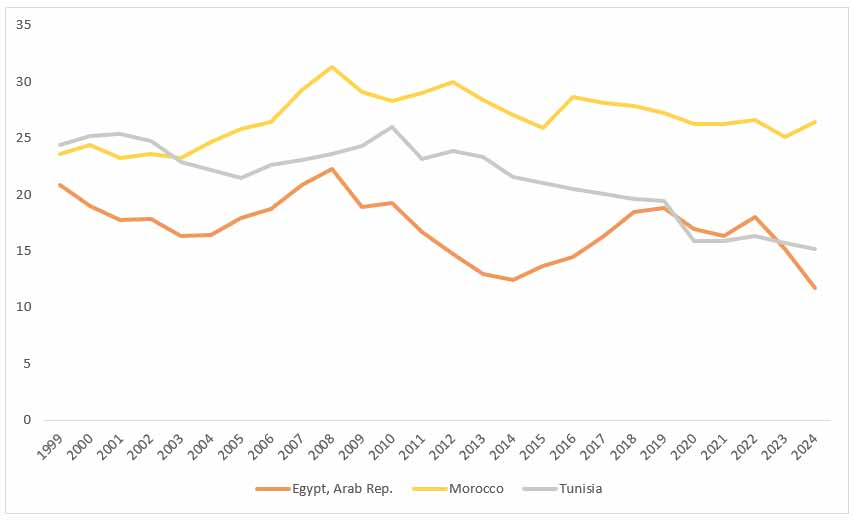
Source: World Bank[26]
The role of SWFs in strategic investment, particularly in infrastructure, should also be underscored. In the UAE, major SOEs active in capital-intensive sectors such as energy and transportation are typically controlled by SWFs. For example, the Abu Dhabi SWF L’IMAD controls TAQA, an SOE active in energy and utilities; the AD Ports Group; and Etihad Rail, while Dubai World controls DP World. Similarly, in Morocco, the creation of the Mohammed VI Investment Fund (FM6I) in 2021 aimed to boost investment in productive and strategic sectors.
Connectivity and investment in infrastructure are central to the two countries’ vision for development and have been important areas of focus in their partnership. In Morocco, the UAE’s financial backing of infrastructure projects has illustrated political commitment to an agenda of political stability through economic development. ADFD contributed to finance projects such as the aforementioned Kenitra–Tangier high-speed rail (HSR) line, the Tanger Med container port (the largest by throughput in Africa and the Mediterranean), and the Mediterranean Coastal Road. The railway line, port, and road are three flagships of the reign of Mohammed VI. These projects converge in their contribution to the development of northern Morocco, particularly the Rif, a traditionally restive region, which had been marginalised during the reign of Hassan II (1961–99). Other projects in Morocco supported by the ADFD include renovations to the ports of Casablanca and Mohammedia, in the country’s traditional industrial heart.
A Common Appetite for Industrialisation
Complementing the investment in infrastructure by SOEs and SWFs, Morocco and the UAE have pursued a combination of openness to investment and trade, outspoken commitment to economic multilateralism, and industrial policy as drivers of industrialisation. In both countries, the latter is seen as a key instrument to boost economic diversification, productivity gains, resilience, sophistication, and sustainability. SOEs have served as important assets for this purpose. These shared features speak to a common conception of development and policymaking, and a similar approach to the international political economy, which have contributed to shape the geoeconomic partnership between Abu Dhabi and Rabat.
Hosting meetings relevant to international climate and economic governance has enabled Morocco and the UAE to present themselves as protagonists in the emerging global value chains and international debates shaping the global economy. The 22nd and 28th conferences of the parties to the United Nations Framework Convention on Climate Change (COPs) were held in Marrakech (COP22, in 2016) and Dubai (COP28, in 2023), signalling commitment by both nations to multilateral discussions. Hosting these events also served to position them as important players in the green transition, providing an industrial opportunity to participate in new value chains related to the production of green goods.
Similarly, by convening meetings on global economic governance, Morocco and the UAE have become visible participants in multilateral discussions on global economic development and stability, bringing to the fore developing countries’ perspectives, [j],[27] while simultaneously signalling their commitment to rules and openness to international investment and trade. This explains why, in 2023, Marrakech was the venue for the annual meetings of the World Bank Group (WBG) and the International Monetary Fund (IMF), while in 2024, Abu Dhabi hosted the 13th ministerial conference of the World Trade Organization (WTO). In 2026, Abu Dhabi was also voted as the venue for the 2029 annual meetings of the WBG and the IMF.
In practice, the two monarchies have sought to transform into connector economies[28] in a global context marked by global economic fragmentation. In 2023, Bloomberg ranked Morocco—together with Indonesia, Mexico, Poland, and Vietnam—as one of the five connector economies that have expanded their domestic industrial base through simultaneous higher investment from and trade with China, the European Union (EU), and the US.[29] On its part, the UAE, which in 2025 was home to the ninth-busiest global container port in Jebel Ali, has concluded Comprehensive Economic Partnership Agreements (CEPAs) with close to 35 countries, 15 of which have entered into force.[30] The two countries’ bet on openness has also translated in commercial relations simultaneously sustained with China, Russia, and the West.
Last, Morocco and the UAE have both embraced industrial policy, whereby certain sectors benefit from targeted incentives to boost their international competitiveness. In Morocco, government strategies including the National Pact for Industrial Emergence (2005–13), the Industrial Acceleration Plan (2014–20) and the Industrial Recovery Plan (2021–23) have prioritised sectors such as automotives and aeronautics, while the December 2022 Investment Charter provided incentives to defence, logistics and transport, and renewables, among others. In 2021, the UAE government launched Operation 300bn, which aims to raise industrial value-added to AED300 billion by 2031, and prioritises 11 industrial sectors, including hydrogen, space technology, pharmaceuticals, and electronics.
Navigating Troubled Currents: From the Arab Spring to the Abraham Accords
The Morocco–UAE strategic partnership has deepened in recent years, with three noteworthy phases of rapprochement. The first followed the Arab Spring and the perceived multidimensional Islamist push that ensued. The second took place in the run-up to and aftermath of the Abraham Accords, with the two countries aligning on the perceived benefits of normalising ties with Israel as a way to strengthen their partnership with the US. The third phase was in the aftermath of the 7 October attacks, during which both countries affirmed their commitment to the Accords.
The deepening partnership between the two nations accelerated after 7 October, built on renewed commitment to the partnership with Israel and the US, seen as the most suitable avenue to pursue national interests and uphold national security. The paragraphs below illustrate how a form of dialectic between Israel, Morocco, the UAE, and the US has provided the ground on which the geoeconomic partnership between Morocco and the UAE has blossomed.
The Post-Arab Spring Acceleration of the Morocco–UAE Strategic Convergence
The years following the Arab Spring saw Morocco and the UAE cement their partnership, built on a shared strategic assessment. In sum, the two countries shared the perception that Islamism[k] constituted a strategic threat to their domestic stability, the authority and power of their leaderships, and the regional order across the Arab region and the Muslim World. This perceived Islamist threat helped lay the ground for a rapprochement between Israel, Morocco, and the UAE.
The perceptions of the leaderships of Morocco and the UAE towards Islamic conservative parties differ. For example, the Kingdom is home to the Justice and Development Party (Parti de la Justice et du Développement or PJD), which has led coalition governments throughout two consecutive legislative mandates (2011–16 and 2016–21), and has regularly and publicly expressed loyalty to the Throne. Nevertheless, the Moroccan leadership retains a form of distrust towards political Islam, which can constitute both a political and a religious-spiritual competitor to the monarchy. Such competition can prove particularly sensitive in times of political turbulence or social unrest. In addition, Islamism has been viewed as a hindrance to cultural and societal openness rooted in Islamic tradition, which the leadership of both countries champion.
The conjunction of the three perceived threats—namely, Islamic-conservative, Jihadi (extremist), and Iran-led—appeared to materialise in the years following the Arab Spring.
Due to this perceived Islamist threat, the UAE stepped up financial commitments to, and political engagement with, Morocco. This was in a wider context of Gulf monarchies extending support to the two middle-income Arab monarchies: Jordan and Morocco. The creation of Wessal Capital, a Moroccan financial vehicle dedicated to investment in tourism, is an example. Backed by SWFs from the four largest Gulf Cooperation Council (GCC) economies as well as Ithmar Capital, a Moroccan SWF founded in 2011, the signing ceremony for the creation of the vehicle was attended in Rabat by Mohammed VI, Sheikh Mohamed bin Zayed, and the then Emir of Qatar Sheikh Hamad bin Khalifa.[31] The ceremony was held on 24 November 2011, on the eve of the Moroccan general election, which the PJD went on to win. On the political front, the first Morocco–GCC summit was held in Riyadh, Saudi Arabia, in April 2016, with attendees including Sheikh Mohamed bin Zayed and the heads of state of Bahrain, Kuwait, Morocco, Qatar, and Saudi Arabia. In a veiled mention to the Joint Comprehensive Plan of Action (JCPoA) and the Jihadi threat, Mohammed VI’s speech expressed the intention to establish deeper cooperation mechanisms with the GCC in the face of the ‘conspiracies’ targeting the collective security of Arab monarchies.
The UAE’s engagement in Morocco thus increased. On the economic front, a series of major decisions were taken. In January 2013, the Abu Dhabi National Energy Company (TAQA) announced a US$1.4 billion investment in its Jorf Lasfar coal plant in Morocco.[32] In June 2013, the ADFD announced a US$1.25 billion grant to finance infrastructure in Morocco,[33] and in November 2013, UAE telecom company Etisalat acquired 53 percent of historic telecom operator Maroc Telecom for US$5.7 billion.[34] Political engagement also intensified, with Mohammed VI and Sheikh Mohamed bin Zayed meeting at least three times in 2015. The perceived Islamist push, combined with social unrest, also contributed to fuel a security turn across the Arab region. This has been the case in Morocco and has facilitated its rapprochement with the UAE.
The Trump 1.0 Opportunity and the Road to the Abraham Accords
After years of frustration with the regional policies of the Obama administration, Donald Trump’s arrival at the White House was seen by Morocco and the UAE as an opportunity to secure stronger US political support in the pursuit of their strategic priorities, including Morocco’s sovereignty over Western Sahara and the Iranian file. The Abraham Accords helped fulfil this objective while facilitating access to Israeli defence materiel, investment, and technology. Signing the Abraham Accords appears to have been the result of close coordination between Morocco and the UAE, and consequently contributed to strengthen their relationship, as both monarchies have regularly doubled down on this strategic bet.
Table 2: Indicative Calendar of Engagement between Morocco and the UAE in the Run-Up to the Abraham Accords
| Date | Event |
| November 2017 | Mohammed VI conducts a two-leg tour of the UAE and Qatar. |
| September 2018 | Mohammed VI visits Abu Dhabi. |
| February 2019 | Representatives from Morocco and the UAE attend the Warsaw conference on the Middle East, an event whose proclaimed objective is to counter the perceived Iranian threat in the Middle East. |
| May 2019 | White House Senior Advisor Jared Kushner is hosted by Mohammed VI in the Royal Palace of Salé, Morocco. |
| June 2019 | The Manama Peace to Prosperity Workshop is held in Manama, Bahrain. |
| August 2019 | Kushner reportedly meets with Sheikh Mohamed bin Zayed and Mohammed VI in Morocco. |
Source: Author’s own.
The pace of coordination between the two countries accelerated in the aftermath of the UAE’s normalisation of its ties with Israel, which took place on 13 August 2020.
Table 3: Calendar of Events Illustrating the Close Coordination between Morocco and the UAE in the Run-up to Morocco’s Normalisation of Its Diplomatic Relations with Israel
| Date | Event |
| 27 October 2020 | The Royal Court announces that the UAE will become the first Arab country to open a consulate in Moroccan-controlled Western Sahara, as an expression of support to Moroccan sovereignty over the territory. |
| 4 November 2020 | The UAE inaugurates its consulate in Laayoune. |
| 13 November 2020 | Morocco’s armed forces expel Polisario-affiliated elements from the border with Mauritania, triggering a resumption of clashes with the Front after close to 30 years of ceasefire. |
| 10 December 2020 | In a series of joint statements, Morocco normalises its relations with Israel while the US recognises Rabat’s sovereignty over Western Sahara. |
| 22 December 2020 | A signing ceremony at the Royal Palace in Rabat officially celebrates the normalisation of ties between Israel and Morocco. |
Source: Author’s own.
Mini-Lateralism and the Attempted Construction of a Geoeconomic Architecture Around the Abraham Accords
During the Joe Biden presidency in the US, engagement between parties to the Abraham Accords took on increasingly mini-lateral forms, consolidating the geoeconomic nature of the Accords. Mini-lateralism is a form of international engagement well-suited for geoeconomics because it allows combining elements of efficient, flexible, and joint governance of public goods on the one hand, with focused partnerships across sectors and technologies critical to national economic interests and security on the other. While the geoeconomic mini-lateralism that developed around the Abraham Accords has lost momentum following the 7 October attacks and the re-election of Donald Trump (who has mostly favoured a bilateral and transactional approach to international affairs), it has created further spaces for engagement between Morocco and the UAE and laid the ground for their bilateral geoeconomic partnership.
Four pillars have been laid to support the geoeconomic architecture, which has been built around the Abraham Accords.
The first is the quadrilateral grouping bringing together India, Israel, the UAE, and the US (I2U2). I2U2 was designed to focus on themes such as clean energy, food security, health, and space. It has been complemented by a range of bilateral engagements, including the UAE’s CEPA with India and heavy commitments to invest in US energy and technology. While Morocco is not a member of I2U2, its historical ties to the UAE and the US, and its growing ties to India—for example, across topics such as defence and food security—and Israel make it relevant in the context of the grouping.
The second pillar is the India–Middle East–Europe Economic Corridor (IMEC). This project builds on a memorandum of understanding (MoU) between the EU, France, Germany, India, Italy, Saudi Arabia, the UAE, and the US. It aims to connect India to the European shore of the Atlantic via the Arabian Peninsula and the Mediterranean through physical infrastructure including rail, pipelines, and undersea data cables. While Israel did not sign the MoU, it was, like Jordan, explicitly mentioned. In addition, France has sought to include Morocco in the project via the production of green hydrogen, feeding into the H2Med Project linking the Iberian Peninsula to France and then to the larger planned network of European hydrogen pipelines.[35] The French sherpa for IMEC, Gérard Mestrallet, has visited Morocco multiple times since April 2024.[36]
The third pillar is the Negev Forum, which followed the organisation of the March 2022 Negev Summit in Sde Boker, Israel. The Summit brought together the top diplomats of Bahrain, Egypt, Israel, Morocco, the UAE, and the US. The Negev Forum has convened working groups on topics such as clean energy, food security and water technology, healthcare, and regional security. It was set to hold a yearly ministerial meeting, but no second meeting has been held till date.
The fourth pillar is the Integrated Industrial Partnership for Sustainable Economic Development (IIPSED). Launched by Egypt, Jordan, and the UAE in Abu Dhabi in May 2022,[37] the partnership aims to foster regional industrial investment and value chains in strategic sectors such as agriculture and food security, fertilisers, minerals, pharmaceuticals, and petrochemicals. Officially launched during a signing ceremony attended by the UAE deputy prime minister and minister of presidential affairs and the prime ministers of Egypt and Jordan, the partnership was supported by a US$10 billion fund managed by SWF Abu Dhabi Developmental Holding Company (ADQ). Bahrain joined the partnership in July 2022 and Morocco in January 2024. While in practice, IIPSED initially acted as a grouping of Arab countries that had normalised their ties to Israel, in February 2025, Qatar and Türkiye also joined the initiative.
Post 7 October: Commitment to the Abraham Accords
Israel’s response to the 7 October attacks strained relations between Israel and the Arab states. Protests across dozens of Moroccan cities were organised amid public opposition to normalisation with Israel, with support for normalisation dropping from 31 percent in 2021–22 to 13 percent in 2023–24, according to Arab Barometer surveys.[38] The second ministerial meeting of the Negev Forum, which was scheduled to take place in Morocco in 2023, was cancelled due to strong anti-Israel sentiment.
Morocco and the UAE are two signatories who, while condemning the Israeli attacks on Palestinian civilians, have continued to display commitment to the Abraham Accords. Their ongoing engagement with Israel supports the Accords’ original goals: access to Israeli defence and technological know‑how and increased political influence in Washington. In the UAE’s case, the partnership with the US has gained in importance in light of the country’s interest in securing access to cutting-edge US technology in the realm of artificial intelligence (AI). Commitment to the Accords has been even more beneficial to Morocco and the UAE as the US’ image has deteriorated in the Arab region due to its open and strong support to Israel amid the onslaught in Gaza. Washington’s interest in regional partners who could affirm their ties to the Israel–US tandem in the region thus increased, and Morocco and the UAE were willing to play this role.
Dialogue with Israel has publicly continued. In January and April 2025, the Israeli minister of foreign affairs visited the UAE, while in February, the minister of transport visited Morocco. Defence and security cooperation has been another prominent axis of engagement, with Morocco particularly active on this front: Israel has now become Morocco’s second-largest supplier of weapons for 2021–25 (contributing about a quarter of its total supply), after the US.
Economic cooperation also continues. In March 2025, it was announced that NewMed Energy, an Israeli company, and Adarco Energy, a company founded by Moroccan businessman Yariv Elbaz, had secured rights to explore and produce gas off the coast of Boujdour in Western Sahara. Elbaz had played a key role in the rapprochement between Morocco and Israel, which eventually led to the normalisation of their ties. As for NewMed Energy, it has become a geoeconomic actor in its own right in the Middle East, particularly in the Eastern Mediterranean. For example, in March 2023, Abu Dhabi’s ADNOC and the UK’s BP were reportedly considering acquiring the company for US$2 billion.
The December 2023 Declaration—the Deepening of a Geoeconomic Partnership
After the 7 October attacks, bilateral engagement between Morocco and the UAE has accelerated, deepened, and taken an increasingly geoeconomic direction. This section’s core focus is the December 2023 joint declaration signed by the heads of state of both countries. Following its adoption, Morocco gained access to UAE-led geoeconomic instruments in 2024, including becoming a member of IIPSED and finalising negotiations for a CEPA. Implementation of the declaration’s provisions accelerated in 2025 with three important deals in the strategic sectors of telecommunications (including 5G deployment), the water–energy nexus in Morocco, and regional energy connectivity. While the strategic nature of these sectors gives a good indication of the geoeconomic nature of the partnership, bilateral contacts at the highest level, the mobilisation of SOEs and SWFs to implement them, and the involvement of politically connected firms and quasi-sovereign entities vindicate this definition.
Context of the December 2023 Visit
Mohammed VI’s state visit on 4 and 5 December 2023 was noteworthy for several reasons.
First, as noted above, it occurred at a moment when the Abraham Accords were under considerable strain following Israel’s military response to the 7 October 2023 attacks. Mohammed VI’s visit to Abu Dhabi took place after hostilities resumed following the 24 November–1 December truce. By then, Israel’s campaign had already become the longest war in its history, far outpacing previous conflicts in Gaza. It was also the deadliest in terms of civilian casualties, with 14,800 people killed in Gaza as of 24 November.[39]
Second, Morocco was reeling from the effects of an earthquake that struck the Al Haouz province in the immediate vicinity of Marrakech on 8 September 2023. The earthquake, which occurred about a month before the 2023 Annual Meetings of the WBG and the IMF, brought new financial constraints for the Moroccan government.
Third, the king of Morocco had given a landmark speech on 6 November 2023, the anniversary of the Green March,[40] in which he did not mention the war on Gaza, although it had raged for about a month. Instead, Mohammed VI insisted on Morocco’s territorial integrity and mentioned the potential of the country’s Atlantic coastline, including that of Western Sahara. The speech laid an institutional architecture proposal for the Atlantic with four layers, namely, the leveraging of the Atlantic as a shared space, serving as an interface between Africa and the Americas; the African Atlantic Gas Pipeline (AAGP), a proposed US$25-billion infrastructure linking Nigeria, Morocco, and 11 other West African countries;[l] the African Atlantic State Process, a framework for cooperation between Morocco and 22 other African states with access to the Atlantic;[m] and an international initiative to offer access to the Atlantic to four landlocked Sahel states.[n]
Thus, Mohammed VI’s visit to the UAE took place in a context of internal challenges and strategic reset for Morocco. Incidentally, it was around the same time as the UAE hosting the COP28 (30 November–13 December 2023).
The December 2023 Joint Declaration
The joint declaration signed by Mohammed VI and Sheikh Mohamed bin Zayed is, first of all, noteworthy for its language.[41] It emphasises “total trust and full convergence of views” between the two heads of state, noting the roles of Hassan II and Sheikh Zayed bin Sultan at the foundation of the bilateral relationship, as well as the relation of “genuine brotherhood and sincere affection between the Heads of States of the two countries.” The declaration underlines “complementarity” between the two nations, acknowledging that their differences can be turned into assets.
Second, the declaration has a clear geoeconomic dimension. It mentions “economic partnerships serving the supreme mutual interests,” suggesting an approach blending economy and security. Proposed extension of the partnership across “regional and international markets,” “particularly in Africa,” confirms a desire to deploy the partnership across geographies, specifically in a continent that has been a focus of both countries’ foreign policies amid their geoeconomic turn. The document mentions several sectors of clear geoeconomic relevance, including agriculture, energy, and water; finance and capital markets; and infrastructure and transport. SOEs and SWFs are to be added to this geoeconomic mix. The OCP Group is explicitly named as a potential partner in the field of fertilisers and food security, as is cooperation between the SWFs of both countries.
The text emphasises that undertakings should follow a win-win logic. While financing mechanisms listed include concessional loans and grants, the win-win logic indicates a preference for investment and trade and a contribution of Moroccan operators to joint projects, for example, within public–private partnerships.
The document also lists physical projects that could receive specific attention, with the aim of strengthening Morocco’s role as a connectivity hub at the confluence of Africa, the Atlantic, and the Mediterranean. UAE investment commitments towards Moroccan infrastructure projects dovetail a broader interest of UAE SWFs for infrastructure as an asset class, as seen in other regions. Infrastructure projects considered in Morocco include a planned Kenitra–Marrakech high-speed rail to be opened by 2029; the airports of Casablanca, Marrakech, and Dakhla (the last is the second-largest city of Western Sahara); and the ports of Nador West Med (on the Mediterranean coast of the Eastern Rif) and Dakhla Atlantic. Two other noteworthy projects quoted in the document are the AAGP and the ‘Dakhla: Gateway to Africa’ project, a possible reference to the West Africa Free Zone, a projected free zone in Dakhla. It is striking that these projects correspond to the domains of activity of some of the most active Moroccan SOEs in infrastructure investment. To concretise these projects, a total of 12 MoUs were signed.
Table 5: MoUs Signed After the Adoption of the December 2023 Joint Declaration
| Theme | Moroccan Signatory | UAE Signatory | |
| 1 | High-speed rail
(Kenitra–Marrakech line) |
Mohamed Rabie Khlie, director-general, ONCF | Suhail Mohamed Al Mazrouei, minister of energy and infrastructure
|
| 2 | Water
(dams, desalination and ‘water highways’ between river basins) |
Nizar Baraka, minister of equipment and water | Mohamed Hassan Alsuwaidi, minister of investment |
| 3 | Development
(including reconstruction of communities affected by the Al Haouz earthquake) |
Fouzi Lekjaa, minister-delegate to the minister of economy and finance for the budget | Mohamed Hassan Alsuwaidi, minister of investment |
| 4 | ADNOC/OCP Group MoU | Mostafa Terrab, chairman and CEO, OCP Group | Mohamed Hassan Alsuwaidi, minister of investment |
| 5 | Energy
(including natural gas, hydroelectric dams, and grid connections between Casablanca and Dakhla ) |
Leila Benali, minister of energy transition and sustainable development | Suhail Mohamed Al Mazrouei, minister of energy and infrastructure |
| 6 | Agriculture and Fisheries | Mohamed Seddiki, minister of agriculture, fisheries, rural development, and water and forests | Mariam Almheiri, minister of climate change and the environment |
| 7 | Airports | Mohamed Abdeljalil, minister of transport and logistics | Mohamed Hassan Alsuwaidi, minister of investment |
| 8 | Ports | Nizar Baraka, minister of equipment and water | Mohamed Hassan Alsuwaidi, minister of investment |
| 9 | African Atlantic Gas Pipeline | Amina Benkhadra, director-general, National Office for Hydrocarbons and Mines | Suhail Mohamed Al Mazrouei, minister of energy and infrastructure |
| 10 | Finance and Capital Markets | Nadia Fettah, minister of economy and finance | Mohamed Hassan Alsuwaidi, minister of investment |
| 11 | Tourism and Real Estate | Mohcine Jazouli, minister-delegate to the head of government, in charge of investment | Mohamed Hassan Alsuwaidi, minister of investment |
| 12 | Data Centres | Mohcine Jazouli, minister-delegate to the head of government, in charge of investment | Mohamed Hassan Alsuwaidi, minister of investment |
Source: Author’s own.
2024: Progress and Hindrances
The first steps to concretise the joint declaration were taken in 2024, covering industrialisation and trade.
In January 2024, Morocco joined IIPSED, becoming its fifth member. In July 2024, Morocco and the UAE signed a CEPA [42] to complement the FTA the two countries had signed in 2001. For Morocco, the CEPA and IIPSED helped strengthen the geoeconomic relationship with the UAE, move forward in the implementation of the December 2023 declaration, and contribute to build resilience for Morocco through access to a new market, industrial investment, and regional supply chains. Arguably, although Morocco has a more diversified industrial base, the signing in October 2024 of a CEPA between the UAE and Jordan served similar purposes.[43]
However, progress on the implementation of the Declaration stalled. In January 2024, the Commercial Court of Rabat ordered Maroc Telecom, Morocco’s historic telecom operator, to pay about US$680 million to Inwi, a private telecom company, a ruling confirmed by the Casablanca Court of Appeal in July 2024. This was noteworthy because of the shareholders of both companies. As mentioned earlier, the first shareholder of Maroc Telecom is UAE telecom company e& (holding 53 percent), a subsidiary of the UAE SWF Emirates Investment Authority; the second one is the Moroccan state (22 percent).[44] As for Inwi, its main shareholder (69 percent) is Al Mada, a holding company linked to Morocco’s ruling dynasty.[o] e& published a communiqué in July 2024 expressing disappointment at the decision and declaring that it was reviewing all possible legal options to protect its investment in Maroc Telecom.[45]
In the face of these hurdles, in December 2024, two visits helped lay the ground for the concretisation of the joint declaration. The first was a private visit of the king of Morocco to the UAE. The second was a private visit of the Mauritanian president, Mohamed Ould Cheikh Ghazouani, to the Royal Palace in Casablanca, Morocco. The visit by the Mauritanian president concluded with a communiqué in which Mauritania expressed support for the AAGP and the international initiative to unlock Sahel states.[46] This development was positive, in part because Mauritania, which traditionally sought to balance its ties with Algeria and Morocco, had appeared to shun Moroccan initiatives in the Sahel until then. [p],[47] Last, in January 2025, Nigerian President Bola Tinubu and Sheikh Mohamed bin Zayed held a meeting on the margins of the Abu Dhabi Sustainability Week.[48]
2025: The Year of Acceleration
High-investment projects covering the water–energy nexus and telecom were announced in 2025. They involved participation from Moroccan and UAE SOEs and SWFs (the latter, directly and indirectly).
Telecom was the first sector that witnessed positive developments. In February 2025, the first director-general of FM6I, Mohamed Benchaâboun, was appointed chair of the management board of Maroc Telecom.[49] In March 2025, Maroc Telecom and Inwi announced a strategic alliance. Under the agreement, they would set up two joint ventures for fibre-optic and 5G towers and invest US$460 million for the first three years.[50] The alliance also brought an end to the dispute triggered by the July 2024 ruling,[51] with the compensation owed by Maroc Telecom revised to about US$470 million.
Later that year, investment in the energy–water nexus received an impetus. In May 2025, the Moroccan minister of energy and sustainable development announced that the UAE would provide financing for the AAGP.[52] The same month, TAQA Morocco—a subsidiary of Abu Dhabi’s TAQA Group—Morocco’s Nareva Holding, FM6I, and ONEE announced a joint investment of about US$14 billion in Morocco. At the time of the deal, the largest in Moroccan history, TAQA Group was a subsidiary of ADQ, and TAQA Morocco was the largest private electricity producer in Morocco (providing a third of the electricity consumed with 17 percent of installed capacity). As for Nareva, it is a utilities company operating a thermal plant and wind farms, which aims to expand its activities into desalination and irrigation, and which is wholly owned by Al Mada. The joint investment aimed at building desalination plants; establishing two 1,500 MW high-voltage direct current lines; installing 1,200 MW of wind power capacity; and doubling the interconnection between the basins of the Bouregreg and the Sebou, two prominent river basins in northwest Morocco.[53] In 2024, the UAE became the top foreign investor in Morocco.[54]
Conclusion
In the months that followed the May 2025 announcements, there were many indications that the partnership between Morocco and the UAE, anchored in a quadrilateral that also includes Israel and the US, was as strong as ever. Both states joined the Board of Peace and took part in the 2026 Critical Minerals Ministerial, where they signed framework agreements with the US. Morocco was also among the five countries[q] committing forces to the International Stabilisation Force for Gaza, with a contingent of up to 500 soldiers.[55] In December 2025, the UAE was among 14 countries to join Pax Silica, a mini-lateral grouping and partnership centred on securing AI value chains for the benefit of its signatories, all allies, and US partners. The rationale for such engagement remains the same: securing access to US influence, security, and technology, advancing core national priorities, and building mutually profitable synergies.
This reasoning was not dented after the Middle East crisis started, triggered by the February 2026 joint Israeli-US attack on Iran. On the contrary, both Morocco and the UAE chose to double down on their partnership with the former two, setting them apart from regional powers that have grown wary of Israel’s designs and the US’s unpredictability. Reports of Israeli security cooperation with the UAE, high-level contacts between Israel and the UAE,[56] and deepening security cooperation between Israel and Morocco signal that the UAE and Morocco’s commitment to the Abraham Accords remains strong.
The crisis also provided an opportunity for Morocco to engage with GCC countries, including the UAE. On the day it started, Mohammed VI called the heads of state of Bahrain, Qatar, Saudi Arabia, and the UAE to express solidarity and affirm that the security of the Arab Gulf and that of Morocco were one and the same thing.[57] In mid-March 2026, about a decade after the first GCC–Morocco summit, the eighth GCC–Morocco ministerial meeting took place virtually, leading to an announcement that the ninth meeting would be held in Morocco, “in recognition of the Kingdom’s role in strengthening cooperation and strategic partnership between the two sides.”[58]
The relationship between Morocco and the UAE appears particularly resilient. In a declaration critical of the position of the Arab League during the conflict, Diplomatic Advisor to the UAE President Anwar Gargash singled out a few Arab countries for positive mentions, including Egypt, Morocco, and Syria.[59] In early June 2026, Sheikh Mohamed bin Zayed al Nahyan undertook a private visit to Morocco, where he met with King Mohammed VI.[60]
In sum, the strategic fundamentals underpinning the partnership are intact, and there are new political incentives to deepen it. While Morocco, which will organise the 2030 Football World Cup, steps up investment in its infrastructure and navigates the fiscal pressure induced by the Middle East crisis, the UAE could step in to support the Kingdom’s development. After its withdrawal from the Organization of the Petroleum Exporting Countries (OPEC), the UAE’s ability to increase its oil exports could create resources to be channelled into new investments abroad. As the crisis has shed light on energy and food security for GCC countries and the importance of diversifying logistical routes, defence supply chains, and tourism and aviation, these sectors, many of which are included in the December 2023 declaration, are likely to constitute priorities in UAE–Morocco engagement. Finally, the Morocco–UAE CEPA will create new opportunities for investment in manufacturing.
The geoeconomic partnership between Morocco and the UAE has solid strategic foundations to build on for the foreseeable future. Across Africa and the Arab region, along the Indo-Atlantic and in other geographies like South America, the monarchies are likely to find new ways to deepen their long-standing cooperation.
Akram Zaoui is Associate Fellow, Geopolitics, ORF Middle East.
The author acknowledges the use of ChatGPT 5.5 and Microsoft Copilot for language refinements prior to submission.
All views expressed in this publication are solely those of the author, and do not represent the Observer Research Foundation, either in its entirety or its officials and personnel.
Endnotes
[a] Examples include the Middle East Strategic Alliance (MESA) proposed by the Donald Trump administration in 2017; the Hormuz Peace Endeavour (HOPE) proposed by Iran in 2019 for the Arabian-Persian Gulf; Egypt–Iraq–Jordan trilateral summits starting from 2019; the Baghdad Conference for Cooperation and Partnership centred on Iraqi stability, regional political dialogue, and economic integration, with editions held in 2021 and 2022; and the Middle East Green Initiative (MGI), inaugurated by Saudi Arabia in 2021.
[b] Assets controlled by SWFs swelled to US$12,400 billion in 2024. That year, 20 percent of the top 2,000 companies worldwide were SOEs. See Ilias Alami, « Le capitalisme d’État mondialisé : définir l’ère des fonds souverains », Le Grand Continent, May 23, 2025, https://legrandcontinent.eu/fr/2025/05/23/le-capitalisme-detat-mondialise-definir-lere-des-fonds-souverains/
[c] ‘Quasi-sovereign’ is a term that usually applies to entities (and the bonds that they issue) to express the fact that although they are distinct from the central government, the latter retains a significant stake in them, which implies an implicit guarantee on their debt, with financial and legal implications towards how the debt is rated and treated. Nevertheless, in the context of this paper, the expression ‘quasi-sovereign’ is used to refer to private sector entities which, because of their direct links to ruling families and involvement in strategic sectors in the said countries (including energy, finance, food security, and water), among other reasons, display features comparable to those of SOEs or SWFs. For instance, Morocco’s Al Mada and Abu Dhabi’s International Holding Company are considered as ‘quasi-sovereign.’
[d] The word ‘Arab’ appears 14 times in Mohammed VI’s speech (in Arabic) during the first Morocco–GCC summit in 2016. The speech contains expressions like “joint Arab action,” “Arab region,” “Arab homeland,” “Arab Spring,” and “Arab countries.” However, the word does not appear in the December 2023 Morocco–UAE joint declaration.
[e] The ‘Abraham Accords’ refer to a series of agreements brokered by the US during the final months of the first Trump administration (August–December 2020), normalising relations between Israel and four Arab states: Bahrain, Morocco, Sudan, and the UAE.
[f] The reliance on industrial policy indicates a degree of pragmatism in the two countries’ approach to industrialisation and international rules, accounting for their development and diversification needs.
[g] That year, Sheikh Zayed also visited India, Iran, Pakistan, and Tunisia, among other countries.
[h] Late Moroccan King Hassan II is well-known for hostile commentaries on the 1979 Iranian revolution, its leader Ayatollah Ruhollah Khomeini, and more broadly, Twelver Shia Islam.
[i] The toponym ‘Western Sahara’ has been used in accordance with the name given to the territory in international law and in UNSC resolutions.
[j] The Marrakech Annual Meetings were the first to be organised in Africa in half a century, the last one having been held in Nairobi in 1973.
[k] ‘Islamism’ is a broad term, which can be defined as encompassing collectives as diverse as Islamic conservative parties more or less connected to the Muslim Brotherhood; non-state violent Jihadi (extremist) armed groups; and the political project spearheaded by the Islamic Republic of Iran, rooted in a revolutionary interpretation of Twelver Shia Islam.
[l] Benin, Côte d’Ivoire, The Gambia, Ghana, Guinea, Guinea-Bissau, Liberia, Mauritania, Senegal, Sierra Leone, and Togo.
[m] Angola, Benin, Cabo Verde, Cameroon, Congo, Côte d’Ivoire, The Democratic Republic of the Congo, Equatorial Guinea, Gabon, The Gambia, Ghana, Guinea, Guinea-Bissau, Liberia, Mauritania, Namibia, Nigeria, São Tomé and Príncipe, Senegal, Sierra Leone, South Africa, and Togo.
[n] Burkina Faso, Chad, Mali, and Niger.
[o]Al Ajial Investment Fund Holding is another leading shareholder of Inwi (15.5 percent of shares). It is a subsidiary of the Kuwait Investment Authority, which is also one of five shareholders of Wessal Capital. The other big shareholder is the Zain Group, a Kuwaiti telecom company where the Kuwait Investment Authority holds 15.9 percent of shares. GCC SWFs are heavily present in the telecom sectors of Morocco, North Africa, and Africa.
[p] For example, in late December 2023, Mauritania did not take part in a ministerial meeting on the initiative to unlock Sahel countries, which was held in Marrakech and attended by the top diplomats of Burkina Faso, Chad, Mali, Morocco, and Niger.
[q] The four other countries are Albania, Indonesia, Kazakhstan, and Kosovo.
[1] Akram Zaoui, “A Levantine Path to Gulf Resilience,” Expert Speak, ORF Middle East, May 28, 2026, https://orfme.org/expert-speak/a-levantine-path-to-gulf-resilience/
[2] The notion of political capitalism was initially proposed by Max Weber. See the series of articles in the French review of international affairs Le Grand Continent, « Capitalismes politiques en guerre, » https://legrandcontinent.eu/fr/themes/economie/capitalismes-politiques-en-guerre/page/2/
[3] Shekhar Aiyar et al., Geoeconomic Fragmentation and the Future of Multilateralism, Washington, DC, International Monetary Fund, 2023, https://www.imf.org/en/publications/staff-discussion-notes/issues/2023/01/11/geo-economic-fragmentation-and-the-future-of-multilateralism-527266
[4] Karl Aiginger and Dani Rodrik, “Rebirth of Industrial Policy and an Agenda for the Twenty-First Century,” Journal of Industry, Competition, and Trade 20 (2020): 189–207, https://drodrik.scholars.harvard.edu/publications/rebirth-industrial-policy-and-agenda-21st-century
[5] There is a growing body of literature from think tanks on economic statecraft in the Maghreb and Morocco’s geoeconomic turn and its implications, particularly for Sahel States. See Yasmina Asrarguis, “Maroc 2035 : De l’émergence économique à la puissance-pivot ? Croissance, cohésion et rayonnement du Royaume Chérifien dans un monde fragmenté ,” Paris, Institut Choiseul, 2025, https://www.choiseul-africa.com/maroc-2035-de-lemergence-economique-a-la-puissance-pivot/; Rachid El Houdaigui, “Marruecos: la apuesta por el eje geoeconomico regional,” in Oriente Medio en Guerra, ¿hasta cuándo?, IEMed: Fundacion Analisis de Politica Exterior, 2026, https://www.iemed.org/publication/marruecos-la-apuesta-por-el-eje-geoeconomico-regional/; Hamza Meddeb, “Economic Statecraft as Geopolitical Strategy: New Dimensions of Moroccan-Algerian Rivalry,” Malcom H. Kerr Carnegie Middle East Center, 2025, https://carnegieendowment.org/middle-east/research/2025/10/economic-statecraft-as-geopolitical-strategy-moroccan-algerian-rivalry
[6] Mohammed VI, “Discours Royal prononcé devant le sommet Maroc-Pays du Golfe,” (speech, Riyadh, April 20, 2016), Rabat, Institut royal des études stratégiques, 2016 https://www.ires.ma/fr/node/12179; Kingdom of Morocco, Ministry of Foreign Affairs, African Cooperation and Moroccan Expatriates, Declaration “Towards an Innovative, Renewed and Consolidated Partnership between the Kingdom of Morocco and the State of the United Arab Emirates,” December 4, 2023, https://diplomatie.ma/en/hm-king-uae-president-sign-abu-dhabi-towards-innovative-renewed-and-consolidated-partnership-between-kingdom-morocco-and-uae-state-declaration
[7] UAE Embassy in Rabat, “UAE Embassy in Rabat Celebrates 52nd Anniversary of UAE-Morocco Diplomatic Relations,” July 14, 2024. https://www.mofa.gov.ae/en/mediahub/news/2024/7/13/13-7-2024-uae-morocco
[8] James Langton, “The UAE and Morocco: Twin Brothers from the Opposite Ends of the Arab world,” The National, April 20, 2019. https://www.thenationalnews.com/arts/the-uae-and-morocco-twin-brothers-from-the-opposite-ends-of-the-arab-world-1.850848
See Asmaa Al Hameli, “The UAE Has Played a Growing Role in World Affairs since its Formation,” The National, November 29, 2015, https://www.thenationalnews.com/uae/heritage/the-uae-has-played-a-growing-role-in-world-affairs-since-its-formation-1.7080
[9] The ADFD website indicates 1976 as the starting date of its activities in Morocco. See Abu Dhabi Fund for Development, “Morocco,” https://www.adfd.ae/en/where-we-work/morocco
[10] SOMED, “Presentation of SOMED Holding,” https://www.somed.ma/en/presentation-of-somed-holding/
[11] The figures in the table are a synthesis from different datasets, accessed via the IMF DataMapper and World Bank Open Data portals. See: https://www.imf.org/external/datamapper/datasets and https://data.worldbank.org/
[12] Embassy of the United Arab Emirates, Washington D.C., “Occupied UAE Lands,” https://www.uae-embassy.org/foreign-policy/occupied-uae-islands
[13] See Enayatollah Yazdani, Ma Yanzhe, “Geopolitical and Geostrategic Importance of the Iranian Islands in the
Persian Gulf,” Review of European Studies; Vol. 14, No.3; 2022, https://www.researchgate.net/publication/362312980_Geopolitical_and_Geostrategic_Importance_of_the_Iranian_Islands_in_the_Persian_Gulf/link/67fefc9cdf0e3f544f420b22/download
[14] “King Mohammed VI Meets Sheikh Zayed of UAE,” Kuwait News Agency, December 28, 1999, https://www.kuna.net.kw/ArticleDetails.aspx?id=1050019&language=en
[15] “Zayed Returns Home,” Gulf News, https://gulfnews.com/uae/zayed-returns-home-1.427695
[16] See the official website dedicated to the Papal visit in the UAE: https://uaepapalvisit.org/
[17] The Holy See, “Apostolic Journey of His Holiness Pope Francis to Morocco. 30-31 March 2019,” https://www.vatican.va/content/francesco/en/travels/2019/outside/documents/papa-francesco-marocco-2019.html
[18] Achraf Tijani, “Émirats arabes unis : collège royal, job étudiant, Marche verte… L’adolescence marocaine de MBZ,” Jeune Afrique, April 26, 2022, https://www.jeuneafrique.com/1342338/politique/emirats-arabes-unis-college-royal-job-etudiant-marche-verte-ladolescence-marocaine-de-mbz/
[19] Mohammed VI, “Discours Royal prononcé devant le sommet Maroc-Pays du Golfe,” (speech, Riyadh, April 20, 2016), Institut royal des études stratégiques, 2016 https://www.ires.ma/fr/node/12179
[20] “Mohammed bin Zayed hôte d’un Iftar offert par le Roi Mohammed VI,” Maghreb Arabe Presse, April 10, 2022, https://medias24.com/2022/04/10/mohammed-ben-zayed-hote-dun-iftar-offert-par-le-roi-mohammed-vi/
[21] “Le Roi Mohammed VI en visite privée aux Émirats arabes unis,” H24info, December 26, 2024, https://h24info.ma/maroc/le-roi-mohammed-vi-en-visite-privee-aux-emirats-arabes-unis/
[22] “Le roi Mohammed VI en visite privée aux Émirats arabes unis,” Bladi.net, November 6, 2025, https://www.bladi.net/roi-maroc-visite-privee-emirats-arabes-unis,117753.html
[23] “Le roi Mohammed VI reçu par le Président des Émirats arabes unis à sa résidence de Rabat,” Maghreb Arabe Presse, June 2, 2026, https://ledesk.ma/encontinu/le-roi-mohammed-vi-recu-par-le-president-des-emirats-arabes-unis-a-sa-residence-de-rabat/
[24] Morocco: Country Private Sector Diagnostic, Washington, DC, The World Bank Group, March 2026, https://www.ifc.org/en/insights-reports/2026/morocco-private-sector-diagnostic
[25] Hicham Doghmi, “L’efficience de l’investissement public direct au Maroc,” Rabat, Bank Al-Maghrib, 2024, https://www.bkam.ma/Publications-et-recherche/Recherche2/Documents-de-travail/2024
[26] The data can be retrieved from the following link: https://data.worldbank.org/indicator/NE.GDI.FTOT.ZS?end=2025&locations=MA-EG-TN&start=2004
[27] African Development Bank Group, https://www.afdb.org/en/news-and-events/press-releases/2023-imf/world-bank-annual-meetings-multilateral-development-banks-pledge-stronger-financing-capacity-greater-impact-65018
[28] Karim El Aynaoui, Abdelaaziz Ait Ali et al. “Morocco as a Connector State: A Winning Strategy in a Fragmented World,” Rabat, Policy Center for the New South, 2026, https://www.policycenter.ma/publications/morocco-connector-state-winning-strategy-fragmented-world
[29] Enda Curran et al., “These Five Countries Are Key Economic ‘Connectors’ in a Fragmenting World,” Bloomberg, November 2, 2023, https://www.bloomberg.com/news/articles/2023-11-02/vietnam-poland-mexico-morocco-benefit-from-us-china-tensions
[30] Yousef al Otaiba, “Why the UAE Really Left Opec,” The Financial Times; May 6, 2026, https://www.ft.com/content/77f79126-bbf5-4343-90ea-c403c04c5640
[31] Emirates News Agency (WAM), “Mohammed Bin Zayed Attends Signing Ceremony in Morocco,” Khaleej Times, November 25, 2011, https://www.khaleejtimes.com/uae/mohammed-bin-zayed-attends-signing-ceremony-in-morocco
[32] Reuters, “Abu Dhabi’s TAQA Seals $1.4bn Financing for Morocco Plant,” Gulf Business, January 29, 2023, https://gulfbusiness.com/en/2013/africa/abu-dhabis-taqa-seals-1-4bn-financing-for-morocco-plant/
[33] “Abu Dhabi Fund for Development Inspects Progress of AED4.6B Projects in Morocco,” Abu Dhabi Fund for Development, April 16, 2017, https://www.adfd.ae/en/media-center/news/abu-dhabi-fund-for-development-inspects-progress-of-aed46b-projects-in-morocco
[34] John Everington, “Etisalat Acquires Control of Morocco’s Maroc Telecom in Dh20bn Deal,” The National, November 5, 2013, https://www.thenationalnews.com/business/etisalat-acquires-control-of-morocco-s-maroc-telecom-in-dh20bn-deal-1.570567
[35] “Comptes rendus de la commission des affaires étrangères, de la défense et des forces armées,” Sénat (French Senate), April 2, 2025, https://www.senat.fr/compte-rendu-commissions/20250331/etrang.html
[36] Ali Amar, “Corridor logistique Imec : Gérard Mestrallet, émissaire de Macron, attendu au Maroc,” Le Desk, March 3, 2024, https://ledesk.ma/2024/03/13/corridor-logistique-imec-gerard-mestrallet-emissaire-de-macron-attendu-au-maroc/
[37] Ministry of Foreign Affairs, Government of the United Arab Emirates, https://www.mofa.gov.ae/en/mediahub/news/2022/5/30/30-05-2022-uae-growth
[38] “MENA Publics and the Future of Normalization with Israel,” Arab Barometer, January 9, 2025, https://www.arabbarometer.org/2025/01/14619/
[39] United Nations Office for the Coordination of Humanitarian Affairs, “Hostilities in the Gaza Strip and Israel | Flash Update #50,” November 25, 2023, https://www.ochaopt.org/content/hostilities-gaza-strip-and-israel-flash-update-50
[40] “SM le Roi adresse un discours à la Nation à l’occasion du 46ème anniversaire de la Marche verte,” Maroc.ma, November 6, 2023, https://diplomatie.ma/fr/sm-le-roi-adresse-un-discours-%C3%A0-la-nation-%C3%A0-loccasion-du-48%C3%A8me-anniversaire-de-la-marche-verte
[41] Kingdom of Morocco, Ministry of Foreign Affairs, African Cooperation and Moroccan Expatriates, Declaration “Towards an innovative, renewed and consolidated partnership between the Kingdom of Morocco and the State of the United Arab Emirates,” December 4, 2023, https://diplomatie.ma/en/hm-king-uae-president-sign-abu-dhabi-towards-innovative-renewed-and-consolidated-partnership-between-kingdom-morocco-and-uae-state-declaration
[42] Marisha Singh, “UAE, Morocco finalise comprehensive free trade agreement,” Gulf Business, July 28, 2024,
https://gulfbusiness.com/en/2024/industry/uae-morocco-comprehensive-free-trade-agreement/
[43] UNCTAD, “Jordan-United Arab Emirates CEPA (2024),” https://investmentpolicy.unctad.org/international-investment-agreements/treaties/tips/5196/jordan—united-arab-emirates-cepa-2024-
[44] “Maroc : Inwi et Maroc Telecom, jusqu’ici rivaux, signent un accord historique,” Radio France Internationale, March 30, 2025, https://www.rfi.fr/fr/afrique/20250330-maroc-inwi-et-maroc-telecom-jusqu-ici-rivaux-signent-un-accord-historique
[45] Etisalat and (e&), https://www.eand.com/en/news/10-july-the-courts-response-to-maroc-telecoms.html
[46] “Le Roi Mohammed VI reçoit le Président mauritanien Mohamed Ould Cheikh El Ghazouani,» Médias 24, December, 20 2024, https://medias24.com/2024/12/20/le-roi-mohammed-vi-recoit-a-casablanca-le-president-mauritanien-mohamed-ould-cheikh-el-ghazouani/
[47] “Initiative atlantique : le Maroc réunit les pays du Sahel à Marrakech,” Médias 24, December 22, 2023 https://medias24.com/2023/12/22/initiative-atlantique-le-maroc-reunit-les-pays-du-sahel-a-marrakech/
[48] Ayobamiji Komolafe, “Tinubu Arrives UAE To Attend Abu Dhabi Sustainability Week 2025,” New Telegraph, January 12, 2025, https://newtelegraphng.com/tinubu-arrives-uae-to-attend-abu-dhabi-sustainability-week-2025/
[49] “Maroc Telecom appoints former finance minister as chair,” Reuters February 26, 2025, https://www.reuters.com/business/media-telecom/maroc-telecom-appoints-former-finance-minister-chair-2025-02-25/
[50] Ahmed Eljechtimi, “Morocco’s Maroc Telecom, Inwi team up to roll out 5G network,” Reuters, March 27, 2025, https://www.reuters.com/business/media-telecom/moroccos-maroc-telecom-inwi-team-up-roll-out-5g-network-2025-03-27/
[51] Tarik Qattab, “Accord entre Maroc Telecom et Inwi: le géant émirati e& confirme son engagement et ses investiseements au Maroc,” Le 360, March 28, 2025, https://fr.le360.ma/economie/accord-entre-maroc-telecom-et-inwi-le-geant-emirati-e-confirme-son-engagement-et-ses-investissements_OCX6Z74SNZDFHIFG6YCQ524PUM/
[52] “Gazoduc Nigeria-Maroc : les Emirats arabes unis appuient financièrement le mégaprojet,” Le Desk, May 6, 2025, https://ledesk.ma/encontinu/gazoduc-nigeria-maroc-les-emirats-arabes-unis-appuient-financierement-le-megaprojet/
[53] Yassine Majdi, “Moroccco-UAE: The inside story of a dazzling 130 billion deal,” TelQuel English, July 2, 2025, https://telquel.ma/2025/07/02/morocco-uae-the-inside-story-of-a-dazzling-130-billion-deal_1939649
[54] Maghreb Arabe Presse, “Office des Changes. Flux net des IDE : les Émirats arabes unis, 1er pays investisseur au Maroc en 2024,” Le Desk, September 3, 2025, https://ledesk.ma/encontinu/flux-net-des-ide-les-emirats-arabes-unis-1er-pays-investisseur-au-maroc-en-2024/
[55] Wissam El Bouzdaini, “Exclusif. Gaza : le contingent marocain comptera jusqu’à 500 membres,” Médias 24, July 20, 2026, https://medias24.com/2026/07/20/exclusif-gaza-le-contingent-marocain-comptera-jusqua-500-membres-1725915/
[56] Paul Wallace, “Netanyahu Holds Rare Call With UAE President as Defense Ties Deepen,” Bloomberg, May 6, 2026, https://www.bloomberg.com/news/articles/2026-05-06/netanyahu-holds-rare-call-with-uae-s-mbz-as-defense-ties-deepen?srnd=undefined
[57] “King Mohammed VI Tells Gulf Rulers their Security is Morocco’s Security,” Hespress English, February 28, 2026,
[58] Ministry of Foreign Affairs, African Cooperation and Moroccan Expatriates, Kingdom of Morocco, March 12, 2026, https://diplomatie.ma/en/morocco-host-upcoming-joint-ministerial-meeting-gcc-states-initiative-gulf-countries
[59] Alexander Christou, “Dr Anwar Gargash Says Iran’s ‘Ferocious’ Attacks on Gulf Were Premeditated,” The National, April 27, 2026, https://www.thenationalnews.com/news/uae/2026/04/27/dr-anwar-gargash-says-irans-ferocious-attacks-on-gulf-were-premeditated/
[60] “UAE President meets King Mohammed VI during Private Visit to Morocco,” June 2, 2026, https://www.mohamedbinzayed.ae/en/latest-news-listing/2026/06/UAE-President-meets-King-Mohammed-VI-during-private-visit-to-Morocco