
 Global
Expert Speak | 27 November, 2026
Building the AI Bridge from Classrooms to the Labour Market
The following excerpt is from Chapter 3 — ORF Global Quarterly: Societies in Transformation
Education systems are facing two massive pressures at once: the scaling pressure, or the need to reach far more learners while ensuring baseline literacy and numeracy; and the Industry 4.0 pressure—i.e., the integration of advanced digital technologies into industrial production. This creates a need for agility, quality, and relevance in the context of rapidly changing workplace competencies.[1] The first challenge is critical: 273 million children and adolescents are out of school, of which about three-fourths are in Sub-Saharan Africa and Central and Southern Asia. Moreover, in Sub-Saharan Africa, 89 percent of children do not reach minimum proficiency in mathematics, and 70 percent in reading, by the end of the primary level.[2] Teacher shortages compound these challenges, and an estimated 44 million additional primary and secondary teachers will be required globally by 2030, 15 million of them in Sub-Saharan Africa alone.[3]
The second challenge is gathering pace: employers surveyed by the World Economic Forum in 2024 expect 39 percent of workers’ current skills to change or become outdated by 2030, bringing to the forefront a massive need for reskilling and upskilling.[4] Digital technology and AI are at the intersection of both these pressures. Generative AI (GenAI) can make explanation, feedback, translation, and personalised tutoring available at a scale that conventional education systems have struggled to provide. Yet the same technologies, alongside robotics, automation, advanced manufacturing, and increasingly data-intensive production, are changing the capabilities required to participate productively in the economy. The International Labour Organization (ILO) estimates that globally, one in four workers is already employed in an occupation with some exposure to GenAI, although the transformation of jobs is considerably more likely than large-scale replacement of this section of the workforce.[5] The rest of this article discusses what this possibility means for the Global South.
Digital technologies can address some long-standing resource constraints on education systems, such as shortages and uneven deployment of qualified teachers, limited access to specialised instruction, and the difficulty of serving rural, remote, and linguistically diverse populations.[6] At the same time, they create a risk: widening the gap between those able to acquire advanced capabilities and those left with little more than nominal digital access.[7]
This article examines trends on the two sides of this transition: first, how digital technology and AI are changing access to education; and second, how Industry 4.0 is changing what students and workers need to learn. It identifies policy priorities for Global South countries to translate expanded educational access into meaningful learning, develop adaptable skills, and strengthen their capacity to respond to rapid technological change.
Digital Technology, AI, and Access to Education
1. From Digital Content to AI-Powered Personalised Support
Since the mid-2000s, digital technology has enhanced educational access by way of distribution. By 2025, about three-fourths of the 6 billion global population were online, with 82 percent of youth (15-24 years) becoming digitally connected.[8] A digitaly connected learner could reach textbooks, recorded lectures, question banks, and courses that geography or cost might previously have placed beyond reach. Today, GenAI potentially moves digital education across a second frontier: from distributing the same resources more widely to providing instruction at scale. GenAI-powered tutoring can transform relatively rigid digital tutors into “digital pedagogical agents” capable of questioning learners, nudging them, and changing instructional strategies through natural dialogue[9]—incorporating personalised and adaptive approaches centred on learning.[10]
For example, in Edo State, Nigeria, a randomised controlled trial by the World Bank tested an after-school programme in which senior secondary students used Microsoft Copilot—supported by teachers—to learn English and develop digital and AI skills. After six weeks, the participants recorded gains of 0.31 standard deviations across the assessed outcomes and 0.23 standard deviations in English.[11] This difference in standard deviation is comparable to effects of several months of learning, compressed into a six-week programme. While this is a meaningful outcome, it is drawn from a small-scale, limited-duration pilot. Nevertheless, the findings demonstrate AI’s potential to improve learning in resource-constrained settings, and highlight the need to prioritise learning quality, effective integration with teaching practices, and context-specific evaluation before pursuing large-scale deployment.
2. Expanding Mobile Internet Connectivity
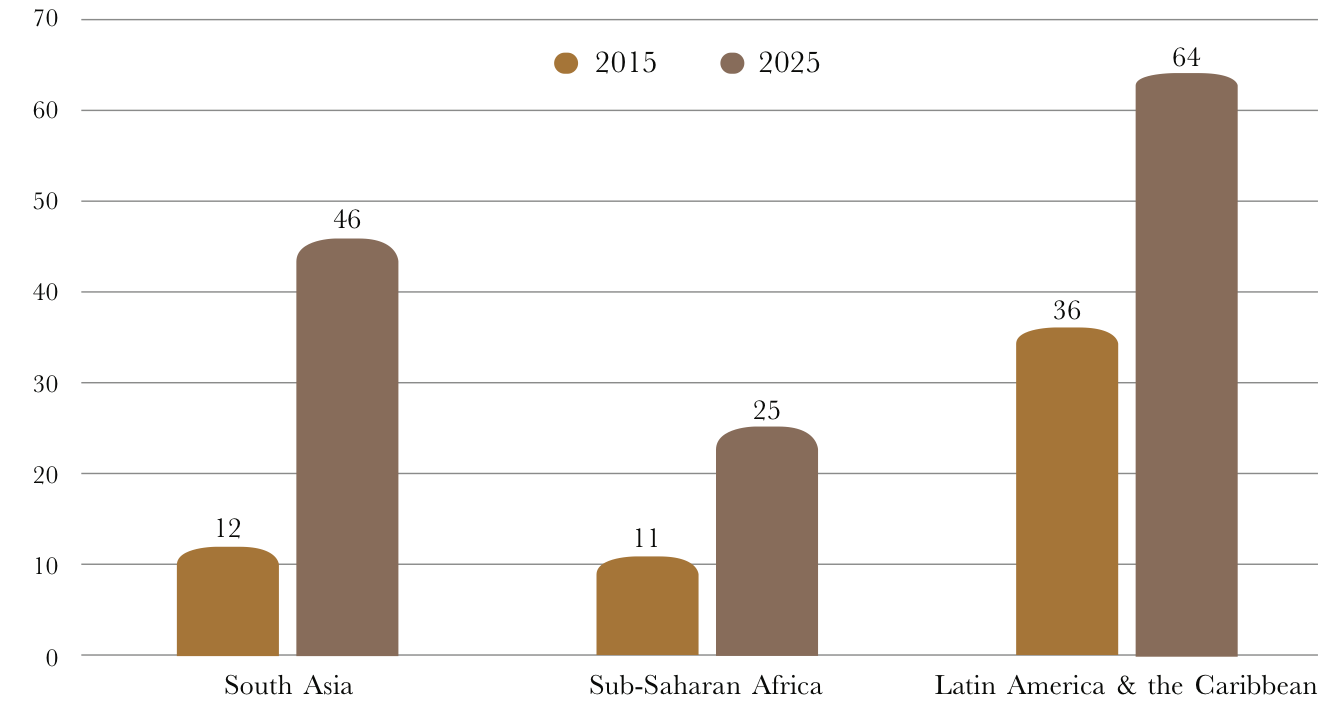
The potential reach of AI-enabled education is increasing with mobile internet connectivity. The Global System for Mobile Communications Association (GSMA) estimates that mobile internet use reached 54 percent of the populations in Low- and Middle-Income Countries (LMICs), with around 3.3 billion people using mobile internet.[12] Between 2015 and 2025, mobile-internet use increased notably in various regions (see Figure 1).[13]
Figure 1. Mobile-Internet Use in Select Regions (2015–2025, % of Population)
Source: GSMA, 2026[14]
School infrastructure is also expanding. In India alone, the share of schools with internet access rose from 49.7 percent in 2022–23 to 67.4 percent in 2025–26, while computer access increased from 47.7 to 69.9 percent.[15]
In the Global South, a more interactive form of digital instruction is emerging as the infrastructure capable of carrying it is reaching hundreds of millions more learners. This expansion creates a wider distribution network for AI-enabled educational services. However, coverage does not necessarily mean adoption. Learners also require affordable devices, reliable connectivity, appropriate digital skills, and educational content that aligns with their linguistic and learning needs. Consequently, the policy challenge is shifting from extending digital infrastructure to ensuring that this infrastructure supports effective learning. Without these complementary investments, the expansion of AI-enabled education could reproduce existing inequalities in a new technological form.
3. Access Is Becoming Less Institution-Bound
Formal education is usually organised through institutions, schools, or university campuses. AI shifts this institution-led education to a learner-led education, fundamentally changing the geography and accessibility of knowledge.[16] Personalised support is thus brought into the learner’s immediate environment. AI-enabled tools can provide real-time feedback and explanations, the translation of learning materials and opportunities for practice through interactive exercises, quizzes, and guided problem-solving. They can also adjust the difficulty and pace of these activities to suit learners’ abilities and progress. This matters particularly for learners outside the formal education system, in disrupted settings, who live far from specialised institutions, or attend schools that cannot offer particular subjects or levels of support.[17]
This does not make institutions or teachers less important; rather, it means that some forms of instructional support are no longer available only through them. The opportunity is significant, and so is the governance challenge. Learning that occurs outside formal systems may also fall outside normal quality assurance, safeguards around student privacy and data use, age-appropriate content, and curriculum oversight.[18]
4. Structural Bottlenecks Are Changing, Not Disappearing
AI can ease long-standing access constraints like teacher shortages, distance from institutions, and multi-grade classrooms, but the pressure often shifts elsewhere: to teacher capability, digital infrastructure, multilingual and locally relevant content, and the capacity of education systems to evaluate and integrate new technologies. The bottlenecks are therefore evolving rather than disappearing.
Teacher shortages demonstrate this well. AI may help existing teachers reach more students, but only if they have the skills, training, and institutional support to use these tools effectively.[19] The same applies to online schooling, which does not ensure affordable devices, reliable bandwidth, or electricity, while multilingual AI still requires oversight to ensure the quality of content in low-resource languages.[20] Ministries and schools must also assess new tools, protect student data, and distinguish useful applications from those that add little educational value.[21] For the Global South, the challenge is therefore moving beyond digital access itself towards building the system capacity that allows learners to benefit from it.
5. The Access Divide Will Not Disappear; It Will Change Form
Despite rapid digitisation, growth in internet coverage has slowed. Between 2024 and 2025, the share of the global population using mobile internet increased only marginally, from 58 percent to 59 percent. Approximately 3.4 billion people remained unconnected to mobile internet in 2025, including 3.1 billion who lived within mobile broadband coverage but did not use it.[22] This reflects a persistent usage gap, driven particularly by the affordability of internet-enabled devices and data, limited literacy and digital skills, as well as concerns about safety and the relevance of available content. In the rural regions of least developed countries, access could be as low as 14 percent.[23] More importantly, the emerging AI divide still rests on much older infrastructure gaps. In low-income countries, only 28 percent of primary schools had electricity in 2024.[24] In Sub-Saharan Africa, school electrification has progressed slowly, rising from around 30 percent of primary schools in 2015 to just 32 percent in 2020.[25]
Even among those that are connected, AI access is unequal. The computing infrastructure that advanced AI depends on is highly concentrated: the United States (US) alone accounts for more than half of the computational performance of the world’s top 500 supercomputers.[26] Language, disability, gender, affordability, and AI literacy add further divides. The emerging distinction may therefore not simply be between learners who are online and offline, but between those who can access reliable, locally relevant, and high-quality AI-enabled learning and those whose access remains basic, intermittent, or dependent on technologies developed elsewhere.[27][28]
Taken together, these developments suggest that digital technologies and AI do not simply mean that more learners will gain digital access. It means that the very concept of access is changing: from access to educational content to access to usable, responsive, and increasingly personalised learning support. Whether that shift narrows or deepens inequality in the Global South will depend increasingly on the capacity of education systems to shape, regulate, and effectively absorb the technology.
From Expanded Access to Adaptable Skills
The importance of expanding access to AI-enabled education becomes clearer when considered alongside the changing requirements of Industry 4.0. Wider access to personalised instruction can help learners strengthen foundational knowledge and develop digital literacy. However, improvements in educational access do not automatically translate into the technical capabilities required by industry or wider economic gains. This transition depends on the quality of learning, relevance of the curricula, and the availability of opportunities to develop and apply skills.
The rapid evolution of technology makes this relationship particularly important. Education systems cannot be expected to anticipate every technological application that will emerge over the coming years. They must, instead, combine foundational knowledge with transferable capabilities, such as analytical thinking, problem-solving, and the ability to learn and adapt. Occupation-specific competencies will require complementary investments in practical training, industry engagement, and continuous upskilling.
For countries in the Global South, the challenge is to use AI to improve educational access and learning, while ensuring that education and skilling systems can respond to changing technological requirements. Even where relevant skills are developed, their contribution to productivity and employment will depend on the capacity of firms and institutions to adopt technologies and deploy them effectively.
Towards a Moving Skills Frontier
Industry 4.0, with its growing integration of AI, robotics, automation, data, connected systems, and advanced manufacturing, is changing the skills required well beyond the technology sector. AI and big data, networks and cybersecurity, and technological literacy are the three fastest-growing skill areas, while skill gaps are already the most frequently cited barrier to business transformation.[29] Two questions flow from this: first, what is changing about the nature of work and second, what do these changes demand from education systems meant to prepare people for it? Another set of five trends, discussed in the next sections, answer both.
1. Employers across occupations want digital skills.
Industry 4.0 is broadening the range of jobs in which technological capability matters. Digital skills were once concentrated in Information and Communication Technology (ICT) and a relatively small set of technical occupations, but they are increasingly becoming part of the normal skills mix across services, manufacturing, and professional work. A 2026 Asian Development Bank (ADB) study analysed millions of job advertisements across six Asia-Pacific economies between 2019 and 2024 and found that demand for digital skills is spreading across the occupational structure, rather than remaining confined to ICT occupations. Intermediate and advanced digital skills also carry substantial returns, with an estimated wage premium of around 11 percent and 26 percent, respectively.[30]
AI is accelerating this shift. World Bank data show that vacancies specifically requiring GenAI skills increased ninefold globally between 2021 and 2024, with one in every five located in middle-income countries.[31] GenAI requirements are already being embedded in occupations that were never considered ‘tech jobs’, into areas like marketing, design, research, education, and healthcare.
The diffusion of digital requirements across occupations suggests that technological literacy can no longer be treated solely as a specialised skill. Education and training systems must develop basic technological competence across occupational pathways, while retaining more advanced programmes for specialised roles. This also requires closer attention to how digital technologies are applied within particular sectors and workplaces.
2. Jobs are being reconfigured instead of disappearing entirely.
Industry 4.0 and the accompanying automation should be understood as an agent of job restructuring, rather than job elimination. The ILO’s 2025 assessment, based on task-level analysis across more than 140 countries, finds that one in every four workers globally is employed in an occupation with some exposure to GenAI, but only 3.3 percent of global employment falls in the highest-exposure category.[32] Since most occupations still involve tasks requiring human judgement, interaction, or responsibility, the ILO concludes that the transformation of jobs, as opposed to replacement, is the most likely impact of GenAI.
However, this exposure is estimated at 34 percent of employment in high-income countries; it is only at 11 percent in low-income economies.[33] Another ILO study ilustrates evidence across the Association of Southeast Asian Nations (ASEAN): 22.9 percent of employment, i.e. nearly 80 million workers, have exposure to GenAI, but only 3.3 percent are in the highest-exposure category.[34] In South Asia, 22 percent of the jobs are AI-exposed, and the demand for AI skills has grown rapidly, with a wage premium of nearly 30 percent compared to other white-collar jobs.[35]
The pace and nature of this transformation vary considerably across economies. The ILO estimates that 34 percent of employment in high-income countries is potentially exposed to GenAI, compared with 11 percent in low-income countries.[36] This difference partly reflects the greater concentration of agricultural, manual, and other less AI-exposed occupations in developing economies. However, lower aggregate exposure should not be interpreted as protection from disruption. In South Asia, approximately 22 percent of the jobs are AI-exposed, while demand for AI-related skills is growing rapidly.[37] The World Bank finds that AI-related vacancies increased from 2.9 percent of online job advertisements in January 2023 to 6.5 percent in March 2025.[38] The region therefore faces a dual challenge: managing changes in exposed occupations while strengthening the skills, infrastructure, and firm-level capabilities needed to benefit from AI adoption.
3. The premium is on combinations of technological and human skills.
Industry 4.0 is not catalysing a simple shift from human skills to technical skills; instead, it is increasing the value of workers who can combine technological proficiency with human abilities like problem-solving, creativity, ethical judgement, and the ability to work with others. Analytical thinking remains the most important core skill, with seven out of 10 companies considering it essential, followed by resilience, flexibility, and agility.[39] This complementarity is becoming more important as AI takes over parts of cognitive work and enhances the importance of literacy, numeracy, and adaptive problem-solving, alongside social and emotional capabilities.[40]
This implies a dual imperative for education and skilling systems, i.e. to create merged tracks of ‘technical’ and ‘human’ skills as the labour market increasingly rewards their combination—a technician who can interpret data, a manager who can work with AI outputs, or an educator who can use EdTech while exercising professional judgement.
4. Skilling is becoming continuous rather than front-loaded.
Industry 4.0 is weakening the old sequence of acquiring a qualification, entering an occupation, and relying on much of the same skills for most of one’s working life. The World Economic Forum estimates that 59 out of every 100 workers will require re-training by 2030, of which 29 will upskill in their existing jobs, and 19 will be retrained and redeployed elsewhere. Eighty-five percent of employers reveal that they plan to prioritise workforce upskilling.[41] Much of this learning will have to happen while people remain in work, as AI, automation, and other technologies continue to change tasks within occupations.
The concern is that existing lifelong-learning systems are not yet built for this scale of adjustment. Only around 16 percent of people aged 15-64 participate in structured training, with particularly weak access among workers with less education, those in informal employment, and employees of small firms.[42] This matters for the Global South, where informality and small enterprises account for a much larger share of employment and employer-financed structured training is less common.[43]
Skilling systems will consequently need to become more flexible and continuous,[44] functioning not only as a pipeline into employment, but increasingly as an infrastructure for promoting lifelong learning.
5. Skills and absorptive capacity will determine the gains from Industry 4.0.
Although technological innovation remains deeply consolidated,[45] this does not mean that developing countries must reproduce the entire frontier technology ecosystem themselves. Open-source models, cloud services, and increasingly accessible digital technologies can allow countries to adopt and adapt innovations developed elsewhere, with skills becoming a critical component of absorptive capacity.[46]
Frontrunners in the Global South, such as China, India, Brazil, and the Philippines, are massively outperforming their income peers in technological readiness, creating an internal divide among Global South nations.[47] Therefore, the decisive issue is increasingly not whether a country can access new technology, but whether it has enough human capability, financial resources, and institutional capacity to adopt it, adapt it, and turn it into better productivity, better firms, and better jobs.
Taken together, these trends point to three priorities for education and skilling systems in the Global South: the need to build foundational and adaptive capacities; keeping pace with a moving skills frontier; and strengthening institutional capacity to make productive use of the aforementioned skills.
Conclusion
The trends examined in this article point to a fundamental shift in the relationship between education, skills, and economic development. AI, aided by enhanced access to mobile internet, is changing how education can be delivered. Industry 4.0 is reshaping the demand for technical skills and analytical human skills, where learning has become continuous and less institution-dependent. For the Global South, the challenge goes beyond expanding access to new technologies and includes the need to build education and skilling systems that can improve learning, respond to changing skill requirements, and support productive employment.
Three policy priorities follow. First, investments in digital infrastructure must be accompanied by teacher training and professional support to use digital and AI tools effectively in teaching, choose locally relevant and multilingual learning tools, and include robust mechanisms to evaluate educational outcomes. Second, education and skilling systems must move beyond front-loaded qualifications towards lifelong learning. This requires combining foundational knowledge and transferable capabilities with modular courses, portable credentials, and workplace-based training. Particular attention must be paid to workers with weaker foundational skills, women, informal workers, and those in lagging regions, who may otherwise have fewer opportunities to adapt.
Third, skills development must be connected to the wider conditions for technology adoption. Firms, particularly smaller enterprises, need access to infrastructure, finance, and organisational support to put new technologies and workers’ capabilities to productive use. Stronger coordination between educational institutions, industry, and governments will be essential to achieving this. Ultimately, the Global South’s ability to benefit from technological change will depend not only on its access to frontier technologies, but also on its capacity to adapt and diffuse them across education systems, workplaces, and the wider economy.
Arpan Tulsyan is Senior Fellow, Centre for New Economic Diplomacy, ORF.
The author acknowledges use of generative AI tools for limited language refinement and research support. All arguments, analysis, source selection, fact-checking, and final writing decisions are those of the author.
[1] “Industry 4.0: An Introduction – Online Training Course,” United Nations Industrial Development Organization (UNIDO), 2019, https://www.unido.org/sites/default/files/files/2019-10/Industry40_training_flyer_A4.pdf.
[2] “Global Education Monitoring Report 2026: Access and Equity, Countdown to 2030,” UNESCO, 2026, https://unesdoc.unesco.org/ark:/48223/pf0000397618.
[3] “Digital Education Strategy 2025–2030: Beyond Digital as Usual -An Equity-Driven, Human-Centered Digital and AI Strategy for Learning,” UNICEF, January 2026, https://www.unicef.org/digitaleducation/media/2101/file/Digital%20Education%20Strategy.pdf.
[4] “The Future of Jobs Report 2025,” Insight Report, World Economic Forum, January 2025, https://reports.weforum.org/docs/WEF_Future_of_Jobs_Report_2025.pdf.
[5] Paweł Gmyrek et al., “Generative AI and Jobs: A Refined Global Index of Occupational Exposure,” ILO Working Paper 140, International Labour Organization, May 20, 2025, https://www.ilo.org/publications/generative-ai-and-jobs-refined-global-index-occupational-exposure.
[6] Arpan Tulsyan, “Using AI to Protect Teaching Time and Improve Learning Quality in Indian Schools,” Observer Research Foundation, July 16, 2026, https://www.orfonline.org/research/using-ai-to-protect-teaching-time-and-improve-learning-quality-in-indian-schools.
[7] Fernando Reimers et al., Artificial Intelligence and Education in the Global South: A Systems Perspective, Springer, 2026, https://link.springer.com/book/10.1007/978-3-032-11449-5.
[8] “Internet Use Remains Highest among Youth, Yet the Generational Gap Is Shrinking,” International Telecommunication Union, 2025, https://www.itu.int/itu-d/reports/statistics/2025/10/15/ff25-youth-internet-use/.
[9] “OECD Digital Education Outlook 2026: Exploring Effective Uses of Generative AI in Education,” OECD, January 19, 2026, https://www.oecd.org/content/dam/oecd/en/publications/reports/2026/01/oecd-digital-education-outlook-2026_940e0dd8/062a7394-en.pdf.
[10] “Digital Education Strategy 2025–2030: Beyond Digital as Usual -An Equity-Driven, Human-Centered Digital and AI Strategy for Learning,” UNICEF, January 2026, https://www.unicef.org/digitaleducation/media/2101/file/Digital%20Education%20Strategy.pdf.
[11] Martin Elias De Simone et al., “From Chalkboards to Chatbots: Evaluating the Impact of Generative AI on Learning Outcomes in Nigeria,” World Bank Policy Research Working Paper 11125, May 2025, https://documents.worldbank.org/en/publication/documents-reports/documentdetail/099548105192529324.
[12] “Mobile Connectivity Index: Methodology 2026,” GSMA, 2026, https://www.gsma.com/solutions-and-impact/connectivity-for-good/mobile-for-development/wp-content/uploads/2026/06/MCI-Methodology-2026.pdf.
[13] “The State of Mobile Internet Connectivity 2026: Trends in Mobile Internet Connectivity,” GSMA, October 2025, https://www.gsmaintelligence.com/research/research-file-download?reportId=84164&assetId=84168.
[14] GSMA, “The State of Mobile Internet Connectivity 2026.”
[15] “The Union Ministry of Education Releases the Report on Unified District Information System for Education Plus (UDISE+) 2025–26 on School Education in India,” Press Information Bureau, Government of India, July 7, 2026, https://www.pib.gov.in/PressReleasePage.aspx?PRID=2282141&lang=1®=48.
[16] “OECD Digital Education Outlook 2026: Exploring Effective Uses of Generative AI in Education,” OECD, 2026, https://www.oecd.org/en/publications/oecd-digital-education-outlook-2026_062a7394-en.html.
[17] “Digital Education Strategy 2025–2030: Beyond Digital as Usual—An Equity-Driven, Human-Centered Digital and AI Strategy for Learning,” UNICEF, January 2026, https://www.unicef.org/digitaleducation/digital-education-strategy-2025-2030.
[18] Lihang Guan, Shaofeng Li and Mingyue Michelle Gu, “AI in Informal Digital English Learning: A Meta-Analysis of Its Effectiveness on Proficiency, Motivation, and Self-Regulation,” Computers and Education: Artificial Intelligence 7, 2024, Article 100323, https://www.sciencedirect.com/science/article/pii/S2666920X24001267.
[19] Xinyan Zhou, Zsolt Lavicza, and Thomas K.F. Chiu, “Developing Teacher AI Competence: A Systematic Review of Beliefs, Professional Learning, and Cultural Factors,” Teaching and Teacher Education 172, April 2026, Article 105384, https://www.sciencedirect.com/science/article/pii/S0742051X26000041.
[20] Vansh Gupta et al., “Are Large Language Models for Education Reliable Across Languages?” Proceedings of the 20th Workshop on Innovative Use of NLP for Building Educational Applications (BEA 2025), Association for Computational Linguistics, July 2025, pp. 612–631, https://aclanthology.org/2025.bea-1.44/.
[21] “AI and Education: Protecting the Rights of Learners,” UNESCO, September 4, 2025, https://www.unesco.org/en/articles/ai-and-education-protecting-rights-learners.
[22] GSMA, “The State of Mobile Internet Connectivity 2026.”
[23] “What You Need to Know About AI and the Right to Education,” UNESCO, September 25, 2025, https://www.unesco.org/en/articles/what-you-need-know-about-ai-and-right-education?hub=67098.
[24] “Global Education Monitoring Report 2026: Access and Equity – Countdown to 2030,” UNESCO, 2026, https://www.unesco.org/reports/gem-report/en/2026-monitoring-sdg4.
[25] “Monitoring SDG 4,” Global Education Monitoring Report 2023, UNESCO, 2023, https://gem-report-2023.unesco.org/monitoring-7/.
[26] “Technology and Innovation Report 2025: Inclusive Artificial Intelligence for Development,” UN Trade and Development (UNCTAD), April 7, 2025, https://unctad.org/system/files/official-document/tir2025_en.pdf.
[27] Jonatan Castaño-Muñoz et al., “Unheard Voices: Identifying Aspects for an Inclusive Digital Education through the Lens of Low-Income Contexts Schools,” Education and Information Technologies, vol. 30, 2025, pp. 17909–17930, https://link.springer.com/article/10.1007/s10639-025-13490-z.
[28] Zeyu Wang et al., “Decoding Divides: The Role of Socioeconomic Status and Personality Traits in AI Divides and Educational Inequality,” Computers and Education: Artificial Intelligence, vol. 10, 2026, Article 100566, https://www.sciencedirect.com/science/article/pii/S2666920X26000287.
[29] “The Future of Jobs Report 2025,” World Economic Forum, January 7, 2025, https://reports.weforum.org/docs/WEF_Future_of_Jobs_Report_2025.pdf.
[30] Pawel Adrjan et al., “Skills That Pay: Digital Skills Demand and Wage Premia in Asia and the Pacific,” Asian Development Bank, June 2026, https://www.adb.org/publications/digital-skills-demand-wage-premia.
[31] “Digital Progress and Trends Report 2025: Strengthening AI Foundations,” World Bank, 2025, https://www.worldbank.org/en/publication/dptr2025-ai-foundations.
[32] Paweł Gmyrek et al., “Generative AI and Jobs: A Refined Global Index of Occupational Exposure,” ILO Working Paper 140, International Labour Organization, May 20, 2025, https://www.ilo.org/sites/default/files/2025-05/WP140_web.pdf.
[33] Gmyrek et al., “Generative AI and Jobs.”
[34] “Generative AI and Labour Markets in ASEAN: Significant Exposure, Limited Disruption, Uneven Preparedness,” International Labour Organization, July 8, 2026, https://www.ilo.org/sites/default/files/2026-07/ILO%20Brief%20ASEAN%20AI%20v11%20clean.pdf.
[35] World Bank, Jobs, AI, and Trade: South Asia Development Update, October 2025, https://thedocs.worldbank.org/en/doc/029dbb0faf2410c6530b32d58325ecc5-0310012025/original/South-Asia-Development-Update.pdf.
[36] Gmyrek et al., “Generative AI and Jobs.”
[37] “South Asia Development Update, October 2025: Jobs, AI, and Trade,” World Bank, October 2025, https://thedocs.worldbank.org/en/doc/029dbb0faf2410c6530b32d58325ecc5-0310012025/original/South-Asia-Development-Update.pdf.
[38] “South Asia Development Update, October 2025: Jobs, AI, and Trade,” World Bank, October 2025, https://thedocs.worldbank.org/en/doc/029dbb0faf2410c6530b32d58325ecc5-0310012025/original/South-Asia-Development-Update.pdf.
[39] “The Future of Jobs Report 2025,” World Economic Forum, January 7, 2025, https://reports.weforum.org/docs/WEF_Future_of_Jobs_Report_2025.pdf.
[40] “OECD Skills Outlook 2025: Building the Skills of the 21st Century for All,” OECD, 2025, https://www.oecd.org/content/dam/oecd/en/publications/reports/2025/12/oecd-skills-outlook-2025_ac37c7d4/26163cd3-en.pdf.
[41] World Economic Forum, “The Future of Jobs Report 2025.”
[42] “Lifelong Learning and Skills for the Future,” World of Work Series, International Labour Organization, 2026, https://researchrepository.ilo.org/esploro/outputs/report/Lifelong-learning-and-skills-for-the/995699970302676/filesAndLinks?institution=41ILO_INST&index=0.
[43] Steven Tobin, “Lifelong Learning and Skills for the Future: Insights for Asia and the Pacific,” International Labour Organization, 2026, https://www.ilo.org/publications/lifelong-learning-and-skills-future-insights-asia-and-pacific.
[44] “Skills in the AI Age,” OECD Artificial Intelligence Papers, no. 60, OECD, 2026, https://www.oecd.org/content/dam/oecd/en/publications/reports/2026/07/skills-in-the-ai-age_e8d8c1e6/972bd15e-en.pdf.
[45] UNCTAD reports that the United States and China together account for around 60 percent of global AI patents, while 100 firms accounted for 40 percent worldwide business R&D investment in 2022.
[46] “Digital Progress and Trends Report 2025: Strengthening AI Foundations,” World Bank, 2025, https://www.worldbank.org/en/publication/dptr2025-ai-foundations.
[47] “Technology and Innovation Report 2025: Inclusive Artificial Intelligence for Development,” UN Trade and Development (UNCTAD), April 7, 2025, https://unctad.org/system/files/official-document/tir2025_en.pdf.



Related posts