 Global
Expert Speak | 12 November, 2026
New GOBARdhan Scheme and the Way Forward for Compressed Biogas
Spotlight
- The new GOBARdhan scheme brings compressed biogas (CBG) support under one framework, strengthening project viability through administered pricing, assured off-take, and capital assistance tied to actual production.
- Reliable CBG production requires dependable feedstock supplies supported by farmer incentives, strengthened urban waste-supply chains, and capacity-building efforts.
- Sustained investment and operational improvements are required before CBG can make a substantial contribution to domestic gas supply.
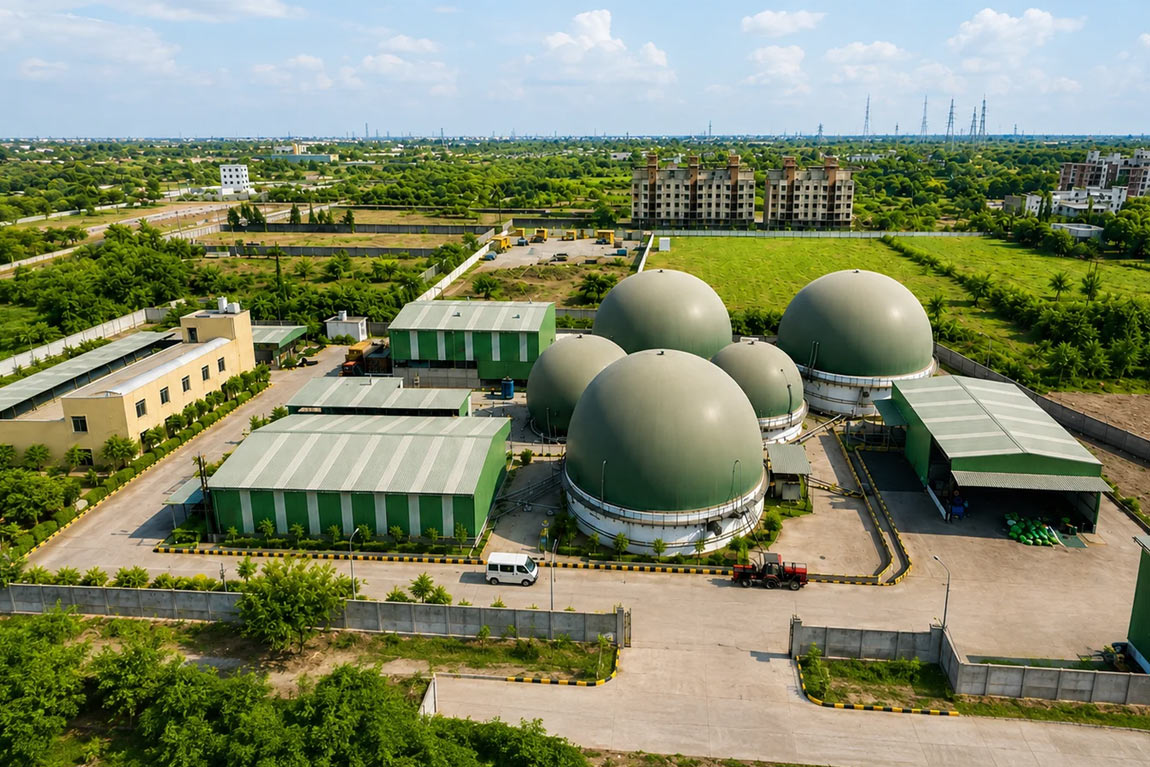
India’s dependence on natural gas imports for nearly 50 percent of its requirements and its focus on energy resilience and energy security have strengthened the case to develop domestic alternatives such as CBG. CBG is chemically equivalent to natural gas, produced by anaerobic decomposition of organic waste. It can be integrated into India’s gas ecosystem if it meets the required quality specifications post purification.
To advance India’s CBG potential, the new Galvanizing Organic Bio-Agro Resources Dhan (GOBARdhan) scheme was announced in August 2026 with a total outlay of INR 237.31 billion, aiming to increase CBG production nearly tenfold by financial year (FY) 2035–36.
GOBARdhan’s success depends on multiple factors, including pipeline connectivity and state-level implementation. However, this article focuses on the scheme’s provisions to secure reliable feedstock and identifies areas in this regard that require further support.
While India’s high feedstock potential provides a strong foundation for CBG production, it alone does not guarantee reliable supply. The seasonality of agricultural residue and fragmented dispersion of organic waste, along with collection costs and storage requirements, complicate the process of collecting and converting waste into a dependable industrial output.
GOBARdhan Scheme: An Overview
GOBARdhan was launched under the Swachh Bharat Mission in 2018 to promote conversion of cattle dung and solid agricultural waste into biogas and bio-slurry by providing financial assistance to gram panchayats (village governing bodies). It was part of a broader CBG policy framework comprising several initiatives administered across four ministries. However, inadequate inter-ministerial coordination led to fragmented support.
The new GOBARdhan is an umbrella scheme structured around six integrated components, administered by the Ministry of Petroleum and Natural Gas (MoPNG). Effective from 1 September 2026, it subsumes existing schemes including Sustainable Alternative Towards Affordable Transportation (SATAT), Market Development Assistance, Biomass Aggregation Machinery, and Development of Pipeline Infrastructure.
Table 1: Original vs Revamped GOBARdhan Framework
| Parameter | Original GOBARdhan Framework (2018–2025) | Revamped GOBARdhan Framework (2026–2036) |
| Primary Focus | Village-level sanitation and biogas promotion under Swachh Bharat Mission (Grameen) | Unified scheme covering six integrated components:
· Assured CBG off-take · Stable CBG Pricing Framework · Capital Assistance · Development of Pipeline Infrastructure · Credit Guarantee Support · CBG Ecosystem Challenge Fund |
| Target | Promotion of local management of organic waste and cluster-based biogas projects | Development of commercial CBG ecosystem with tenfold growth in domestic CBG production |
| Financial Structure | Financial assistance up to INR 5 million per district for setting up biogas plants | INR 237.31 billion outlay, allocated across components |
| Administration | Part of multiple separate schemes across four ministries; GOBARdhan administered by the Ministry of Drinking Water and Sanitation | One integrated framework; Ministry of Petroleum and Natural Gas as single nodal ministry |
| CBG Price | Producer price linked to 85 percent of CNG’s retail selling price; approximately INR 1,478/MMBtu | Administered price of INR 2,110/MMBtu with 10-year purchase agreements |
| Feedstock Aggregation and Planning | Separate Biomass Aggregation Machinery scheme supported equipment procurement by eligible CBG producers | Capital assistance covers eligible aggregation machinery; Ecosystem Challenge Fund supports feedstock mapping and district planning |
Source: Authors’ own.
To strengthen revenue predictability, the New GOBARdhan introduces an administered CBG price (ACP) of INR 2,110/Metric Million British thermal unit (MMBtu) (~US$22.3/MMBtu), nearly 43 percent higher than the previous benchmark of INR 1,478/MMBtu, which was linked to 85 percent of compressed natural gas’s retail price. To limit the cost passed onto consumers, the government will provide affordability support at INR 10/kilogramme of CBG, equivalent to ~INR 215/MMBtu for CBG with 95 percent methane content. The Project Approval Board (PAB) will determine the ACP for a 12-month period based on factors including CBG production economics and prevailing Consumer Price Index. Eligible CBG producers can opt for 100 percent off-take of the saleable CBG, subject to quality requirements and technical and operational feasibility.
To reduce upfront investment costs, a Credit Guarantee Fund with an outlay of INR 6.25 billion has been established to support micro, small, and medium enterprises (MSME) developers. It covers up to 85 percent of the loan amount for eligible infrastructure projects, subject to a cap of INR 200 million for general borrowers and up to INR 250 million for women-led MSMEs.
Additionally, eligible greenfield projects can receive capital assistance of INR 12.5 million per tonne/day of installed capacity, with additional support for feedstock aggregation and manure machinery, subject to an INR 300 million ceiling. Realising these benefits depends on actual production, since capital assistance is calculated against installed capacity and partly disbursed against actual performance. The final 50 percent is tied to capacity utilisation—the full amount is released at 75 percent or above, proportionately between 50 and 75 percent, and withheld below 50 percent.
Achieving these production levels requires a consistent supply of suitable feedstock. A Centre for Science and Environment report noted that plants receiving substantially less feedstock than planned operated only at 10–50 percent of their installed capacity, making feedstock supply critical to maintain plant output and access financial support.
Plants receiving substantially less feedstock than planned operated only at 10–50 percent of their installed capacity, making feedstock supply critical to maintain plant output and access financial support.
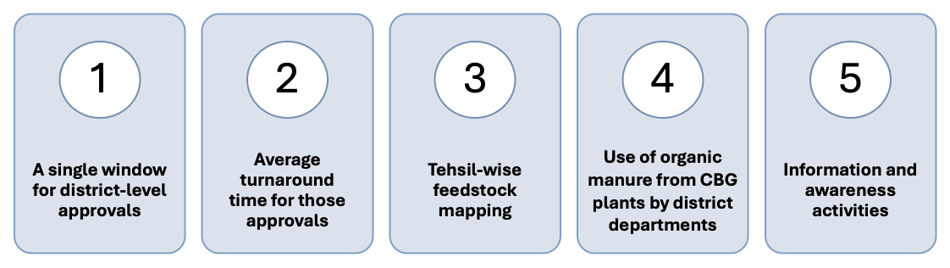
Ensuring reliable feedstock supply requires collection infrastructure, local coordination, and financial support. The scheme establishes an INR 5 billion CBG Ecosystem Challenge Fund, which encourages resource mapping, district-level planning, and capacity building. It has two components: Firstly, the District CBG Challenge Programme, which rewards districts for CBG ecosystem development, with the assessment criteria including subdistrict-wise feedstock mapping and capacity building. Secondly, Ecosystem Enablement, that supports sector-wide and scalable interventions, including improvements in indigenous technology and aggregation infrastructure.
Figure 1: Parameters for District Assessment
Source: Authors’ own.
The scheme also reimburses 50 percent of eligible expenditure on feedstock aggregation machinery, capped at INR 7.5 million per tonne/day, to reduce the equipment acquisition costs needed to manage feedstock.
While the new unified framework is a strong step towards improving CBG project viability, further steps must be taken to strengthen feedstock supplies, such as:
- Build durable farmer relationships: Farmers should be central to the CBG ecosystem, with policy encouraging project developers to utilise India’s Farmer Producer Organisations and cooperatives to organise collection and create rural employment. Experts have proposed benefit-sharing mechanisms to align farmers’ interests with plant requirements by exploring competitive feedstock prices and incentives such as preferential access to digestate-based organic fertilisers.The demonstration between Japan’s Suzuki and India’s National Dairy Development Board links dung purchases from dairy farmers in Gujarat with biogas production and organic fertiliser distribution through dairy cooperatives. It also includes training for farmers and operators, including women, on manure management, plant operation, and fertiliser use. This approach illustrates how local institutions can be made central to CBG business models, and suitable clusters could adapt this approach to strengthen farmer participation.
- Strengthen urban waste-supply chains: India generates ~170,339 tonnes of daily municipal solid waste. Integrating this into feedstock supply chains can expand CBG feedstock while reducing the waste disposal burden. However, mixed collection can introduce contaminants such as plastics and glass, making processing difficult and expensive. Efforts must be made to promote behavioural change and encourage households to segregate waste at source. Municipalities can coordinate with suitable processing facilities or plant operators to organise segregation, collection, and transport of organic waste.Moreover, projects such as Indore’s Gobar-Dhan, Asia’s biggest municipal solid-waste-based plant, demonstrate what coordinated collection, processing, and off-take can achieve. It processes 550 tonnes of segregated city organic waste daily. The municipal corporation purchases at least 50 percent of the CBG produced to fuel ~400 buses. Similar collection mechanisms and models can be adapted across India.
International experience like Japan’s Nagaoka biogas plant, which combines designated food-waste collection arrangements with mechanical removal of contaminants before digestion, highlights the importance of creating urban-waste supply chain.
Currently under the scheme, projects deriving at least 50 percent of their feedstock from municipal or sewage waste are excluded from capital assistance and credit-guarantee support, and are directed to approach applicable schemes under the Ministry of Housing and Urban Affairs. A coordination mechanism can be introduced between these funding channels and waste-management programmes.
- Tailored appraisals and feedback: The scheme’s appraisal process can help project developers identify and address weaknesses in feedstock planning. Appendix II of the capital-assistance guidelines require detailed project reports to describe the predominant feedstock, procurement arrangements, cost estimates, and technology, alongside risk and sensitivity analyses.The Project Management Agency (PMA) scrutinises these reports, while the Project Appraisal Committee (PAC) appraises completed applications and recommends eligible projects and admissible assistance to the PAB. This process can be further strengthened through feedstock-specific assessment and technical feedback. The PMA and PAC could identify and flag supply risks, allowing developers to address gaps in procurement or plant design within defined timelines before approval.
- Capacity building and co-learning: Existing schemes can be complemented with practical training and knowledge exchanges on feedstock supply and plant design between municipalities, developers, and technology providers.Partnerships such as the India–Japan Cooperative Biogas for Growth Initiative and the Global Biofuels Alliance could broaden this knowledge base, building on existing international cooperation. For example, Germany’s GIZ collaborated with India’s Ministry of Environment, Forest and Climate Change to train municipal personnel and plant operators and conduct local feedstock-feasibility studies for biogas production in Nashik, Maharashtra. Initiatives such as these can enable cross-learning and adaptation of best practices to local conditions.
The GOBARdhan portal’s ‘Knowledge Hub’ category can be expanded into a repository of verified CBG case studies. Periodic technical workshops translating these findings into action items could help improve waste management by municipalities, project preparation by developers, and appraisal by reviewers.
GOBARdhan is an ambitious step towards diversifying India’s energy mix. However, with production of just 0.4 million standard cubic meters/day (MSCMD) as of August 2026, it will require sustained investment and operational improvements before it can make a substantial contribution to domestic gas supply.
GOBARdhan is an ambitious step towards diversifying India’s energy mix. However, with production of just 0.4 million standard cubic meters/day (MSCMD) as of August 2026, it will require sustained investment and operational improvements before it can make a substantial contribution to domestic gas supply. Reliable feedstock supply is central to build commercially viable projects and translate policy support into sustained production. Therefore, measures to strengthen financial support and market certainty must be complemented with durable farmer partnerships, effective municipal collection systems, project appraisal grounded in local feedstock conditions, alongside capacity building and technical exchanges.
Parul Bakshi is Deputy Director, Energy Transitions, Observer Research Foundation (ORF) Global.
Pranita Gupta is Research Assistant, Centre for Economy and Growth, ORF.
The authors acknowledge the use of ChatGPT 5 for preliminary research and minor refinements to phrasing.