 Global
Expert Speak | 27 November, 2026
Getting the Platform Economy Right: Gig Workers in the MENA Region
The following excerpt is from Chapter 4 — ORF Global Quarterly: Societies in Transformation
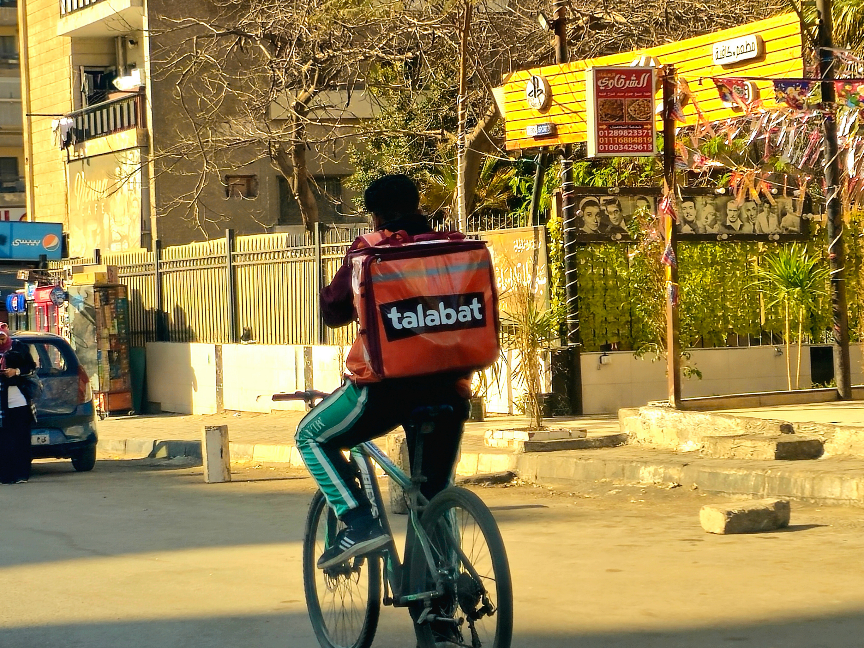
Across the Middle East and North Africa (MENA) region, digital labour platforms (DLPs) such as Uber, Talabat, and Mostaql comprise a rapidly growing sector, providing ride share, delivery, and job-matching services for freelancers. In a region with the highest unemployment[1] and lowest labour force participation rates (LFPRs)[2] in the world, the latest comprehensive estimate by the World Bank, in 2023, says that up to 43 million people were registered on DLPs for online gig work alone.[3]
DLPs have provided on-location jobs in care, delivery, domestic services, and ride-hailing, as well as online jobs in data labelling, design, marketing, multimedia production, and software development. While these platforms have created sources of income, they also carry risks. The absence of adequate regulatory frameworks leads to issues such as lack of accountability, algorithmic opacity, health and safety concerns, and lack of social protection.[4] These issues have all been addressed by the International Labour Organisation (ILO) in the Decent Work in the Platform Economy Convention which it adopted in June 2026.[5]
Yet, with the right set of policies, DLPs can enable higher income generation, spur economic growth, drive labour formalisation, increase public revenue, and even boost foreign currency inflows. To date, governments have lagged in creating clear, comprehensive strategies and policies for digital labour markets. Unlocking the full potential of DLPs will require removing regulatory barriers and enhancing the institutional, legal, and physical infrastructure.
The task list for lawmakers, regulators, and stakeholder communities is long. It will involve clarifying the legal status of gig workers and updating labour laws; including digital gig work in national employment strategies; providing adequate social protection and safety measures; establishing clearer rules for access to foreign currency and international payments; building more efficient and reliable infrastructure, from broadband and electricity to payment systems; establishing training programmes for would-be gig workers, including enhancing language and business skills; giving extra attention to women’s concerns; and expanding opportunities for workers outside of bigger cities. Governments should also aim at counterbalancing DLPs’ market power—notably, the extra-regional ones— that are often criticised for their arbitrary and extractive practices.
To achieve any of these steps, governments, higher education institutions, employers, trade unions, and civil society, along with the platform companies, will need to build a new level of sustained dialogue. Countries will have to further orient their national efforts and institutions towards designing strategies that adopt technology that supports the accumulation of human capital, increases productivity, fosters growth, and creates better jobs at scale.
Consider Egypt, Jordan, Morocco, and Tunisia. These four middle-income, triple-deficit countries[6] grapple, like the rest of the region, with high youth unemployment—particularly for graduates—and low LFPRs. While they generally permit DLPs to operate, they have not sufficiently leveraged these platforms, which often leaves gig workers in a legal and regulatory grey area that provides no adequate social protection and constrains their activities.
The Dire State of MENA Labour Markets
Similar to the landscape in other developing countries, skills mismatches, the youth bulge, and unfair competition from the informal sector are mentioned as causes of high youth unemployment in the MENA region.
The role of the government in generating employment is striking. In 2023, on average, the public sector accounted for 23 percent of total employment as opposed to 16 percent globally. Public wage as share of public expenditure stood at 30 percent, two percentage points higher than the global average.[7] Politicaly connected firms have crowded out small and medium enterprises—prime producers of jobs globally, accounting for about half of global employment—constraining their ability to grow and generate jobs.[8]
In the past decade, climate shocks, the COVID-19 pandemic, and geopolitical conflicts have aggravated the underlying weaknesses of MENA labour markets. Severe droughts, such as the ones Morocco experienced from 2019 to 2025 and Tunisia from 2019 to 2023, have destroyed agriculture, leading to a rise in unemployment in the rural areas.[9] In net energy-importing countries—including Egypt, Jordan, Morocco, and Tunisia—the Russia–Ukraine war and the 2026 Iran war have increased the cost of key inputs across energy, fertilisers, petrochemicals, and metals, eroding profits, weighing on activity, and destroying jobs or slowing down the creation of new ones.
Labour data released by national institutions in Egypt,[10] Jordan,[11] Morocco,[12] and Tunisia[13] for the second quarter of 2026 illustrates persistent challenges. Compared to middle-income countries, youth unemployment rates (YURs) have remained particularly high, while LFPRs have plateaued at low levels, notably as the result of low female LFPRs.
Table 1. Youth Unemployment and LFP Rates (Egypt, Jordan, Morocco, Tunisia, and Middle-Income Countries)
| Egypt | Jordan | Morocco | Tunisia | MICs | |
|---|---|---|---|---|---|
| YURs (%; Q2 2026) |
27.2 | 35.4 | 14.2 | ||
| LFPRs (%, Q2 2026) |
47.5 | 34.3 | 42.2 | 44.7 | 61 |
| Female LFPRs (%, 2025) |
21.2 | 18.6 | 18.1 | 27.1 | 47 |
Source: CAPMAS, DoS, HCP, INS, World Bank.[14][15]
Note: All data for MICs is from 2025.
This indicates an accumulation of discontent in the four economies, especially among the educated and the urban youth. It is against this backdrop that DLPs should be leveraged as a potential employment source.
The Challenges of DLP-Related Policies
Online labour platforms have been present in Egypt, Jordan, Morocco, and Tunisia since the mid-2000s. Today, dozens of DLPs of various sizes operate across the four countries, comprising international, regional, and national players.[16] In 2023, the European Training Foundation estimated that there were 34 ride-sharing platforms operating in Jordan alone.[17]
Active DLP workers across the four countries now probably number in the millions. In April 2026, Egypt’s Ministry of Communications announced that there were 850,000 digital freelancers in the country.[18] In late June 2026, Tunisia’s leading labour union, the Tunisian General Labour Union (UGTT), estimated that there were about 60,000 DLP workers in delivery, care, and motorcycle-based transport alone.[19]
Therefore, DLPs are an important sector for policymakers to address and regulate. In 2015 and 2020, respectively, Morocco and Tunisia introduced the ‘auto-entrepreneur’ status—a form of self-employment that allows individuals to establish single-person businesses. Workers in both countries have used this to formalise their DLP activities, particularly in delivery services.
In May 2025, Egypt adopted a labour law whose Article 96 recognises work performed through digital platforms as a distinct form of employment.[20] Egypt has also recognised the potential of online platform work for foreign exchange inflows and growth. In June 2026, its Information Technology Industry Development Agency publicly embraced freelancers as leading assets for its offshoring strategy—an avenue to boost service exports in a country whose balance of payments is under recurring pressure.[21]
Yet, the lack of social protection for DLP workers remains a pervasive problem. In Egypt, they remain outside the coverage of Law 148 of 2019 on social insurance,[22] largely excluding them from social protection. In Tunisia, the UGTT estimated in 2026 that 98 percent of gig workers had no social protection.[23] The lack of “paid holidays, retirement benefits, or paid sick leave”[24] is a frequent concern.
Renewed Regulatory Push Under Mounting Social Pressure
For the governments of Egypt, Jordan, Morocco, and Tunisia, growing frustration among location-based gig workers and mounting public scrutiny have provided incentives to act.[25] In June 2026, the ILO’s adoption of the Decent Work in the Platform Economy Convention, 2026, provided both a clearer regulatory framework and fresh impetus for global governance of this category of work.
While measures across Egypt, Jordan, Morocco, and Tunisia are still in their early stages, increased attention is being paid to platform labour and its social implications. In July 2026, the Egyptian Ministry of Labour formulated proposals such as the registration of platforms and workers, creation of a national database of digital freelancers and platform workers, regulation of remuneration and contractual terms, and establishment of procedures for workers to challenge the suspension or deactivation of their accounts.[26] In July and September 2026, Jordan’s Social Security Corporation, together with the Ministry of Transport, announced that it was working on extending social security coverage to freelancers and self-employed workers, with ride-hailing and delivery-app drivers among the first groups targeted.[27][28] The proposed system would offer flexible contribution levels for old-age, disability and death insurance, alongside coverage for work injury, maternity leave, and unemployment. In Tunisia, the Ministry of Social Affairs announced the development of a framework for digital platform work and adapting the Labour Code to new forms of employment in July 2026.[29]
The Untapped Potential of Platform Work
While workers on online labour platforms point to increasing competition over gigs—a phenomenon that should be exacerbated by the automation of tasks through artificial intelligence (AI)—and data remains scarce, cross-regional comparison suggests that DLPs can absorb more labour, including skilled work. In 2022, the number of active workers on selected prominent international DLPs for online work in the Western Balkans and in countries of the Eastern Partnership of the European Union was pegged at 23 and 14 per 100,000 inhabitants, respectively, against 3.4 in Egypt, 2.6 in Morocco, 2.4 in Tunisia, and 1.2 in Jordan.[30]
Sector inclusiveness could also be improved. Online platform workers in Egypt, Jordan, Morocco, and Tunisia tend to be heavily concentrated in capital cities and urban centres. In 2023, nearly three-fifths of online platform workers in Egypt lived in Cairo, and about three-fourths of Moroccan platform workers were based in large cities.[31]
There is still a lot that governments can do. They should deepen their understanding of DLP-related work dynamics at the domestic, regional, and international levels; build coordinated national economic-planning and research capacities and draw on international statistical efforts to refine their understanding of digital labour;[32] engage with peers across the Global South and organisations such as the ILO to learn, adapt, and negotiate collectively; deploy industrial-policy tools to cultivate new job opportunities and domestic platforms through targeted interventions (training, guarantees, dialogue and partnerships with DLPs, localisation rules);[33] and move beyond traditional employment regulations.[34]
Such endeavours will require data-driven institutional efforts and sustained cross-government coordination.
Akram Zaoui is Associate Fellow, Geopolitics, ORF Middle East.
The author acknowledges the use of Claude Opus 5.5 and Copilot for language refinement prior to submission.
[1] “Unemployment Rate: Data Snapshot,” ILOSTAT, International Labour Organization, https://ilostat.ilo.org/data/snapshots/unemployment-rate/.
[2] “Labour Force Participation Rate,” ILOSTAT, International Labour Organization, https://ilostat.ilo.org/data/snapshots/labour-force-participation-rate/.
[3] Namita Datta and Rong Chen et al., “Working without Borders: The Promise and Peril of Online Gig Work.” Washington, DC, World Bank, 2023, https://openknowledge.worldbank.org/entities/publication/ebc4a7e2-85c6-467b-8713-e2d77e954c6c.
[4] Nazneen Ahmed, “The Gig Economy Is Reshaping Work in Asia and the Pacific. Can Governance Keep Pace?” United Nations Development Programme (UNDP) Asia-Pacific Blog, June 25, 2026, https://www.undp.org/asia-pacific/blog/gig-economy-reshaping-work-asia-and-pacific-can-governance-keep-pace.
[5] International Labour Organization (ILO), Decent Work in the Platform Economy Convention, 2026 (Convention No. 193), adopted at the 114th Session of the International Labour Conference, Geneva, June 12, 2026, https://normlex.ilo.org/dyn/nrmlx_en/f?p=NORMLEXPUB:12100:0::NO::P12100_INSTRUMENT_ID:4496059.
[6] These countries are experiencing, simultaneously, current account, energy, and fiscal deficits.
[7] World Bank, Worldwide Bureaucracy Indicators: Public Sector in the Middle East and North Africa, Washington, D.C., World Bank Group, 2023, https://documents.worldbank.org/en/publication/documents-reports/documentdetail/099062623201021775.
[8] Steffen Hertog, Locked Out of Development: Insiders and Outsiders in Arab Capitalism, Cambridge: Cambridge University Press, 2023, https://doi.org/10.1017/9781009042444.
[9] Federica Alfani et al., “Job Displacement and Reallocation Failure: Evidence from Climate Shocks in Morocco,” Policy Research Working Paper No. 10279, Washington, D.C.: World Bank Group, Poverty and Equity Global Practice, January 2023, https://openknowledge.worldbank.org/entities/publication/074a91ad-6b66-5208-807a-5530741d3c23.
[10] Central Agency for Public Mobilization and Statistics (CAPMAS), Quarterly Bulletin: Labour Force Survey, Second Quarter (April–May–June) 2026, Cairo: CAPMAS, August 2026, https://www.capmas.gov.eg/publications/11.
[11] Department of Statistics (DoS), Unemployment Rate for Total Population Decreased to 16.1% in Q2 2026, Amman: DoS, September 7, 2026, https://dosweb.dos.gov.jo/unemp_092026/.
[12] Haut-Commissariat au Plan (HCP), Note D’information : Situation Du Marché Du Travail Au Maroc Au Deuxième Trimestre 2026 – Nouvelle Enquête Sur La Main-d’Œuvre (EMO 2026), Rabat: HCP, 2026, https://www.hcp.ma/Situation-du-marche-du-travail-au-Maroc-au-deuxieme-trimestre-de-2026-a-partir-de-la-nouvelle-enquete-sur-la-main-d_a4342.html.
[13] Institut National de la Statistique (INS), Indicateurs De L’emploi Et Du Chômage, Deuxième Trimestre 2026, Tunis: INS, 2026, https://www.ins.tn/publication/indicateurs-de-lemploi-et-du-chomage-deuxieme-trimestre-2026.
[14] World Bank, Labor Force Participation Rate, Total (% of Total Population Ages 15+) (Modeled ILO Estimate), ILOSTAT Database, https://data.worldbank.org/indicator/SL.TLF.CACT.ZS?locations=XP.
[15] World Bank, Labor Force Participation Rate, Female (% of Female Population Ages 15+) (Modeled ILO Estimate), ILOSTAT Database, https://data.worldbank.org/indicator/SL.TLF.CACT.FE.ZS?locations=XP.
[16] European Training Foundation (ETF), New Forms of Work and Platform Work in the Southern and Eastern Mediterranean – Regional Report, Turin: ETF, 2023, https://www.etf.europa.eu/en/publications-and-resources/publications/new-forms-work-and-platform-work-southern-and-eastern.
[17] European Training Foundation (ETF), New Forms of Work and Platform Work in SEMED: Country Profile – Jordan, Turin: ETF, 2023, https://www.etf.europa.eu/en/publications-and-resources/publications/new-forms-work-and-platform-work-semed-country-profile-4.
[18] Youm7, وزير الاتصالات: مصر تشغل المركز التاسع عالميا بالعمل الحر بـ 850 ألف مهني مستقل, 5 April 2026, https://www.youm7.com/story/2026/4/5/وزير-الاتصالات-مصر-تشغل-المركز-التاسع-عالميا-بالعمل-الحر-بـ/7366444.
[19] Business News, 98% Sans Protection Sociale: Le Visage Caché Des Travailleurs Des Plateformes Numériques En Tunisie, June 29, 2026, https://businessnews.com.tn/2026/06/29/98-sans-protection-sociale-le-visage-cache-des-travailleurs-des-plateformes-numeriques-en-tunisie/1408155/.
[20] Habib Al Mulla and Partners, A Landmark Reform for Egypt’s Workforce, October 21, 2025, https://habibalmulla.com/articles/a-landmark-reform-for-egypts-workforce/.
[21] Information Technology Industry Development Agency (ITIDA), https://itida.gov.eg/English/PressReleases/Pages/egypt-itida-freelancer-incentives-offshoring-2026.aspx.
[22] Egypt, Law No. 148 of 2019 on Social Insurance and Pensions, Official Gazette, Vol. 33 bis. NATLEX Reference: EGY-2019-L-115545, August 19, 2019, https://natlex.ilo.org/dyn/natlex2/r/natlex/fe/details?p3_isn=115545.
[23] Business News, 98% Sans Protection Sociale.
[24] Mohammad Tariq and Solidarity Center Strategic Research Department, Platform Workers: A Morocco Case Study, MENA Observatory on Responsible AI & Access to Knowledge for Development Center (AUC School of Business), 2025, https://menaobservatory.ai/en/home.
[25] Salma Hamri, «Les Glovers Marocains Livrés à Eux-Mêmes,» Le Desk, [date unknown], https://ledesk.ma/grandangle/les-glovers-marocains-livres-a-eux-memes/.
[26] Rouaa Al-Azab, “مشروع قانون جديد لحماية العاملين في الاقتصاد الرقمي” [“New Draft Law to Protect Digital Economy Workers»], Shorouk News, July 5, 2026, https://www.shorouknews.com/news/view.aspx?cdate=05072026&id=19cebf64-160a-470f-904e-512eccab1570.
[27] “Social Security Corporation to Extend Social Security Coverage to Freelancers,” Petra/Jordan News Agency, July 26, 2026, https://petra.gov.jo/teleparkwiki/index.php/en/news/social-security-corporation-to-extend-social-security-coverage-to-freelancers.
[28] “Transport Minister Explores Social Security Coverage for Ride-Hail Drivers,» Petra/Jordan News Agency, September 3, 2026, https://petra.gov.jo/en/news/transport-minister-explores-social-security-coverage-for-ride-hail-drivers.
[29] Agence Tunis Afrique Presse (TAP), “Le Ministre Des Affaires Sociales Appelle À Développer La Législation Nationale Pour Garantir Les Droits Des Travailleurs Des Plateformes Numériques,” July 14, 2026, https://www.tap.info.tn/fr/Portail-Titres-de-l-actualité/20392434-le-ministre-des.
[30] ETF, “New Forms of Work and Platform Work in the Southern and Eastern Mediterranean — Regional Report.”.
[31] ETF, “New Forms of Work and Platform Work in the Southern and Eastern Mediterranean — Regional Report.”
[32] OECD, International Labour Organization, and European Union, Handbook on Measuring Digital Platform Employment and Work, Paris: OECD Publishing, 2023, https://www.oecd.org/en/publications/handbook-on-measuring-digital-platform-employment-and-work_0ddcac3b-en.html.
[33] Victo Silva, “Industrial Policy in the Platform Economy,” Reimagining the Economy Working Paper, Harvard Kennedy School, October 2025, https://www.hks.harvard.edu/centers/wiener/publications/industrial-policy-platform-economy.
[34] Matteo Morgandi, David Alzate, and Maho Hatayama, “Regulating Platform-Based Work in Low- and Middle-Income Countries: Towards a Context-Appropriate Approach,” Social Protection Discussion Paper No. 2611 (Washington, D.C.: World Bank Group, February 2026), https://documents.worldbank.org/en/publication/documents-reports/documentdetail/099122325142526447.